

Table of Contents
ToggleHEALTH-SEEKING BEHAVIOUR IN INDIA (NSO SURVEY FINDINGS)
TOPIC: (GS3) SOCIETY: PIB
Why in News?
The latest National Statistical Office (NSO) survey indicates a significant improvement in health-seeking behaviour in India between 2017–18 and 2025.
What is Health-seeking behaviour?
Health-seeking behaviour refers to the actions individuals take when they perceive a health problem, including whether and where they seek medical care. It is a key indicator of health awareness, accessibility, and system efficiency.
Key Findings of the NSO Survey
1. Rise in Reporting of Ailments (IPRA)
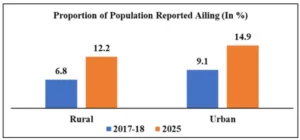
- The proportion of persons reporting ailments (IPRA) has nearly doubled since 2017–18.
- Rural areas: Increased from ~6–7% to about 12%+.
- Urban areas: Increased from ~9% to around 14–15%.
2. Expansion of Public Healthcare Utilisation
- Increased preference for government health facilities, especially in rural India.
- Outpatient care usage in public facilities rose from about one-third to more than one-third (~35%).
3. Reduction in Out-of-Pocket Expenditure (OOPE)
- Median OOPE for hospitalisation remains relatively low (around ₹10,000–₹12,000 range in many cases).
- In public hospitals, costs are significantly lower (often close to ₹1,000 or less for many cases).
4. Expansion of Health Insurance Coverage
- Coverage under government schemes has increased sharply:
- Rural: ~29% → 45%+
- Urban: ~19% → 30%+
- Major contributors:
- Ayushman Bharat – PM Jan Arogya Yojana (PM-JAY)
- State health insurance schemes
5. Shift Towards Preventive and Institutional Care
- Growing emphasis on Preventive healthcare and Early diagnosis
- Institutional deliveries have crossed 95%+, showing strong maternal health progress.
- Rise in screening for non-communicable diseases (NCDs) like diabetes and hypertension.
6. Epidemiological Transition
- Decline in infectious diseases.
- Rise in lifestyle diseases (NCDs) such as:
- Diabetes
- Cardiovascular diseases
Government Initiatives
1. Ayushman Bharat Scheme
- Launched in 2018 to achieve Universal Health Coverage (UHC).
- Provides ₹5 lakh insurance cover for poor and vulnerable families.
- Covers hospitalisation, medicines, and diagnostics in empanelled hospitals.
- Reduces Out-of-Pocket Expenditure (OOPE) and improves access to care.
2. National Health Mission (NHM)
- Focuses on strengthening rural and urban healthcare systems.
- Improves infrastructure, human resources, and service delivery.
- Promotes maternal, child health, and immunisation services.
- Enhances community outreach through ASHA workers.
3. Health and Wellness Centres (HWCs)
- Provide Comprehensive Primary Health Care (CPHC) services.
- Focus on preventive, promotive, and basic curative care.
- Offer screening for NCDs like diabetes and hypertension.
- Improve last-mile healthcare access in rural areas.
4. Free Drugs and Diagnostics Initiative
- Ensures free essential medicines in public health facilities.
- Provides free diagnostic tests like blood tests and X-rays.
- Reduces financial burden on patients, especially the poor.
- Encourages greater use of government hospitals.
Challenges
- Quality of Public Healthcare: Issues like overcrowding, staff shortages, and infrastructure gaps persist.
- Urban-Rural Disparity: Urban areas still rely more on private healthcare, leading to higher costs.
- Rising Burden of NCDs: Requires long-term treatment, increasing system pressure.
- Awareness Gaps: Despite improvement, health literacy remains uneven.
- Private Sector Dependence: High dependence on private hospitals increases OOPE in urban areas.
Way Forward
- Strengthening Primary Healthcare: Expand Health and Wellness Centres with better staffing and equipment.
- Focus on Preventive Healthcare: Promote screening, vaccination, and lifestyle changes.
- Improve Quality of Public Services: Enhance infrastructure, digital health systems, and accountability.
- Universal Health Coverage (UHC): Expand insurance coverage to include outpatient care and medicines.
- Address NCD Burden: Integrate chronic disease management into primary care.
Conclusion
India’s improving health-seeking behaviour reflects growing awareness, better access, and stronger public health systems, but sustained efforts are needed to ensure quality and equitable healthcare for all.
SUPREME COURT OBSERVATIONS ON HATE SPEECH
TOPIC: (GS2) POLITY: THE HINDU
Why in News?
The Supreme Court of India recently observed that hate speech originates from an ‘us versus them’ mindset, which threatens social harmony.
About Hate speech
Hate speech refers to expressions that incite hatred, discrimination, or violence against individuals or groups based on identity markers such as religion, caste, ethnicity, gender, or language.
Supreme Court’s Key Observations
1. ‘Us vs Them’ Mindset as Root Cause
- Hate speech arises from a sense of exclusion and superiority.
- It creates a divide between “insiders” and “outsiders”.
- This mindset leads to alienation and dehumanisation of certain groups.
- It undermines the idea of India as a plural and inclusive society.
2. Threat to Constitutional Values
- Directly affects the principle of fraternity in the Preamble.
- Weakens social harmony and unity.
- Violates dignity of individuals (Article 21).
- The Court stressed that hate speech damages the moral fabric of society.
3. No Need for New Laws
- The Court refused to direct creation of new hate speech laws.
- Highlighted that existing legal provisions are adequate but underutilised.
- Emphasised that the problem lies in implementation, not legislation.
4. Role of Judiciary
- Judiciary’s role is to interpret and enforce laws, not create them.
- Making new laws falls under the legislature’s domain.
- Maintaining separation of powers is essential.
5. Enforcement Gap
- Hate crimes persist due to weak enforcement of existing laws.
- Delays in police action and prosecution worsen the issue.
- Need for accountability in law enforcement agencies.
Legal Framework on Hate Speech
1. Constitutional Provisions
- Article 19(1)(a) – Freedom of speech and expression.
- Article 19(2) – Reasonable restrictions (public order, decency, morality).
- Article 21 – Protection of life and dignity.
2. Indian Penal Code (IPC) / Bharatiya Nyaya Sanhita (BNS)
- Section 153A IPC / BNS equivalent – Promoting enmity between groups.
- Section 295A IPC – Outraging religious sentiments.
- Section 505 IPC – Statements causing public mischief.
3. Other Laws
- Representation of People Act, 1951 – Prohibits hate speech during elections.
- Information Technology Act, 2000 – Regulates online content.
Challenges
- Definitional Ambiguity: Absence of a clear legal definition makes it difficult to distinguish hate speech from legitimate free speech.
- Misuse of Laws: Hate speech provisions can be selectively applied, sometimes suppressing genuine dissent and criticism.
- Social Media Amplification: Digital platforms enable rapid and wide dissemination, making regulation and control more complex.
- Weak Enforcement: Inefficient implementation and low conviction rates reduce the deterrent effect of existing laws.
Way Forward
- Effective Enforcement of Laws: Strengthen institutional capacity to ensure timely action and proper implementation of laws.
- Promote Constitutional Values: Foster fraternity, tolerance, and civic responsibility through awareness and education.
- Regulating Digital Platforms: Enhance content moderation and accountability mechanisms in collaboration with tech companies.
- Clear Guidelines and Judicial Clarity: Develop precise legal standards to balance free speech with the need to maintain public order.
Conclusion
Hate speech reflects deeper social divisions, and addressing it requires both strict law enforcement and societal change to uphold India’s unity.
RETURN OF TRAFFICKED ARTEFACTS TO INDIA
TOPIC: (GS2) INTERNATIONAL RELATIONS: INDIAN EXPRESS
Why in News?
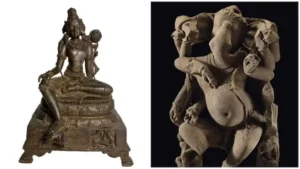
The United States has recently returned over 650 trafficked antiquities to India, valued at around $14 million, following long-term investigations.
Issue of Antiquities Trafficking in India
1. Causes of Trafficking
High Global Demand:
- Strong demand for Indian idols, temple sculptures, and artefacts in Western art markets and private collections.
- Auction houses and collectors often pay very high prices, incentivising theft.
Weak Security at Heritage Sites:
- Many temples and archaeological sites lack adequate surveillance and guards.
- Remote and rural locations make sites easy targets for theft.
Poor Documentation and Inventory:
- Absence of a comprehensive digital record of artefacts.
- Difficulty in proving ownership or tracing stolen items due to missing provenance data.
Organised Criminal Networks:
- Involvement of international smuggling syndicates with local agents.
- Use of intermediaries, dealers, and fake exporters to create complex trafficking chains.
2. Modus Operandi
Theft and Illegal Removal:
- Artefacts stolen from temples, museums, and excavation sites, often replaced with replicas.
- Targeting of less-guarded heritage locations.
Forgery and Fake Documentation:
- Creation of fake ownership records and export permits.
- Mislabeling artefacts as modern handicrafts to bypass checks.
International Smuggling Routes:
- Smuggling through multiple transit countries to hide origin.
- Use of shipping containers, courier services, and diplomatic loopholes in some cases.
Sale in Global Markets:
- Sold through auction houses, galleries, and private collectors.
- Artefacts often get legal cover abroad due to lack of immediate claims.
Legal and Institutional Framework
1. Domestic Laws
- Antiquities and Art Treasures Act, 1972:
- Defines antiquities (objects over 100 years old).
- Mandates registration of artefacts with authorities.
- Prohibits export without government permission.
- Provides for licensing of dealers and penalties for violations.
- Indian Penal Code (IPC) / Bharatiya Nyaya Sanhita (BNS):
- Covers offences like theft (Section 378 IPC) and criminal breach of trust.
- Penalises smuggling and illegal trade of cultural property.
- Customs Act, 1962:
- Regulates illegal export/import of goods, including antiquities.
2. International Conventions
- UNESCO Convention, 1970:
- Aims to prevent illicit import, export, and transfer of ownership of cultural property.
- Encourages countries to return stolen artefacts and cooperate in investigations.
- UNIDROIT Convention, 1995:
- Provides legal framework for restitution of stolen or illegally exported objects.
- Emphasises due diligence by buyers and return of stolen artefacts.
Significance of Artefact Repatriation
1. Cultural Restoration
- Reclaims India’s historical and civilizational heritage.
- Strengthens national identity and pride.
2. Diplomatic Success
- Reflects growing international cooperation.
- Enhances India’s image as a responsible cultural stakeholder.
3. Deterrence Against Smuggling
- Sends a strong message to illegal traffickers.
- Increases risk for art theft networks.
4. Boost to Research and Tourism
- Returned artefacts support academic research.
- Enhance museum collections and tourism appeal.
Challenges
- Identification and Documentation: Many artefacts lack proper records or provenance history.
- Legal Complexities: Lengthy litigation and ownership disputes.
- Global Art Market: Continued demand in international black markets.
- Limited Institutional Capacity: Need for better technology and trained personnel.
Way Forward
- Strengthen Documentation: Create a comprehensive digital database of artefacts.
- Enhance Security: Use technology (CCTV, AI tracking) at heritage sites.
- International Cooperation: Strengthen bilateral agreements for faster repatriation.
- Public Awareness: Promote awareness about heritage protection.
Conclusion
The return of trafficked artefacts marks a crucial step in restoring India’s cultural legacy, but sustained efforts are needed to prevent future losses and protect heritage.
THERIDION HIMALAYANA (NEW SPIDER SPECIES)
TOPIC: (GS3) ENVIRONMENT: DTE
Why in News?
A new species of spider named Theridion himalayana has been discovered in the western Himalayas.

Key Features
1. Morphological Characteristics
- Known as a “happy-face spider” due to distinctive patterns resembling a smiling face.
- Exhibits polymorphism with over 30 different morphs.
- Color patterns include red, black, and white combinations arranged uniquely.
2. Reproductive Structures
- Displays highly specialised reproductive anatomy.
- Copulatory ducts are long, curved, and forward-projecting.
- Fertilisation ducts are short and arranged in a V-shape.
- These features help in species identification and evolutionary studies.
3. Habitat and Distribution
- Found in the western Himalayan region of India.
- Likely inhabits forest ecosystems with moderate humidity.
- Indicates the ecological richness of Himalayan biodiversity hotspots.
4. Ecological Role
- Acts as a predator of small insects and flies.
- Helps in natural pest control within forest ecosystems.
- May contribute indirectly to pollination cycles by maintaining insect populations.
GEOPHAGY AND BARBARY MACAQUE
TOPIC: (GS3) ENVIRONMENT: INDIAN EXPRESS
Why in News?
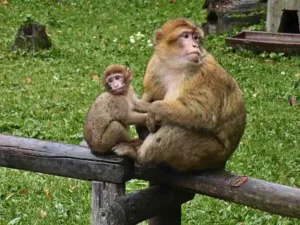
Recent studies show that Barbary macaques in Gibraltar frequently engage in geophagy (soil eating).
This behaviour is linked to dietary imbalances and human-induced feeding patterns.
About Geophagy
1. Definition and Occurrence
- Consumption of substances like clay, chalk, or soil.
- Seen in animals, birds, and humans, especially in tropical regions.
2. Possible Reasons
- Nutritional supplementation (minerals like iron, calcium).
- Detoxification of harmful substances in diet.
- Relief from digestive issues or toxins.
Barbary Macaque (Macaca sylvanus)
1. Distribution and Habitat
- Found in North Africa (Morocco, Algeria) and Gibraltar (Europe).
- Only wild monkey species in Europe.
2. Conservation Status
- Listed as Endangered (IUCN Red List).
- Included in CITES Appendix I (highest protection).
Geophagy in Barbary Macaques
1. Observations
- Frequent soil consumption, especially in tourist-heavy regions.
- Behaviour is socially learned and widely shared.
2. Reasons for Behaviour
- Diet altered by human-provided food lacking minerals.
- Soil helps in neutralising toxins and aiding digestion.
3. Human Influence
- Tourism leads to unnatural feeding patterns.
- Highlights the impact of human activities on wildlife behaviour.
ATLAS DRONE SWARM SYSTEM (CHINA)
TOPIC: (GS3) SECURITY: THE HINDU
Why in News?
China’s People’s Liberation Army (PLA) has unveiled the Atlas (Atelasi) drone swarm system.
The Atlas drone swarm system is a next-generation military platform designed to deploy and control multiple drones simultaneously.

Key Features
1. Mass Deployment Capability
- Can launch up to 90+ drones in a short time.
- Rapid deployment within a few minutes.
2. Centralised Control System
- Operated by a single command interface.
- Enables coordinated multi-drone operations.
3. Multi-Role Functionality
- Used for reconnaissance, surveillance, electronic warfare, and attacks.
- Drones can act collectively to confuse enemy systems.
4. Mobility and Flexibility
- Mounted on vehicles for quick movement.
- Can be easily concealed and repositioned.
Comparison with Other Systems
- Unlike systems like US Perdix, Atlas focuses more on intelligence coordination than just numbers.
- Emphasises swarm intelligence and coordinated tactics.
Strategic Significance
1. Modern Warfare Transformation
- Marks shift towards AI-driven combat systems.
- Reduces reliance on human soldiers in high-risk areas.
2. Cost-Effective Warfare
- Swarms are cheaper compared to traditional military hardware.
3. Tactical Advantage
- Difficult to detect and defend against large coordinated drone attacks.
WORLD TAPIR DAY
TOPIC: (GS3) ENVIRONMENT: DTE
Why in News?
World Tapir Day is observed globally to spread awareness about the conservation of tapirs.
About Tapirs
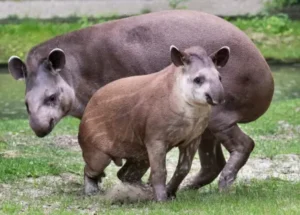
Tapirs are large, herbivorous mammals considered living fossils, as they have existed for millions of years with little evolutionary change.
Key Features of Tapirs
1. Habitat and Distribution
- Found in South America, Central America, and Southeast Asia.
- Prefer dense forests and wetland areas.
2. Ecological Role
- Known as “gardeners of the forest”.
- Help in seed dispersal, aiding forest regeneration.
3. Evolutionary Significance
- Among the oldest surviving mammal groups.
- Provide insights into evolutionary biology.
Types and Conservation Status
- Lowland Tapir – Vulnerable
- Mountain Tapir – Endangered
- Malay Tapir – Endangered
- Baird’s Tapir – Endangered
Threats
- Habitat Loss: Deforestation for agriculture and urbanisation.
- Hunting and Poaching: Hunted for meat and skin.
- Human-Wildlife Conflict: Increasing encroachment into natural habitats.