
Table of Contents
ToggleUNIQUE NATURE OF UPSC PREPARATION
TOPIC: (GS1) SOCIAL ISSUES: THE HINDU
Recent studies and expert opinions have highlighted that long UPSC preparation cycles are causing chronic stress and mental health challenges among lakhs of aspirants.
Psychological Strain of UPSC Preparation
- Longer Duration than Other Exams: Unlike JEE or NEET, UPSC preparation often spans several years, leading to chronic stress rather than shortterm exam anxiety.
- Identity Fusion: Aspirants begin to anchor their selfworth entirely around the exam, making setbacks deeply personal.
- Uncertainty Factor: Fear of repeated failure, vast syllabus, and changing exam patterns intensify distress.
Evidence of Distress
- A 2024 study found 70% of aspirants reported moderate to severe psychological distress.
- Common issues include selfdoubt, fear of forgetting, decision fatigue, and emotional exhaustion.
- Underprivileged aspirants face added stress due to financial constraints and limited resources.
Structural Stressors
- SeattoAspirant Gap: Only ~1,000 positions for over 10 lakh candidates.
- Delayed Answer Keys & Unpredictable Papers: Increase uncertainty and anxiety.
- Coaching Ecosystem: While offering support, coaching hubs often profit from prolonged cycles without accountability.
Sociological Dimensions
- Prestige of Civil Services: Rooted in colonial legacy, civil services remain symbols of power, stability, and upward mobility.
- Social Reinforcement: Families, media, and even matrimonial ads valorise civil servants, sustaining the dream.
- Parallel Economy: Coaching hubs in Delhi, Prayagraj, and Hyderabad reflect the scale of collective aspiration.
Consequences of Prolonged Preparation
- Chronic Stress & Burnout: Persistent anxiety, avoidance, and isolation.
- Delayed Career Formation: Aspirants in their 20s often postpone financial independence.
- Maladaptive Continuation: Some continue preparation compulsively, fearing disengagement.
Suggested Way Forward
- Counselling & Peer Support: Integrating mental health services into coaching ecosystems.
- Streamlined Evaluation: Faster results, more frequent prelims, and specialised undergraduate pathways.
- Diversification of Aspirations: Encouraging youth toward alternative careers, entrepreneurship, and skillbased jobs.
- Policy Recognition: Addressing structural employment gaps that fuel UPSC obsession.
Conclusion
A balanced approach combining mental health support, systemic reforms, and diversified career guidance is essential to safeguard aspirants’ wellbeing and India’s human capital.
INDIA’S STRATEGIC VULNERABILITY IN LPG SUPPLY
TOPIC: (GS3) ECONOMY: THE HINDU
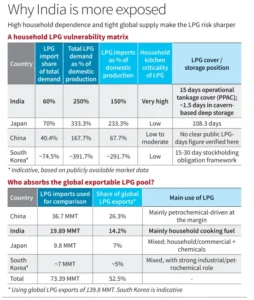
India’s LPG supply chain has come under scrutiny as domestic production meets only 40% of demand, leaving households heavily dependent on imports.
India’s LPG Demand–Supply Gap
- Annual consumption: ~33 million tonnes.
- Domestic production: ~40% of requirement.
- Imports: ~60% of demand, equal to 150% of domestic output.
- Household dependence: Over 90% of LPG is used in kitchens, making shortages socially sensitive.
Strategic Vulnerability
- Route Risk: Nearly 90% of imports pass through the Strait of Hormuz, a corridor prone to geopolitical tensions.
- Storage Weakness:
- Operational cover: ~15 days.
- Strategic cavern storage: only ~140,000 tonnes (≈1.5 days of demand).
- Concentration Risk: Imports are not diversified; supply pool is already claimed by major Asian buyers.
Global Comparisons
- Japan: Appears more importdependent but has alternatives (electricity, city gas) and ~108 days of LPG reserves.
- China: Large share of LPG used in petrochemicals, not households.
- South Korea: Household energy supported by natural gas and electricity.
- India: More exposed because LPG imports go directly into kitchens, with limited substitutes and thin reserves.
Lessons for India
- Not all molecules equal: Domestic LPG and refinery propane/butane should be reserved for household use, not petrochemicals.
- Build deeper buffer: Aim for 2–3 weeks of protected household cover (~1.3–1.9 million tonnes).
- Promote alternatives:
- Expand electric cooking in urban/semiurban areas with reliable power.
- Scale up Piped Natural Gas (PNG) where feasible.
- Launch a sustained campaign like “Give It Up 2.0” to reduce exclusive reliance on LPG cylinders.
Way Forward
- Policy redesign: Separate household fuel security from industrial feedstock demand.
- Infrastructure investment: Expand cavern storage capacity significantly.
- Energy diversification: Encourage induction cooking, PNG expansion, and renewablepowered kitchens.
- Strategic resilience: Reduce dependence on a single import corridor and diversify sources.
Conclusion
The solution lies in reserving domestic molecules for households, expanding storage, diversifying energy options, and reducing exclusive LPG dependence.
HAZARDOUS INDUSTRIES AND HUMAN COST
TOPIC: (GS3) DISASTER MANAGEMENT: THE HINDU
On April 19, 2026, a massive explosion at a fireworks unit in Virudhunagar district, Tamil Nadu killed 25 workers and injured many others.
Background of the Issue
- Virudhunagar is a hub of fireworks manufacturing, employing lakhs of workers.
- In the last four years, 134 deaths and 89 injuries have occurred due to repeated explosions.
- Most victims belong to economically weaker sections, highlighting the social dimension of the crisis.
Nature of Negligence
- Not Accidental: These explosions are not unforeseen events but the result of ignored safety norms.
- Violation of Licence Rules: The unit operated on a Sunday without permission and had 40 workers present, far above the permitted limit of 12.
- Ritualistic Inspections: Official checks are often perfunctory, failing to detect violations.
- Manpower Shortage: Monitoring authorities cite lack of staff, weakening enforcement capacity.
Role of Authorities
- Law Enforcement Failure: Units operate illegally or in violation of norms with little deterrence.
- Posttragedy Response: Authorities limit themselves to condolences and compensation, without systemic reforms.
- Balance Needed: While cracking down on violators, legitimate units should not face harassment.
Economic Context
- The fireworks industry provides largescale employment in an arid region with limited agriculture.
- Any reform must balance worker safety with livelihood protection.
- The challenge is to ensure safe practices without undermining economic survival.
Human Cost
- Workers face constant risk due to negligence and unsafe working conditions.
- Families suffer repeated tragedies, eroding trust in governance.
- The absence of automation and modern safety systems keeps human involvement dangerously high.
Way Forward
- Stricter Monitoring: Regular, meaningful inspections with adequate manpower.
- Automation: Reduce human involvement in hazardous processes.
- Accountability: Penalise unlicensed units and habitual violators.
- Worker Protection: Mandatory safety training, protective gear, and insurance coverage.
- Balanced Approach: Safeguard livelihoods while enforcing safety norms.
Conclusion
India must adopt automation, strict enforcement, and workercentric reforms to ensure that employment does not come at the cost of safety.
FEMALE LABOUR FORCE PARTICIPATION IN INDIA
TOPIC: (GS3) ECONOMY: THE HINDU
The government’s failure to advance the Women’s Reservation Act has renewed debate on women’s participation in India’s workforce and leadership, highlighting persistent gaps in labour force participation and representation.
Importance of Women’s Economic Participation
- Growth Imperative: World Bank (2023) notes India must grow at ~8% annually to become a developed economy by 2047 — impossible without higher female workforce participation.
- Leadership Impact: A 2018 study found constituencies with women legislators had 1.8% higher economic growth compared to those led by men.
- Human Capital Utilisation: Low female LFPR means a large share of women remain outside productive work, reducing national potential.
Female Labour Force Participation Rate (LFPR)
- Definition: Share of workingage women (15–64 years) who are employed or seeking work.
- India’s Position:
- 2022: 33.9%
- 2025: 40% (positive rise)
- Global average: 49%
- Brazil: 53%, Vietnam: 69% (India lags peers).
Why India’s Female LFPR is Low
- DemandSide Problem:
- India’s labour market is informal and lowwage.
- Simply increasing female supply without new jobs depresses wages.
- Need for labourintensive industries to create demand.
- Other Barriers:
- Patriarchal norms and institutional bias.
- Limited opportunities in highproductivity sectors.
- Underrepresentation in decisionmaking roles.
Women in Academia
- Professors: Share rose from 25.9% (2011–12) to 29.5% (2021–22).
- IITs: Female faculty stagnant at ~14%; IITJodhpur highest at 22%.
- IIMs: Representation varies — Calcutta ~31%, Kozhikode ~30%, Ahmedabad ~20%.
Women in Business and Corporate Leadership
- Entrepreneurship: Femaleowned enterprises only 27% of unincorporated sector.
- Senior Management: For every 100 men in leadership, only 13 women.
- Corporate Boards: Most firms have at least one woman director. 77% of firms have only 1–2 women directors.
- Only 7% of BSE 200 and 5% of NSE 500 board chairs are women. Research shows critical mass of 30% is needed for meaningful influence.
Conclusion
Achieving inclusive growth requires demandside job creation, dismantling patriarchal barriers, and ensuring women’s presence is substantive, not symbolic.
APIS MELLIFERA
TOPIC: (GS3) ENVIRONMENT: THE HINDU
The CSIRIndian Institute of Integrative Medicine (IIIM), Pulwama has demonstrated that Apis mellifera (Western honey bee) can survive subzero temperatures, reducing the need for beekeepers to migrate hives to plains during winter.
About Apis mellifera
- Commonly called the Western or European honey bee.
- Most widely domesticated insect species globally.
- Commercially important for honey, wax, propolis, and crop pollination.
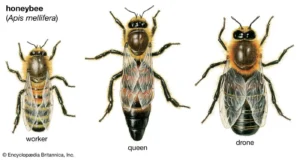
- Colonies are eusocial, with a queen, workers, and drones.
Habitat and Distribution
- Native to Europe, Western Asia, and Africa.
- Introduced worldwide since the 17th century — now found in Asia, Australia, North & South America.
- Prefer flowerrich habitats like meadows, gardens, and open woodlands.
- Can adapt to grasslands, deserts, and wetlands if food and shelter are available.
- Nesting requires cavities such as hollow trees.
Features
- Appearance: Reddishbrown to yellow with black bands and orangeyellow rings.
- Structure: Two pairs of wings, slender waist, hairy thorax and abdomen.
- Colony Size: Tens of thousands of bees.
- Stingers:
- Workers: Barbed stinger, fatal after use.
- Queen: Smooth stinger, can sting multiple times.
- Nest Architecture: Multicomb structures made of beeswax inside protective cavities.
Significance in India
- Pollination: Crucial for agriculture and horticulture, enhancing crop yields.
- Livelihoods: Supports rural beekeepers through honey and wax production.
- Adaptability: Survival in cold climates reduces costs of hive migration, improving sustainability.
Challenges
- Climate Stress: Extreme cold or heat affects survival.
- Diseases & Pests: Vulnerable to mites, viruses, and colony collapse disorder.
- Habitat Loss: Deforestation and pesticide use reduce bee populations.
- Competition: Native bee species sometimes displaced by Apis mellifera.
Way Forward
- Research & Innovation: Expand studies on coldclimate survival and disease resistance.
- Training for Beekeepers: Promote scientific methods of hive management.
- Policy Support: Encourage apiculture under rural development schemes.
- Sustainability: Balance use of Apis mellifera with conservation of native bee species.
Conclusion
The breakthrough in Apis mellifera survival under subzero conditions is a major step for Indian apiculture, reducing costs and strengthening rural livelihoods. As pollinators, these bees are vital for food security, biodiversity, and sustainable agriculture.
CHINA’S LIFELINE AND STRATEGIC CORRIDOR
TOPIC: (GS3) ECONOMY: THE HINDU
China has recently completed an 11.18km highspeed underwater tunnel beneath the Yangtze River, allowing bullet trains to travel at speeds of up to 350 kmph.
About the Yangtze River
- Known in China as Chang Jiang or Yangzi.
- Length: 6,300 km — longest in Asia, thirdlongest in the world after the Nile and Amazon.
- Longest river flowing entirely within one country.
- Has been a major transport route since the 1200s.
Course and Tributaries
- Origin: Mountains of Tibet.
- Flow: Through mountains, then wide plains before emptying into the East China Sea near Shanghai.
- Tributaries:
- Left bank: Yalung, Min, Jialing, Han.
- Right bank: Wu, Yuan, Xiang, Gan.
- Over 700 streams and rivers join the Yangtze.
Economic and Social Importance
- Agriculture: Basin is China’s “granary,” producing nearly half of national crops.
- Fisheries: Provides about half of China’s fish consumption.
- Industry: Farming and industries in the basin contribute ~40% of China’s economy.
- Population: Houses ~400 million people (onethird of China’s population).
- Cities: Major urban centers like Shanghai, Wuhan, Chongqing, Nanjing lie along the river.
Strategic Role
- Transport Corridor: Connects inland and coastal ports, enabling trade and mobility.
- Energy Projects: Site of the Three Gorges Dam, the world’s largest hydroelectric project.
- Urban Development: Supports industrial hubs and metropolitan growth.
- Global Significance: Plays a role in China’s Belt and Road connectivity.
Environmental Concerns
- Pollution: Industrial waste and urban discharge threaten water quality.
- Biodiversity Loss: Endangered species like the Yangtze River dolphin have faced extinction.
- Flood Risks: Seasonal flooding impacts millions, requiring largescale management projects.
- Climate Change: Rising temperatures and altered rainfall patterns affect river flow.
Conclusion
The new underwater tunnel reflects how China continues to leverage the Yangtze for transport, energy, and development, while balancing challenges of environmental sustainability and population pressure.
COLORADO RIVER
TOPIC: (GS1) GEOGRAPHY: THE HINDU
Scientists from the University of Washington have solved the mystery of the Colorado River’s missing water, revealing a major shift in the hydrological cycle of the American West.
Colorado River
- A major river of North America, often called the “Lifeline of the Southwest.”
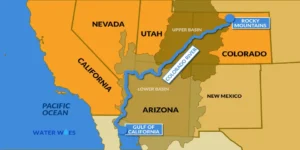
- Origin: Rises in the Rocky Mountains of Colorado, USA.
- Course: Flows west and south for about 1,450 miles (2,330 km) into the Gulf of California, Mexico.
- States Covered: Passes through seven U.S. states and two Mexican states.
- Drainage: Covers vast arid and semiarid regions.
Key Features
- Reservoirs: Forms major lakes such as Lake Mead and Lake Powell.
- International Boundary: Serves as a border between Arizona (US) and Mexico.
- Tributaries: Includes Green, Gunnison, San Juan, Dolores, Little Colorado, Gila, and Virgin Rivers.
- Grand Canyon: Carved by the river over millions of years; a UNESCO World Heritage Site and global tourist attraction.
- Also flows through Canyonlands National Park and Horseshoe Bend in Arizona.
Economic and Ecological Importance
- Provides water for agriculture, cities, and industries in the arid southwest.
- Supports millions of people and extensive irrigation networks.
- Plays a vital role in tourism and recreation.
Conclusion
The Colorado River is central to the ecology, economy, and culture of the American Southwest. The recent scientific findings on its missing water highlight the urgent need for sustainable water management in the face of climate change and rising demand.
ANAMALAI TIGER RESERVE
TOPIC: (GS3) ENVIRONMENT: THE HINDU
An elderly woman who went missing was found dead in the Manampally forest range of the Anamalai Tiger Reserve, drawing attention to the reserve’s human–wildlife interface and safety concerns.
Location and Geography
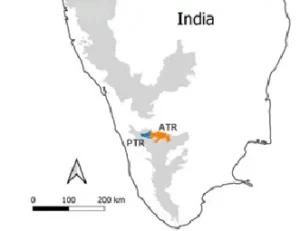
- Situated in the Anamalai Hills of Pollachi and Coimbatore districts, Tamil Nadu.
- Lies south of the Palakkad Gap in the Southern Western Ghats.
- Surrounded by:
- Parambikulam Tiger Reserve (east)
- Chinnar Wildlife Sanctuary and Eravikulam National Park (southwest)
- Reserved forests of Kerala (Nenmara, Vazhachal, Malayattur, Marayur).
- Declared a Tiger Reserve in 2007.
Communities
- Home to six indigenous groups: Kadar, Muduvar, Malasar, Malai Malasar, Eravalar, Pulayar.
- These communities depend on forest resources and have cultural ties to the landscape.
Vegetation and Flora
- Diverse habitats: wet evergreen, semievergreen, moist deciduous, dry deciduous, thorn, and shola forests.
- Unique ecosystems: montane grasslands, savannahs, marshy grasslands.
- Rich in wild relatives of cultivated plants: mango, jackfruit, wild plantain, ginger, turmeric, pepper, cardamom.
Fauna
- Key species: Tiger, Asiatic elephant, leopard, sambar, spotted deer, barking deer, jackal, jungle cat.
- Supports high biodiversity typical of the Western Ghats.
Conclusion
The Anamalai Tiger Reserve is a critical biodiversity hotspot in the Western Ghats, it plays a vital role in conservation, recent incidents highlight the need for stronger safety measures and balanced coexistence