
Table of Contents
ToggleThe term “biogeochemical” is derived from Bio (living organisms), Geo (rocks, soil, air, and water), and Chemical (the elements themselves). These cycles represent the movement of matter through the biotic and abiotic components of the ecosystem. For the UPSC Prelims, it is essential to distinguish between the various reservoirs and types of these cycles.
Definition of Biogeochemical Cycle
A biogeochemical cycle is the pathway by which a chemical substance moves through both the biotic (biosphere) and abiotic (lithosphere, atmosphere, and hydrosphere) compartments of Earth. It is the process that maintains homeostasis in the environment by recycling nutrients like carbon, nitrogen, and phosphorus.
Parts and Components of Biogeochemical Cycles
Every cycle consists of two basic “pools” or compartments:
Reservoir Pool: This is a large, slow-moving abiotic portion where the nutrient is stored (e.g., the atmosphere for nitrogen or the lithosphere for phosphorus). It compensates for any imbalance in the exchange pool.
Exchange (Cycling) Pool: This is the smaller but more active portion where nutrients are rapidly exchanged between organisms and their immediate environment.
Types of Biogeochemical Cycles
Based on the nature of the reservoir pool, types of geochemical cycles are divided into two main categories:
1. Gaseous Cycles
- Reservoir: The atmosphere or the hydrosphere (oceans).
- Speed: These cycles are relatively fast and “perfect” because they adjust quickly to fluctuations.
- Examples: Carbon cycle, Nitrogen cycle, Water cycle, and Oxygen cycle.
2. Sedimentary Cycles
- Reservoir: The Earth’s crust (lithosphere/rocks).
- Speed: These are much slower and “imperfect” because nutrients can get locked in sedimentary rocks for millions of years.
- Examples: Phosphorus cycle and Sulphur cycle.
Explanation of Major Cycles
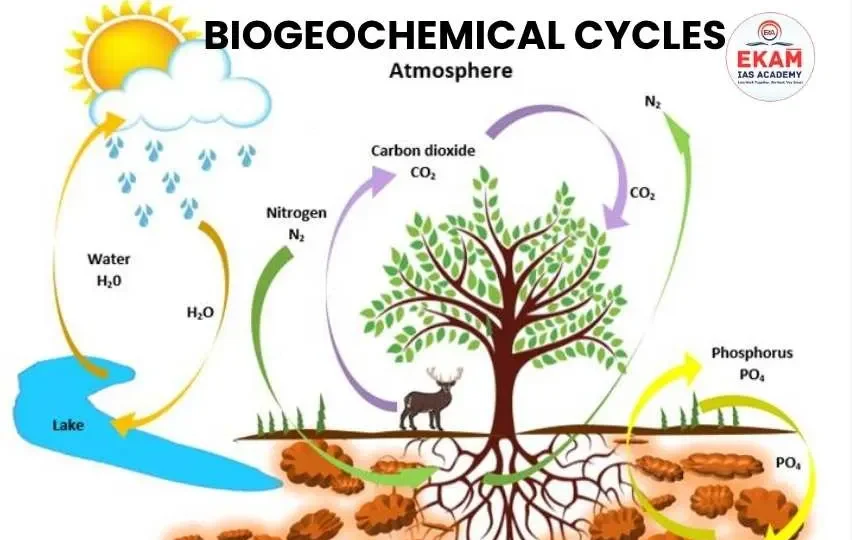
The Nitrogen Cycle
Nitrogen is the most abundant gas in the atmosphere (78%) but cannot be used directly by most life forms. It must undergo Nitrogen Fixation.
- Key Processes: Nitrogen Fixation (by Rhizobium or lightning) → Nitrification → Assimilation → Ammonification → Denitrification (returning $N_2$ to the air).
The Carbon Cycle
Carbon is the basic building block of life. It circulates through the biosphere via photosynthesis (carbon fixation) and returns through respiration, decomposition, and combustion.
- Oceanic Reservoir: Oceans hold about 50 times more carbon than the atmosphere, acting as a major carbon sink.
The Phosphorus Cycle
Unlike nitrogen or carbon, phosphorus has no atmospheric component. It is released from rocks through weathering.
- UPSC Tip: It moves from soil to plants to animals and returns to the soil through decay. Excess phosphorus in water bodies leads to eutrophication.
Importance of Biogeochemical Cycles
- Nutrient Availability: They ensure that essential elements are always available for producers to sustain the food chain.
- Waste Recycling: They prevent the accumulation of organic waste by converting it back into inorganic nutrients.
- Climate Regulation: Cycles like the carbon cycle are vital for maintaining the Earth’s temperature.
Human Impacts on These Cycles
Human activities have significantly disrupted these cycles:
- Carbon: Burning fossil fuels increases atmospheric $CO_2$, leading to global warming.
- Nitrogen & Phosphorus: Excessive use of chemical fertilizers causes nutrient runoff, leading to dead zones in oceans.
- Deforestation: Disrupts the water and oxygen cycles by reducing transpiration and oxygen production.
Conclusion
For environment ecology notes UPSC, biogeochemical cycles represent the “circulatory system” of our planet. Disrupting these loops through pollution or resource extraction poses a direct threat to sustainable development. Understanding the delicate balance between the reservoir and exchange pools is key to effective conservation and environmental management.
UPSC Prelims: PYQs & Practice Questions
Previous Year Questions (Prelims)
Q: With reference to the 'Sulphur Cycle', consider the following statements:
1. Sulphur is released into the atmosphere by the weathering of rocks.
2. Sulphur is released into the atmosphere by volcanic eruptions.
Which of the statements given above is/are correct?
(a) 1 only
(b) 2 only
(c) Both 1 and 2
(d) Neither 1 nor 2
Answer: (c) Both 1 and 2
Explanation:
Sulphur cycle is largely a sedimentary cycle where the major reservoir is the Earth’s crust. Sulphur is released through weathering of rocks, runoff, decomposition of organic matter, and volcanic eruptions, which release sulphur dioxide into the atmosphere.
Q: With reference to the food chains in ecosystems, which of the following kinds of organism is/are known as decomposer organisms?
1. Virus
2. Fungi
3. Bacteria
Select the correct answer using the codes given below:
(a) 1 only
(b) 2 and 3 only
(c) 1 and 3 only
(d) 1, 2 and 3
Answer: (b) 2 and 3 only
Explanation:
Bacteria and fungi are decomposers that break down organic matter and return nutrients to the ecosystem. Viruses are not considered decomposers because they require a living host to replicate.
Practice Questions
Q: Which of the following is considered a "perfect" biogeochemical cycle?
(a) Phosphorus Cycle
(b) Nitrogen Cycle
(c) Calcium Cycle
(d) Sedimentary Cycle
Answer: (b) Nitrogen Cycle
Explanation:
Gaseous cycles like the Nitrogen Cycle are considered “perfect” because the reservoir is the atmosphere, allowing rapid adjustment to fluctuations. Sedimentary cycles like the Phosphorus Cycle are considered “imperfect” because nutrients may remain locked in sediments for long periods.
Q: In the Carbon Cycle, which of the following acts as the largest reservoir of carbon?
(a) Atmosphere
(b) Terrestrial Biosphere
(c) Oceans
(d) Fossil Fuels
Answer: (c) Oceans
Explanation:
Oceans are the largest functional carbon reservoir, holding far more carbon than the atmosphere. This makes them a critical carbon sink in the global ecosystem.
UPSC Mains – Previous Year & Practice Questions
Mains Previous Year Questions
Question: Each year a large amount of plant material is produced by photosynthesis. Explain the mechanism of their decomposition. (Mains 2022)
Question: Explain the purpose of the 'Green Grid Initiative' announced at COP26. (Mains 2021)
Question: What is an ecosystem? Describe the various services provided by an ecosystem. (Mains 2017)
Question: Enumerate the indirect services provided by an ecosystem. How do these help in sustainable development? (Mains 2014)
Question: What do you understand by 'Environmental Ethics'? (Mains 2013)
Mains Practice Questions
[10 Marks | 150 Words]
Question: Differentiate between gaseous and sedimentary biogeochemical cycles. Why is the disruption of the phosphorus cycle harder to rectify than the carbon cycle?
[15 Marks | 250 Words]
Question: Analyze the impact of excessive nitrogenous fertilizer use on the Nitrogen Cycle and marine ecology. Suggest remedial measures.
[15 Marks | 250 Words]
Question: Explain the role of the Carbon Cycle in maintaining Earth's heat budget. How does deforestation lead to a feedback loop in global warming?



Biogeochemical Cycles-FAQs
What is the 'Reservoir Pool' in a biogeochemical cycle?
It is the large, abiotic portion of the cycle where a nutrient is stored for long periods (e.g., the atmosphere for nitrogen or rocks for phosphorus).
How do Carbon, Nitrogen, and Phosphorus cycles differ?
Carbon and Nitrogen are gaseous cycles with atmospheric reservoirs. Phosphorus is a sedimentary cycle with no significant atmospheric phase, moving primarily through soil and water.Carbon and Nitrogen are gaseous cycles with atmospheric reservoirs. Phosphorus is a sedimentary cycle with no significant atmospheric phase, moving primarily through soil and water.
What is Eutrophication?
It is a syndrome of ecosystem response to the addition of artificial or natural substances, such as nitrates and phosphates, through fertilizers or sewage, to an aquatic system.
Why are these cycles essential for life?
Earth is a closed system for matter; since no new elements are added, the biogeochemical cycles are the only way essential nutrients are made available for successive generations of organisms.
What is Denitrification?
It is the chemical reduction of nitrates into nitrogen gas ($N_2$) by bacteria (e.g., Pseudomonas), which then escapes into the atmosphere, completing the Nitrogen cycle.