
Table of Contents
ToggleThe Green Revolution transformed India into a food-surplus nation but at a heavy ecological cost, including groundwater depletion and loss of biodiversity. Organic farming UPSC preparation requires an understanding of how traditional wisdom integrates with modern ecological science to create a resilient food system that avoids synthetic inputs.
Definition of Organic Farming
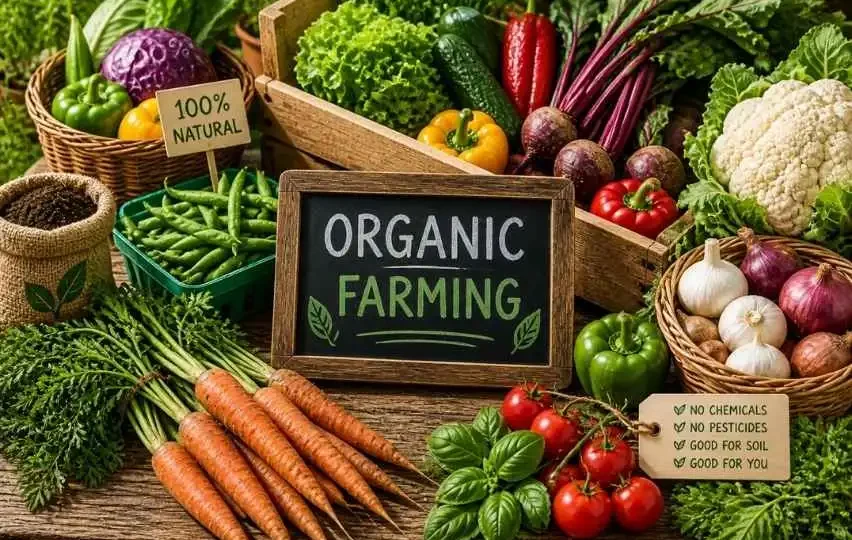
Organic farming is a holistic production management system that promotes and enhances agro-ecosystem health, including biodiversity, biological cycles, and soil biological activity. It emphasizes the use of management practices in preference to the use of off-farm inputs, taking into account that regional conditions require locally adapted systems.
Principles of Organic Farming
According to the International Federation of Organic Agriculture Movements (IFOAM), organic farming is based on four pillars:
- Principle of Health: It should sustain and enhance the health of soil, plants, animals, and humans as one and indivisible.
- Principle of Ecology: It should be based on living ecological systems and cycles, working with them, emulating them, and helping sustain them.
- Principle of Fairness: It should build on relationships that ensure fairness with regard to the common environment and life opportunities.
- Principle of Care: It should be managed in a precautionary and responsible manner to protect the health and well-being of current and future generations.
Key Practices in Organic Farming
To maintain soil fertility and manage pests, organic farmers employ several biological pest control methods and soil-building techniques:
- Green Manure: Growing specific plants (like legumes) and plowing them into the soil to improve nutrient content.
- Crop Rotation: Changing the type of crops grown in a field each season to break pest cycles and prevent soil exhaustion.
- Biological Pest Control: Using natural predators (like ladybugs) or botanical extracts (like Neem) instead of synthetic pesticides.
- Composting: Converting organic waste into nutrient-rich humus via aerobic decomposition.
- Biofertilizers: Utilizing microorganisms like Rhizobium and Azotobacter to fix atmospheric nitrogen.
Advantages and Disadvantages of Organic Farming
Organic Farming Advantages
- Nutritional Quality: Organic produce is often richer in antioxidants and free from harmful chemical residues.
- Soil Health: Enhances soil structure, water-holding capacity, and microbial activity.
- Environmental Protection: Prevents biomagnification of toxins in the food chain and reduces nitrogen leaching into water bodies.
- Climate Resilience: Organic soils sequester more carbon and are more resistant to droughts.
Organic Farming Disadvantages (Challenges)
- Lower Yields initially: The transition period (usually 3 years) often sees a dip in productivity.
- High Input Costs: Bio-inputs can be expensive if not produced on-farm.
- Lack of Marketing: Insufficient cold storage and specialized supply chains for organic produce in India.
- Certification Hurdles: Small farmers find it difficult to navigate the complex and costly certification processes like PGS-India or NPOP.
Government Initiatives in India
The Government of India has launched several schemes to promote sustainable agriculture India UPSC candidates should note:
- Paramparagat Krishi Vikas Yojana (PKVY): Promotes cluster-based organic farming with a focus on certification and marketing.
- Mission Organic Value Chain Development for North Eastern Region (MOVCDNER): Aimed at developing certified organic production in a value chain mode in NE states.
- Sikkim – The First Organic State: In 2016, Sikkim became the first state in the world to be fully organic.
- National Programme for Organic Production (NPOP): Provides the regulatory framework for organic exports.
Sustainable Development and Climate Change Mitigation
Organic farming is central to achieving Sustainable Development Goal (SDG) 2 (Zero Hunger) and SDG 12 (Responsible Consumption and Production). By eliminating synthetic nitrogen fertilizers—a major source of Nitrous Oxide emissions—it directly contributes to climate change mitigation.
Way Forward
To scale organic farming in India, the focus must shift toward:
- Market Linkages: Creating dedicated “Organic Hubs” and improving “Farm-to-Fork” logistics.
- Research & Development: Developing high-yielding organic seed varieties.
- Farmer Education: Providing training on in-situ bio-input production to reduce costs.
Conclusion
Organic farming is more than just a technique; it is a philosophy that respects the ecosystem hierarchy. While challenges like certification and yield stability remain, its role in ensuring long-term biodiversity conservation and environmental safety makes it a non-negotiable part of India’s future agricultural policy.
UPSC Prelims: PYQs & Practice Questions
Previous Year Questions (Prelims)
Q: With reference to organic farming in India, consider the following statements:
1. ‘The National Programme for Organic Production’ (NPOP) is operated under the guidelines and directions of the Union Ministry of Rural Development.
2. ‘The Agricultural and Processed Food Products Export Development Authority’ (APEDA) functions as the Secretariat for the implementation of NPOP.
3. Sikkim has become India’s first fully organic State.
Which of the statements given above is/are correct?
(a) 1 and 2 only
(b) 2 and 3 only
(c) 3 only
(d) 1, 2 and 3
Answer: (b) 2 and 3 only
Explanation:
Statement 1 is incorrect because NPOP is operated by the Ministry of Commerce and Industry. Statement 2 is correct as APEDA acts as the Secretariat for NPOP. Statement 3 is correct; Sikkim was declared India’s first fully organic state in 2016.
Q: Which of the following is/are the advantage/advantages of practicing sodic soil (usar) reclamation?
1. Improving soil structure.
2. Increasing water infiltration.
3. Enhancing crop yields.
Select the correct answer:
(a) 1 only
(b) 1 and 2 only
(c) 2 and 3 only
(d) 1, 2 and 3
Answer: (d) 1, 2 and 3
Explanation:
Sodic soil reclamation improves soil’s physical and chemical properties. Methods such as gypsum application, green manure, and organic amendments improve soil structure, increase water infiltration, and enhance crop productivity.
Practice Questions
Q: In the context of organic farming, which of the following are recognized as "Bio-fertilizers"?
1. Rhizobium
2. Azotobacter
3. Blue-green algae
4. Phosphate Solubilizing Bacteria (PSB)
Select the correct code:
(a) 1 and 2 only
(b) 1, 2, and 3 only
(c) 2 and 4 only
(d) 1, 2, 3, and 4
Answer: (d) 1, 2, 3, and 4
Explanation:
Rhizobium, Azotobacter, Blue-green algae, and Phosphate Solubilizing Bacteria are bio-fertilizers that improve nutrient availability in soil naturally, making them essential for organic cultivation.
Q: The Paramparagat Krishi Vikas Yojana (PKVY) primarily focuses on:
(a) Direct benefit transfer for chemical fertilizers.
(b) Cluster-based organic farming and certification.
(c) Genetic modification of food crops.
(d) Corporate farming in drought-prone areas.
Answer: (b)
Explanation:
PKVY is a sub-component of the National Mission on Sustainable Agriculture (NMSA) that promotes organic farming through clusters and the Participatory Guarantee System (PGS-India) certification.
UPSC Mains – Previous Year & Practice Questions
Mains Previous Year Questions
Question: How and to what extent would micro-irrigation help in solving India’s water crisis? (Mains 2018)
Question: What is an ecosystem? Describe the various services provided by an ecosystem. (Mains 2017)
Question: What are the impediments in marketing and supply chain management in developing the organic food market in India? (Mains 2015)
Question: Establish the relationship between land reform, agriculture productivity, and elimination of poverty. (Mains 2013)
Question: Enumerate the indirect services provided by an ecosystem. How do these help in sustainable development? (Mains 2014)
Mains Practice Questions
[15 Marks | 250 Words]
Question: Evaluate the advantages and disadvantages of organic farming in the context of India's goal to achieve 'Zero Hunger' by 2030. Is a complete shift to organic farming feasible?
[15 Marks | 250 Words]
Question: Sikkim's journey as the first organic state provides a template for hilly regions. Discuss the challenges in replicating this model in the plains of Punjab and Haryana.
[10 Marks | 150 Words]
Question: How does organic farming contribute to climate change mitigation and adaptation? Explain with reference to soil carbon sequestration.



Organic Farming-FAQs
What is the difference between NPOP and PGS-India?
NPOP (National Programme for Organic Production) is third-party certified and primarily for exports, whereas PGS-India (Participatory Guarantee System) is a peer-review based certification for the domestic market.
Does organic farming use any pesticides?
It avoids synthetic chemical pesticides. Instead, it uses biological pest control methods like Neem oil, pheromone traps, and natural predators like ladybugs.
Why is organic food more expensive?
Costs are higher due to labor-intensive practices, lower initial yields during the transition phase, and the costs associated with specialized certification and supply chains.
Is Zero Budget Natural Farming (ZBNF) the same as organic farming?
While both avoid synthetics, ZBNF (or Bharatiya Prakritik Krishi Paddhati) relies strictly on on-farm inputs like cow dung/urine (Jeevamrutha) and forbids off-farm organic fertilizers like vermicompost, which are allowed in organic farming.
How does organic farming prevent Biomagnification?
By eliminating persistent organic pollutants (POPs) and heavy-metal-laden fertilizers from the environment, it ensures that toxic substances do not accumulate as they move up the food chain.