
Table of Contents
ToggleBiochar: Black Gold for Sustainable Agriculture
Biochar has emerged as a promising solution to two major challenges confronting Indian agriculture: large-scale crop residue burning and declining soil health. As India seeks climate-resilient and sustainable farming practices, biochar is gaining attention as a soil-enhancing, carbon-sequestering and waste-converting resource.
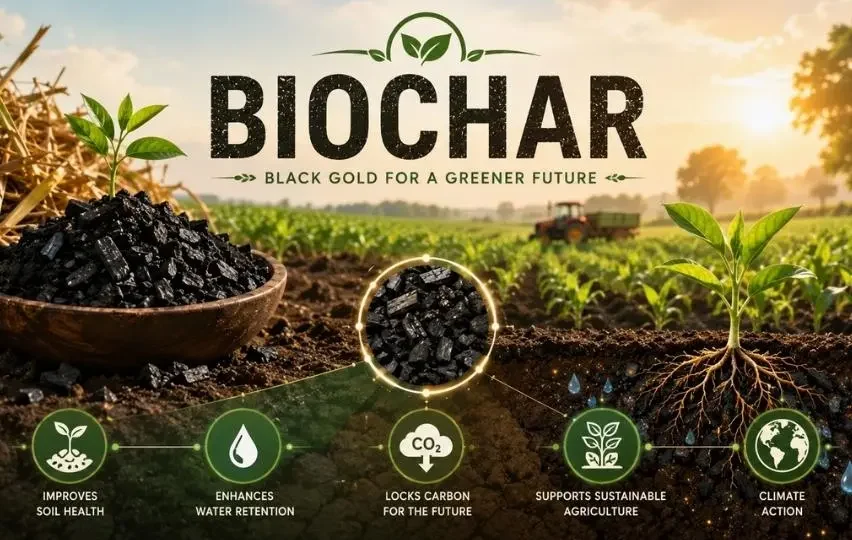
Often called the “black gold”, biochar turns agricultural waste into climate-smart wealth. It provides a practical way to manage biomass waste, improve soil fertility, reduce greenhouse gas emissions and support sustainable agriculture.
Why is Biochar in News?
Biochar is in news because it offers a solution to two pressing problems in Indian agriculture.
First, crop residue burning remains a major source of air pollution, especially in northern India. Farmers often burn leftover crop residues due to lack of affordable alternatives. Biochar production can convert this waste into a useful soil amendment.
Second, declining soil health has become a serious concern due to excessive use of chemical fertilizers, intensive cultivation, erosion and loss of organic matter. Biochar helps improve soil structure, water retention and nutrient availability.
As India promotes sustainable and climate-resilient farming, biochar is increasingly seen as a valuable tool for improving farm productivity while reducing environmental damage.
What is Biochar?
Biochar is a highly porous, carbon-rich material that resembles charcoal. It is produced through the thermal decomposition of organic biomass in limited oxygen conditions. This process is known as pyrolysis.
The raw materials used for producing biochar include agricultural waste, forestry residues, municipal waste and animal manure. During pyrolysis, this biomass is heated in a controlled environment with limited oxygen, converting it into stable carbon-rich biochar.
Unlike ordinary burning, pyrolysis reduces uncontrolled emissions and converts waste into a useful resource.
How is Biochar Produced?
Biochar is produced through the process of pyrolysis. In this process, biomass is heated at high temperatures in the absence or limited presence of oxygen.
The feedstocks for biochar production include:
Forest Waste
Wood chips, dry branches, leaves and forestry residues can be converted into biochar.
Municipal Waste
Organic portions of municipal waste can be processed to create biochar, reducing the pressure on landfills.
Agricultural Waste
Crop residues such as straw, husk, stalks and other farm waste can be converted into biochar instead of being burnt in open fields.
Animal Manure
Animal waste can also be processed into biochar, helping in waste management and nutrient recycling.
The output from pyrolysis is biochar, which can be used for soil enrichment, wastewater treatment, bio-briquettes, bioenergy generation and reduction of greenhouse gas emissions.
Significance of Biochar
Biochar has multiple benefits for agriculture, climate action and environmental management.
Increasing Agricultural Productivity
Adding biochar to degraded or nutrient-poor soils can improve agricultural productivity. It enhances soil structure, increases nutrient retention and supports microbial activity.
Biochar can help increase crop yields by improving the ability of soil to hold water and nutrients. This is especially useful in dryland regions and degraded farmlands.
Carbon Sequestration and Climate Action
Biochar plays an important role in carbon sequestration. It traps carbon in a stable form that can remain in the soil for decades.
When agricultural waste is burnt openly, carbon is released into the atmosphere as carbon dioxide and other pollutants. But when biomass is converted into biochar, a significant amount of carbon remains locked in the soil.
This makes biochar a climate-friendly resource that supports India’s efforts to reduce greenhouse gas emissions and build climate-resilient agriculture.
Water Purification
Chemically treated biochar can help remove toxic heavy metals such as lead, arsenic and chromium from wastewater. Its porous structure allows it to absorb pollutants, making it useful in water purification and wastewater treatment.
This gives biochar importance not only in agriculture but also in environmental pollution control.
Biochar and Soil Health
Biochar improves soil fertility by increasing organic carbon content and enhancing microbial activity. It helps soils retain nutrients for a longer period and reduces nutrient leaching.
Its porous structure improves aeration and water-holding capacity. This is especially useful in regions facing water stress, drought and declining groundwater availability.
By restoring degraded soil, biochar can help make farming more sustainable and reduce dependence on excessive chemical fertilizers.
Biochar and Crop Residue Management
Crop residue burning is one of the major causes of seasonal air pollution in India. Instead of burning crop residues, farmers can use them as feedstock for biochar production.
This approach has two benefits. It reduces air pollution and also creates a useful product that can be returned to the soil. Thus, biochar supports the idea of waste-to-value agriculture.
If promoted at scale, biochar can become an important part of India’s circular economy in the agriculture sector.
Biochar and Climate-Smart Agriculture
Climate-smart agriculture focuses on improving productivity, building resilience and reducing emissions. Biochar supports all three goals.
It improves productivity by enhancing soil fertility. It builds resilience by improving water retention and helping crops withstand dry conditions. It reduces emissions by preventing open burning of biomass and storing carbon in soil.
Therefore, biochar can become an important tool in India’s climate adaptation and mitigation strategy.
Challenges in Biochar Adoption
Despite its benefits, biochar adoption faces several challenges.
High Initial Cost
Small farmers may find it difficult to access pyrolysis units due to high initial costs.
Lack of Awareness
Many farmers are unaware of biochar, its production method and its long-term benefits.
Quality Variation
The quality of biochar depends on feedstock type, temperature and production process. Poor-quality biochar may not deliver expected results.
Limited Market Linkages
There is still no strong market ecosystem for biochar production, sale and distribution in many regions.
Need for Scientific Guidance
Farmers require proper guidance on dosage, soil type suitability and application methods.
Way Forward
India should promote decentralized biochar production units at the village and farmer-producer organization level. This can help manage agricultural waste locally and provide farmers with affordable soil amendments.
Government support through subsidies, training and awareness campaigns can encourage adoption. Biochar should also be integrated with sustainable agriculture schemes, natural farming initiatives and climate-resilient agriculture programmes.
Scientific institutions should develop region-specific guidelines on biochar application. Public-private partnerships can help build biochar value chains, from biomass collection to processing and marketing.
UPSC Relevance
Biochar is important for UPSC because it connects with agriculture, environment, climate change, soil health, carbon sequestration, circular economy, crop residue burning, water purification and sustainable development.
It can be used in GS Paper 3 answers related to sustainable agriculture, pollution control, climate-smart farming, waste management and mitigation of greenhouse gas emissions.
Conclusion
Biochar represents a powerful example of turning waste into wealth. By converting agricultural waste into a carbon-rich soil amendment, it addresses multiple challenges such as crop residue burning, declining soil fertility, water stress and climate change.
For India, biochar can become a valuable tool for sustainable agriculture and environmental protection. With proper policy support, farmer awareness and scientific implementation, biochar can help build healthier soils, cleaner air and a more climate-resilient agricultural future.



Frequently Asked Questions on Biochar
What is biochar?
Biochar is a highly porous, carbon-rich material similar to charcoal. It is produced by heating organic biomass such as crop residue, forest waste or animal manure in limited oxygen conditions.
How is biochar produced?
Biochar is produced through pyrolysis, a process in which organic biomass is thermally decomposed at high temperature in the absence or limited presence of oxygen.
Why is biochar called black gold?
Biochar is called black gold because it converts agricultural waste into a valuable resource that improves soil fertility, increases water retention and supports carbon sequestration.
What are the benefits of biochar in agriculture?
Biochar improves soil health, enhances nutrient retention, increases water-holding capacity, supports microbial activity and can help increase crop productivity in degraded soils.
Why is biochar important for UPSC?
Biochar is important for UPSC because it connects with sustainable agriculture, crop residue burning, soil health, carbon sequestration, climate change, circular economy and waste-to-wealth initiatives.