
Table of Contents
ToggleTelangana Formation Day 2026
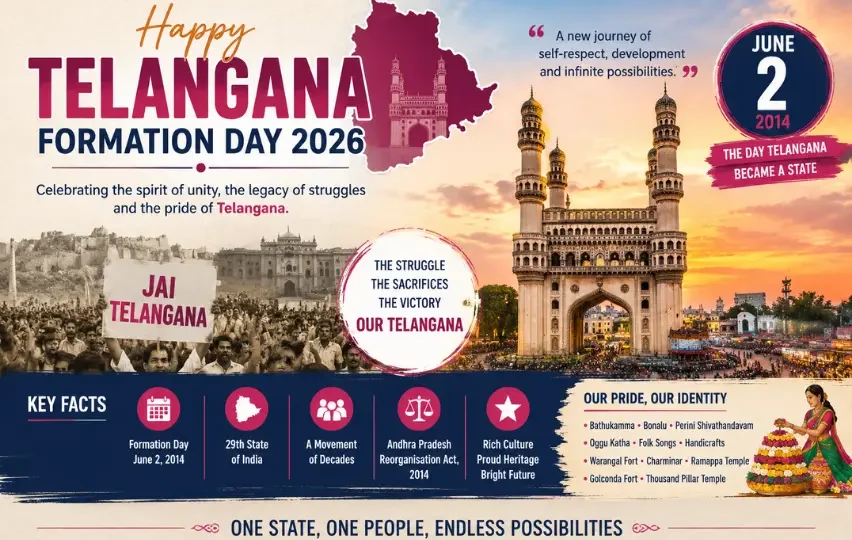
Telangana Formation Day is celebrated every year on June 2 to commemorate the creation of Telangana as a separate state of India. The day marks the culmination of a long political, social, and cultural movement that sought recognition for the unique identity, aspirations, and developmental needs of the people of Telangana.
On June 2, 2014, Telangana officially became the 29th state of India following the enactment of the Andhra Pradesh Reorganisation Act, 2014. The occasion is celebrated across the state with official ceremonies, tributes to martyrs, cultural programs, and public events that honor the sacrifices made during the statehood movement.
Historical Background of Telangana
The history of Telangana is deeply rooted in India’s political evolution.
Before Independence, the Telangana region was part of the Hyderabad Princely State ruled by the Nizams. Following India’s independence in 1947, Hyderabad was integrated into the Indian Union through Operation Polo in 1948.
In 1956, under the States Reorganisation Act, the Telangana region of Hyderabad State was merged with the Andhra State to form Andhra Pradesh. The merger was based primarily on linguistic considerations, as both regions were predominantly Telugu-speaking.
However, over time, concerns emerged regarding regional disparities in employment, irrigation, education, resource allocation, and political representation. These issues gradually gave rise to demands for a separate Telangana state.
States Reorganisation Act, 1956
The States Reorganisation Act, 1956 was a landmark legislation that reorganized Indian states largely on linguistic lines.
Key Facts
- Enacted in 1956
- Based on recommendations of the States Reorganisation Commission (SRC)
- Chairman: Fazl Ali
- Members: K.M. Panikkar and H.N. Kunzru
- Came into effect on November 1, 1956
The Act significantly altered India’s political map and led to the formation of Andhra Pradesh through the merger of Andhra State and the Telangana region of Hyderabad State.
Why Did the Demand for Telangana Arise?
Economic Concerns
Many people felt that Telangana was not receiving a fair share of investments, infrastructure development, and public expenditure.
Employment Issues
Concerns were raised regarding recruitment and employment opportunities in government services.
Water and Irrigation
Disputes over river water allocation and irrigation projects became major points of contention.
Cultural Identity
People sought recognition and preservation of Telangana’s distinct culture, dialect, traditions, and historical heritage.
Regional Imbalance
Perceived developmental disparities between Telangana and other regions fueled the statehood movement.
Telangana Statehood Movement
The Telangana movement evolved through multiple phases spanning several decades.
First Phase (1969 Telangana Agitation)
The first major agitation emerged in 1969 under the slogan “Jai Telangana.” Students, employees, and civil society groups participated in large-scale protests demanding a separate state.
Revival of the Movement
The movement regained momentum in the late 1990s and early 2000s.
A major turning point came in 2001 with the formation of the Telangana Rashtra Samithi (TRS) under the leadership of K. Chandrashekar Rao (KCR).
Key Events
- 2001: Formation of TRS
- 2009: KCR’s indefinite hunger strike
- 2010–2013: Intensification of protests across Telangana
- 2011: Sakala Janula Samme (All People’s Strike)
- Large participation by students, employees, farmers, intellectuals, and civil society
The movement eventually gained national attention and political support.
Formation of Telangana State
The Andhra Pradesh Reorganisation Bill was passed by Parliament in February 2014.
Timeline
- February 18, 2014: Bill passed in Lok Sabha
- February 20, 2014: Bill passed in Rajya Sabha
- March 1, 2014: Presidential assent received
- June 2, 2014: Telangana officially became a state
Hyderabad was designated as the joint capital of Andhra Pradesh and Telangana for a transitional period.
Constitutional Provisions Related to State Formation
The Constitution empowers Parliament to create new states and alter existing state boundaries.
Article 2
Admission or establishment of new states.
Article 3
Formation of new states and alteration of areas, boundaries, or names of existing states.
Article 4
Supplementary provisions relating to state reorganisation.
These provisions provide flexibility to accommodate regional aspirations while preserving national unity.
Significance of Telangana Formation Day
Telangana Formation Day is not merely a political event but a celebration of democratic aspirations and regional identity.
Importance of the Day
- Honors the sacrifices of Telangana martyrs
- Celebrates democratic struggle and people’s movements
- Recognizes Telangana’s cultural identity
- Highlights achievements of the state
- Promotes regional pride and unity
- Encourages reflection on future developmental goals
Telangana's Cultural Heritage
Telangana possesses a rich and vibrant cultural tradition.
Major Cultural Symbols
- Bathukamma Festival
- Bonalu Festival
- Perini Shivathandavam
- Oggu Katha
- Telangana Folk Songs
- Traditional Handicrafts
Important Heritage Sites
- Charminar
- Golconda Fort
- Ramappa Temple (UNESCO World Heritage Site)
- Thousand Pillar Temple
- Warangal Fort
These cultural elements form an integral part of Telangana’s unique identity.
Telangana Since 2014: Developmental Journey
Since its formation, Telangana has witnessed significant developments in multiple sectors.
Agriculture
- Mission Kakatiya
- Rythu Bandhu Scheme
- Expansion of irrigation infrastructure
Water Resources
- Kaleshwaram Lift Irrigation Project
- Drinking water initiatives
Infrastructure
- Road connectivity
- Urban development
- Expansion of Hyderabad as an economic hub
Information Technology
- Growth of IT and start-up ecosystem
- Establishment of innovation centers
Welfare Initiatives
- Social welfare programs
- Education and healthcare improvements
Telangana Formation Day and UPSC Preparation
Telangana Formation Day holds relevance for competitive examinations, particularly UPSC and State Public Service Commission examinations.
Important Topics for UPSC
- Federalism
- Regionalism
- State Reorganisation
- Constitutional Provisions (Articles 2, 3, and 4)
- Social Movements
- Cooperative Federalism
- Governance and Public Policy
Questions related to state formation, linguistic reorganisation, and regional movements frequently appear in UPSC Prelims and Mains examinations.
Conclusion
Telangana Formation Day represents the triumph of democratic aspirations, cultural identity, and collective determination. It commemorates the long struggle of the people of Telangana and honors those who dedicated their lives to the cause of statehood.
As Telangana celebrates another year of its formation, the occasion serves as a reminder of the values of democracy, federalism, and people’s participation in nation-building. It also offers an opportunity to reflect on the state’s achievements and its vision for a prosperous and inclusive future.
Happy Telangana Formation Day!



Frequently Asked Questions on Telangana Formation Day 2026
When is Telangana Formation Day celebrated?
Telangana Formation Day is celebrated every year on June 2. It marks the day when Telangana officially became a separate state of India in 2014.
Why is Telangana Formation Day celebrated?
Telangana Formation Day is celebrated to commemorate the creation of Telangana as a separate state and to honour the long struggle, sacrifices, and democratic movement of the people of Telangana.
When was Telangana formed as a separate state?
Telangana was officially formed on June 2, 2014, after the Andhra Pradesh Reorganisation Act, 2014 came into effect. It became the 29th state of India.
What was the Telangana statehood movement?
The Telangana statehood movement was a long political and social movement demanding a separate state for Telangana. It was driven by concerns related to regional imbalance, employment, irrigation, cultural identity, and political representation.
Why is Telangana Formation Day important for UPSC?
Telangana Formation Day is important for UPSC because it is linked to topics such as federalism, regionalism, state reorganisation, Articles 2, 3 and 4 of the Constitution, social movements, and democratic aspirations.