Table of Contents
TogglePlastic Currency in India
Imagine a banknote that can survive a trip through the washing machine, resist tearing, and remain cleaner for years. This may soon become a reality in India.
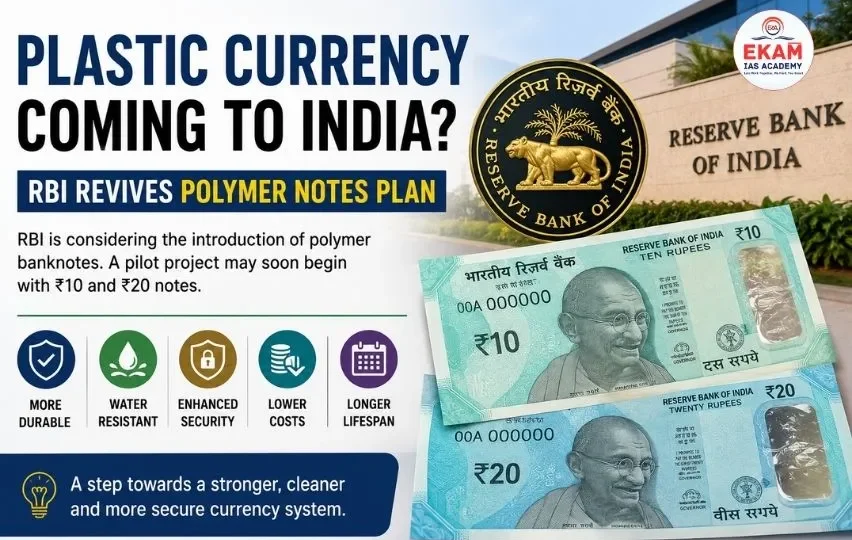
The Reserve Bank of India (RBI) is reportedly considering the introduction of polymer banknotes, commonly known as plastic notes. A pilot project is expected to be launched soon, with ₹10 and ₹20 denomination notes likely to be tested first.
If implemented, the move could mark one of the most significant changes in India’s currency system since the introduction of the Mahatma Gandhi New Series notes.
What Are Polymer Notes?
Polymer notes are currency notes made from a flexible plastic substrate instead of traditional cotton-based paper.
First introduced by Australia in 1988, polymer banknotes are now used by more than 60 countries around the world due to their durability, security features, and lower long-term costs.
Unlike conventional paper notes, polymer notes are designed to withstand harsh conditions and remain in circulation for a much longer period.
Polymer Notes vs Paper Notes
Feature | Paper Notes | Polymer Notes |
Material | Cotton-based paper | Flexible plastic substrate |
Durability | Lower | Higher |
Water Resistance | No | Yes |
Tear Resistance | Low | High |
Lifespan | Short | Longer |
Security Features | Limited | Advanced |
The key difference lies in durability. Polymer notes can remain usable for years longer than paper notes, reducing the need for frequent replacement.
Why Is RBI Considering Polymer Currency?
The RBI’s renewed interest in polymer banknotes is driven by several practical and economic considerations.
Rising Currency Printing Costs
Printing and replacing damaged currency notes involve substantial expenditure every year. As the volume of currency in circulation grows, so do printing costs.
Large Number of Soiled Notes
Millions of notes become damaged, torn, or heavily soiled and must be withdrawn from circulation annually. This creates an additional burden on the currency management system.
Longer Lifespan
Polymer notes last significantly longer than conventional paper notes. Their resistance to wear and tear makes them ideal for high-circulation denominations.
Lower Replacement Costs
Since polymer notes remain in circulation longer, the frequency of reprinting decreases, resulting in lower long-term costs.
Better Security Features
Polymer currency can incorporate sophisticated security features such as transparent windows, holographic elements, and advanced anti-counterfeiting technology.
Major Advantages of Polymer Notes
More Durable
Polymer notes can withstand rough handling much better than paper notes.
Water Resistant
Unlike paper currency, polymer notes are resistant to water damage and moisture.
Cleaner Circulation
The non-porous surface accumulates less dirt and bacteria, helping maintain cleaner currency circulation.
Difficult to Counterfeit
Advanced security features make replication more challenging for counterfeiters.
Longer Shelf Life
Many countries report that polymer notes last several times longer than traditional paper currency.
Lower Long-Term Costs
Although initial production costs may be higher, reduced replacement frequency lowers overall expenditure.
India's First Polymer Note Experiment
India’s interest in polymer currency is not new.
In 2012, the RBI proposed issuing one billion polymer ₹10 notes as part of a pilot project.
Key Details of the Experiment
Particular | Details |
Year | 2012 |
Proposed Denomination | ₹10 |
Quantity | 1 Billion Notes |
Trial Cities | Kochi, Mysore, Jaipur, Bhubaneswar and Shimla |
Objective | Improve durability and reduce replacement costs |
However, the project was eventually shelved due to technical and operational challenges.
Now, more than a decade later, the RBI appears to be revisiting the proposal with improved technology and international experience available.
Which Countries Already Use Polymer Currency?
Several developed and developing nations have successfully adopted polymer banknotes.
Some notable examples include:
- Australia (First country to introduce polymer notes in 1988)
- Canada
- United Kingdom
- Singapore
- New Zealand
- Malaysia
- Thailand
- Vietnam
- Romania
Today, more than 60 countries use polymer-based currency in some form.
The global trend suggests growing confidence in polymer technology as a modern alternative to paper currency.
Challenges India May Face
While polymer notes offer several advantages, implementation may not be entirely straightforward.
Some potential challenges include:
- Higher initial manufacturing costs.
- Modifications required in ATM and cash-handling machines.
- Public adaptation to the new texture and feel.
- Recycling and environmental management considerations.
The pilot project is expected to help the RBI assess these issues before a wider rollout.
What Could This Mean for India?
If the pilot project proves successful, India could gradually transition to polymer currency, beginning with lower denominations such as ₹10 and ₹20.
The move could:
- Reduce expenditure on currency replacement.
- Improve note quality in circulation.
- Strengthen anti-counterfeiting measures.
- Enhance efficiency in currency management.
For a country with one of the world’s largest cash circulation systems, even small improvements in note durability can generate substantial savings over time.
RBI at a Glance
Particular | Details |
Established | 1 April 1935 |
RBI Act | 1934 |
Headquarters | Mumbai |
Nationalised | 1949 |
First Governor | Sir Osborne Smith |
First Indian Governor | Sir C.D. Deshmukh |
Key Functions | Monetary Policy, Currency Issuance, Banking Regulation and Financial Stability |
Conclusion
The RBI’s renewed interest in polymer banknotes signals a possible transformation in India’s currency ecosystem. With advantages such as durability, enhanced security, water resistance, and lower long-term costs, polymer notes could offer a modern solution to many challenges associated with traditional paper currency.
While the proposal is still at the pilot stage, the coming months may determine whether India joins the growing list of nations that have embraced plastic currency. If successful, the humble ₹10 and ₹20 notes could become the first symbols of a new era in India’s monetary system.



Frequently Asked Questions on Plastic Currency in India
What are polymer notes?
Polymer notes are currency notes made from a flexible plastic material instead of traditional cotton-based paper. They are more durable, water-resistant, and harder to counterfeit.
Is India introducing plastic currency notes?
The RBI is reportedly considering a pilot project for polymer banknotes in India. The trial may begin with lower denominations such as ₹10 and ₹20 notes.
Why is RBI planning to introduce polymer notes?
RBI is considering polymer notes because they last longer, reduce replacement costs, remain cleaner in circulation, and provide better security features against counterfeiting.
Which countries use polymer banknotes?
Countries such as Australia, Canada, the United Kingdom, Singapore, New Zealand, Malaysia, Thailand, Vietnam, and Romania use polymer banknotes in some form.
What are the advantages of polymer notes over paper notes?
Polymer notes are more durable, water-resistant, tear-resistant, cleaner, longer-lasting, and more secure than traditional paper currency notes.