
Table of Contents
ToggleQuit India Movement
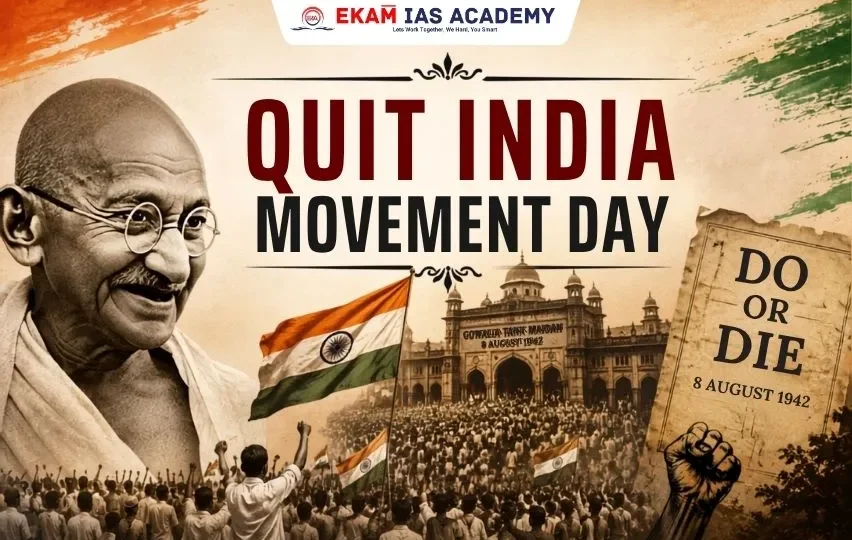
Quit India Movement Day, also known as August Kranti Diwas, is observed every year on 8 August to commemorate the launch of the historic Quit India Movement (Bharat Chhodo Andolan) in 1942.
The movement, led by Mahatma Gandhi and the Indian National Congress, marked a decisive phase in India’s freedom struggle by demanding the immediate withdrawal of British rule.
The day honours the sacrifices of freedom fighters and reminds citizens about the values of patriotism, unity, democracy and commitment towards nation-building.
Quit India Movement Day 2026 Theme
Quit India Movement Day does not have a separate officially declared national theme.
The observance focuses on remembering the historic events of 1942, paying tribute to the freedom fighters who participated in the struggle and recalling Mahatma Gandhi’s inspiring slogan:
“Do or Die”
The day also highlights the importance of preserving the ideals of freedom, justice and democratic values.
History of the Quit India Movement
The Quit India Movement, also known as the August Movement or August Kranti, was launched on 8 August 1942 by the Indian National Congress under the leadership of Mahatma Gandhi.
It was one of the most powerful mass movements against British colonial rule and demanded immediate independence for India.
Key Facts
- Date of Launch: 8 August 1942
- Organisation: Indian National Congress
- Venue: Gowalia Tank Maidan (now August Kranti Maidan), Bombay (Mumbai)
- Leader: Mahatma Gandhi
- Main Slogan: “Do or Die”
- Objective: To force the British government to leave India immediately and grant complete independence.
Following the launch of the movement, the British government arrested Gandhi and several senior Congress leaders on 9 August 1942.
Despite severe repression, the movement spread across the country, with participation from students, workers, farmers, women and ordinary citizens.
Causes Behind the Quit India Movement
Several political, economic and international developments contributed to the launch of the Quit India Movement.
Failure of the Cripps Mission (1942)
The British proposal offered limited constitutional reforms but did not promise immediate independence.
This disappointed Indian leaders and increased opposition against British rule.
India’s Forced Participation in World War II
Britain involved India in the Second World War without consulting Indian political representatives.
This decision created widespread resentment among Indians.
Demand for Complete Independence
The Congress intensified its demand for Purna Swaraj (Complete Independence) instead of gradual constitutional reforms.
Economic Hardships
The war period resulted in:
- Rising inflation
- Food shortages
- Unemployment
- Increased economic difficulties for ordinary people
These conditions increased public dissatisfaction.
Repressive Colonial Policies
British measures such as:
- Arrests of nationalist leaders
- Press censorship
- Restrictions on civil liberties
further strengthened anti-colonial sentiments.
Growing Nationalist Consciousness
Decades of freedom movements had created strong national awareness and increased the demand for self-rule.
Japanese Expansion in Asia
Japan’s rapid advance during World War II exposed Britain’s vulnerability in Asia and encouraged Indian leaders to press for immediate independence.
Major Leaders of the Quit India Movement
The movement was led by Mahatma Gandhi and supported by several national leaders who organised mass protests and underground resistance.
Mahatma Gandhi
- Launched the movement on 8 August 1942.
- Gave the historic “Do or Die” call.
- Inspired millions of Indians to participate in the struggle.
Jawaharlal Nehru
- Played an important role in Congress leadership.
- Supported the movement and was arrested by the British authorities.
Sardar Vallabhbhai Patel
- Mobilised public support.
- Encouraged people to participate in the national movement.
Maulana Abul Kalam Azad
- President of the Indian National Congress during the movement.
- Played a key role in the adoption of the Quit India Resolution.
Aruna Asaf Ali
- Hoisted the national flag at Gowalia Tank Maidan after the arrest of senior Congress leaders.
- Became a symbol of resistance against British rule.
Ram Manohar Lohia
- Organised underground activities.
- Helped spread nationalist messages despite British restrictions.
Jayaprakash Narayan
- Led underground resistance activities.
- Continued the struggle even after imprisonment.
Usha Mehta
- Operated the secret Congress Radio.
- Broadcast patriotic messages and information about the movement.
Yusuf Meherally
- Credited with popularising the slogan “Quit India”.
- Played an important role in mobilising public opinion.
Significance of the Quit India Movement
The Quit India Movement became a turning point in India’s struggle for independence and accelerated the process of ending British rule.
Strengthened the Demand for Independence
The movement clearly communicated that Indians wanted complete freedom and no longer accepted colonial rule.
Mass Participation in Freedom Struggle
People from different sections of society participated, including:
- Students
- Farmers
- Workers
- Women
- Common citizens
This transformed the movement into a nationwide struggle.
Inspired National Unity
The movement brought together people from different regions, communities and social groups with a common objective of independence.
Increased Pressure on British Rule
Although the British suppressed the movement through arrests and force, it demonstrated that colonial rule could not continue indefinitely.
Contribution Towards Independence
The movement weakened British authority in India and became one of the major factors that paved the way for independence in 1947.
Preservation of Democratic Values
Quit India Movement Day reminds citizens about the importance of:
- Freedom
- Justice
- Equality
- Democratic participation
Conclusion
The Quit India Movement of 1942 remains one of the most significant chapters in India’s freedom struggle.
Led by Mahatma Gandhi’s call of “Do or Die”, the movement reflected the determination, courage and unity of millions of Indians fighting for independence.
Quit India Movement Day serves as a reminder of the sacrifices made by freedom fighters and inspires future generations to uphold the values of democracy, national unity and civic responsibility.



FAQ: Quit India Movement Day
Why is Quit India Movement Day observed on 8 August?
Quit India Movement Day is observed on 8 August to commemorate the launch of the Quit India Movement by the Indian National Congress in 1942.
Who launched the Quit India Movement and what was its main slogan?
The movement was launched by Mahatma Gandhi in 1942 with the famous slogan “Do or Die”, demanding the immediate withdrawal of British rule from India.
Where was the Quit India Resolution passed?
The Quit India Resolution was passed at Gowalia Tank Maidan (now August Kranti Maidan), Bombay (Mumbai) on 8 August 1942.
What were the major causes behind the Quit India Movement?
The movement was triggered by factors such as the failure of the Cripps Mission, forced Indian participation in World War II, economic hardships, and demand for complete independence.
What was the significance of the Quit India Movement?
The movement became a turning point in India’s freedom struggle by strengthening mass participation and increasing pressure on British rule, contributing to independence in 1947.