Table of Contents
ToggleBreast Cancer Therapy
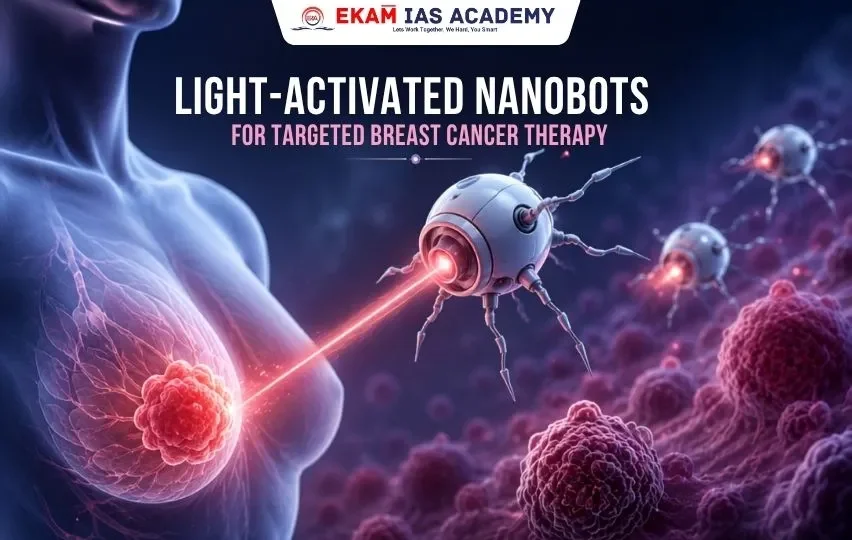
Scientists from the Institute of Nano Science and Technology (INST), Mohali have developed innovative light-responsive multifunctional nanobots aimed at improving the precision and effectiveness of breast cancer treatment.
These advanced nanobots use near-infrared light activation to achieve targeted tumour destruction while minimising damage to healthy tissues, marking a significant development in nanotechnology-based cancer therapy.
What are Light-Activated Nanobots?
Light-activated nanobots are microscopic robotic systems designed to perform targeted therapeutic functions inside the human body.
The newly developed nanobots are based on Upconversion Nanoparticles (UCNPs), which can respond to near-infrared light and convert external energy into therapeutic action.
Their ability to move directionally and deliver treatment precisely makes them a promising tool for minimally invasive cancer therapy.
Working Mechanism of Nanobots
The nanobots operate through a combination of light-controlled movement and targeted therapy.
Key Features
- The nanobots respond to near-infrared light and exhibit phototaxis, allowing them to move towards the light source.
- This controlled movement helps deliver therapeutic effects at specific tumour locations.
- The system is fuel-free, reducing the risk of unwanted reactions inside the body.
Cancer Cell Targeting Mechanism
To improve tumour specificity, researchers modified the nanobots with folic acid functionalisation.
How it Works
- Breast cancer cells often show increased expression of folate receptors.
- Folic acid helps nanobots selectively recognise and attach to these cancer cells.
- Exposure to a 980-nanometre near-infrared laser generates localised heat, destroying targeted cancer cells.
This targeted approach reduces the impact on surrounding healthy tissues.
Combined Photothermal and Photodynamic Therapy
The nanobots use two therapeutic mechanisms simultaneously:
Photothermal Therapy
- Near-infrared irradiation produces localised heating.
- The generated heat damages and destroys cancer cells.
Photodynamic Therapy
- A photosensitiser present in the system produces Reactive Oxygen Species (ROS) when activated by light.
- ROS causes additional damage to tumour cells.
The combined effect provides greater tumour inhibition compared to using either therapy individually.
Smart Control and Precision Treatment
The therapeutic activity of these nanobots can be externally controlled through biological and environmental factors.
The response can be adjusted based on:
- Laser intensity
- pH conditions
- Glutathione concentration
This controllability allows better regulation of treatment inside complex biological environments.
Advantages of Nanobot-Based Cancer Therapy
The technology offers several potential benefits:
- Targeted treatment: Directs therapy towards cancer cells rather than affecting the entire body.
- Reduced toxicity: Minimises damage to healthy tissues compared to conventional treatments.
- External control: Allows doctors to regulate therapeutic activity using light.
- Minimally invasive approach: Provides a potential alternative for precision cancer treatment.
Testing and Future Potential
The developed nanobots demonstrated therapeutic effectiveness in:
- Laboratory cellular models.
- Breast tumour-bearing mice.
The results indicate their potential for future applications in precision oncology, where treatments can be customised and delivered directly to disease sites.
Significance
The development of light-activated multifunctional nanobots represents an important advancement in the field of nanomedicine.
By combining targeted delivery, artificial movement and dual therapeutic mechanisms, this technology could contribute to safer, more effective and personalised cancer treatments in the future.



Frequently Asked Questions About Light-Activated Nanobots
What are light-activated nanobots?
Light-activated nanobots are microscopic systems designed to deliver targeted therapeutic effects using near-infrared light.
How do these nanobots target breast cancer cells?
The nanobots are functionalised with folic acid, which helps them recognise and attach to breast cancer cells that have elevated folate receptor expression.
How does near-infrared light help destroy cancer cells?
Near-infrared light activates the nanobots, producing localised heat and reactive oxygen species (ROS) that can damage and destroy targeted cancer cells.
What therapies are combined in the nanobot system?
The technology combines photothermal therapy (PTT) and photodynamic therapy (PDT) to enhance tumour-cell destruction.
Has the technology been tested in living organisms?
Yes. The nanobots demonstrated therapeutic effects in laboratory cellular models and in breast tumour-bearing mice. Further research is required before potential clinical use in humans.