
Table of Contents
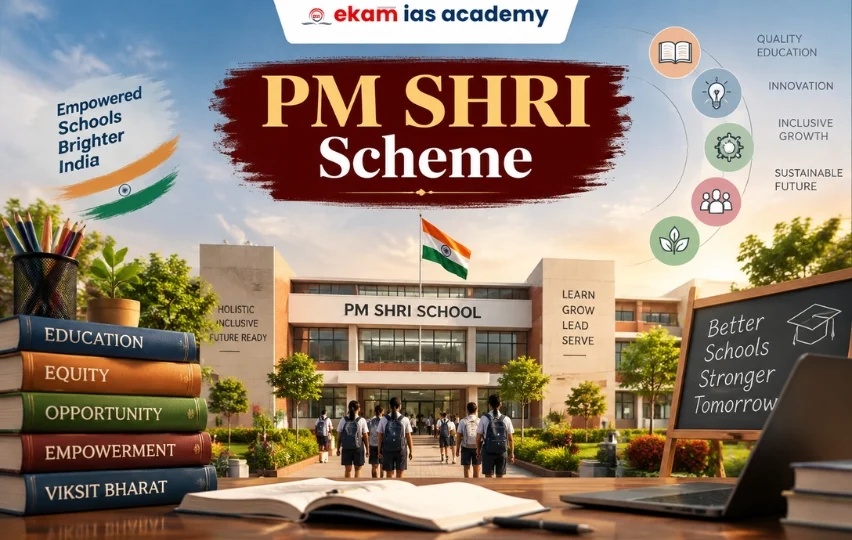
TogglePM SHRI Scheme UPSC: Transforming Schools into Model Institutions under NEP 2020
The Pradhan Mantri Schools for Rising India (PM SHRI Scheme) is in focus for its progress in developing existing schools as model institutions aligned with the National Education Policy (NEP) 2020. As of July 2026, 13,092 schools have been selected across 36 States/UTs, covering nearly 90% of the target of more than 14,500 schools.
What are the Key Facts About PM SHRI?
Launched on 7 September 2022, PM SHRI is a Centrally Sponsored Scheme implemented by the Department of School Education and Literacy, Ministry of Education. Its primary objective is to upgrade existing schools and demonstrate how the principles of NEP 2020 can be effectively implemented at the grassroots level.
The scheme targets more than 14,500 schools managed by Central and State/UT Governments and local bodies, including institutions under Kendriya Vidyalaya Sangathan (KVS) and Navodaya Vidyalaya Samiti (NVS). It is being implemented during 2022–23 to 2026–27, with a Central share of ₹18,128 crore.
The Project Approval Board outlay increased from ₹2,520 crore in 2023–24 to ₹5,224 crore in 2026–27, indicating a significant expansion in investment.
Strategic Focus of PM SHRI
PM SHRI schools are intended to function as exemplar institutions that demonstrate NEP 2020 principles and share successful practices with neighbouring schools. The approach emphasises quality, equity, inclusion, experiential learning and 21st-century skills.

How PM SHRI Schools Transform School Education?
Learning Designed Around the Child
PM SHRI schools follow CBSE or State/UT curricula aligned with the National Curriculum Framework (NCF) and the 5+3+3+4 structure under NEP 2020. Learning is made more practical through bagless days, internships with local artisans, exposure to local arts and crafts, cultural activities and indigenous knowledge.
Equity, Inclusion and Multilingual Learning
The scheme promotes inclusive and equitable education while recognising India’s linguistic diversity. Greater use of mother tongue and regional languages, particularly in early education, is encouraged to strengthen foundational learning.
As per the given UDISE+ 2025–26 data, PM SHRI schools have 6,102 Sanskrit, 1,994 Urdu and 9,152 regional-language teachers. The approach also supports Foundational Literacy and Numeracy (FLN).
Technology-Enabled Learning
PM SHRI schools encourage smart classrooms, ICT facilities, internet connectivity and digital learning resources. Platforms such as DIKSHA support access to educational content and promote digital learning.
Holistic Student Development
Education under PM SHRI extends beyond academics by integrating sports, arts, extracurricular activities and life skills. The scheme seeks to develop creativity, leadership, resilience, adaptability and socio-emotional skills among students.
Empowering Teachers and School Leaders
Teacher development is supported through DIETs, with up to ₹3 lakh per DIET for capacity-building programmes and up to ₹2,500 per teacher for training. Training covers areas such as ICT, school safety, counselling, mental well-being and competency-based pedagogy.
A Growing National Network
By July 2026, 13,092 schools had been selected across 36 States/UTs, covering 725 districts and 8,340 blocks/ULBs. This growing network aims to create a multiplier effect by enabling PM SHRI schools to serve as models for surrounding institutions.
Conclusion
PM SHRI represents a shift towards holistic, inclusive and future-ready school education. By converting existing schools into exemplar institutions, the scheme seeks to translate NEP 2020 from policy into classroom-level practice while improving learning outcomes, teacher capacity, digital access and educational equity.
PM SHRI Scheme-FAQs Answered
What is the PM SHRI Scheme?
The Pradhan Mantri Schools for Rising India (PM SHRI) Scheme is a Centrally Sponsored Scheme launched in 2022 to develop existing schools as model institutions aligned with NEP 2020 principles.
What is the main objective of PM SHRI Schools?
The scheme aims to create exemplar schools focusing on quality education, inclusion, experiential learning, digital learning and 21st-century skills, while demonstrating NEP 2020 implementation.
How many schools are targeted under the PM SHRI Scheme?
PM SHRI aims to upgrade more than 14,500 existing government schools across India, including schools under KVS, NVS and State/UT governments.
How does PM SHRI promote holistic education?
PM SHRI schools integrate academics with sports, arts, life skills, vocational exposure, internships, multilingual learning and technology-enabled education to support overall student development.
How is PM SHRI connected with NEP 2020?
PM SHRI acts as a demonstration model for implementing NEP 2020 through the 5+3+3+4 structure, foundational literacy and numeracy, experiential learning and inclusive education practices.