Table of Contents
ToggleFirecracker Policy
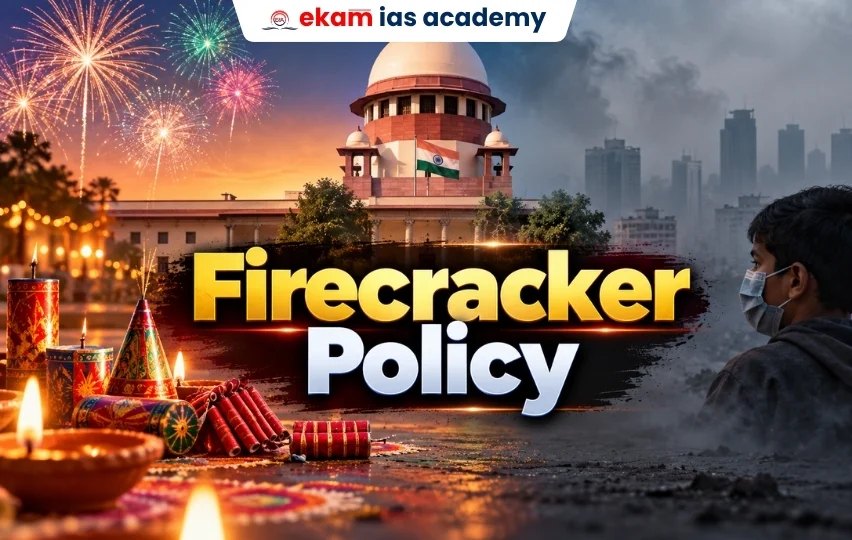
The Supreme Court has moved away from the possibility of a complete ban on firecrackers during Deepavali and supported a limited, conditional relaxation under a balanced Firecracker Policy for specified next-generation green crackers. The approach draws on recommendations from CSIR-NEERI, while keeping emission, noise and safety standards applicable.
What are Next-Generation Joined Green Crackers?
Joined crackers consist of multiple crackers connected in sequence, while green crackers are designed to reduce pollution compared with conventional products.
Key features include:
- Barium-free formulation: The approved green-cracker design excludes barium, commonly associated with colour-producing compounds.
- Lower emissions: Tests indicate around 30% lower emissions compared with conventional joined crackers.
- Reduced waste: Smaller shells can reduce solid waste generation by approximately 4% to 32%.
- Longer duration: The bursting duration has been increased while reducing the environmental load.
- Lower noise and particulate emissions: The formulation is intended to reduce both sound and fine particulate pollution.
What Conditions Has the Court Accepted?
The relaxation is subject to regulatory compliance.
- Only approved formulations tested by competent authorities can be manufactured.
- Production is restricted to licensed manufacturers.
- Crackers must comply with prescribed emission and noise standards.
- The permissible noise limits include 125 dB(AI) or 145 dB(C) peak.
- Banned chemical ingredients cannot be used.
- CSIR-NEERI has prescribed specifications relating to shell size, number of shells and bursting duration.
How Will Festive Sentiment and Clean Air Be Balanced?
The Court has sought to balance religious and cultural practices with public-health and environmental concerns.
A complete prohibition was not considered appropriate, partly because of concerns regarding public sentiment. At the same time, unrestricted use of crackers has not been permitted.
The Court has indicated that round-the-clock bursting should not be allowed, particularly considering its impact on children, elderly people and those with health vulnerabilities. Specific time windows may therefore be considered.
The CPCB and Union Government have also been given additional time for testing related to barium and the decibel levels of joined crackers.
Challenges
Implementation remains a major concern:
- Fake green labels may make identification difficult for consumers.
- Monitoring prescribed bursting hours can be challenging in densely populated areas.
- Firecracker emissions add to seasonal pollution, particularly when winter conditions and other pollution sources already affect air quality.
- Strict restrictions may affect livelihoods in the firecracker industry, particularly around Sivakasi.
- Further technical testing is still relevant to determining compliance.
Way Forward
Effective implementation could include verifiable QR-based certification, uniform time windows, real-time air and noise monitoring, and financial and technical support for manufacturers shifting to approved green formulations.
Conclusion
The emerging framework seeks to combine festive traditions with environmental safeguards rather than relying solely on prohibition. Its effectiveness will ultimately depend on reliable certification, strict enforcement, transparent monitoring and wider adoption of cleaner firecracker technologies.


FAQs: Firecracker Policy
What is the Supreme Court’s approach to firecrackers?
The Supreme Court has moved away from a complete ban on firecrackers and supported a limited, conditional relaxation for specified next-generation green crackers, subject to regulatory standards.
What are next-generation joined green crackers?
Joined crackers are multiple crackers connected in sequence. The approved green-cracker formulations are designed to reduce emissions, particulate pollution, noise and solid waste compared with conventional crackers.
What conditions apply to the use of green crackers?
Only approved formulations and licensed manufacturers are permitted. Crackers must meet prescribed emission and noise standards and cannot contain banned chemical ingredients.
How does the policy balance festivals and environmental protection?
The approach seeks to balance festive and cultural practices with public health and environmental concerns by permitting limited use under specified conditions rather than allowing unrestricted bursting or imposing a complete prohibition.
What are the major challenges in implementing the firecracker policy?
Key challenges include fake green labels, monitoring bursting hours, controlling seasonal air pollution, enforcing noise standards and ensuring compliance by manufacturers, particularly in major firecracker