
Table of Contents
ToggleStubble Burning in India
Every winter, stubble burning becomes a major contributor to air pollution in North India, particularly Delhi-NCR. However, the practice is closely linked to agricultural economics, groundwater policies, crop choices and limited residue-management options rather than being simply a matter of farmer behaviour.
What Is Stubble Burning?
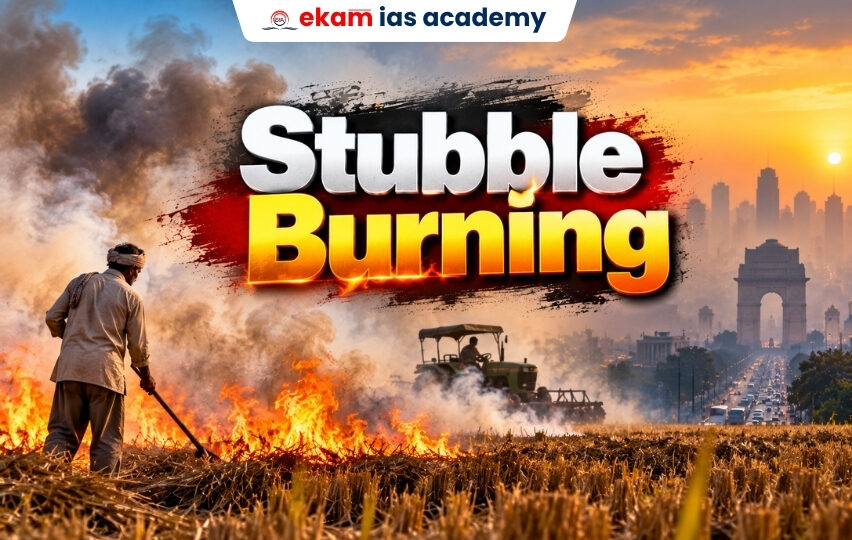
Stubble burning refers to burning the crop residue left in fields after harvesting. It is particularly common from October to November in Punjab, Haryana and parts of Uttar Pradesh, mainly after paddy harvesting. Punjab and Haryana together generate nearly 29 million tonnes of paddy straw.
Why Does Stubble Burning Matter?
Burning crop residue releases particulate matter, carbon monoxide, volatile organic compounds and other harmful pollutants, contributing to seasonal smog.
It also damages soil by destroying nutrients such as nitrogen, phosphorus, potassium and sulphur. The intense heat can reduce soil moisture and organic matter, potentially increasing dependence on fertilisers.
The Water Crisis Behind the Problem
Stubble burning became more closely associated with late-season pollution after the Punjab Preservation of Sub-Soil Water Act, 2009 delayed paddy cultivation.
The law restricted early sowing and transplantation to conserve groundwater. While this helped address water depletion, it also pushed the paddy harvest towards late October and early November, leaving farmers only a short period to prepare fields for wheat.
Why Farmers Continue Paddy-Wheat Cultivation
The underlying issue is the existing agricultural incentive structure. Punjab and Haryana have historically benefited from relatively high procurement of paddy and wheat compared with the national average.
Assured procurement provides farmers with income security, while subsidised or free electricity encourages groundwater-based cultivation. Together, these incentives make crop diversification difficult.
Technical Solutions and Their Limits
In-situ solutions include Happy Seeders, Super Seeders, Rotavators and short-duration rice varieties. Ex-situ options include converting residue into bioethanol and compressed biogas.
However, machinery can be expensive and difficult to access during the narrow harvesting window, while transporting residue for industrial use can impose additional costs.
Punjab vs Haryana Approaches
Punjab has relied substantially on crop-residue management machinery, while Haryana has adopted a stronger incentive-based approach, including payments for residue management, direct seeding and crop diversification.
The experience suggests that economic incentives may complement enforcement more effectively than penalties alone.
The Measurement Problem
Reported reductions in farm fires require careful interpretation because satellite-based monitoring captures fires only during specific observation windows. Studies have suggested that some farmers may shift burning to evening hours, reducing satellite detection without necessarily eliminating the practice.
Way Forward
A durable solution requires crop diversification, better residue markets, affordable machinery, stronger biomass-based industries and improved satellite monitoring. Farmers should be provided economically viable alternatives rather than relying primarily on punitive measures.
Conclusion
Stubble burning is ultimately a structural agricultural and environmental challenge. Addressing it requires aligning procurement, electricity, groundwater and crop policies with pollution-control objectives. A combination of incentives, technology and reliable markets for crop residue can offer a more sustainable long-term solution.


FAQs: Stubble Burning in India
What is stubble burning, and why is it practised in India?
Stubble burning is the practice of burning crop residue left after harvesting. It is common in Punjab, Haryana and Uttar Pradesh, where farmers burn paddy straw to quickly prepare their fields for wheat cultivation.
How does stubble burning contribute to air pollution in Delhi-NCR?
Stubble burning releases particulate matter (PM2.5 and PM10), carbon monoxide and other harmful pollutants. These emissions contribute to winter smog and deteriorating air quality in Delhi-NCR.
How is the Punjab Preservation of Sub-Soil Water Act, 2009 linked to stubble burning?
The Act restricts early paddy cultivation to conserve groundwater. However, delayed transplantation pushes harvesting towards October–November, reducing the time available for wheat sowing and encouraging farmers to burn crop residue.
What are the major alternatives to stubble burning?
Alternatives include Happy Seeders, Super Seeders, direct seeding, crop diversification and biomass utilisation. Paddy straw can also be converted into bioethanol, compressed biogas and other useful products.
What measures can reduce stubble burning in India?
Effective solutions include financial incentives for farmers, affordable residue-management machinery, crop diversification, better biomass markets and improved satellite monitoring. Aligning agricultural procurement and groundwater policies with environmental goals is essential for long-term results.