Table of Contents
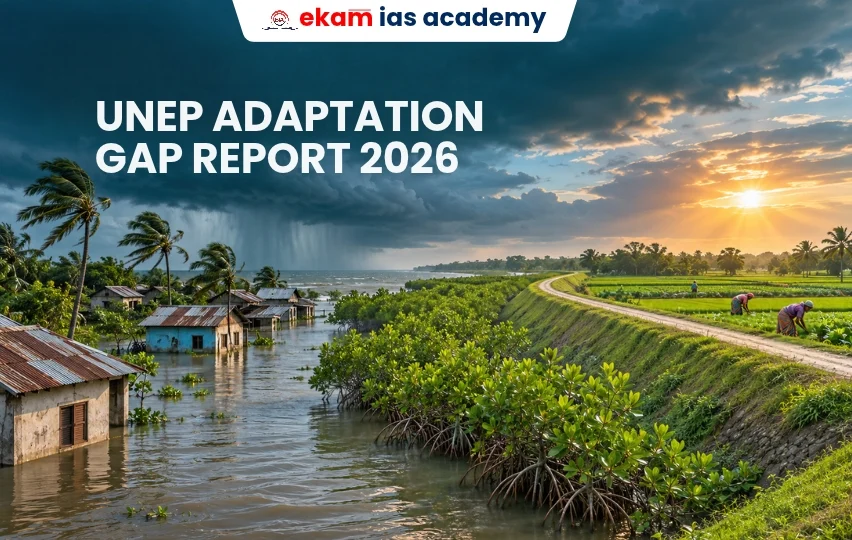
ToggleThe United Nations Environment Programme (UNEP) has released the Adaptation Gap Report 2026, titled “Ready? Not. Climate impacts will not wait. Adaptation finance must rise.” The report highlights the widening gap between the financial resources required by developing countries to adapt to climate change and the funds currently available.
It calls for predictable, grant-based climate finance, stronger support for loss and damage mechanisms and greater adherence to the principle of Common But Differentiated Responsibilities and Respective Capabilities (CBDR-RC).
What are the Key Highlights of the Adaptation Gap Report 2026?
The Adaptation Finance Deficit
Based on the latest Nationally Determined Contributions (NDCs) and National Adaptation Plans (NAPs) of 155 developing countries, annual adaptation needs are estimated at USD 255–328 billion, rising to around USD 305 billion by 2035.
However, international public adaptation finance stood at only USD 28.2–31.7 billion in 2024, leaving a substantial financing gap. Least Developed Countries and Small Island Developing States face particularly high requirements relative to their economies.
The report also notes that 55% of adaptation finance received by developing countries in 2024 was provided as loans, increasing concerns over debt sustainability. Private finance remains limited and cannot substitute for public funding in many public-oriented adaptation projects.
Effective adaptation also depends on institutional capacity, including clear legal mandates, coordination between governments, stakeholder participation, accountability and effective financial systems.
Loss and Damage
Climate-related disasters are disproportionately affecting developing countries. Between 2020 and 2025, 99% of the 765 million people affected by floods and landslides lived in low- and middle-income countries.
The report highlights major gaps in monitoring and reporting loss and damage, particularly regarding non-economic impacts such as biodiversity loss, cultural heritage and mental health.
The Fund for Responding to Loss and Damage (FRLD) also faces a major funding shortfall, with developing countries seeking substantially more resources than the Fund’s initial financial envelope.
What is Climate Adaptation?
Climate adaptation involves modifying ecological, social and economic systems to reduce vulnerability to actual or expected climate impacts.
International mechanisms include the Global Goal on Adaptation, National Adaptation Plans, Adaptation Committee and Nairobi Work Programme under the UN climate framework.
India emphasises climate justice and CBDR-RC, advocating predictable, concessional and publicly funded climate finance for developing countries.
What Measures are Needed to Strengthen Global Climate Adaptation?
- Integrate adaptation finance tracking into the New Collective Quantified Goal (NCQG).
- Reform multilateral development bank lending towards grants and highly concessional finance.
- Strengthen and recapitalise the Loss and Damage Fund.
- Develop national systems to measure economic and non-economic climate losses.
- Integrate national, State and local adaptation planning.
- Strengthen institutional capacity, community participation and independent monitoring.
Conclusion
The report makes clear that climate adaptation cannot depend on plans alone. Developing countries require adequate, predictable and affordable finance, stronger institutions and effective loss-and-damage mechanisms. Closing the adaptation gap is therefore central to achieving climate resilience and ensuring climate justice for the Global South.


FAQs - UNEP Adaptation Gap Report 2026
What is the UNEP Adaptation Gap Report 2026 about?
According to the article, the report examines the gap between developing countries’ climate adaptation needs and available finance, alongside challenges in implementation and addressing climate losses.
What is climate adaptation?
Climate adaptation means adjusting ecological, social and economic systems to reduce harm from actual or expected climate impacts, such as floods, droughts and rising temperatures.
Why is grant-based adaptation finance important?
Grants help vulnerable countries build resilience without increasing debt. Many adaptation projects provide essential public benefits but generate limited commercial returns.
How does loss and damage differ from adaptation?
Adaptation aims to reduce climate risks, while loss and damage concerns impacts that occur despite adaptation efforts or where adaptation is insufficient or impossible.
What measures can help close the adaptation gap?
Key measures include predictable public finance, stronger institutions, coordinated planning, community participation, better monitoring and greater support for loss-and-damage mechanisms.