
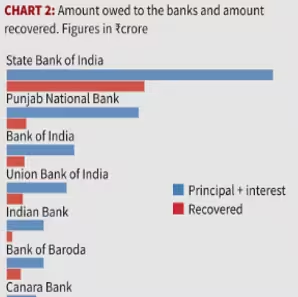
The Ministry of Finance informed Parliament that 15 individuals have been declared Fugitive Economic Offenders (FEOs) till October 31. Out of these, nine major offenders owe Indian banks over ₹58,000 crore, of which only about ₹19,000 crore has been recovered so far.
Background
- Fugitive Economic Offenders (FEOs) are individuals accused of large-scale financial fraud who flee India to avoid prosecution.
- The Fugitive Economic Offenders Act, 2018 empowers authorities to confiscate their assets and recover dues.
- These offenders are linked to high-value scams involving banks and financial institutions.
Scale of the Problem
- Total dues: ₹58,082 crore (Principal: ₹26,645 crore + Interest: ₹31,437 crore).
- Recovery so far: Just over ₹19,000 crore (~33%).
- Outstanding amount: Nearly ₹39,000 crore still unpaid.
Bank Exposure
- State Bank of India (SBI): Largest exposure, over ₹22,000 crore.
- Punjab National Bank (PNB) & Bank of India: Significant losses.
- Recovery performance: SBI has recovered ~52% of dues, mainly through liquidation of Vijay Mallya’s assets. Other banks have recovery rates below 40%.
Impact on Public Sector Banks
- Public banks carry most of the burden of these unpaid loans.
- The State Bank of India has the maximum exposure among lenders.
- Punjab National Bank and Bank of India follow in terms of outstanding dues.
Key Offenders
- Vijay Mallya: Tops the list with nearly ₹27,000 crore owed; recovery rate ~56%.
- Sandesara Family (Sterling Group): Owes large sums; recovery rate ~17%.
- Nirav Modi: Linked to PNB fraud; recovery rate ~7%.
- Together, these three account for the bulk of the outstanding dues.
Government Action
- Legal measures: Arrest warrants issued, assets attached under the FEO Act.
- Challenges: Offenders remain abroad, making extradition and recovery difficult.
- Policy focus: Strengthening international cooperation and tightening banking oversight.
Conclusion
Fugitive economic offenders represent a major financial and governance challenge for India.
Fast legal action, foreign cooperation, and stronger banking oversight are essential to protect national wealth.
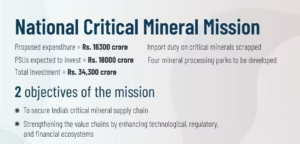
The Union Cabinet recently approved a ₹7,280 crore rare-earth magnet programme to strengthen India’s supply chain.
Critical Minerals
- Critical minerals are raw materials necessary for defence, clean energy, electronics and communication systems.
- They are used in electric vehicles, solar panels, wind turbines, semiconductors and missiles.
- Countries that control these minerals also influence technology leadership and national security.
Present Status of India
- India has introduced reforms to increase domestic mining activities. However, the country lacks sufficient refining and purification facilities.
- India imports almost all of its lithium, cobalt and nickel. Advanced industries still depend on foreign suppliers for high-grade minerals.
Global Scenario and Risks
- Global refining is controlled by very few countries.
- Recent export restrictions show how fragile mineral supply chains are.
- Processing is the weakest and most sensitive stage in mineral security.
Why Mining Alone Is Not Enough
- Mining gives raw ore but not usable materials. Processing creates high-value industrial inputs.
- Without refining capacity, India exports minerals cheaply and imports finished products at high cost.
Roadmap for Strengthening Processing Capacity
- Research and Innovation: Centres of Excellence must focus on industry-ready technology. Universities and research labs should work on low-cost refining techniques.
- Resource Recovery: Coal ash, steel slag and industrial waste contain valuable minerals. Recycling should be integrated into mineral processing parks.
- Skill Development: India needs trained metallurgists and technicians. New courses and training programmes must be started.
- Financial Support: Government should guarantee mineral purchases by public sector industries. Stockpiling can reduce price shocks and investor risk.
- Strategic Diplomacy: International partnerships should focus on joint refining projects. Industrial parks can attract foreign technology and capital.
Strategic Partnerships and Agreements
- Quad Critical Minerals Initiative: Supply chain cooperation with USA, Japan, and Australia.
- Mineral Security Partnership (MSP): India collaborates with advanced economies for stable mineral access.
- Indian Public Sector Abroad: KABIL invests in lithium and cobalt mines abroad. National Mineral Development Corporation (NMDC) active overseas.
The Hayli Gubbi volcano erupted in Ethiopia on November 23, 2025, after millennia of dormancy. The Director General of Civil Aviation (DGCA) in India directed airlines to avoid ash-affected airspace and conduct safety checks.

The Eruption and Ash Movement
- “After lying dormant for nearly 12,000 years, the Hayli Gubbi volcano erupted, hurling massive ash plumes soaring 14–15 km into the atmosphere.”
- Winds carried ash across the Red Sea, Middle East, Iran, and into India’s western airspace on November 24.
- The plume moved at 100–120 km/h at altitudes of 15,000–25,000 ft, crossing Rajasthan, Gujarat, Delhi-NCR, Punjab, and Uttar Pradesh before drifting into China.
Why Volcanic Ash is Dangerous for Aircraft
- What Ash Is Made Of Volcanic ash is not soft dust. It contains tiny particles of rock, minerals, and volcanic glass (silica).
- Effect on Jet Engines: Engines run at very high heat (~1,600°C). Ash melts inside, turns into glassy deposits, blocks cooling holes, and can cause engine failure or shutdown.
- Damage to Aircraft Surfaces: Sharp ash particles can scratch windscreens, reducing pilot visibility. They also erode the aircraft’s body and wings over time.
- Impact on Systems and Cabin: Ash can block sensors and navigation instruments, affecting flight safety. Inside the cabin, passengers may notice a sulphur-like smell due to gases mixed with ash.
DGCA Orders and Institutional Response
- Airlines instructed to avoid affected zones and altitudes.
- Mandatory engine and surface inspections for ash contamination.
- Pilots told to report smoke, odour, or unusual engine behaviour.
- Airports ordered to check runways for ash deposits and suspend operations if unsafe.
- Airlines like Air India and Akasa cancelled multiple flights from Dubai, Doha, Dammam, Jeddah, Kuwait, and Abu Dhabi.
- International coordination: Volcanic Ash Advisory Centres (VAACs) and ICAO advisories supported DGCA’s actions.
Past Incidents Showing Real Danger
- 1982: British Airways Boeing 747 lost all four engines after flying through ash near Jakarta; engines restarted after descent.
- 1989: KLM Boeing 747-400 hit ash from Mount Redoubt, Alaska; all engines shut down at 24,000 ft, later restarted, but engines were destroyed.
- These cases highlight how ash clouds can cause near-catastrophic failures.
Institutional Framework
- ICAO (International Civil Aviation Organization): Issues global rules for volcanic ash zones.
- VAACs (Volcanic Ash Advisory Centres): Track ash movement worldwide using satellites and meteorological data.
- DGCA (India): Implements advisories, flight rerouting, and operational checks.
- Airports Authority of India (AAI): Released ASHTAM (Aeronautical Special Notice to Airmen) for ash alerts.
Conclusion
Volcanic eruptions are global aviation safety hazards, not just local events. The Hayli Gubbi eruption shows how ash clouds can travel thousands of kilometres, affecting India’s skies. Timely DGCA advisories, ICAO coordination, and airline precautions ensured passenger safety.
The Human Development Index (HDI), developed by UNDP, is a composite measure that evaluates development beyond GDP, focusing on people’s health, education, and living standards. The 2025 Human Development Report placed India at 130th rank with an HDI value of 0.685, showing progress but highlighting inequality.
Human Development Index (HDI),
- Introduced by UNDP in 1990, inspired by Mahbub ul Haq and Amartya Sen.
- Measures human well-being rather than just economic growth.
- Score ranges between 0 and 1, with higher values indicating better development.

Calculation Method
- Health Dimension: Life expectancy at birth.
- Education Dimension: Mean years of schooling (adults) + expected years of schooling (children).
- Income Dimension: Gross National Income (GNI) per capita (PPP).
- Formula: HDI = Geometric mean of the three indices.
Classification of Countries
- Very High HDI: 0.800 and above.
- High HDI: 0.700–0.799.
- Medium HDI: 0.550–0.699.
- Low HDI: Below 0.550.
India’s Performance (2025 Report)
- HDI Value: 0.685 (2023), rank 130/193 → Medium Human Development.
- Life Expectancy: 72 years (up from 58.6 in 1990).
- Education: Mean years of schooling rose from 3.0 (1990) to 6.2 (2023).
- Income: GNI per capita (PPP) increased from US$2,000 (1990) to ~US$9,000 (2023).
- Inequality Impact: India loses ~31% of HDI value when adjusted for inequality (IHDI).
- Regional Variation: Kerala, Goa, Himachal Pradesh perform better; Bihar, UP, Jharkhand lag behind.
Government Initiatives to Improve HDI
- Ayushman Bharat (2018): Expands healthcare access.
- National Education Policy (2020): Inclusive and skill-based learning.
- Skill India Mission (2015): Vocational training for youth.
- PM-KISAN & PM Awas Yojana: Rural income and housing support.
- Beti Bachao Beti Padhao (2015): Promotes girls’ education.
- Digital India Mission: Improves access to technology and governance.
Challenges
- Oversimplifies complex realities into one number.
- Does not capture environment, governance, or informal work.
- Regional and gender inequalities remain hidden in overall score.
Conclusion
The HDI highlights India’s steady progress in health, education, and income, but also exposes deep inequalities and regional gaps. For sustainable human development, India must focus on inclusive growth, quality education, health equity, and climate resilience.
The Enforcement Directorate (ED) has recently issued notices to the Kerala Chief Minister in connection with the KIIFB Masala Bond investigation, intensifying the ongoing tussle between the LDF government and central agencies over the state’s financing model.
About Masala Bonds
- Masala Bonds are rupee-denominated bonds issued outside India by Indian entities.
- The International Finance Corporation (IFC), part of the World Bank, introduced the first Masala Bonds in October 2013 under its $2 billion offshore rupee programme.
- These are debt instruments that allow Indian companies to raise funds in local currency from foreign investors.
- The currency risk due to exchange rate fluctuations is borne by the investor, not the issuer, reducing risk for Indian firms.
- To compensate investors for this risk, Masala Bonds usually offer higher interest rates compared to those available in their home countries.
- Both government bodies and private companies are eligible to issue these bonds.

Who Can Invest?
- Investors outside India can subscribe, provided they are residents of countries that are members of the Financial Action Task Force (FATF).
- Eligible investors include individuals, institutions, financial organisations, and multilateral or regional institutions where India is a member.
Maturity Period
- For bonds up to USD 50 million, maturity is typically 3 years.
- For larger amounts, maturity can extend to 5 years, offering flexibility to investors.
Use of Funds
- Proceeds are directed towards productive purposes such as affordable housing, infrastructure projects, refinancing rupee loans, or meeting corporate working capital needs.
- Activities like land purchase, stock market investment, or real estate projects are restricted unless specifically approved by the government.
The 14th edition of Exercise EKUVERIN will be organised in Thiruvananthapuram, Kerala, bringing together the armies of India and Maldives for joint training activities.
EKUVERIN
- Ekuverin means “Friends” in the Dhivehi language spoken in Maldives.
- The exercise was first conducted in 2009.
- It is a bilateral military drill held every year between India and Maldives.
- The venue alternates between the two countries.
- It is one of the three key defence exercises conducted jointly by both nations.

Objectives of the Exercise
- To improve coordination and teamwork between the two armed forces.
- To strengthen interoperability in joint military operations.
- To rehearse combat in coastal, jungle and semi-urban environments.
- To enhance preparedness for counter-terrorism and counter-insurgency missions.
- To share professional experiences and promote tactical understanding.
- Special focus on use of modern military technologies for better cooperation.
Other Defence Exercises Between India & Maldives
Bilateral Exercises
- Ekuverin – Army-level exercise
- Ekatha – Police training exercise
Trilateral Exercise
- Dosti – A maritime security exercise involving India, Maldives, and Sri Lanka.
India–Maldives Relationship
- India was among the first nations to recognise Maldives after independence in 1965.
- The two countries share strong cultural, religious and trade ties.
- India plays a major role in Maldives’ defence training and disaster relief.
- Cooperation continues under India’s vision of Security and Growth for All in the Region (SAGAR).
- The partnership supports peace, stability and maritime security in the Indian Ocean Region.
The Government of India has announced a year-long celebration to mark 150 years of the National Song Vande Mataram. The programme will be inaugurated in New Delhi by Prime Minister Narendra Modi.

Vande Mataram
- Vande Mataram is the National Song of India.
- It was written by Bankim Chandra Chatterjee.
- The song is composed in a mix of Sanskrit and Bengali.
- It expresses love and devotion towards the motherland.
- The music was composed by Yadunath Bhattacharya.
- The song played a major role in awakening national consciousness during the freedom struggle.
Historical Background
- The song was first written independently and later included in the novel Anandamath in 1882.
- It was first sung at a Congress session in 1896 by Rabindranath Tagore.
- The slogan “Vande Mataram” became popular during the 1905 Swadeshi Movement.
- In 1907, Madam Bhikaji Cama displayed India’s flag in Germany with “Vande Mataram” written on it.
- On 24 January 1950, the Constituent Assembly adopted it officially as the National Song.
Significance of the Song
- Symbol of unity and national pride. Inspired millions during the freedom movement.
- Represents sacrifice, courage and devotion to the nation.
- Connects culture with patriotism. It continues to inspire patriotism among citizens.
Conclusion
The 150-year celebration highlights the emotional and historic value of Vande Mataram.
It reminds Indians of the song’s powerful role in the freedom struggle and nation-building.