

Table of Contents
ToggleUGC EQUITY REGULATIONS
TOPIC: (GS2) POLITY: THE HINDU
The Supreme Court has stayed the UGC’s revised equity regulations (2026), citing ambiguity and possible misuse.
Background
- UGC 2012 Regulations: Introduced to promote equity and prevent discrimination in higher education institutions.
- Defined discrimination broadly (caste, creed, religion, gender, disability, etc.).
- Mandated Equal Opportunity Cells and anti-discrimination officers for grievance redressal.
- Trigger Events:
- Suicides of Rohith Vemula (2016) and Payal Tadvi (2019) highlighted caste-based discrimination.
- Their families petitioned the Supreme Court for stricter enforcement.
- UGC Review: A committee was set up, leading to the 2026 revised regulations.
Controversial Provisions in 2026 Regulations
- Defined discrimination as unfair or biased treatment of students, faculty, or staff.
- Caste-based discrimination: Specifically defined as discrimination against SC, ST, and OBCs.
- Concerns Raised:
- Seen as biased against unreserved categories, presuming them as perpetrators.
- No safeguards against false or motivated complaints.
- Ambiguity in definitions could lead to misuse.
Supreme Court’s Observations
- Case: Mritunjay Tiwari vs Union of India.
- Court noted provisions were unclear and open to misuse.
- Key questions framed:
- Is a separate definition of caste-based discrimination necessary when caste is already included under general discrimination?
- Could this definition affect sub-classification within disadvantaged groups?
- Ordered continuation of 2012 regulations until clarity is achieved.
Constitutional Principles at Stake
- Article 14: Equality before law and equal protection.
- Article 15: Prohibits discrimination on grounds of caste, religion, sex, etc., but allows special provisions for SC, ST, and OBCs.
- Formal vs Substantive Equality:
- Formal equality = equal treatment for all.
- Substantive equality = special measures to uplift historically disadvantaged groups.
- Relevant laws: Protection of Civil Rights Act (1955), SC/ST (Prevention of Atrocities) Act (1989).
Policy Concerns
- Regulations must balance protection of vulnerable groups with fairness to all stakeholders.
- Ambiguity in definitions risks campus polarization instead of fostering inclusivity.
- Need for consultation with stakeholders to refine rules and ensure effective grievance redressal.
Conclusion
The Supreme Court’s stay highlights the tension between equity and fairness in higher education. While caste-based discrimination remains a serious issue, regulations must be clear, balanced, and enforceable to protect underprivileged groups without creating scope for misuse.
META–WHATSAPP CASE AND JUDICIAL ULTIMATUM
TOPIC: (GS2) POLITY: THE HINDU
The Supreme Court of India has questioned Meta over its data-sharing practices, and whether digital consent is meaningful in a country with limited digital literacy and whether Meta’s dominance makes user choice coercive.
Background of the Dispute
- 2021 Privacy Policy Update: WhatsApp introduced a “take-it-or-leave-it” policy allowing greater data sharing with Meta.
- CCI Intervention: The Competition Commission of India (CCI) ruled this as abuse of market dominance, imposing a ₹213 crore penalty.
- NCLAT Appeal:
- Upheld penalty but removed the five-year ban on data-sharing.
- Argued that sharing data between parent and subsidiary is a standard business practice.
- Relied on the upcoming Digital Personal Data Protection (DPDP) Act, 2023 to regulate privacy concerns.
Supreme Court’s Concerns
- Market Dominance: Chief Justice Surya Kant noted that leaving WhatsApp in India is like “opting out of the country,” showing the network effect trap.
- Consent as Fiction: Court observed that consent in monopolistic platforms is illusory and coercive.
- Digital Literacy: Questioned whether ordinary users (e.g., domestic workers) can truly understand complex privacy policies.
- Data Value: Justice Joymalya Bagchi raised the issue of economic ownership of data — if Meta profits from user behaviour, should citizens share in that value?
- Risk of Exploitation: Without safeguards, users become “products” rather than consumers.
Importance of Data & Data Privacy
- Protection of Individual Rights: Personal data reflects identity, habits, and preferences. Safeguarding it ensures dignity, autonomy, and freedom from exploitation.
- Trust in Digital Ecosystem: Secure handling of data builds confidence in online platforms, encouraging participation in digital services, e-commerce, and governance.
- National Security & Economic Value: Data is a strategic resource. Protecting it prevents misuse by hostile actors and ensures citizens benefit from the economic value generated.
Broader Implications
- Data as Property: Court hinted at treating personal data as an economic resource, aligning India closer to EU’s Digital Services Act.
- Sovereign Protection: Suggested that privacy alone may not be enough; the economic value of data requires regulation.
- Free Internet Model Questioned: The Solicitor General remarked that users are not just consumers but also commodities in the digital economy.
Challenges
- Informed Consent: Complex terms and conditions make it difficult for users, especially those with low digital literacy, to understand what they are agreeing to.
- Misuse & Exploitation: Companies may monetize user data without fair compensation, turning individuals into “products” rather than consumers.
- Weak Enforcement & Regulation: Ambiguities in laws, lack of strong oversight, and global data flows make it hard to ensure accountability and prevent misuse.
Conclusion
The case highlights the intersection of privacy, competition, and digital literacy. The Supreme Court’s intervention signals that India may move towards stronger regulation of tech giants, ensuring that citizens’ data is protected not just as private information but also as an economic asset.
CONTRACT TEACHERS IN INDIA
TOPIC: (GS2) POLITY: THE HINDU
Contract teachers in Puducherry have launched fresh protests demanding regularisation of their jobs.
Background
- This reflects a larger national issue, with nearly 16 lakh teachers across India working on contract with lower pay and fewer benefits.
- Origin: States began hiring contract teachers in the early 1990s to address teacher shortages.
- Terminology: Known as para teachers, guest teachers, or shiksha mitras.
- Nature of Employment: Short-term contracts, often renewed, but without the pay scale, job security, or benefits of permanent teachers.
Current Situation
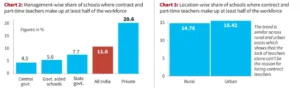
- Workforce Share: Contract and part-time teachers form 16% of India’s school teacher workforce (~16 lakh teachers).
- School-Level Impact:
- In 1.5 lakh schools, at least half the staff are contract teachers.
- Private schools: 21% rely heavily on contract teachers.
- State government schools: 8% (over 77,000 schools) have half or more staff on contract.
- Rural vs Urban: Trend is similar in both areas, showing that shortage alone is not the reason.
- Regional Concentration: High reliance in Northeastern states (Mizoram, Arunachal Pradesh, Meghalaya), and also in Jharkhand, Haryana, and Chandigarh (30%+ schools).
Issues Faced by Contract Teachers
- Lower Wages: Salaries often one-fourth of regular teachers (World Bank study, 2009).
- Lack of Benefits: No job security, pension, or allowances.
- Equal Workload: Perform duties similar to permanent teachers but without equal recognition.
- Protests Nationwide: Demonstrations in Uttar Pradesh, Bihar, Andhra Pradesh, Delhi, Jharkhand, and Puducherry.
Judicial Intervention
- Punjab & Haryana High Court (Nov 2025):
- Held that administration cannot misuse contractual labels.
- Ordered regularisation of Chandigarh teachers under Sarva Shiksha Abhiyan with over 10 years of service.
Policy Concerns
- Cost-Effective Strategy: States view contract hiring as cheaper to ensure teacher availability.
- Quality of Education: Over-reliance on underpaid, insecure teachers may affect teaching standards.
- Equity Issue: Creates disparity between regular and contract teachers despite similar responsibilities.
Conclusion
The widespread use of contract teachers highlights a structural challenge in India’s education system. While cost-saving for states, it raises concerns about fair treatment, teacher morale, and quality of education.
THE BUDGET AND FISCAL CONSOLIDATION
TOPIC: (GS3) ECONOMY: THE HINDU
The Union Budget 2026-27 has emphasized expenditure programmes to achieve the vision of Viksit Bharat by 2047. Concerns have been raised about the pace of fiscal consolidation and the sustainability of India’s debt-GDP ratio.
Expenditure Priorities
- Shift in expenditure composition: Revenue expenditure share declined from 88% (2014-15) to 77% (2026-27 BE). Subsidies reduced by 7 percentage points.
- Capital expenditure share increased, supporting growth.
- Capital expenditure trends: Growth peaked at 28.3% (2023-24), fell to 10.8% (2024-25), and 4.2% (2025-26 RE).
- Budgeted growth for 2026-27 BE is 11.5%, nearly equal to nominal GDP growth (10%). Capital expenditure remains static at 3.1% of GDP.
Revenue Prospects
- Tax revenue projections: Conservative but achievable.
- Buoyancy concerns:
- Overall buoyancy at 0.8, below benchmark of 1.
- Direct taxes buoyancy: 1.1 (61.2% share).
- Indirect taxes buoyancy: 0.3 (38.8% share).
- Weak GST collections are the main reason.
- Policy suggestion: Review indirect tax structure to raise buoyancy to 1.
Tax Buoyancy
Tax buoyancy is the measure of how responsive tax revenues are to changes in the Gross Domestic Product (GDP). In simple terms, it shows whether government tax collections rise (or fall) in proportion to economic growth, without changing tax rates.
Definition
- Tax Buoyancy = % change in tax revenue ÷ % change in GDP.
- It indicates the efficiency of a tax system in generating revenue as the economy grows.
Key Features
- Responsiveness: Shows how tax revenues automatically adjust with economic activity.
- No Rate Change Needed: A buoyant tax system collects more revenue even without increasing tax rates.
- Benchmark: A buoyancy value of 1 means tax revenues grow at the same pace as GDP.
- Greater than 1 → Tax revenues grow faster than GDP.
- Less than 1 → Tax revenues grow slower than GDP.
FC16 recommendations:
- States’ share in divisible pool unchanged at 41%.
- Tax assignment to States steady at 3.9% of GDP.
- No revenue deficit or sector-specific grants.
- Impact:
- Overall transfers to States reduced compared to FC15.
- FC grants fell from 0.43% of GDP (2025-26 RE) to 0.33% (2026-27 BE).
Fiscal Consolidation Concerns
- Deficit reduction pace slowing: 0.7% points (2024-25), 0.4% points (2025-26 RE), 0.1% point (2026-27 BE).
- Debt-GDP ratio: Targeting strategy shift lacks clarity.
- Interest burden: Effective interest rate on debt: 7.12% (2026-27 BE). Interest payments consume ~40% of revenue receipts.
- Logic of 3% fiscal deficit cap: Prevents crowding out of private investment. Ensures fiscal stability and growth.
Conclusion
The Budget provides a roadmap for development by 2047, highlighting technology and infrastructure. However, fiscal consolidation needs a clearer glide path with transparent targets for debt and deficit ratios.
INDIA–U.S. TRADE DEAL
TOPIC: (GS2) INTERNATIONAL RELATIONS: THE HINDU
India has finalized a major trade agreement with the United States, reducing tariffs on Indian goods to 18%.
Background
- India’s trade strategy is increasingly based on comprehensive trade agreements with key partners.
- After deals with the EU, U.K., EFTA, Australia, New Zealand, Oman, and UAE, the U.S. agreement adds a crucial dimension.
- The U.S. is India’s largest export destination, accounting for nearly 20% of total exports.
Key Features of the Deal
- Tariff Reduction: U.S. tariffs on Indian goods lowered from 50% to 18%, restoring competitiveness.
- Market Access: Provides Indian exporters greater entry into the world’s largest import market.
- Policy Certainty: Reduces trade frictions and creates space for broader cooperation under the India-U.S. Bilateral Trade Agreement (BTA).
Sectoral Gains
- Apparel: India regains price competitiveness in the U.S., the world’s largest apparel import market.
- Gems & Jewellery: Sensitive to tariff changes; gains significant relief.
- Marine Products & Processed Foods: Lower tariffs improve landed costs and export viability.
- Footwear & Leather: Employment-intensive sectors benefit from reduced duties.
- Manufacturing Value Chains: Boosts employment and supports expansion in export-oriented industries.
Strategic Implications
- Global Competitiveness: Positions India better against rivals like China, Vietnam, Bangladesh, ASEAN nations, and others facing higher tariffs.
- Supply Chain Integration: Strengthens India’s role in diversified global supply chains.
- Long-term Partnerships: Encourages joint ventures, technology collaborations, and investment in high-value sectors.
- Quad Cooperation: Complements India’s role in forums like the Quad, focusing on supply-chain resilience and trusted partnerships.
Broader Impact
- Economic Diplomacy: Enhances India’s credibility as a global trade partner.
- Innovation & Employment: Opens opportunities in technology, clean energy, and advanced manufacturing.
- Trust Building: Moves beyond tariffs to establish a strategic reset in India-U.S. relations.
- Mutual Benefits: For India – global leadership and manufacturing hub ambitions; for the U.S. – innovation, market expansion, and resilient supply chains.
Conclusion
It strengthens India’s export competitiveness, supports employment-intensive sectors, and lays the foundation for long-term cooperation in technology, defence, and energy.
TURNING POINT FOR NUCLEAR DETERRENCE
TOPIC: (GS2) INTERNATIONAL RELATIONS: THE HINDU
The expiry of the New START treaty between the U.S. and Russia has raised concerns about renewed nuclear arms competition.
Background
- NATO Formation (1949): Created as a defensive alliance against the Soviet Union, with the U.S. as the main guarantor of security.
- Recent Rupture: Disputes such as Donald Trump’s push to acquire Greenland have strained trust between Europe and the U.S.
- Impact: Without trust, NATO’s nuclear deterrence framework appears weakened, forcing Europe to rethink its security architecture.
Nuclear Deterrence – Traditional Thinking
- Certainty vs. Uncertainty:
- Some states relied on uncertainty (e.g., Israel’s opaque nuclear status, India-Pakistan dynamics before 1998).
- Others emphasized certainty through stockpiles, testing, and declared intent.
- Taboo on Use: Despite threats and development of tactical nuclear weapons, no nuclear weapon has been used since 1945.
- Arms Control: Agreements like New START and the Nuclear Non-Proliferation Treaty (NPT) helped restrain proliferation and stockpiles.
Current Developments
- Modernisation of Arsenals:
- U.S., Russia, and China are expanding and upgrading nuclear stockpiles.
- China reportedly adds ~100 warheads annually since 2023, reaching 600.
- U.K. reversed earlier reductions, now at 225 warheads.
- Expiry of New START (Feb 5): Could trigger a return to Cold War-style arms race, with U.S. and Russia holding over 5,000 warheads each.
Lessons from Ukraine
- Nuclear Threats by Russia: Issued before and during the war, but not acted upon.
- Ukraine’s Defence: Despite being non-nuclear, Ukraine has resisted a nuclear-armed adversary with external support.
- Implication: Deterrence may not solely depend on nuclear weapons but also on robust conventional and collective responses.
Europe’s Choices Ahead
- Options:
- Extend nuclear umbrella via France and U.K.
- Create a new defensive alliance with or without nuclear elements.
- Depend less on U.S. and more on regional coalitions (e.g., Coalition of the Willing supporting Ukraine).
- Impact: Europe’s decision will shape future global nuclear discourse and deterrence strategies.
Significance
- Marks a turning point in nuclear politics, with trust deficits in NATO and expiry of arms control treaties.
- Raises questions on whether nuclear weapons remain the ultimate guarantor of security or if new models of deterrence will emerge.
- Relevant for UPSC under International Relations, Security Studies, and Nuclear Policy.
Major Nuclear Arms Control Treaties
1968 – Nuclear Non-Proliferation Treaty (NPT)
- Divided the world into nuclear-weapon states (U.S., U.K., France, Russia, China) and non-nuclear states.
- Aim: Prevent spread of nuclear weapons, promote disarmament, and encourage peaceful use of nuclear energy.
- Still the cornerstone of global nuclear governance.
1991 – Strategic Arms Reduction Treaty (START I)
- U.S. and USSR agreed to reduce deployed strategic nuclear warheads to 6,000 each.
- Marked the beginning of actual reductions rather than just limits.
1993 – START II
- Aimed to ban multiple-warhead land-based missiles.
- Signed but never fully implemented due to political changes in Russia.
1996 – Comprehensive Nuclear-Test-Ban Treaty (CTBT)
- Prohibits all nuclear test explosions.
- Adopted by UN but not entered into force as key states (U.S., China, India, Pakistan) have not ratified.
2010 – New START Treaty
- Signed by U.S. and Russia.
- Limited deployed strategic nuclear warheads to 1,550 each and delivery vehicles to 700.
- Verification mechanisms included.
- Set to expire on February 5, 2026, unless renewed.
Conclusion:
The expiry of arms control treaties and Europe’s reduced trust in U.S. security guarantees mark a critical turning point in nuclear deterrence. Future global stability will depend on whether nations choose renewed arms races or innovative security frameworks beyond nuclear reliance.
PROJECT HIMANK
TOPIC: (GS3) ECONOMY: THE HINDU
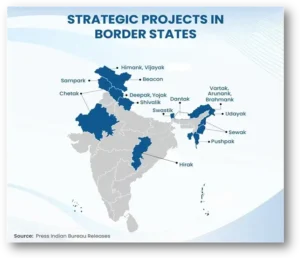
Recently, Project Himank recorded a rare sighting of the snow leopard in the High Himalayas. This highlights how conservation efforts are being balanced with infrastructure development in Ladakh.
About Project Himank
- Initiated by: Border Roads Organization (BRO) in 1985.
- Region: Ladakh, India.
- Objective: To develop and maintain road connectivity in extremely high-altitude terrain.
- Known as “Mountain Tamers” for their ability to build and sustain roads in some of the harshest conditions.
- Responsible for around 2216 km of roads in Ladakh.
- Ensures access to strategic zones near the Line of Actual Control (LAC) with China.
Achievements
- Built some of the highest motorable roads in the world:
- Khardung La
- Tanglang La
- Chang La
- Mig La (highest at 19,400 ft).
- Developed and maintained airfields in forward areas.
- Provides vital communication links for both civilians and the armed forces.
Challenges
- Entire area lies in high-altitude zones with limited working seasons.
- Extreme weather conditions make construction and maintenance difficult.
- Requires specialized workforce and machinery to operate in freezing temperatures and rugged terrain.
Strategic Importance
- Ensures mobility of armed forces in border regions.
- Facilitates logistics and supply chains in remote areas.
- Strengthens India’s defence preparedness along sensitive frontiers.
- Supports local communities by improving connectivity and access to essential services.
Border Roads Organization (BRO)
- Established: 7 May 1960.
- Under Ministry of Defence since: 2015.
- Works in 19 states, 3 union territories, and neighboring countries (Afghanistan, Bhutan, Myanmar, Tajikistan, Sri Lanka
TENDER YEARS DOCTRINE
TOPIC: (GS2) POLITY: THE HINDU
The Delhi High Court recently ruled that the welfare and best interests of minor children must take precedence over the Tender Years Doctrine.
About Tender Years Doctrine
- A common law principle in family and custody matters.
- Suggests that children of tender age (usually below 5 years) should remain with their mother unless she is proven unfit.
- Originated in the late 19th century and often applied in divorce and custody disputes.
Recent Delhi High Court Ruling
- The judgment emphasized that custody decisions should be based on a holistic assessment of the child’s well-being rather than traditional assumptions about parental roles.
- Stated that child welfare is paramount and overrides the Tender Years Doctrine.
- Custody disputes must be resolved through a comprehensive evaluation of the child’s physical, emotional, and social needs.
- Rejected stereotypical assumptions about mothers being the default custodians.
Basis of the Doctrine
- Biological Bond: Infants are naturally attached to their mothers.
- Nurturing Role: Mothers are presumed to be better caregivers for very young children.
- Developmental Needs: Early childhood is believed to require maternal involvement.
- Emotional Security: Presence of the mother is seen as providing psychological stability.
Declining Relevance
- Modern views on gender equality and shared parenting challenge the doctrine.
- Courts increasingly recognize that fathers can also be capable and nurturing caregivers.
- The focus has shifted from presumptions to child-centric welfare principles.
Significance
- Reflects the evolving jurisprudence in India towards gender-neutral parenting roles.
- Reinforces the principle that best interest of the child is the guiding factor in custody cases.
MYOGLOBIN
TOPIC: (GS3) SCIENCE AND TECHNOLOGY: THE HINDU
Scientists have recently created a flexible and inexpensive biosensor that can detect myoglobin. elevated myoglobin levels are linked to the early stages of heart attacks, enabling faster diagnosis and treatment.
About Myoglobin
- A small protein that makes up nearly 2% of total muscle protein.
- Found mainly in skeletal muscles and cardiac muscles.
- Located in the cytoplasm of heart muscle cells and the sarcoplasm of oxidative skeletal fibers.
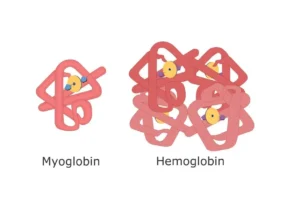
- Composed of a single polypeptide chain with one oxygen-binding site.
- Belongs to the globin family, which also includes hemoglobin.
- Hemoglobin has four chains and four oxygen-binding sites, while myoglobin has only one chain and one site.
- Structure: Made of amino acids, iron, and other molecules that help store and transport oxygen.
Functions of Myoglobin
- Oxygen Transport: Moves oxygen from blood to muscles to support energy use during activity.
- Oxygen Reservoir: Acts as a storage unit and buffer for oxygen inside muscle cells.
- Damage Indicator: Presence in urine or plasma signals muscle or cardiac injury.
- Nitric Oxide Regulation: Breaks down nitric oxide into nitrate, improving mitochondrial function.
- Protection Against Stress: Helps reduce reactive oxygen species by interacting with fatty acids.
Importance
- Plays a critical role in muscle physiology by ensuring oxygen supply during high demand.
- Serves as a biomarker for heart attacks and muscle injuries, making it medically significant.
- The new biosensor technology could allow early detection of cardiac events, improving survival chances.