
Mustard, India’s largest indigenous edible oilseed crop, is facing severe yield losses due to Orobanche aegyptiaca, a parasitic weed.
- The infestation is spreading rapidly, raising concerns over domestic oil production and import dependence.
Background
- Mustard is grown on nearly 9 million hectares, mainly in Rajasthan, Uttar Pradesh, Madhya Pradesh, Haryana, and West Bengal.
- Contributes 4 million tonnes to India’s annual edible oil output (~10.5–10.6 million tonnes).
- India imports ~16 million tonnes of edible oils annually, costing over $18 billion (2024–25).
- Improving mustard productivity is crucial to reduce import dependence.
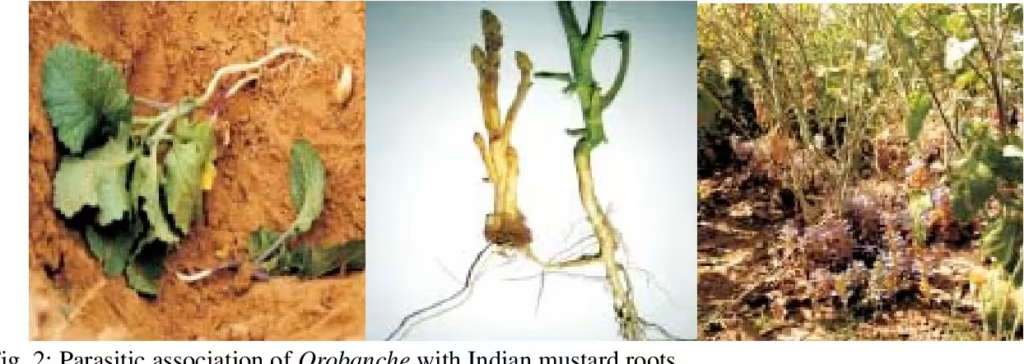
How Orobanche Damages Mustard
- Orobanche attaches to mustard roots underground, sucking water, nutrients, and carbon.
- Leads to wilting, yellowing, stunted growth, and sharp yield decline.
- Damage becomes visible only after infestation is advanced.
- Farmers in Haryana report yields dropping from 9–12 quintals/acre to ~6 quintals/acre.
Why Infestation is Spreading
- Each plant produces thousands of seeds that remain viable for up to 20 years.
- Seeds spread through wind and water, creating long-lasting soil seed banks.
- Continuous mustard cultivation and irrigation favour germination.
- Infestation now appears earlier in crop cycles and even in fertile soils, unlike earlier sandy-field outbreaks.
Wider Concerns
- Farmers losing confidence in mustard, shifting to wheat, chickpea, and barley.
- Mustard also faces pests like aphids and fungal diseases (white rust, leaf blight, stem rot, powdery mildew).
- Threat to India’s edible oil security if acreage declines further.
Control Measures
- Conventional herbicides (glyphosate): Ineffective at low doses; kill mustard along with weed.
- Herbicide-resistant mustard hybrids: Pioneer-45S42CL, tolerant to imidazolinone herbicides (imazapyr, imazapic). Requires single spray after 25 days; early results promising.
- GM Mustard: Lines resistant to glyphosate and other herbicides developed. Could provide multiple chemical options and reduce resistance risk.
Conclusion
Orobanche infestation is a serious threat to mustard farming and India’s edible oil security. Farmers need effective solutions like herbicide-resistant or GM mustard varieties, along with stronger research and support, to protect yields and reduce dependence on imports.
ISRO’s PSLV-C62 mission failed to place the EOS-N1 earth observation satellite and 15 co-passenger satellites in orbit due to a third-stage anomaly. This marks the second consecutive PSLV failure after PSLV-C61 in May 2025.
Background
- PSLV (Polar Satellite Launch Vehicle): India’s main and most trusted rocket, widely used for both strategic and commercial satellite launches.
- Mission Goal: To place EOS-N1 and 15 co-passenger satellites into a Sun Synchronous Orbit, and later guide the PS4 stage and KID capsule back safely into Earth’s atmosphere.
- Reason for Failure: A disturbance in the rocket’s movement (roll rates) during the third stage caused the vehicle to stray from its planned flight path.
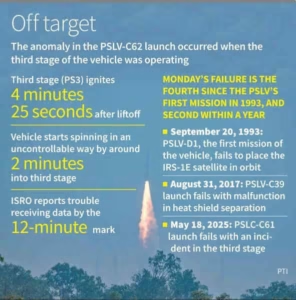
Recent Failures
- PSLV-C61 (May 2025): EOS-09 satellite lost due to third-stage anomaly.
- PSLV-C62 (Jan 2026): EOS-N1 satellite lost, raising concerns about PSLV reliability.
Strategic Importance
- EOS-N1: Built for strategic earth observation, crucial for defence and surveillance.
- Loss delays India’s remote sensing capability and requires fresh budgetary approval for replacement.
Financial Impact
- Government Satellites: Loss of EOS-N1 borne by the state; no insurance due to high premiums.
- Private Satellites: Covered by insurance if purchased; otherwise loss absorbed by companies.
- NSIL Contracts: May offer re-flight guarantees or refund of launch fees, but ISRO/NSIL not liable for satellite value unless gross negligence is proven.
Implications
- Technical: Need for detailed review of PSLV’s third-stage systems.
- Strategic: Delay in deployment of critical earth observation assets.
- Commercial: Confidence of private and international customers may be affected.
- Financial: Additional burden on DRDO and affected startups.
Conclusion
The PSLV-C62 failure highlights the need for corrective measures in India’s workhorse rocket. Beyond financial losses, the setback impacts strategic capability, commercial credibility, and India’s space ambitions.
In August 2025, India signed the Joint Crediting Mechanism (JCM) with Japan, marking its entry into Article 6 of the Paris Agreement.
Background
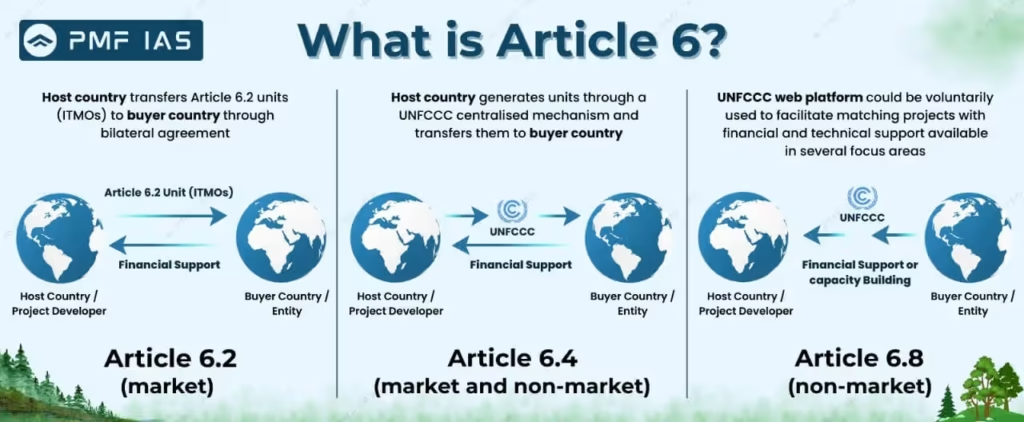
- Article 6 provides a framework for international carbon markets to strengthen climate finance and cooperation.
- It has two key mechanisms:
- Article 6.2: Bilateral/multilateral cooperation through transfer of emission reductions.
- Article 6.4: Paris Agreement Crediting Mechanism, replacing the Clean Development Mechanism (CDM).
- India’s participation signals a new era of climate-aligned finance and technology partnerships.
Why Article 6 Matters for India
- Climate Finance: Channels funds into India’s economy through carbon credit trading.
- Technology Transfer: Enables access to advanced low-carbon technologies.
- Industrial Transformation: Supports decarbonisation in energy, transport, and industry.
- Global Trade Relations: Builds resilient partnerships in a carbon-constrained world.
- Socio-economic Benefits: Aligns climate action with growth and employment.
India’s Strategy under Article 6
- Government identified 13 eligible activities for credit generation, balancing development and climate goals.
- Focus areas include:
- Renewable energy with storage.
- Solar thermal and offshore wind.
- Green hydrogen and compressed bio-gas.
- Fuel cell mobility solutions.
- Advanced energy efficiency technologies.
- Sustainable aviation fuel.
- Emerging solutions like carbon capture, utilisation and storage (CCUS) for cement and steel sectors are critical for deep decarbonisation.
Challenges and Policy Priorities
- Domestic Framework: Need clear rules for Letters of Authorisation, corresponding adjustments, and carbon trading regulations.
- Project Clearances: Current voluntary projects take ~1,600 days to register; a single-window clearance system is essential.
- Carbon Removals Market: Rising global demand for removals (e.g., Biochar, Enhanced Rock Weathering) offers India export opportunities.
- South–South Cooperation: India can lead developing nations in shared systems, knowledge networks, and financing models.
Conclusion
By moving from intent to action with strong domestic frameworks and faster clearances, India can position itself as a leader in the low-carbon economy, supporting both Viksit Bharat 2047 and global climate goals.
A recent study highlights that solar panels generate far more energy per acre than biofuels. With biofuels occupying land equal to the size of Poland, questions arise on whether this land could be used more efficiently for renewable energy.
Background
- In the early 2000s, biofuels were seen as a low-carbon alternative to oil.
- Today, despite the rise of electric vehicles, biofuel production continues to grow.
- Biofuels are mainly produced from sugarcane (Brazil), corn (U.S./EU), soybean and palm oil (U.S., Brazil, Indonesia).
- They currently meet only 4% of global transport energy demand.
Biofuels
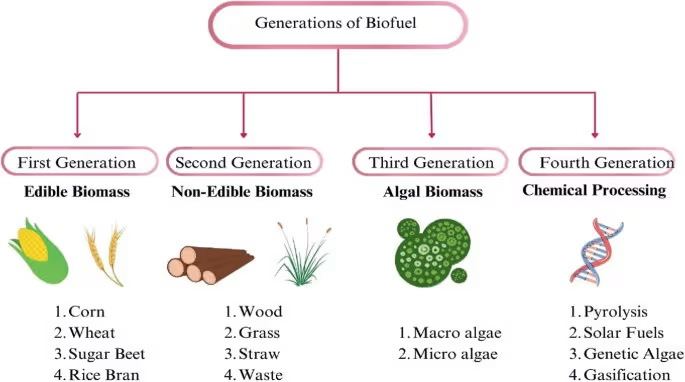
- Biofuels are fuels derived from biomass — organic material like crops, agricultural residues, algae, or animal waste.
- They are considered renewable energy sources because their feedstock can be regrown or replenished.
- Mainly used in transportation, but also for heating and electricity generation.
Climate Concerns with Biofuels
- Carbon savings from biofuels are often small once farming and processing emissions are considered.
- Using cropland for biofuels has opportunity costs — the same land could be rewilded or reforested to absorb carbon.
- Biofuels therefore may not deliver strong climate benefits compared to other options.
Land Use Estimates
- Around 61 million hectares are linked to biofuels; net land use is ~32 million hectares (size of Germany or Poland).
- This large land footprint produces relatively little energy compared to alternatives.
Solar Power Potential
- If the same land were used for solar panels, it could generate 32,000 TWh annually.
- This is 23 times more energy than all liquid biofuels combined.
- For perspective, global electricity generation in 2024 was ~31,000 TWh — solar on biofuel land could meet the world’s current electricity demand.
Transport Implications
- Biofuels currently meet only 3–4% of transport demand.
- Electrifying vehicles and powering them with solar could meet 100% of road transport demand using just one-quarter of biofuel land.
- The remaining land could be used for food, aviation biofuels, or rewilding.
Key Takeaways
- Plants convert <1% of sunlight into biomass, while solar panels convert 15–25% into electricity.
- Solar panels are far more efficient in energy yield per acre.
- Land use decisions must weigh climate benefits, energy efficiency, and food security.
Conclusion
Biofuels occupy vast land but deliver limited energy. Solar panels on the same land could transform global energy supply and transport decarbonisation, making land use efficiency a critical climate policy issue.
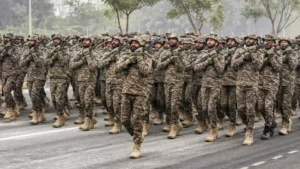
For the first time, the Indian Army’s newly formed Bhairav Battalion will participate in the Republic Day parade on Kartavya Path.
What are Bhairav Battalions?
- Bhairav Battalions are newly created, small, and highly mobile combat units of the Indian Army.
- They are designed for quick, high-impact missions in sensitive border areas.
- These units focus on speed, flexibility, and rapid deployment.
Composition and Structure
- Each battalion consists of around 250 soldiers.
- Personnel are drawn from infantry, artillery, air defence, signals, and support units.
- This mixed structure allows them to operate independently.
- They are placed under corps-level and division-level commands.
Role and Functions
- These battalions are meant for fast-response operations.
- They handle sudden tactical situations requiring immediate action.
- Their role is not long-term deep missions, but short, sharp, and decisive engagements.
- They act as a bridge between regular infantry and elite Special Forces.
Key Features
- Designed to be “ready to fight at short notice”.
- Equipped with modern weapons, drones, and electronic systems.
- Capable of operating across multiple domains — land, air (drones), and electronic warfare.
- Can function in deserts, mountains, and forest terrains.
Deployment Areas
- These battalions are mainly stationed in sensitive regions.
- Important sectors include Rajasthan, Jammu, Ladakh, and the Northeast.
- These areas often face security challenges and require quick military response.
Strategic Importance
- Improves India’s border preparedness.
- Enhances rapid reaction capability.
- Strengthens deterrence against sudden threats.
- Reflects India’s shift towards modern, technology-driven warfare.
Conclusion
Bhairav Battalions represent a major transformation in India’s military approach.
They combine speed, technology, and flexibility to address future security challenges.