Table of Contents
ToggleThe Celluloid Journey: A Comprehensive Encyclopedia of Indian Cinema
Indian Cinema is the world’s largest film industry in terms of output. For a UPSC aspirant, cinema is not just entertainment; it is a reflection of India’s social struggles, the nationalist movement, and the post-liberalization cultural shift.
1. The Silent Era: The Birth of a Dream (1913–1931)
The foundation of Indian cinema was laid during the peak of the British Raj, heavily influenced by traditional theatre and mythology.
A. Dada Saheb Phalke: The Father of Indian Cinema
- Raja Harishchandra (1913): The first indigenous silent feature film. Phalke was inspired by a screening of ‘The Life of Christ’ and decided to bring Indian gods to the screen.
- Mythological Focus: Early films focused on Puranic stories because they were already familiar to the masses, overcoming the barrier of the lack of sound.
B. International Influences
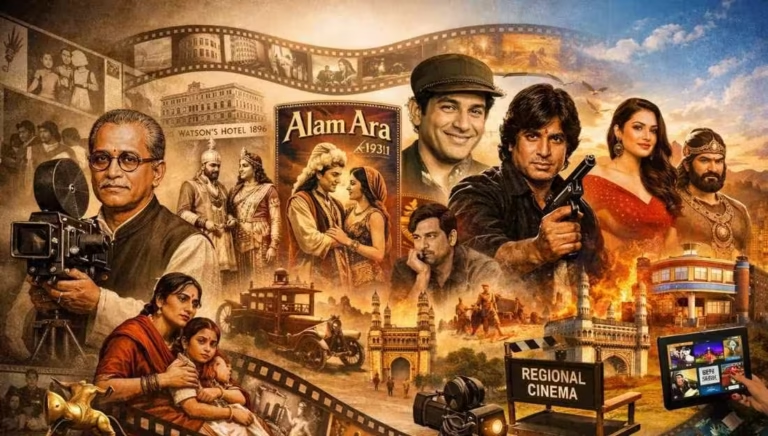
- The Lumiere Brothers: Held the first cinema screening in India at the Watson’s Hotel in Mumbai (1896).
- Hiralal Sen & J.F. Madan: Pioneers in Bengal who started filming stage plays and newsreels.
2. The Arrival of Sound: The Talkies (1931–1940s)
The introduction of sound revolutionized the medium, making it an inseparable part of Indian musical culture.
- Alam Ara (1931): Directed by Ardeshir Irani, it was India’s first talkie. It introduced the concept of film songs, which remains a unique feature of Indian cinema today.
- Socially Conscious Cinema: The 1930s saw the rise of the Prabhat Film Company (Pune) and New Theatres (Calcutta).
- Sant Tukaram (1936): The first Indian film to win an award at the Venice Film Festival.
- Duniya Na Mane (1937): Addressed social issues like the treatment of women and unequal marriages.
3. The Golden Age of Indian Cinema (1950s–1960s)
Post-Independence cinema focused on nation-building, the rural-urban divide, and socialist ideals.
A. The Big Three Directors
- Satyajit Ray: Represented the Parallel Cinema movement. His Apu Trilogy (Pather Panchali, Aparajito, Apur Sansar) brought Indian cinema international acclaim for its realism.
- Raj Kapoor: Known as the “Charlie Chaplin of Indian Cinema,” his films like Awaara and Shree 420 reflected the struggles of the common man in a new Republic.
- Guru Dutt: Mastered the use of light and shadow to depict melancholia and the disillusionment of the artist (Pyaasa, Kaagaz Ke Phool).
B. Iconic Masterpieces
- Mother India (1957): Directed by Mehboob Khan, it symbolized India as a resilient mother. It was India’s first submission for the Academy Award for Best Foreign Language Film.
- Mughal-e-Azam (1960): Defined the historical epic genre, showcasing the grandeur of the Indo-Islamic era.
4. The Rise of the "Angry Young Man" (1970s–1980s)
The 1970s saw a shift from romanticism to themes of systemic corruption, unemployment, and rebellion.
- Salim-Javed & Amitabh Bachchan: Created the “Angry Young Man” persona in films like Zanjeer, Deewaar, and Sholay. This reflected the public’s frustration with the political climate (Emergency era).
- Masala Movies: A blend of action, romance, comedy, and music became the commercial standard.
5. Parallel Cinema (The New Wave)
A movement that started in the late 1940s in Bengal and matured in the 70s as an alternative to commercial “Masala” films.
- Focus: Realism, social critique, and a rejection of the “song-and-dance” routine.
- Key Figures: Ritwik Ghatak, Mrinal Sen, Shyam Benegal (Ankur), and Govind Nihalani.
- FTII (Film and Television Institute of India): Played a crucial role in training the actors and directors of this movement (e.g., Naseeruddin Shah, Om Puri).
6. Post-Liberalization and the Globalized Hero (1990s–2010s)
After 1991, cinema shifted focus to the aspirations of the urban middle class and the Non-Resident Indian (NRI).
- The Yash Chopra/Karan Johar Era: Films like Dilwale Dulhania Le Jayenge (DDLJ) emphasized traditional family values within a globalized context.
Digital Revolution: The shift from celluloid to digital filmmaking and the rise of Multiplexes
7. Regional Cinema: Beyond Bollywood
UPSC often asks about the diversity of Indian cinema.
- South Indian Cinema: Known for its technical excellence and grand spectacles (e.g., the Baahubali franchise).
- Malayalam Cinema: Praised for its strong scripts and realistic narratives (e.g., Drishyam).
- Marathi Cinema: Saw a major revival with films like Shwaas and Sairat.
- Bengali Cinema: Continues the legacy of intellectual and artistic depth started by Ray and Ghatak.
8. Important Bodies and Awards
- CBFC (Central Board of Film Certification): Responsible for certifying films for public exhibition (Under the Ministry of I&B).
- NFDC (National Film Development Corporation): Supports the production of high-quality “Parallel” cinema.
- Dadasaheb Phalke Award: The highest honor in Indian cinema, awarded for “outstanding contribution to the growth and development of Indian cinema.”
- National Film Awards: Established in 1954 to encourage art and culture through films.
UPSC Prelims: PYQs & Practice Questions
Previous Year Questions (PYQs)
Question 1 (2020)
Q: Consider the following statements:
1. The first feature film made in India was 'Raja Harishchandra'.
2. It was a silent film directed by Dadasaheb Phalke.
Which of the statements given above is/are correct?
Options:
(a) 1 only | (b) 2 only | (c) Both 1 and 2 | (d) Neither 1 nor 2
Answer: (c)
Explanation: 'Raja Harishchandra' (1913) is recognized as the first indigenous Indian feature film. It was a silent film based on the legend of King Harishchandra and was directed and produced by Dadasaheb Phalke, known as the 'Father of Indian Cinema'.
Question 2 (Generic/Frequently asked in state PSCs)
Q: Who among the following directed the 'Apu Trilogy'?
Options:
(a) Guru Dutt | (b) Satyajit Ray | (c) Raj Kapoor | (d) Mrinal Sen
Answer: (b)
Explanation: Satyajit Ray directed the world-renowned 'Apu Trilogy'—Pather Panchali, Aparajito, and Apur Sansar—widely celebrated for its realism and global impact on Indian cinema.
Question 3 (Generic/Current Affairs)
Q: With reference to the Dadasaheb Phalke Award, consider the following statements:
1. It is India’s highest award in the field of cinema.
2. It is presented annually at the National Film Awards ceremony by the Directorate of Film Festivals.
Which of the statements given above is/are correct?
Options:
(a) 1 only | (b) 2 only | (c) Both 1 and 2 | (d) Neither 1 nor 2
Answer: (c)
Explanation: The Dadasaheb Phalke Award is regarded as India’s highest honour in cinema. It was instituted in 1969 to commemorate Phalke’s contribution. Devika Rani was the first recipient.
Prelims Practice Questions
Question 1
Q: Match the following 'Firsts' in Indian Cinema:
List:
A. Alam Ara
B. Kisan Kanya
C. Sant Tukaram
D. Duniya Na Mane
Firsts:
1. First Indigenous Color Film
2. First Talkie Film
3. First Socially Conscious Film
4. First to win at Venice Film Festival
Options:
(a) A-1, B-2, C-3, D-4
(b) A-2, B-1, C-4, D-3
(c) A-2, B-1, C-3, D-4
(d) A-4, B-3, C-2, D-1
Answer: (b)
Explanation: Alam Ara is India’s first talkie; Kisan Kanya is the first indigenous color film; Sant Tukaram was the first Indian film to win at the Venice Film Festival; and Duniya Na Mane is known as an early socially conscious film.
Question 2
Q: Which movement in Indian cinema is characterized by a rejection of the "song-and-dance" routine in favor of realism and social critique?
Options:
(a) Masala Cinema
(b) Parsi Theatre Style
(c) Parallel Cinema
(d) Neo-Classical Cinema
Answer: (c)
Explanation: Parallel Cinema (also called the Indian New Wave) emphasized naturalistic acting, realist storytelling, and socio-political themes, associated with filmmakers like Satyajit Ray, Mrinal Sen, and Ritwik Ghatak.
UPSC Mains: Previous Year Questions (PYQs) – Indian Cinema & Society
Early 1950s: Cinema, Social Change & Nation-Building
Question: "Indian cinema has been a powerful tool for social change and nation-building." Discuss with examples from the early 1950s. (Generic recurrent theme)
Parallel Cinema: Global Perception of Indian Films
Question: Analyze the impact of the 'Parallel Cinema' movement on the global perception of Indian films. (Generic theme)
1970s: ‘Angry Young Man’ and Post-Emergency Disillusionment
Question: "The 'Angry Young Man' persona of the 1970s was a reflection of the disillusioned youth of post-emergency India." Elaborate. (Generic/History theme)
Regional Cinema: Linguistic & Cultural Diversity
Question: Examine the role of regional cinema in promoting linguistic and cultural diversity in India. (2019 - Modified)
1990s Liberalization: Changing Narrative of the ‘Indian Hero’
Question: How has the liberalization of the 1990s changed the narrative of the 'Indian Hero' in cinema? (Generic theme)
Mains Practice Questions
Evolution of Themes in Indian Cinema
Question: "From Phalke's 'Raja Harishchandra' to the modern digital age, Indian cinema has acted as a mirror to Indian society." Trace the evolution of themes in Indian cinema. (250 Words)
Satyajit Ray & Global Recognition
Question: Evaluate the contribution of Satyajit Ray in making Indian cinema a globally recognized art form. (150 Words)
OTT vs Multiplex & Star-Culture
Question: "The rise of Over-the-Top (OTT) platforms is challenging the traditional hegemony of the 'Multiplex' and 'Star-culture' in India." Critically analyze. (250 Words)
Frequently Asked Questions (FAQs)
Why is Dadasaheb Phalke called the 'Father of Indian Cinema'?
- He produced and directed India’s first indigenous feature film, Raja Harishchandra, in 1913. He oversaw almost every aspect of filmmaking (script, set, direction, processing) at a time when the medium was entirely new to India.
What is the 'Parallel Cinema' movement?
- It is a film movement that originated in the late 1940s as an alternative to mainstream commercial cinema. It prioritizes realism, naturalism, and serious content over the typical “masala” elements of song, dance, and melodrama.
What is the significance of the film 'Mother India' (1957)?
- Directed by Mehboob Khan, it was the first Indian film to be nominated for an Academy Award (Oscar). It is culturally significant for its portrayal of the “ideal Indian mother” as a symbol of the newly independent nation’s resilience.
Who are the 'Trinity' of the Golden Age of Indian Cinema?
- Satyajit Ray, Ritwik Ghatak, and Mrinal Sen are often considered the pioneers who brought intellectual depth and international awards to Indian films during the 1950s and 60s.
What is the role of the CBFC?
- The Central Board of Film Certification (CBFC) is a statutory body under the Ministry of Information and Broadcasting. It regulates the public exhibition of films under the provisions of the Cinematograph Act, 1952.