
DISCORD BETWEEN THE SUPREME COURT AND CENTRE OVER TRIBUNALS
TOPIC: (GS2) POLITY: THE HINDU
The Supreme Court’s ongoing hearings on challenges to the Tribunals Reforms Act, 2021 have revived tensions between the judiciary and the Union government.
What Are Tribunals?
- Tribunals are quasi-judicial bodies created to resolve disputes in specialised areas like taxation, service matters, company law, environment, and consumer protection.
- They aim to provide faster, expert, and less formal dispute resolution than regular courts. They reduce the burden on High Courts and the Supreme Court.
- Members can include judges and domain experts (e.g., economists, engineers, accountants).
Constitutional Provisions for Tribunals
Articles 323A and 323B (42nd Constitutional Amendment, 1976)
- Article 323A → Allows Parliament to create tribunals for service matters (e.g., CAT – Central Administrative Tribunal).
- Article 323B → Allows Parliament and State legislatures to create tribunals for areas like: Tax, Labour, Land reforms, Elections, Industrial disputes, Consumer matters
- Part XIV-A of the Constitution: Added by the 42nd Amendment, specifically for tribunals. Provides a structural framework for tribunal creation and functioning.
Judiciary vs Executive: The Ongoing Institutional Friction
- The re-enactment of provisions similar to those invalidated in earlier Madras Bar Association judgments has deepened distrust between the two branches.
- This conflict traces back to the Finance Act, 2017, which reorganised tribunals and shifted major administrative powers to the Centre.
- In Rojer Mathew v. Union of India (2019), the Supreme Court emphasised that tribunals cannot remain effective if the executive controls appointments and service conditions.
Contested Provisions in the 2021 Act
- Four-year tenure for Chairpersons and Members is seen as too short to ensure freedom from executive influence.
- Minimum age of 50 years for appointments restricts younger judges and legal practitioners from joining.
- Re-promulgation of earlier rejected provisions is viewed as bypassing judicial scrutiny and undermining Article 141, which makes Supreme Court rulings binding.
- Judicial recommendations for longer tenure, reduced executive interference, and strengthened selection committees were not incorporated.
Why Tribunals Play a Crucial Role
- As quasi-judicial bodies, they enable quicker and more specialised resolution of disputes.
- They help reduce pendency in High Courts and the Supreme Court.
- Their functioning is constitutionally grounded under Articles 323A and 323B, ensuring a balance between administrative efficiency and justice delivery.
Implications for Governance
- Could set a precedent for future legislation to bypass judicial review.
- May reduce public confidence in tribunals as impartial bodies.
- Weakens the purpose behind tribunals—ensuring quick, expert, and independent dispute resolution.
- It questions the sanctity of judicial pronouncements and threatens the independence of tribunal adjudication, considered part of the Constitution’s basic structure.
HOW ARE TRIBUNALS SIMILAR TO COURTS?
- They adjudicate disputes just like courts.
- Their decisions are legally binding on parties.
- They follow basic principles of natural justice (fair hearing, impartiality).
- They can take evidence, follow procedures, and pass orders or penalties.
- Tribunal decisions are appealable, often to High Courts or Supreme Court.
- They ensure rule of law in specialised domains of governance.
HOW TRIBUNALS DIFFER FROM COURTS
- Tribunals are less formal, not bound by strict Civil Procedure Code (CPC) or Evidence Act.
- They include technical experts, unlike courts which have only judges.
- They are created by Acts of Parliament or State laws, not directly by the Constitution (except specified categories).
- Administrative ministries often control their staff and finances (a major issue in the tribunal debate).
Conclusion
The tribunal dispute underscores a deeper constitutional battle over institutional autonomy and accountability. A stable resolution must reinforce judicial independence while ensuring efficient tribunal administration, protecting both governance and the rule of law.
This article has been updated and published in detail on our new platform. Please visit the link below for the latest version:
INDIA RECORDED THE HIGHEST RISE IN GHG EMISSIONS IN 2024
TOPIC: (GS3) ENVIRONMENT: THE HINDU
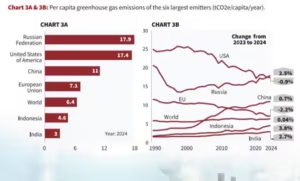
The UNEP Emissions Gap Report 2024 (“Off Target”), released ahead of COP30, reveals that India registered the largest increase in greenhouse gas emissions globally in 2024,
About the UNEP Emissions Gap Report
- The Emissions Gap Report is UNEP’s annual flagship assessment, reviewing how far countries are from meeting the Paris Agreement goals of limiting warming to 1.5°C or 2°C.
- It compares national pledges and existing policies with the level of emission cuts needed for climate-safe pathways.
- The document covers major emitting sectors such as energy, industry, agriculture, and land use, and provides global mitigation recommendations.
Highlights of the 2024 “Off Target” Report
- The core warning: The world remains significantly behind the trajectory required to keep warming within 1.5°C.
- Global emissions reached 57.7 GtCO₂e in 2024, marking a 2.3% increase from 2023—the highest level ever.
- Warming projections indicate: 2.8°C by 2100 under current policies. 2.3–2.5°C even if all current NDCs are fully implemented.
- The G20 nations contribute 77% of global emissions, led by China, the U.S., India, the EU, Russia, and Indonesia.
- Only 64 countries, accounting for 63% of global emissions, updated their NDCs by 2024, and most G20 countries are off-track to achieve 2030–2035 goals.
- Sectorally, fossil fuels account for 69% of emissions, methane 16%, while land-use changes continue to be a major driver of additional emissions.
- The report anticipates a temporary breach of the 1.5°C limit by early 2030s if global mitigation does not accelerate.
India-Specific Assessment
- India recorded the largest absolute increase in emissions in 2024, adding 165 MtCO₂e, reflecting a 3.6% growth rate, second only to Indonesia.
- Despite this rise, India’s per-capita emissions remain low at around 3 tCO₂e, less than half the global average of 6.4 tCO₂e.
- India remains the third-largest emitter, after China and the U.S., largely due to its scale, energy needs, and ongoing industrial expansion.
- India’s NDC targets include: 45% reduction in emission intensity by 2030 (from 2005 levels). 50% installed electricity capacity from non-fossil sources by 2030.
- India has already exceeded its emission intensity reduction trajectory but has not yet submitted an updated NDC for the 2025 cycle, which may draw attention during COP30 negotiations.
GREENHOUSE GASES (GHGS)?
Greenhouse gases are gases in the atmosphere that trap heat and keep the Earth warm. They create a “greenhouse effect,” which is natural and necessary for life, but human activities have increased their levels abnormally.
Major GHGs include: Carbon dioxide (CO₂), Methane (CH₄), Nitrous oxide (N₂O), Ozone (O₃), Water vapour, Fluorinated gases (industrial gases)
How Are They Harmful to the Earth?
- Global Warming: Extra GHGs trap too much heat, raising the Earth’s temperature.
- Climate Change: Leads to changing rainfall patterns, more heatwaves, droughts, floods, and stronger cyclones.
- Melting Ice and Rising Seas: Warmer temperatures melt glaciers and polar ice caps, causing sea-level rise.
- Ocean Acidification: High CO₂ dissolves in oceans, harming coral reefs and marine life.
- Biodiversity Loss: Changing climates destroy habitats, threatening plants, animals, and ecosystems.
Conclusion:
India’s rising emissions reflect the realities of a developing economy balancing growth with climate responsibility. Ensuring equity while accelerating clean-energy transitions will be central to India’s positioning in upcoming global climate negotiations.
This article has been updated and published in detail on our new platform. Please visit the link below for the latest version:
DRAFT SHRAM SHAKTI NITI 2025
TOPIC: (GS2) POLITY: THE HINDU
The Government of India recently released the draft Shram Shakti Niti 2025, the first attempt to create a unified labour and employment policy for the country.
Significance of the Draft Policy
- This is India’s first comprehensive labour and employment policy, a major step after the consolidation of 29 labour laws into four labour codes.
- It presents itself as a “rights-based, future-oriented” framework aligned with the India@2047 vision.
- The draft blends digital tools, flexible labour regimes, and cultural references drawn from ancient Indian texts, which many view as outdated for a modern labour policy.
- Its release accompanies rising reports of modern slavery-like conditions in multiple sectors, highlighting a troubling gap between policy claims and worker realities.
Does the Draft Strengthen Workers or Employers?
- Informal conditions dominate construction, textile, seafood and quarrying sectors, where workers lack contracts, safety cover, ESI and PF.
- The policy’s strong tilt toward employer flexibility and ease of doing business risks institutionalising precarious work.
- Critics argue that it sidelines the spirit of Articles 14, 16 and 21 by weakening equality, opportunity, and dignity guarantees.
- The policy does not reflect commitments under ILO conventions on workplace safety, gender equity, and maternity protection.
Limits of the Draft’s Digital-Centric Approach
- Heavy reliance on AI-powered skilling and employment matching platforms, including the NCS and Skill India tools.
- But only 38% of Indians possess adequate digital literacy, leaving most informal workers—especially women—outside the system.
- The eSHRAM portal, despite massive enrolment, has seen uneven benefits and weak financial support.
- Technology-based hiring may deepen existing caste, class, and gender biases, with little oversight on algorithmic discrimination.
Concerns with Constitutional and Global Norms
- The draft does not adequately strengthen collective bargaining or the functioning of tripartite bodies.
- Dilution of inspectorates under self-certification shrinks accountability for workplace safety.
- The plan to raise women’s labour force participation to 35% by 2047 lacks clarity on infrastructure, safety, mobility, and wage parity.
Way Forward
- Introduce a universal social protection floor covering informal and gig workers under ESI and EPFO.
- Revive labour inspectorates with independent audits for safety and wage compliance.
- Use gender budgeting to monitor women’s participation and workplace equity.
- Build digital systems with data security, algorithmic fairness, and low-literacy accessibility.
- Anchor reforms in constitutional morality rather than cultural symbolism.
Conclusion
The draft Shram Shakti Niti 2025 has an ambitious vision, but its emphasis on flexibility and digital solutions risks bypassing India’s most vulnerable workers. For real transformation, labour policy must prioritise enforceable rights, stronger institutions, and dignity for every worker.
This article has been updated and published in detail on our new platform. Please visit the link below for the latest version:
CLEAN AIR IS NOT A PRIVILEGE
TOPIC: (GS2) GOVERNANCE: THE HINDU
The protests at India gate raised alarm about Delhi’s hazardous air, marking a rare public outcry for children’s right to breathe.
Air Pollution: A Public Health Emergency
- The health dimension of pollution has become unavoidable: respiratory illnesses, especially among children, are now chronic in Delhi.
- Despite the severity, air pollution does not receive the same national prioritisation as communicable diseases, leaving the health ministry marginally involved.
- Classifications like “very poor” underestimate the real danger, masking the alarming toxicity to which citizens are routinely exposed.
Why Current Policies Are Cyclical
- Governments routinely announce emergency measures—odd-even schemes, smog guns, sprinklers—only after pollution peaks, reflecting reactivity rather than prevention.
- Each winter, the GRAP framework triggers familiar, short-term actions without addressing root causes such as crop burning, transport emissions, or industrial pollution.
- Lack of accessible, transparent real-time data widens the gap between official claims and citizens’ lived experiences.
Failures in Governance and Accountability
- Multiple agencies share responsibility, yet none is singularly accountable, creating administrative fragmentation.
- Pollution management spikes seasonally rather than functioning as continuous governance. India lacks a “clean air by design” model.
- Public expenditure on air quality interventions remains opaque, with little clarity on whether investments yield measurable improvements.
Way forward
- Strengthen Health-Centric Governance: Establish a single accountable authority for monitoring, enforcement, and coordination across sectors (transport, agriculture, industry).
- Integrate public health data into pollution policy and issue health advisories based on real-time AQI.
- Tackle Major Emission Sources with Structural Reforms: Expand clean energy transition, faster EV adoption, and strict industrial emission norms and Scale up in-situ stubble management.
- Improve Monitoring: Expand CAAQMS coverage, make real-time pollution data public, and enforce penalty-based mechanisms.
Constitutional and Ethical Dimensions
- Article 21 encompasses the right to clean and breathable air, giving citizens a constitutional basis to demand action.
- Pollution disproportionately harms marginalised groups, transforming it into a question of equity and justice.
- The state’s limited response reflects a breach of its moral obligation to safeguard life and health.
How India Monitors Air Pollution
Central Pollution Control Board (CPCB) – National Air Quality Monitoring Programme (NAMP)
- CPCB operates one of the world’s largest air quality monitoring systems under NAMP.
- Measures key pollutants like PM10, PM2.5, SO₂, NO₂, O₃, CO, NH₃, benzene.
Continuous Ambient Air Quality Monitoring Stations (CAAQMS)
- Automated real-time monitoring stations installed in major cities.
- Provide hourly data for Air Quality Index (AQI).
- India has 500+ CAAQMS stations, covering most urban centres.
- Data flows directly to CPCB.
System of Air Quality and Weather Forecasting and Research (SAFAR)
- Developed by IITM Pune & Ministry of Earth Sciences.
- Provides real-time air quality data, short-term forecasts (1–3 days), and source contribution maps.
- Functional in Delhi, Mumbai, Pune, and Ahmedabad.
Air Quality Index (AQI) Framework
- India uses a unified AQI system introduced in 2014 with 6 categories: Good → Severe.
- Colour-coded public alert system used by government, media, and health advisories.
Conclusion:
India’s air quality crisis stems more from institutional inertia than from the absence of policy frameworks. Protecting the right to breathe demands a shift from symbolic, seasonal measures to consistent, accountable, and health-centred governance.
This article has been updated and published in detail on our new platform. Please visit the link below for the latest version:
INDIA’S ROAD SAFETY SYSTEM
TOPIC: (GS2) GOVERNANCE: THE HINDU
India has one of the highest numbers of road accident deaths globally. Despite policies, awareness campaigns and legal reforms, the country continues to struggle with a weak road safety ecosystem.
Why in News?
- The Supreme Court recently took note of two major road crashes in Rajasthan (44 deaths) and Telangana (19 deaths).
- Over 1.7 lakh lives were lost in 2023 due to road accidents, highlighting deep gaps in India’s road safety framework.
Structural Gaps
- Licensing and training should act as the first filter against unsafe driving, but in India they are often treated as formalities.
- Many drivers obtain licences without proper training or standardised testing.
- Post-licensing monitoring—to check physical fitness, eye health or mental alertness—is largely absent.
- Fatigued drivers or those with health issues often operate heavy vehicles, endangering passengers.
Poor Enforcement Standards
- Speeding, drunk driving, lane violations, and overloading are major contributors to fatal crashes.
- Enforcement is inconsistent: Manual policing is weak and discretionary. Digital systems like automated cameras and radar are poorly integrated.
- Technology-driven enforcement, though emphasised by the Supreme Court, remains patchy across States.
Faulty Road and Infrastructure Design
- Problems include:
- Unbanked curves, damaged crash barriers, inadequate lighting.
- Sudden design shifts, poor signage, unmarked construction zones.
- Decades-old highways designed for lower traffic volume.
- Lack of regular maintenance, broken reflectors, potholes, and encroachments increase risk.
- Evidence shows that engineering-led interventions (e.g., Zero Fatality Corridor projects) can cut deaths by more than half.
Weak Trauma and Emergency Care
- Survival after a crash often depends on the critical “golden hour”, not the impact itself.
- Emergency medical response is uneven—rural areas face delays of over an hour.
- Many accident victims are moved by bystanders or police without medical support.
- Limited availability of trauma centres, blood banks and resuscitation facilities worsens outcomes.
- A nationwide Right to Trauma Care law could mandate faster and uniform emergency response.
NCRB
- Total road accidents in India in 2023: 4,64,029.
- Fatalities from road accidents in 2023: 1,73,826 persons.
- Injuries from road accidents in 2023: Approximately 4.47 lakh persons.
- Timing: 20.7% of the accidents occurred between 6 pm–9 pm (2023 data).
- Vehicle type: Two-wheelers accounted for the highest number of fatal accidents (79,533 deaths; ~45.8% of total) in 2023.
- Location: On national highways, 34.6% of fatalities occurred (2023).
Conclusion
India’s road safety failure is not due to a single factor but a combination of weak licensing, poor enforcement, unsafe road design, and inadequate trauma care. A coordinated national framework—combining engineering, education, enforcement, and emergency response—is essential to reduce preventable deaths.
This article has been updated and published in detail on our new platform. Please visit the link below for the latest version:
TUBERCULOSIS INCIDENCE DECLINE IN INDIA
TOPIC: (GS2) HEALTH: THE HINDU
Recent data indicates that India is making rapid progress toward reducing TB burden through improved diagnosis, treatment, and community-based interventions.
India’s Progress in TB Reduction
- TB incidence down by 21% (2015–2024).
- TB mortality reduced by 46%, from 28 per lakh in 2015 to 21 per lakh in 2024.
- Treatment coverage increased from 53% (2015) to 92% (2024).
- Treatment success rate under the TB Mukt Bharat Abhiyan rose to 88%, among the highest globally.
- “Missing cases” dropped from 15 lakh (2015) to less than 1 lakh in 2024, due to community screening and digital monitoring.
Reasons for India’s Improvement
- Adoption of a community-driven TB elimination model.
- Expansion of active case finding, especially among vulnerable groups.
- Use of digital adherence tools, improved diagnostics like CB-NAAT, and patient-centric treatment.
- Nationwide mobilisation through Panchayats, ASHA workers, NGOs, and TB champions.
Government Measures
- National TB Elimination Programme (NTEP) aiming for TB-free India by 2025.
- Nikshay Poshan Yojana: Monthly nutrition support to TB patients.
- Nikshay Mitra Scheme: Community members adopt TB patients and provide food, care, and support.
- Drones & digital tools for medicine delivery and monitoring.
- Strengthening diagnostic infrastructure with rapid molecular testing machines in districts.
- Private sector engagement to increase notification and standardised treatment.
TUBERCULOSIS (TB)
What is TB?
- TB is an infectious disease caused by the bacterium Mycobacterium tuberculosis.
- It mainly affects the lungs (pulmonary TB) but can also impact bones, brain, kidneys, and other organs.
- TB spreads through airborne droplets when an infected person coughs, sneezes, or talks.
Spread of TB in India
How TB Spreads
- Through close and prolonged contact with an infected person.
- Inhaling tiny TB bacteria droplets expelled from coughing or sneezing.
- Living in crowded, poorly ventilated spaces increases infection risk.
- TB does not spread through food, water, shaking hands, or sharing utensils.

Treatment:
- Drug-Sensitive TB (DS-TB): This is the most common and easiest to treat form of TB.
- Medicines Used (First-Line Drugs): Isoniazid (H), Rifampicin (R)
- Drug-Resistant TB (DR-TB): Occurs when TB bacteria stop responding to one or more first-line drugs.
- Multidrug-Resistant TB (MDR-TB): Resistant to Isoniazid + Rifampicin.
- Medicines Used (Second-Line Drugs) Fluoroquinolones (Levofloxacin, Moxifloxacin), Bedaquiline (BDQ)
- Extensively Drug-Resistant TB (XDR-TB): MDR-TB + resistance to fluoroquinolones and another key drug.
- Medicines Used: High-dose Linezolid, Bedaquiline
Conclusion
India’s rapid reduction in TB incidence is a landmark achievement, showing the success of community participation, technological innovation, and robust public health policies. Continued focus and sustained financing will be essential for achieving the goal of eliminating TB by 2025 and strengthening India’s healthcare system.
This article has been updated and published in detail on our new platform. Please visit the link below for the latest version:
CLIMATE INVESTMENT FUND (CIF)
TOPIC: (GS3) ENVIRONMENT: THE HINDU
The Climate Investment Fund (CIF) is one of the largest global instruments functions as a major source of concessional climate finance, helping vulnerable economies shift towards sustainable and resilient development pathways.
Key Features of CIF
- Designed to support climate mitigation and adaptation in low and middle-income nations.
- created to support climate-related transformation in developing countries. Set up in 2008,
- Works to accelerate transitions in sectors such as clean energy, climate resilience, nature-based solutions, and energy access.
- Provides highly concessional finance, enabling countries to undertake changes that may otherwise be financially difficult.
Institutional Structure
Components
- CIF consists of two major funds:
- Clean Technology Fund (CTF) – focuses on large-scale low-carbon technologies.
- Strategic Climate Fund (SCF) – supports broader climate resilience and sector-specific initiatives.
Governance
- The CTF Trust Fund Committee is the apex decision-making body that supervises operations, investments, and policy direction.
- The CIF Secretariat, located in the World Bank, manages coordination and implementation support.
Partner Institutions
- CIF operates exclusively through six AAA-rated Multilateral Development Banks, including:
ADB, AfDB, EBRD, Islamic Development Bank, IFC, and World Bank.
Recent Developments
- At COP-30, Germany and Spain jointly pledged USD 100 million for the new CIF program ARISE (Accelerating Resilience Investments and Innovations for Sustainable Economies).
- In 2024, CIF became the first global climate fund to issue bonds through the CIF Capital Markets Mechanism (CCMM), expanding its financing reach.
- CIF is increasingly supporting Just Energy Transition Partnerships (JET-Ps) and adaptation financing in climate-fragile regions such as Africa and South Asia.
Conclusion
By leveraging MDBs and concessional capital, CIF helps developing nations take meaningful steps towards low-carbon, climate-resilient growth, which is essential in the decade of climate action.
This article has been updated and published in detail on our new platform. Please visit the link below for the latest version:
NEODYMIUM
TOPIC: (GS3) SCIENCE AND TECHNOLOGY: THE HINDU
Neodymium (Nd) is a major rare earth element crucial to modern strategic and clean-energy technologies. With rising global demand for electric mobility and renewable energy, neodymium has become central to the geopolitics of critical minerals.

Strategic importance of Neodymium (Nd)
- India plans to boost neodymium production nearly nine times to 500 tonnes by FY27, aiming to cut reliance on China and enhance strategic mineral security.
- Countries worldwide are pushing supply chain diversification to secure critical minerals essential for the clean-energy transition.
- Under India’s Critical Minerals Mission (2023), agencies like NMDC and MECL are undertaking detailed mapping and exploration of rare-earth deposits, including neodymium-rich sites.
Characteristics Of Neodymium (Nd)
- Symbol: Nd
- Atomic Number: 60
- Part of the lanthanide series, classified as a rare earth metal.
- Identified in 1885 by Karl Auer in Vienna.
Occurrence
- Found mainly in monazite and bastnäsite minerals.
- Major deposits occur in China, India, Brazil, USA, Australia, and Sri Lanka.
- It is the second most abundant rare earth element after cerium.
- Physical & Chemical Properties: Appears as a malleable, ductile, silvery-white metal.
Applications
- Essential in manufacturing neodymium-iron-boron (NdFeB) permanent magnets, among the strongest industrial magnets.
- Widely used in electric vehicle motors, wind turbine generators, electronics, laser systems, and defense equipment.
- Important in optical instruments and power electronics.
Conclusion
With expanding clean energy and advanced-technology needs, neodymium has become indispensable for India’s energy security and strategic autonomy. Strengthening domestic production and reducing import reliance will play a major role in India’s transition to a green economy.

This article has been updated and published in detail on our new platform. Please visit the link below for the latest version: