Table of Contents
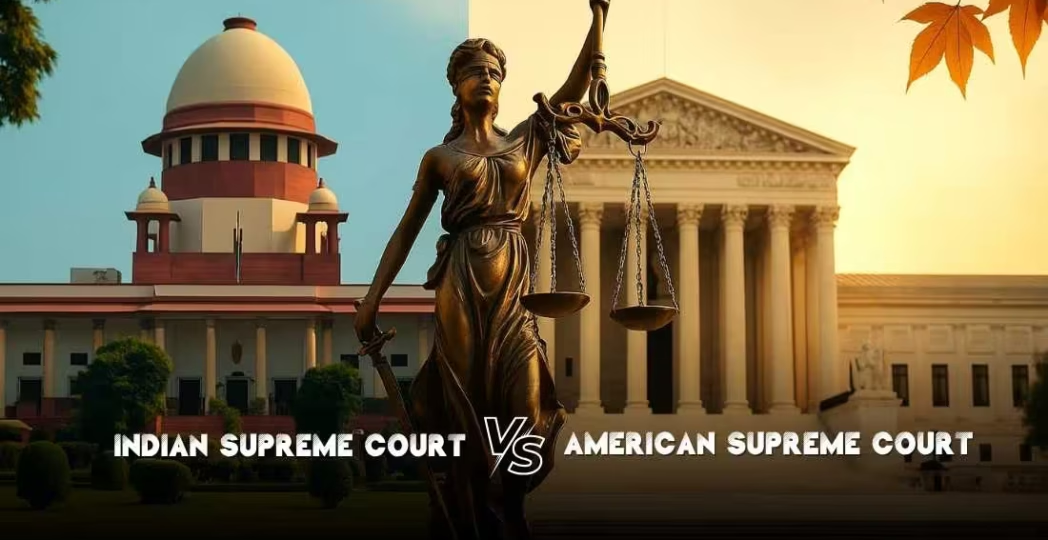
ToggleThe judiciary is the cornerstone of any democratic polity. Both India and the United States have established independent and powerful judicial systems to safeguard the Constitution and citizens rights. However, despite their shared democratic ethos, their judicial structures, powers, and functions differ significantly due to variations in constitutional design, political culture, and historical evolution.
Detailed Comparison between Indian and American Judiciary
| Parameter | Indian Judiciary | American Judiciary |
|---|---|---|
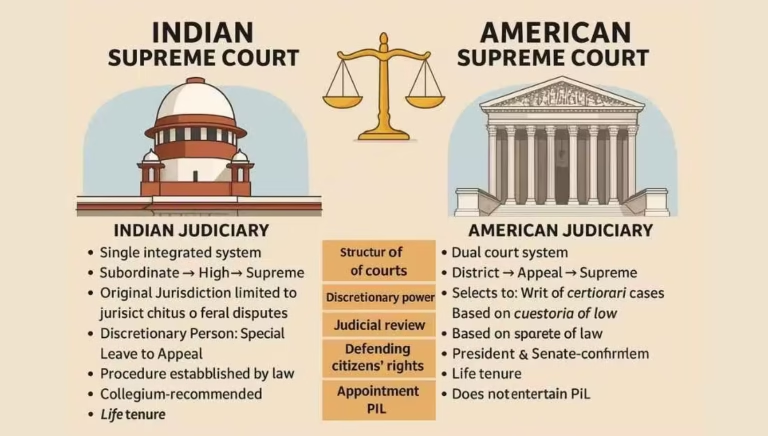
| Judicial System | India follows a single and integrated system of courts, adopted from the Government of India Act, 1935. Both Central and State laws are enforced by the same hierarchy of courts — from Subordinate Courts to the Supreme Court. | The U.S. follows a dual system — Federal Courts for federal laws and State Courts for state laws. Both operate independently, though the U.S. Supreme Court is the final interpreter of the Constitution. |
| Structure of Courts | The hierarchy includes Subordinate Courts → High Courts → Supreme Court, ensuring a unitary judicial system. | The U.S. has District Courts → Courts of Appeal → Supreme Court, but federal and state systems are distinct and non-integrated. |
| Original Jurisdiction | Limited to federal disputes — between Centre and States or among States (Article 131). | Covers federal disputes and cases involving ambassadors, public ministers, consuls, and maritime issues. |
| Appellate Jurisdiction | Hears appeals in constitutional, civil, and criminal cases from High Courts and tribunals. | Primarily hears constitutional and federal law cases; acts as the final interpreter of the U.S. Constitution. |
| Advisory Jurisdiction | Under Article 143, the President may seek the Supreme Court’s advisory opinion. Advice is non-binding. | No advisory jurisdiction; the Court gives opinions only on actual cases or controversies. |
| Discretionary Power | Under Article 136, the Supreme Court can grant Special Leave to Appeal (SLP) against judgments of any court or tribunal. | No plenary appellate power; cases are selected via writ of certiorari on substantial constitutional questions. |
| Judicial Review | Present but limited — based on ‘procedure established by law’. Expanded through interpretation (e.g., Maneka Gandhi case). | Much wider — established in Marbury v. Madison (1803); can strike down unconstitutional laws or acts. |
| Jurisdiction & Powers | Can be enlarged by Parliament under Article 138. | Fixed by the U.S. Constitution; Congress cannot expand it beyond constitutional limits. |
| Defending Citizens’ Rights | Based on ‘Procedure Established by Law’ — laws can be enforced if duly enacted, though activism has liberalized interpretation. | Based on ‘Due Process of Law’ — ensures both substantive and procedural fairness; courts can nullify unjust laws. |
| Appointment of Judges | Appointed by the President on recommendation of the Collegium System, ensuring independence. | Appointed by the President and confirmed by the Senate — involving both executive and legislative roles. |
| Tenure & Removal | Judges serve until 65 years; removal only by impeachment for proven misbehavior or incapacity. | Appointed for life (subject to good behavior), ensuring strong independence from politics. |
| Binding Nature of Precedent | Supreme Court judgments bind all courts in India under Article 141. | Doctrine of stare decisis strictly applied — lower courts must follow higher court precedents. |
| Public Interest Litigation (PIL) | Developed PILs to make justice accessible to marginalized groups; expanded scope of Fundamental Rights. | No PILs; only individuals with direct legal standing (locus standi) can approach courts. |
| Role in Constitutional Interpretation | Often activist — uses judicial creativity to expand Fundamental Rights (e.g., Right to Privacy, Right to Education). | Generally restrained — emphasizes textual and original constitutional interpretation. |
Conclusion
The Supreme Court of India serves as a guardian of the Constitution, balancing the powers of the legislature and executive through an integrated judicial system. It often adopts a proactive and activist approach to deliver social justice and uphold citizens’ rights.
In contrast, the U.S. Supreme Court, guided by the doctrine of due process and judicial restraint, plays a more conservative role within a federal and dual judicial framework. While both serve the same democratic purpose of ensuring constitutional supremacy, they differ fundamentally in their scope, structure, and style of functioning — reflecting the distinct socio-political philosophies of their nations.
Indian and American Supreme Courts - FAQs Answered
What is the main difference between the Indian and American judiciary?
The Indian judiciary follows a single integrated system, while the American judiciary follows a dual system — separate federal and state courts.
How does the appointment of judges differ between India and the USA?
In India, judges are appointed by the President on the recommendation of the Collegium System, ensuring judicial independence. In the USA, the President nominates judges, and the Senate confirms them, combining executive and legislative oversight.
What is the scope of Judicial Review in India and the USA?
India’s Judicial Review operates under ‘procedure established by law’, while the U.S. Supreme Court follows ‘due process of law’, granting broader power to strike down unconstitutional acts.
Does the U.S. Supreme Court have advisory jurisdiction like India’s Supreme Court?
No. The U.S. Supreme Court has no advisory jurisdiction. In contrast, under Article 143, the President of India can seek the Supreme Court’s advisory opinion.
Which judiciary is more independent — Indian or American?
The U.S. judiciary is considered more independent due to lifetime tenure for judges. However, the Indian judiciary, with constitutional safeguards and a collegium-based appointment, maintains significant autonomy within a parliamentary framework.