Daily Current Affairs 14-November-2025

Share this Post

TAMIL NADU’S REFORMS IN TRANSGENDER HEALTHCARE

TOPIC: (GS2) POLITY: THE HINDU

Tamil Nadu is in the news for introducing new reforms to strengthen transgender-inclusive healthcare, making it a leading State in providing gender-affirming services, insurance coverage, and rights-based health policies.

Why Transgender Persons Face Healthcare Barriers

  • Limited trained healthcare providers, especially in transgender medicine, results in misinformation, stigma, and unsafe practices.
  • Many patients face restricted access to gender-affirming hormone therapy or surgeries.
  • Discrimination, humiliation, and ignorance in hospitals discourage individuals from seeking timely care.
  • Social barriers such as homelessness, low education, unemployment, and lack of insurance coverage worsen exclusion.
  • Hostile treatment in institutional settings often pushes transgender persons away from formal medical systems.

Tamil Nadu’s Reforms in Transgender Healthcare

  • Tamil Nadu was the first State to establish a Transgender Welfare Board (2008), integrating health, education, and livelihood support.
  • The Rajiv Gandhi Government General Hospital set up India’s earliest government-run gender-affirming surgery unit, later expanded into Gender Guidance Clinics (2018).
  • Under National Health Mission, clinicians received training in gender-sensitive practices.
  • The 2019 Transgender Persons (Protection of Rights) Act shaped sustained policy action.
  • The State removed the ₹72,000 annual income cap for enrolling transgender persons under CMCHIS-PMJAY and waived the requirement of a ration card for abandoned individuals.
  • By 2025, over 5,200 transgender persons are expected to be enrolled under insurance schemes.

Expansion of Insurance Coverage

  • Tamil Nadu, in 2022, included gender-affirming surgeries, hormone therapy, and related follow-up care under the Chief Minister’s Comprehensive Health Insurance Scheme (CMCHIS).
  • These services, earlier financed solely through hospital funds, are now covered under a five-year insurance model.
  • This makes Tamil Nadu the first region in South Asia to bring transgender healthcare under universal health coverage.

Remaining Challenges

  • Gender Guidance Clinics must expand into comprehensive, multi-level services (primary to tertiary).
  • There is a need for more trained doctors, counsellors, and para-medical staff.
  • Persistent societal stigma, police harassment, and employment discrimination hinder access.
  • Strong community participation is required to ensure continuity of care.

Social Welfare & Financial Inclusion

  • SMILE Scheme (2022): Provides shelter homes, food, skill training, and rehabilitation for transgender persons.
  • Garima Greh Homes: Safe housing, counseling, and support services funded by the Ministry of Social Justice.
  • Inclusion in priority groups for welfare schemes like pensions, housing, and scholarships.

Conclusion

Tamil Nadu has set a progressive benchmark for transgender-inclusive healthcare by embedding dignity, rights, and financial access into policy. While challenges continue, the State’s approach reflects the essence of equity-driven public health, offering a model other States can adapt for inclusive development.

This article has been updated and published in detail on our new platform. Please visit the link below for the latest version:

👉 Read the full article on ekamiasacademy.in

HOW MAHARASHTRA’S SEC IS WORKING TO ENSURE FAIR LOCAL ELECTIONS

TOPIC: (GS2) POLITY: THE HINDU

The SEC has started a fresh programme to clean and verify voter lists ahead of the local polls beginning on December 2. This has raised questions regarding its powers, the process of identifying errors, and the concerns expressed by political parties.

What Are the State Election Commission Powers?

  • The SEC’s role is limited by the Constitution—it cannot add or delete names from the voters’ list.
  • Only the Chief Electoral Officer (CEO) under the Representation of the People Act, 1950 can revise the electoral roll.
  • The SEC can only use the existing Assembly voters’ list for conducting local body elections.
  • However, it has full authority over conduct, supervision, and delimitation of constituencies for urban and rural bodies.
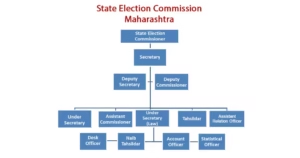
State Election Commission Maharastra

What Steps Has the SEC Taken?

  • Ward Delimitation: It is reshaping the boundaries of all local wards. This includes redistributing voters across Assembly constituencies to ensure each ward has balanced representation.
  • Although deletion is not in its mandate, the SEC can: Flag entries using filters like name, age, gender, and address. Mark “double” and “doubtful” voters for field verification.
  • Processing Objections and Claims: From November 20, the SEC is inviting objections from citizens and political parties. Draft rolls will be published, and after assessing objections through booth-level verification, final lists will be issued in December.
  • Field Verification: Special teams will visit households to confirm flagged entries. Polling centres will maintain marked voter lists to ensure no voter casts more than one ballot.

Concerns Raised

  • Many errors from earlier elections, such as zero-address voters, bulk additions, and cross-district registrations, remain unresolved.
  • Voters listed with addresses outside Maharashtra continue appearing on rolls.
  • Parties argue that without correcting the base electoral roll, the exercise will not be fully effective.

ELECTORAL ROLL?

  • An electoral roll is the official list of all eligible voters in a particular constituency.
  • It is prepared and updated under the Representation of the People Act, 1950.
  • The roll contains voter details such as name, age, address, and polling station.
  • It ensures that only eligible individuals vote and that each voter votes only once, maintaining the integrity of elections.

Who is Eligible to be Included?

  • Citizenship: Must be an Indian citizen.
  • Age: Must be 18 years or above on the qualifying date (usually January 1 of the year).
  • Ordinary Residence: Must be an ordinary resident of the constituency—i.e., living there regularly, not temporarily.

Constitutional Provisions

  • Article 324: Vests superintendence, direction and control of elections in the Election Commission of India (ECI).
  • Article 325: Mandates one general electoral roll for every territorial constituency. No exclusion on grounds of religion, race, caste, or sex.
  • Article 326: Provides for universal adult suffrage: Every citizen aged 18+ has the right to vote.

Conclusion

The SEC’s efforts mark an important step toward safeguarding electoral integrity. However, its restricted legal powers mean deeper corrections depend on the CEO’s revision of rolls. Effective elections will require coordination, transparency, and timely verification to build public confidence in the electoral process.

This article has been updated and published in detail on our new platform. Please visit the link below for the latest version:

👉 Read the full article on ekamiasacademy.in

HOW GRASSROOTS MOVEMENTS AND CAMPAIGNS ARE SHAPING INDIA

TOPIC: (GS2) POLITY: THE HINDU

New writings by Subroto Bagchi, Bela Bhatia, and Jayapadma R.V. have spotlighted the lived experiences of India’s marginalised communities. Their work has reignited discussion on inequality, informal work, and the growing importance of grassroots-led change.

Drivers of Grassroots Transformation

Human Experiences as Development Signals

  • Lived stories reveal social mobility, resilience and the impact of opportunities at the local level.
  • Case studies like Nunaram Hansda and Muni Tigga show how individuals overcome structural barriers through skilling and support networks.

Persistent Systemic Barriers

  • Inequalities rooted in caste, gender, and land relations continue to restrict access to education, healthcare and employment.
  • Bureaucratic inefficiencies and local political patronage delay welfare delivery.

Local Leadership as Catalyst

  • Teachers, health workers, panchayat leaders and field officials often innovate within limited resources.
  • Their interventions enable last-mile service delivery and inspire community confidence.

Grassroots Skilling and Odisha’s Experience

  • Bagchi’s 3,000 km rural journey reflects the importance of direct engagement in public policy.
  • In a country where only 2% of youth are formally skilled, “nano-unicorns”—individuals who improve their lives through basic training—show how skilling can transform family economies.
  • Odisha’s bottom-up skilling model demonstrates that localised design often outperforms one-size-fits-all approaches.

Inequalities Exposed Through Grassroots Narratives

  • Bela Bhatia documents caste atrocities, bonded labour, and the lived trauma of Dalits and Adivasis.
  • In conflict regions like Bastar, communities face both insurgent violence and state excesses.
  • Gendered vulnerabilities—widowhood, trafficking, domestic violence—remain deeply embedded in tribal and rural India.

Role of Civil Society Organisations

  • NGOs and CBOs develop alternative pathways of development based on dignity, participation and inclusion.
  • Movements like MKSS (Right to Information), SEWA, Narmada Bachao Andolan, Niyamgiri Movement, and Kudumbashree show how grassroots activism shapes national laws and social attitudes.
  • Grassroots innovations—community water management, digital literacy campaigns, local entrepreneurship—illustrate scalable development models.

Conclusion

Grassroots movements reveal that sustainable development grows from community experience, not just official policy. They expose inequality while offering practical models built on trust, participation and resilience. India’s future progress must integrate grassroots wisdom into mainstream governance to ensure justice and dignity for all.

This article has been updated and published in detail on our new platform. Please visit the link below for the latest version:

👉 Read the full article on ekamiasacademy.in

DRAFT SEEDS BILL, 2025

TOPIC: (GS2) POLITY: THE HINDU

The Union Government has released the Draft Seeds Bill, 2025, aiming to modernise India’s seed regulation framework. It seeks to replace the Seeds Act, 1966 and the Seeds (Control) Order, 1983, aligning the sector with present agricultural needs, global standards, and emerging private sector participation.

Objectives of the Draft Bill

  • Improve seed quality: Ensures only tested and certified seeds are sold in the market.
  • Enhance farmers’ access to high-quality planting material at fair prices.
  • Liberalise seed imports to enable farmers to benefit from high-performing global varieties.
  • Protect farmer interests by regulating rates and ensuring accountability of seed companies.

Major Provisions of the Draft Seeds Bill, 2025

  • Mandatory registration: Every seed dealer must secure a registration certificate from the State Government before selling, importing, or exporting seeds.
  • Minimum quality standards: Seeds must meet standards for germination, genetic purity, physical purity, traits, and seed health as per the Indian Minimum Seed Certification Standards.
  • Decriminalisation of minor offences: Reduces compliance burden and supports the government’s “Ease of Doing Business” agenda.
  • Penal provisions remain for serious violations affecting farmers.
  • Liberalised import regime to allow access to better-quality global seed varieties.

Concerns Raised by Farmer Organisations

  • The Bill may tilt in favour of seed companies, increasing private sector dominance.
  • Possibility of higher seed prices due to reduced state control.
  • Farmers fear reduced autonomy over traditional and farm-saved seeds.

Conclusion

The Draft Seeds Bill, 2025 attempts to create a more efficient, quality-driven seed market. While it strengthens standards and modernises regulations, balancing farmer protections, affordability, and private sector participation will be essential for its successful implementation.

This article has been updated and published in detail on our new platform. Please visit the link below for the latest version:

👉 Read the full article on ekamiasacademy.in

CLIMATE RISK INDEX (CRI) 2026

TOPIC: (GS3) ENVIRONMENT: THE HINDU

The latest Germanwatch Climate Risk Index 2026 reports that extreme weather events have claimed over 8 lakh lives globally between 1995 and 2024. The data highlights growing climatic vulnerability, especially among developing nations, including India.

What is the Climate Risk Index (CRI)?

  • Published annually by Germanwatch, an international environmental organization.
  • Ranks countries based on actual impacts of extreme weather, not future projections.
  • Provides a real-world assessment of climate vulnerability.
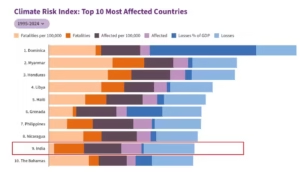
Climate Risk Index Top 10 Most Affected Countries

Hazards Covered

  • Meteorological events: storms, cyclones, heatwaves
  • Hydrological events: floods, landslides
  • Climatological events: droughts, wildfires

Indicators (6 total under 3 metrics)

  • Human Impact: Total fatalities, Deaths per 100,000 population
  • Population Affected: Total number of people affected, Relative percentage affected
  • Economic Impact: Total economic losses (USD), Losses as a share of GDP

Purpose

  • Identifies highly vulnerable nations.
  • Helps direct adaptation planning, climate finance, and Loss & Damage discussions under UNFCCC.

INDIA IN CRI 2026

  • Long-term Rank (1995–2024): 9th most affected globally.
  • Rank for 2024: 15th.
  • Faced ~430 extreme weather events in 30 years.
  • Impact: 80,000+ deaths, 1.3 billion people affected, USD 170 billion in economic losses
  • Classified as a “continuous threat” country due to frequent cyclones, floods, heatwaves.
  • Strengthens India’s case for Loss & Damage financing in global climate negotiations.

Global Findings (CRI 2026)

  • Period assessed: 1995–2024, with a deep-dive into 2024.
  • 832,000+ deaths and USD 4.5 trillion losses from ~9,700 events.
  • Heatwaves and storms caused most fatalities.
  • Floods impacted the most people.
  • Storms created maximum economic losses.
  • Worst-affected (1995–2024): Dominica, Myanmar, Honduras.
  • Worst-hit in 2024: St. Vincent & the Grenadines, Grenada, Chad.
  • Shows a clear disproportionate burden on the Global South, especially Small Island Developing States (SIDS).

This article has been updated and published in detail on our new platform. Please visit the link below for the latest version:

👉 Read the full article on ekamiasacademy.in

RICIN: A RISING BIO-WEAPON THREAT

TOPIC: (GS3) SCIENCE AND TECHNOLOGY: THE HINDU

Investigations into the recent Delhi blast uncovered a terror plan involving ricin, one of the most lethal biological toxins known.
The incident has renewed concerns about India’s vulnerability to bio-terrorism and the need for tighter monitoring of hazardous biological substances.

What is Ricin?

  • Origin: Ricin is a toxic protein extracted from the residue obtained after processing castor seeds (Ricinus communis) for oil production.
  • Discovery: German scientist Peter Hermann Stillmark identified and described its deadly cellular effects in 1888.

castor seeds (Ricinus communis)

How Ricin Acts in the Body

  • Ricin enters cells and halts protein synthesis, causing rapid cell destruction.
  • This leads to organ failure, internal bleeding, respiratory collapse, and death.
  • Lethality: Even microgram quantities can be fatal.

Routes of Exposure

  • Inhalation: Severe respiratory distress, fever, pulmonary edema.
  • Ingestion: Vomiting, bloody diarrhoea, liver and kidney damage.
  • Injection: Immediate organ shutdown, seizures, circulatory failure.

Treatment

  • There is no specific antidote to ricin poisoning.
  • Management focuses on: IV fluids, oxygen support, Activated charcoal if ingested, Ventilation for severe respiratory distress
  • Survival depends on dose and speed of treatment.

Security Concerns & Weaponisation

  • Ricin is easy to extract from a widely grown crop, making it a high-risk bioterror agent.
  • Listed under Schedule 1 of the Chemical Weapons Convention and controlled by the Biological Weapons Convention.
  • In India, possession or use is punishable under:
    • CWC Act, 2000
    • Unlawful Activities (Prevention) Act (UAPA)
    • WMD and Delivery Systems Act, 2005
  • Dual-Use Challenge: Since castor is a major industrial crop, ricin remains a dual-use substance, requiring strict surveillance of castor-processing units and by-products.

Conclusion

Ricin’s accessibility, extreme toxicity, and lack of antidote make it one of the most dangerous bio-agents. The Delhi case demonstrates the urgent need for strong bio-security protocols. India must strengthen monitoring, law enforcement, and public-health preparedness to counter future bio-threats.


This article has been updated and published in detail on our new platform. Please visit the link below for the latest version:

👉 Read the full article on ekamiasacademy.in

PROTECTION OF PLANT VARIETIES AND FARMERS’ RIGHTS AUTHORITY

TOPIC: (GS3) AGRICULTURE: THE HINDU

Recently, during the 21st Foundation Day of the Protection of Plant Varieties and Farmers’ Rights Authority (PPV&FRA), the Union Agriculture Minister announced that the Plant Varieties Act, 2001 will be amended to address emerging needs of breeders and farmers.

Protection of Plant Varieties and Farmers’ Rights Authority

  • The PPV&FRA is a statutory body created under the Protection of Plant Varieties and Farmers’ Rights (PPV&FR) Act, 2001 and became functional on 11 November 2005.
  • It operates under the Ministry of Agriculture & Farmers’ Welfare, Government of India, and is headquartered in New Delhi.
  • The Authority was established to provide a legal framework that supports plant breeding innovation, while also ensuring that farmers’ traditional rights over seeds remain protected.

Objectives of the Authority

  • To provide intellectual property rights to plant breeders who develop new or improved plant varieties.
  • To acknowledge and reward farmers and traditional communities for conserving indigenous genetic resources.
  • To safeguard farmers’ rights to save, use, sow, resow, exchange, share, and sell farm-saved seeds of registered varieties (except branded seeds).
  • To promote research, innovation, and development in plant breeding.
  • To maintain the National Register of Plant Varieties (NRPV) and ensure documentation, conservation, and availability of valuable germplasm.

Structure of the Authority

  • The Chairperson serves as the Authority’s Chief Executive.
  • It consists of 15 members, notified by the Government of India.
  • Eight are ex-officio members from different ministries and departments.
  • Three represent State Governments and State Agricultural Universities (SAUs).
  • Four nominated members represent farmers, tribal groups, the seed industry, and women’s organisations involved in agriculture.
  • The Registrar General functions as the ex-officio Member Secretary.

Functions of the Authority

  • Registration of new plant varieties, extant varieties, and essentially derived varieties (EDVs).
  • Providing compulsory cataloguing facilities for all plant varieties.
  • Conservation and preservation of plant genetic resources, including wild relatives of economic crops.
  • Maintenance of the National Register of Plant Varieties.
  • Overseeing the National Gene Bank for long-term storage of seeds and germplasm.

This article has been updated and published in detail on our new platform. Please visit the link below for the latest version:

👉 Read the full article on ekamiasacademy.in

Write a Review

Your email address will not be published. Required fields are marked *