

Table of Contents
ToggleREDISTRIBUTION OF LOK SABHA SEATS
TOPIC: (GS2) POLITY: THE HINDU
The Union Government has circulated drafts of the Constitution (131st Amendment) Bill and the Delimitation Bill, proposing redistribution of Lok Sabha seats based on the 2011 Census.
What is Delimitation?
- Definition: Delimitation is the process of fixing boundaries of territorial constituencies for Lok Sabha and State Assemblies.
- Purpose: To ensure each constituency has roughly equal population, maintaining the principle of “one person, one vote, one value.”
- Conducted by: An independent Delimitation Commission, whose orders have the force of law and cannot be challenged in court.
Constitutional Basis
- Article 81: Provides for allocation of Lok Sabha seats among States based on population.
- Article 82: Mandates readjustment of Lok Sabha constituencies after every Census by a Delimitation Commission.
- Article 170: Provides for readjustment of seats in State Legislative Assemblies after each Census.
- Delimitation Commission Acts: Passed by Parliament to set up the Commission (1952, 1962, 1972, 2002).
Background of Delimitation & Seat Freeze
- Current Arrangement: Lok Sabha seats among States are allocated using the 1971 Census (interState distribution), while division within each State is based on the 2001 Census.
- Reason for Freeze: The freeze was introduced through the 42nd Constitutional Amendment (1976) to ensure that States which controlled population growth were not penalised with fewer seats. This was reinforced by the 84th Amendment (2001) under PM Vajpayee, extending the freeze to 2026.
- Proposed Change: The draft 131st Amendment Bill (2026) seeks to remove this safeguard and immediately redistribute Lok Sabha seats using the 2011 Census.
Provisions of the Draft Bills
- Increase in Lok Sabha size: Maximum seats: 850 (815 for States, 35 for Union Territories). Current ceiling: 550.
- Women’s Reservation: 33% seats reserved for women in Lok Sabha and State Assemblies. Reservation linked to delimitation exercise.
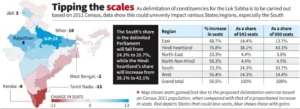
- Redistribution of Seats: Based on 2011 Census figures. Hindi heartland States gain more seats; southern States lose relative share.
Concerns Raised
- Federalism: Southern States argue redistribution punishes them for successful population control.
- Political balance: Fear of dominance by Hindi heartland in Parliament.
- Process issues: Bills introduced without multi-party consultation or committee review.
- Opposition view: Women’s reservation being used as a “facade” to push delimitation before 2029 elections.
Significance
- Political representation: Alters balance of power between regions.
- Women’s empowerment: Ensures 33% reservation but tied to contentious delimitation.
- Demographic justice vs. federal equity: Raises debate on whether representation should strictly follow population or balance regional interests.
Impact on Southern States
- Reduced Share of Seats: Southern States like Tamil Nadu, Kerala, Karnataka, and Telangana will see their percentage share of Lok Sabha seats shrink, even if they gain a few seats numerically.
- Tamil Nadu Example:
- Current seats: 39
- Proposed seats: 50
- Share falls from 7.18% → 5.88%
- Despite gaining 11 seats, its relative influence in Parliament decreases.
- Overall Southern States:
- Current share: 24.31%
- Proposed share: 20.71%
- Indicates a collective decline in political weight compared to northern States.
Conclusion:
The proposed redistribution strengthens northern States but diminishes the political voice of southern States, punishing them for successful population control. It is a decisive test of federal fairness, reshaping India’s democratic balance.
WOMEN’S EMPOWERMENT VS FEDERAL EQUITY
TOPIC: (GS2) SOCIAL JUSTICE AND HEALTH: THE HINDU
The Union government has introduced the Constitution (131st Amendment) Bill, 2026 and a Delimitation Bill, linking women’s reservation with redistribution of Lok Sabha seats, sparking concerns that federal balance is being undermined.
Background
- 106th Amendment (2023): Provided 33% reservation for women in Lok Sabha and State Assemblies, tied to postCensus delimitation.
- Census Delay: The 2021 Census was postponed repeatedly, now scheduled for 202627. This allowed the government to push delimitation earlier using the 2011 Census.
- Existing Freeze: The 42nd Amendment (1976) froze seat allocation based on the 1971 Census; the 84th Amendment (2001) extended this freeze till after the first Census post2026.
- Proposed Change: The 131st Amendment removes this safeguard, raising Lok Sabha strength to 850 seats and redefining “population” as whichever Census Parliament decides by law.
Key Provisions of the 131st Amendment
- Expansion of Lok Sabha: From 543 seats to a maximum of 850 (815 for States, 35 for UTs).
- Population Definition: No longer fixed to 1971/2001 Census; Parliament can decide through ordinary law.
- Removal of Freeze Clause: Deletes protection that prevented States with lower fertility rates from losing representation.
- Articles Amended: 55, 81, 82, 170, 330, 332, 334A.
Impact on States (Based on 2011 Census)
- Hindi Heartland States: Seats rise from 207 → 366; share increases from 38.1% → 43.1%.
- Southern States: Seats rise from 132 → 176; share falls from 24.3% → 20.7%.
- Eastern States: Share drops from 14.4% → 13.7%.
- NorthEast: Share declines from 4.4% → 3.8%.
- Implication: States that controlled population growth (South, East, NorthEast) lose political weight, while highfertility States gain.
Concerns Raised
- Federal Equity: Advanced States with better health, education, and women’s empowerment face reduced representation.
- Political Motive: Bundling women’s reservation with delimitation seen as a cover for electoral advantage.
- Process Issues: Legislation rushed without adequate debate or committee review.
- Alternative Approach: Women’s reservation could be implemented within existing 543 seats through rotational allocation.
Conclusion
The proposed amendment is not just about women’s empowerment but a restructuring of India’s federal balance. By linking reservation with delimitation, the government risks punishing States that achieved demographic stability and rewarding those that lagged.
WOMEN’S EMPOWERMENT VS FEDERAL EQUITY
TOPIC: (GS2) SOCIAL JUSTICE AND HEALTH: THE HINDU
The Union government has introduced the Constitution (131st Amendment) Bill, 2026 and a Delimitation Bill, linking women’s reservation with redistribution of Lok Sabha seats, sparking concerns that federal balance is being undermined.
Background
- 106th Amendment (2023): Provided 33% reservation for women in Lok Sabha and State Assemblies, tied to postCensus delimitation.
- Census Delay: The 2021 Census was postponed repeatedly, now scheduled for 202627. This allowed the government to push delimitation earlier using the 2011 Census.
- Existing Freeze: The 42nd Amendment (1976) froze seat allocation based on the 1971 Census; the 84th Amendment (2001) extended this freeze till after the first Census post2026.
- Proposed Change: The 131st Amendment removes this safeguard, raising Lok Sabha strength to 850 seats and redefining “population” as whichever Census Parliament decides by law.
Key Provisions of the 131st Amendment
- Expansion of Lok Sabha: From 543 seats to a maximum of 850 (815 for States, 35 for UTs).
- Population Definition: No longer fixed to 1971/2001 Census; Parliament can decide through ordinary law.
- Removal of Freeze Clause: Deletes protection that prevented States with lower fertility rates from losing representation.
- Articles Amended: 55, 81, 82, 170, 330, 332, 334A.
Impact on States (Based on 2011 Census)
- Hindi Heartland States: Seats rise from 207 → 366; share increases from 38.1% → 43.1%.
- Southern States: Seats rise from 132 → 176; share falls from 24.3% → 20.7%.
- Eastern States: Share drops from 14.4% → 13.7%.
- NorthEast: Share declines from 4.4% → 3.8%.
- Implication: States that controlled population growth (South, East, NorthEast) lose political weight, while highfertility States gain.
Concerns Raised
- Federal Equity: Advanced States with better health, education, and women’s empowerment face reduced representation.
- Political Motive: Bundling women’s reservation with delimitation seen as a cover for electoral advantage.
- Process Issues: Legislation rushed without adequate debate or committee review.
- Alternative Approach: Women’s reservation could be implemented within existing 543 seats through rotational allocation.
Conclusion
The proposed amendment is not just about women’s empowerment but a restructuring of India’s federal balance. By linking reservation with delimitation, the government risks punishing States that achieved demographic stability and rewarding those that lagged.
MAPPING THE LEGISLATIVE VACUUM IN INDIA’S HEAT CRISIS
TOPIC: (GS3) DISASTER MANAGEMENT: THE HINDU
India is facing record heatwaves, with over half of districts now heatprone, yet there is no binding legal framework to protect vulnerable workers or recognise heatwaves as national disasters.
Background
- Heatwaves have expanded beyond arid regions to coastal and temperate zones.
- 57% of districts are now classified as heatprone.
- Nearly 400–490 million informal workers lack “cooling autonomy,” making heat a threat to survival and livelihood.
- Impacts are unequal, hitting poorer, marginalised, and outdoor workers hardest.
Evidence from Frontlines
- Sanitation workers: Face toxic fumes and microclimates hotter than surroundings; report burns from heated waste.
- Gig workers: Algorithmic deadlines prevent rest even during red alerts.
- Construction workers: Suffer metabolic heat plus exposure to steel and concrete.
- Street vendors: Lose income as goods perish and customers avoid heat.
- Heat exposure is shaped by class, caste, and occupation, creating “thermal injustice.”
Legislative & Fiscal Gaps
- Factories Act, 1948: Covers only indoor workrooms, ignoring outdoor heat.
- OSHWC Code, 2020: Section 23 allows weather standards but does not mandate them, leaving safety discretionary.
- Fiscal Constraint: Heatwaves not on the Nationally Notified Disaster list; States can use only 10% of disaster funds for relief.
- Current framework treats heat as a disaster advisory, not an enforceable occupational safety issue.
Addressing Thermal Injustice
- Disaster Recognition: Accept Finance Commission’s recommendation to include heatwaves and lightning in the Notified Disaster list (2026–31).
- Legal Standards: Notify binding heat safety rules under OSHWC Code — workrest cycles, PPE, insulated flasks.
- Heat Index Adoption: Use temperature + humidity as the legal trigger for declaring heatwaves, especially for coastal regions.
- Right to Cool: Based on SC’s Ranjitsinh (2024) ruling, recognise cooling as part of Article 21 (Right to Life).
- Worker Protection:
- Cooling shelters and water kiosks by urban local bodies.
- Ban delivery penalties during heat alerts for gig workers.
- Special directives for sanitation and mining workers.
- Financial Compensation: Introduce incomeloss insurance models like SEWA’s parametric heat insurance scheme.
Conclusion
Recognising heatwaves as disasters, enforcing binding safety rules, and treating cooling as a fundamental right are essential to protect lives and livelihoods in a warming India.
FOOD WASTE IN INDIA
TOPIC: (GS1) SOCIAL ISSUES: THE HINDU
On the International Day of Zero Waste (March 30), UNEP’s Food Waste Index Report 2024 revealed that India wastes food worth ₹1.55 lakh crore annually, ranking second globally after China.
Global Context
- World wasted 1.05 billion tonnes of food in 2024.
- Sources: Households (60%), food services (28%), retail (12%).
- 783 million people face hunger; 3.1 billion cannot afford a healthy diet.
- Food waste contributes 8–10% of global greenhouse gas emissions; if it were a country, it would be the thirdlargest emitter.
India’s Position
- 78–80 million tonnes of food wasted annually, worth ₹1.55 lakh crore.
- Per capita household waste: 55 kg/year, lower than U.S. (73 kg) and Germany (75 kg).
- India ranks 111/125 in Global Hunger Index; 194 million people remain undernourished.
- Punjab records the highest foodgrain spoilage in FCI storage (8,200 tonnes between 2019–24).
Causes of Food Waste
- Postharvest inefficiencies: poor storage, lack of cold chain, inadequate mechanisation.
- Packaging issues: reliance on porous jute sacks under outdated laws.
- Extreme weather events: damage crops and storage facilities.
- Cultural and behavioural factors: food discarded casually in households, retail, and hospitality.
Ecological Impact
- Wasted food = wasted water, land, fuel, and farmer effort.
- Example: 1 kg rice requires 5,000 litres of water; when wasted, water is lost too.
- Punjab faces severe groundwater depletion, making food waste even more damaging.
Suggested Solutions
- Cold Chain Infrastructure: Launch a national mission; treat it as food security infrastructure.
- Legislation Against Waste: Mandate redistribution of unsold food to food banks; provide tax incentives for donations.
- Farmer Empowerment: Provide mechanised drying, hermetic storage bags, mobile cold units; review Jute Packaging Act.
- Data & Accountability: Create a national database; mandate food waste reporting for large businesses, caterers, and institutions.
- Cultural Ethic: Revive respect for food (“Anna Brahma” – food is sacred) as civic responsibility in schools and communities.
Conclusion
Tackling this requires cold chain investment, strong laws, farmer support, data transparency, and cultural change, making food waste reduction a national priority for food security and climate resilience.
UNEVEN CONSUMPTION GROWTH IN RURAL STATES
TOPIC: (GS3) ECONOMY: THE HINDU
Recent Household Consumption Expenditure Survey (HCES) data (201112 vs 202324) shows that ruraldominated States are witnessing uneven consumption growth, highlighting Statespecific economic patterns.
Background
- Consumption growth in India is often seen as urbandriven, but rural households remain crucial in States where over 70% of the population lives in villages.
- Analysis based on Monthly Per Capita Consumption Expenditure (MPCE) adjusted for inflation using CPI data.
- Real growth rates give a clearer picture of spending power, avoiding distortion from rising prices.
Importance of Consumption Expenditure for the Economy
- Major Component of GDP
- In India, private final consumption expenditure (PFCE) contributes nearly 55–60% of GDP, making it the single largest driver of economic growth.
- Any rise or fall in household spending directly impacts overall economic momentum.
- Indicator of Living Standards
- Monthly Per Capita Consumption Expenditure (MPCE) is used to measure household welfare and poverty.
- Higher MPCE reflects improved access to food, education, healthcare, and better living conditions.
- Urban vs Rural Trends
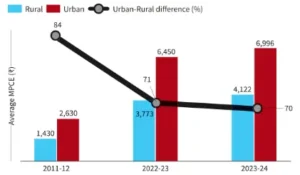
- According to the Household Consumption Expenditure Survey (HCES) 202324, rural MPCE has grown at 3.4% annually in real terms, while urban MPCE grew at 2.9%.
- This shows rural demand is increasingly important for sustaining national growth.
Statewise Trends
- Bihar: Rural growth at 4.7%, urban at 4.6%; both above national averages (3.4% rural, 2.9% urban). Shows strong and balanced growth.
- Odisha: Rural growth 4.5%, urban 4.0%; robust and balanced performance.
- Himachal Pradesh: Rural 4.0%, urban 3.7%; steady growth above national averages.
- Jharkhand & Madhya Pradesh: Rural 3.8% (above average), urban 2.9% (equal to national average). Rural demand drives growth.
- Uttar Pradesh: Rural 3.8% (above average), urban 2.8% (slightly below average). Mixed pattern.
- Rajasthan: Rural 3.4% (equal to average), urban 3.0% (slightly above). Balanced but not leading.
- Chhattisgarh: Rural 3.1% (below average), urban 3.2% (above average). Urban areas pulling ahead.
Key Observations
- Highgrowth quadrant: Bihar, Odisha, Himachal Pradesh show strong performance across both rural and urban sectors.
- Ruraldriven growth: Jharkhand, Madhya Pradesh, Uttar Pradesh.
- Urbandriven growth: Chhattisgarh.
- Steady but average: Rajasthan.
- Rural consumption growth now matches or exceeds urban growth in several States, reversing the traditional urbanled demand pattern.
Significance
- Growth is becoming Statespecific, shaped by local economic conditions and structural factors.
- Rural India is not just catching up but increasingly driving demand, challenging the assumption that cities alone fuel consumption.
- Policy focus must recognise regional diversity in consumption trends to design effective welfare and development strategies.
Conclusion
While Bihar and Odisha lead with balanced expansion, others show uneven patterns. This underscores the need for Statetailored policies to sustain inclusive growth across India’s diverse economic geography.

MATERNAL HEALTHCARE IN INDIA
TOPIC: (GS1) SOCIAL ISSUES: THE HINDU
A recent Lancet study shows that while India has reduced maternal mortality significantly since 1990, progress has slowed after 2015, raising concerns about regional disparities and gaps in healthcare quality.
What is maternal mortality ratio?
- Maternal Mortality: Death of a woman while pregnant or within 42 days of termination of pregnancy, due to causes related to pregnancy or its management (excluding accidental/incidental causes).
- MMR: The number of maternal deaths per 100,000 live births in a given time period.
Maternal Healthcare
- Progress Made: India’s Maternal Mortality Ratio (MMR) fell from 384 (2000) → 80 (2023), an 86% decline.
- Global Context: In 2023, 260,000 women died globally due to pregnancyrelated causes (≈700 deaths/day).
- Persistent Burden: India still accounts for 1 in 10 global maternal deaths; preventable causes include haemorrhage, infections, and hypertension disorders.
- Regional Disparities:
- Kerala, Maharashtra, Tamil Nadu: MMR < 70 (achieved SDG target).
- Assam (195), Madhya Pradesh (173), Uttar Pradesh (167), Bihar (118): lagging behind.
- COVID19 Impact: Pandemic disrupted antenatal visits and institutional deliveries, exposing system fragility.
Challenges in Maternal Healthcare
- Human Resource Shortage: 80% shortfall of specialists at Community Health Centres (RHS 202122).
- Weak Midwifery System: Nurse Practitioner in Midwifery (NPM) initiative still nascent; overreliance on doctors.
- Infrastructure Deficits: Many First Referral Units lack 24×7 readiness; blood banks often nonfunctional.
- Drug Shortages: Intermittent lack of Magnesium Sulfate (for eclampsia) and Oxytocin (for bleeding).
- Overmedicalisation: Caesarean section rate in private hospitals at 47.4% (NFHS5), far above WHO’s 10–15% recommendation.
- Social Determinants:
- Anemia: 57% of women (15–49 years) anemic (NFHS5).
- Early Marriage: 23.3% of women married before 18, leading to higher risks during childbirth.
- Nutrition Inequality: Patriarchal norms cause women to “eat last and least,” worsening malnourishment.
Way forward:
- Respectful Maternity Care (RMC): Ensure dignity, privacy, and allow birth companions.
- MidwiferyLed Care Units (MLCUs): Empower midwives to handle lowrisk deliveries, reducing unnecessary Csections.
- Blood Storage & Transport: Expand hubandspoke blood bank model; ensure treatment of postpartum haemorrhage within the “golden hour.”
- Digital Tracking: Use PM Surakshit Matritva Abhiyan portals to identify highrisk pregnancies early.
- Combat Anemia: Strengthen Anemia Mukt Bharat with ironfolic acid supplementation and nutrition counselling.
- Empower ASHA & Anganwadi Workers: Provide diagnostic tools and incentives for postpartum care monitoring.
Conclusion
India has made remarkable progress in reducing maternal mortality, but slowing momentum and regional gaps threaten SDG 3.1 targets. Achieving maternal health goals requires a shift from infrastructure expansion to equitable, respectful, and holistic care.
ESAFEHER
TOPIC: (GS2) GOVERNANCE: THE HINDU
The Government of India launched the eSafeHER initiative to train one million rural women in safe digital practices, enhancing inclusive and secure digital participation.
About the Initiative
- Objective: Build a genderresponsive, communityled model of digital safety and inclusion.
- Institutional Framework:
- Anchored under Ministry of Electronics & IT’s ISEA Programme.
- Implemented by CDAC in partnership with Reliance Foundation.
- Approach: Communitybased, peerled training through SelfHelp Groups (SHGs).
- Cyber Sakhis: Trained women who spread awareness on safe online practices and digital confidence.
Target & Timeline
- Reach 1 million women in 3 years.
- Scale up nationwide by 2029 through multistakeholder partnerships.
- Initial rollout in Madhya Pradesh and Odisha, later expanded across India.
Significance
- Strengthens cybersecurity awareness at the grassroots level.
- Promotes safe digital transactions and boosts confidence among rural women.
- Integrates with existing women empowerment and digital literacy programmes, ensuring sustainability.
- Helps bridge the digital gender divide, enabling secure participation in India’s growing digital economy.
Conclusion
The eSafeHER programme is a strategic step toward inclusive digital empowerment, ensuring rural women can safely access and benefit from India’s expanding digital ecosystem.
BAISAKHI FESTIVAL
TOPIC: (GS1) INDIAN ART AND CULTURE: THE HINDU
The festival of Baisakhi is being celebrated across Punjab with great devotion and unity, marking the harvest season and the Sikh New Year.
About the Festival
- Nature of Festival: Baisakhi (or Vaisakhi) is a spring harvest festival celebrated mainly in Northern India, especially by the Sikh and Punjabi communities.
- Date & Calendar: Observed on the first day of Vaishakha month in the Hindu solar calendar — usually April 13 or 14.
- Significance:
- Marks the Sikh New Year.
- Farmers express gratitude for a good harvest, symbolizing prosperity and new beginnings.
- In 1699, Guru Gobind Singh founded the Khalsa Panth (Order of the Pure) at Anandpur Sahib, giving Baisakhi deep religious importance.
Regional Variations
- Bengal – Pohela/Poila Boishakh or Nobo Borsho (Bengali New Year).
- Kerala – Vishu, marking the end of the spring equinox.
- Assam – Bohag Bihu, celebrating the Assamese New Year.
- Tamil Nadu – Puthandu, the Tamil New Year.
- Bihar – Vaishakha, honoring Surya, the Sun God.
Cultural Importance
- Promotes community harmony, gratitude, and renewal.
- Reflects India’s agricultural roots and cultural diversity.
- Celebrated with folk dances (Bhangra, Gidda), fairs, and prayers at Gurdwaras, especially the Golden Temple in Amritsar.
Conclusion:
Baisakhi is both a harvest and spiritual festival, symbolizing unity, faith, and prosperity. It connects India’s agrarian traditions with Sikh history, making it one of the most vibrant celebrations of cultural identity and gratitude.
ESAFEHER
TOPIC: (GS2) GOVERNANCE: THE HINDU
The Government of India launched the eSafeHER initiative to train one million rural women in safe digital practices, enhancing inclusive and secure digital participation.
About the Initiative
- Objective: Build a genderresponsive, communityled model of digital safety and inclusion.
- Institutional Framework:
- Anchored under Ministry of Electronics & IT’s ISEA Programme.
- Implemented by CDAC in partnership with Reliance Foundation.
- Approach: Communitybased, peerled training through SelfHelp Groups (SHGs).
- Cyber Sakhis: Trained women who spread awareness on safe online practices and digital confidence.
Target & Timeline
- Reach 1 million women in 3 years.
- Scale up nationwide by 2029 through multistakeholder partnerships.
- Initial rollout in Madhya Pradesh and Odisha, later expanded across India.
Significance
- Strengthens cybersecurity awareness at the grassroots level.
- Promotes safe digital transactions and boosts confidence among rural women.
- Integrates with existing women empowerment and digital literacy programmes, ensuring sustainability.
- Helps bridge the digital gender divide, enabling secure participation in India’s growing digital economy.
Conclusion
The eSafeHER programme is a strategic step toward inclusive digital empowerment, ensuring rural women can safely access and benefit from India’s expanding digital ecosystem.
A recent Lancet study shows that while India has reduced maternal mortality significantly since 1990, progress has slowed after 2015, raising concerns about regional disparities and gaps in healthcare quality.
What is maternal mortality ratio?
- Maternal Mortality: Death of a woman while pregnant or within 42 days of termination of pregnancy, due to causes related to pregnancy or its management (excluding accidental/incidental causes).
- MMR: The number of maternal deaths per 100,000 live births in a given time period.
Maternal Healthcare
- Progress Made: India’s Maternal Mortality Ratio (MMR) fell from 384 (2000) → 80 (2023), an 86% decline.
- Global Context: In 2023, 260,000 women died globally due to pregnancyrelated causes (≈700 deaths/day).
- Persistent Burden: India still accounts for 1 in 10 global maternal deaths; preventable causes include haemorrhage, infections, and hypertension disorders.
- Regional Disparities:
- Kerala, Maharashtra, Tamil Nadu: MMR < 70 (achieved SDG target).
- Assam (195), Madhya Pradesh (173), Uttar Pradesh (167), Bihar (118): lagging behind.
- COVID19 Impact: Pandemic disrupted antenatal visits and institutional deliveries, exposing system fragility.
Challenges in Maternal Healthcare
- Human Resource Shortage: 80% shortfall of specialists at Community Health Centres (RHS 202122).
- Weak Midwifery System: Nurse Practitioner in Midwifery (NPM) initiative still nascent; overreliance on doctors.
- Infrastructure Deficits: Many First Referral Units lack 24×7 readiness; blood banks often nonfunctional.
- Drug Shortages: Intermittent lack of Magnesium Sulfate (for eclampsia) and Oxytocin (for bleeding).
- Overmedicalisation: Caesarean section rate in private hospitals at 47.4% (NFHS5), far above WHO’s 10–15% recommendation.
- Social Determinants:
- Anemia: 57% of women (15–49 years) anemic (NFHS5).
- Early Marriage: 23.3% of women married before 18, leading to higher risks during childbirth.
- Nutrition Inequality: Patriarchal norms cause women to “eat last and least,” worsening malnourishment.
Way forward:
- Respectful Maternity Care (RMC): Ensure dignity, privacy, and allow birth companions.
- MidwiferyLed Care Units (MLCUs): Empower midwives to handle lowrisk deliveries, reducing unnecessary Csections.
- Blood Storage & Transport: Expand hubandspoke blood bank model; ensure treatment of postpartum haemorrhage within the “golden hour.”
- Digital Tracking: Use PM Surakshit Matritva Abhiyan portals to identify highrisk pregnancies early.
- Combat Anemia: Strengthen Anemia Mukt Bharat with ironfolic acid supplementation and nutrition counselling.
- Empower ASHA & Anganwadi Workers: Provide diagnostic tools and incentives for postpartum care monitoring.
Conclusion
India has made remarkable progress in reducing maternal mortality, but slowing momentum and regional gaps threaten SDG 3.1 targets. Achieving maternal health goals requires a shift from infrastructure expansion to equitable, respectful, and holistic care.