Daily Current Affairs 19-January-2026

Share this Post

TACKLING CHILD TRAFFICKING IN INDIA

TOPIC: (GS2) GOVERNANCE: THE HINDU

The Supreme Court in K. P. Kiran Kumar vs State recently issued strict directions to curb child trafficking, calling it a grave violation of the fundamental right to life.

What is Child Trafficking?

  • International Definition (Palermo Protocol, 2000): Recruitment, transport, transfer, harbouring, or receipt of a child for exploitation.
  • Indian Law (BNS, 2023 – Section 143): Trafficking includes recruitment or transfer through threats, force, fraud, coercion, abuse of power, or inducement for exploitation.
  • Scope of Exploitation: Covers sexual and physical abuse, slavery, servitude, forced labour, and organ removal.

Child trafficking Reports (2025)

  • 53,651 children rescued from child labour, trafficking, and kidnapping between April 2024–March 2025.
  • Nearly 90% of rescued children were trapped in the worst forms of child labour (e.g., hazardous industries, bonded labour).
  • Data compiled by the Centre for Legal Action and Behaviour Change (C-LAB) under India Child Protection.

Constitutional Safeguards

  • Article 23: Prohibits trafficking, forced labour, and begar.
  • Article 24: Bans child employment in hazardous industries.
  • Directive Principles (Article 39 e & f): Mandates protection against exploitation and abandonment; ensures healthy development with dignity.

Legislative Framework

  • BNS (Sections 98 & 99): Criminalises selling and buying of minors.
  • Immoral Traffic (Prevention) Act, 1956: Targets trafficking for sexual exploitation.
  • Juvenile Justice Act, 2015: Provides care, protection, and rehabilitation.
  • Criminal Law Amendment Act, 2013: Expands trafficking definition to include slavery, servitude, forced labour, and organ trade.
  • POCSO Act, 2012: Gender-neutral law against sexual offences; includes stringent punishments up to life imprisonment and death penalty. 400 fast-track courts set up for speedy disposal of cases.

Judicial Approach

  • Vishal Jeet vs Union of India (1990): Called trafficking and child prostitution serious socio-economic issues.
  • M. C. Mehta vs State of Tamil Nadu (1996): Issued guidelines against child labour in hazardous industries.
  • Bachpan Bachao Andolan vs Union of India (2011): Directed measures to combat trafficking and exploitation.

Challenges Ahead

  • Socio-economic vulnerabilities: Poverty, unemployment, migration, disasters, and family breakdown push children into risk.
  • Digital threats: Social media and online platforms increasingly used for recruitment under false pretenses.
  • Weak deterrence: Conviction rate between 2018–2022 was only 4.8%.

Way Forward

  • Protect children’s social, economic, and political rights through strong institutions.
  • Improve conviction rates to create deterrence.
  • Strengthen Centre–State cooperation since law and order is a State subject.
  • Focus on rehabilitation, awareness, and community vigilance to break trafficking chains.

Conclusion

Child trafficking undermines India’s constitutional promise of dignity and protection for children. A coordinated legal, judicial, and administrative response—backed by strong Union-State collaboration—is essential to safeguard vulnerable children and dismantle trafficking networks.

ARBITRATION COUNCIL OF INDIA

TOPIC: (GS2) POLITY: THE HINDU

Nearly six years after the 2019 amendment to the Arbitration and Conciliation Act, the Union government has not yet set up the Arbitration Council of India (ACI). Its absence has slowed reforms in India’s arbitration system and global competitiveness.

Arbitration Council of India

  • Proposed under the 2019 amendments based on the B. N. Srikrishna Committee Report (2017).
  • Purpose: Promote and regulate institutional arbitration in India.
  • Functions: Grade arbitral institutions. Recognise professional bodies accrediting arbitrators. Maintain a record of arbitral awards.
  • Leadership: Chairperson to be appointed by the Union government in consultation with the Chief Justice of India.
  • Composition: Former judges or experts, plus ex officio members from the executive.

Concerns Over Independence

  • Heavy government presence raises fears of executive influence in arbitration.
  • Critics argue neutrality may be compromised since the government is India’s largest litigant.

Risks of Government Dominance

  • A regulator with powers to grade institutions and accredit arbitrators could create conflicts of interest.
  • Few global precedents exist for such a government-heavy model in arbitration-friendly countries.

Accreditation Model Issues

  • Inspired by Singapore and Hong Kong but differs in design.
  • Those countries rely on a single strong arbitral institution, not a regulator.
  • Allowing unlimited accreditation may dilute standards, increase costs, and burden administration.

Impact on Global Appeal

  • Exclusion of foreign legal professionals from arbitrator panels reduces India’s attractiveness as an international arbitration hub.
  • Foreign parties may prefer neutral jurisdictions with global expertise.

Way Forward

  • Ad hoc arbitration dominates due to distrust in domestic institutions.
  • To build credibility, India must: Ensure independence of arbitral bodies. Strengthen governance and transparency.
  • Only then can Indian centres compete with global hubs like Singapore and London.

Draft Arbitration Reform Bill, 2024

Key Proposals:

    • Redefine arbitral institutions (broader definition, not limited to court designation).
    • Transfer certain powers from courts to institutions (extend timelines, reduce fees, replace arbitrators).
    • Limit courts’ interim relief powers to two stages: before arbitration begins and after award.
    • Amend Section 9(2): 90-day rule clock to start from filing of interim application.
    • Introduce emergency arbitration (Section 9-A) for quick remedies before tribunal formation.

Conclusion:

India’s arbitration reforms will succeed only if institutional independence and credibility are ensured. Without a truly autonomous Arbitration Council, India cannot position itself as a trusted global arbitration hub.

BALANCING GRID EFFICIENCY AND RENEWABLE ENERGY GROWTH

TOPIC: (GS3) ECONOMY: THE HINDU

The Central Electricity Regulatory Commission (CERC) has proposed new rules linking Inter-State Transmission System (ISTS) connectivity to signed Power Purchase Agreements (PPAs).

Grid Access Rules

  • Current GNA Rules: Developers can get grid connectivity using LoAs, (Letters of Award) partial land proof, or bank guarantees. This allows early project start even before signing PPAs.
  • Role of REIAs: Agencies like SECI, NTPC, NHPC, and SJVN act as intermediaries—buy power from developers (PPAs) and sell to DISCOMs (PSAs). PPAs usually come after PSAs.
  • CERC Proposal: Grid access only after signing PPAs; LoAs will not be accepted. Connectivity may be auctioned with fixed commissioning timelines.
  • Reason for Change: About 31.8 GW has connectivity but no PPAs, and nearly 42 GW projects are stalled due to PPA delays, causing inefficient use of transmission capacity.

Concerns Raised

  • Developers penalised unfairly: PPA delays often caused by slow tariff approvals and inefficiencies in DISCOMs. Punitive measures reduce regulatory certainty.
  • Threat to clean energy targets: Could slow renewable capacity addition, risking 2030 goals. Transmission grid (495,000 circuit km) already struggling to keep pace.
  • Tariff and market risks: Auctioning connectivity may raise tariffs. Favors large players, sidelining smaller developers.

Sector-Specific Issues

  • Solar: State-level approval delays; warned against auction-based distortions.
  • Wind: Manufacturing cycles longer; opposed 18-month deadline, sought 24–30 months.
  • SECI’s View: Auctioning connectivity will raise tariffs; suggested allocation based on readiness (land, finance, equipment).

Challenges and Way Forward

  • Transmission bottlenecks: Expand ISTS proactively to match renewable growth.
  • Delayed PPAs: Reform DISCOM processes with time-bound approvals.
  • Mismatch in timelines: Flexible norms for solar, wind, hybrid projects.
  • Policy uncertainty: Better coordination between CERC, Ministry of Power, and MNRE.
  • Avoid monopolisation: Allocate based on project readiness, not auctions.

Green Energy Growth in India (2025)

Overall Capacity

  • Non-fossil fuel installed capacity: 266.78 GW (up from 217.62 GW in 2024).
  • Annual growth: 22.6% increase in one year.
  • India crossed the 250 GW milestone of non-fossil capacity in August 2025.

Solar Energy

  • Installed capacity: 135.81 GW (PIB data).
  • Annual addition: ~35 GW in 2025 alone.
  • Solar remains the largest contributor to India’s renewable mix.

Wind Energy

  • Installed capacity: 54.51 GW.
  • Annual addition: ~5.8 GW in 2025.
  • Growth slower compared to solar but remains critical for balancing grid supply.

Other Renewables

  • Hydro and biomass continue to contribute but at smaller scales compared to solar and wind.
  • India is also expanding green hydrogen projects as part of its long-term clean energy strategy.

Milestones Achieved

  • India achieved 50% of total installed electricity capacity from non-fossil sources in June 2025, five years ahead of its 2030 Paris Agreement target.
  • The country added 44.5 GW renewable capacity in 2025 (till November), nearly doubling annual additions compared to previous years.

Conclusion

The ISTS connectivity debate reflects the tension between grid efficiency and renewable expansion. While addressing idle capacity is vital, punitive rules risk slowing India’s clean energy journey. A balanced, flexible, and developer-friendly approach is essential to meet climate and energy commitments.

SPACE-BASED SOLUTIONS FOR AI ENERGY DEMAND

TOPIC: (GS3) SCIENCE AND TECHNOLOGY: THE HINDU

Tech companies and space agencies are studying orbital datacentres to tackle the rising electricity demand of artificial intelligence. The idea is to use uninterrupted solar energy in space to power high-density computing systems.

Rising Energy Demand from AI

  • Datacentres are among the fastest-growing electricity consumers worldwide.
  • AI workloads, especially training large models, require clusters of GPUs and accelerators.
  • Unlike traditional cloud datacentres, AI facilities consume huge energy internally for computation.
  • Generative AI adoption has raised concerns about sustainability, carbon emissions, and grid stress.

Concept of Space-Based Datacentres

  • Proposal: Place datacentres in low-Earth orbit, powered entirely by solar energy.
  • Benefits: Continuous sunlight in space ensures uninterrupted power. Avoids land, cooling, and fossil fuel constraints on Earth.
  • Example: Google’s Project Suncatcher envisions satellite clusters with computing hardware operating in choreographed orbits.

Technical Architecture

  • Relies on inter-satellite communication rather than heavy Earth links.
  • AI workloads need high internal bandwidth for parallel processing.
  • Ground communication bandwidth is modest, similar to terrestrial AI systems where user queries are lighter than training data transfers.

Engineering Challenges

  • Radiation exposure: Cosmic rays can degrade chips; long missions remain risky.
  • Thermal management: No atmosphere in space makes cooling difficult; advanced heat dissipation needed.
  • Maintenance: Repairs in orbit are costly and complex, raising reliability concerns.

Economic Viability

  • Launch costs are currently high but may drop to ~$200/kg by mid-2030s.
  • Orbital systems must compete with improving Earth-based solutions like renewable-powered datacentres.
  • Past experiments (e.g., underwater datacentres) showed promise but failed economically.

India’s Interest

  • ISRO is exploring orbital datacentre technologies for commercial and strategic use.
  • Fits India’s goals of expanding AI capacity and renewable energy integration.
  • Aligns with India’s broader push to use space technology for sustainable digital growth.

Conclusion

Space-based datacentres offer a futuristic solution to AI’s energy challenge, but technical risks and high costs remain. India’s involvement signals long-term interest, yet balancing innovation with economic feasibility will be key to success.

CRISIS IN HIGHER EDUCATION

TOPIC: (GS1) SOCIAL ISSUES: THE HINDU

The Supreme Court, while hearing a case on student suicides, issued nine directions to the Centre and States to improve higher education institutions. The Court highlighted poor quality, faculty shortages, and governance issues as major causes of student distress.

Supreme Court’s Directions

  • Invoked Article 142 to ensure immediate reforms in Record-keeping, reporting, and tracking of student suicides separately in HEIs.
  • Two directives to fill vacant posts of Registrars, Vice-Chancellors, and faculty positions.
  • Aims to strengthen institutional capacity and improve student well-being.

Current Challenges in HEIs

  • Vacancies: Many public universities face nearly 50% faculty shortage.
  • Case Study – University of Madras:
    • Once a premier institution with strong research and teaching.
    • No new faculty appointments in the last decade.
    • Teaching strength reduced to half of sanctioned posts.
    • Centres for advanced studies (philosophy, botany, mathematics) weakened.
  • Research decline: Humanities, science, and social science research neglected.
  • Governance hurdles: Vice-Chancellor appointments stalled due to disputes over Governor’s powers.

Structural Issues

  • UGC recruitment process: Filling faculty posts takes at least six months.
  • Budgetary constraints: Need Union government support for funding.
  • Quality concerns: Corruption and politically motivated appointments undermine academic standards.
  • Qualified faculty shortage: Availability of skilled teachers remains a challenge.

Way Forward

  • Resolve governance ambiguity: Clarify Governor’s role in VC appointments.
  • Speed up recruitment: Streamline UGC procedures and ensure timely appointments.
  • Union-State cooperation: Financial and administrative support from the Centre to strengthen State universities.
  • Focus on research revival: Invest in humanities, sciences, and social sciences for balanced growth.
  • Ensure transparency: Merit-based appointments to restore credibility.

Conclusion

The Supreme Court’s order is a wake-up call to address systemic gaps in higher education. Filling vacancies, improving governance, and reviving research are essential steps to build a robust education system. Without these reforms, aspirations like Viksit Bharat will remain incomplete.

CHANG’E-6 MISSION

TOPIC: (GS3) SCIENCE AND TECHNOLOGY: THE HINDU

China’s Chang’e-6 lunar mission has successfully returned samples from the far side of the Moon. Recent analysis of the regolith suggests the Moon was formed after a massive ancient collision between Earth and another celestial body.

About the Mission

  • Part of the Chang’e lunar exploration programme, named after the Chinese Moon goddess.
  • Launched on May 3, 2024 by a Long March-5 rocket from Hainan.
  • First mission to collect and return samples from the far side of the Moon.
  • Spacecraft components: orbiter, returner, lander, ascender.
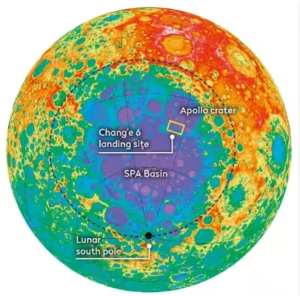
Chang’E-6 lunar mission                                                  

Sampling Techniques

  • Equipped with microwave, laser, and optical sensors for navigation and obstacle detection.
  • Two sampling methods: Drill for subsurface material. Robotic arm for surface collection.
  • Returned samples to Earth in July 2024.

Scientific Importance

  • Landed in the South Pole–Aitken Basin, a 4-billion-year-old crater.
  • Samples may contain material from the Moon’s deep interior, excavated during the ancient impact.
  • Provides clues about the Moon’s origin, geology, and evolution.

Challenges of Far Side Exploration

  • Communication with Earth is difficult; requires relay satellites.
  • Only the second mission to reach the far side (after Chang’e-4 in 2019).

Significance

  • Strengthens China’s position in space exploration and planetary science.
  • Enhances global understanding of the Moon’s formation and resources.
  • Demonstrates advanced capability in sample-return missions, crucial for future deep-space exploration.

IRRAWADDY DOLPHIN

TOPIC: (GS3) ENVIRONMENT: THE HINDU

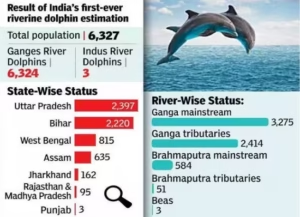
The Ministry of Environment, Forest and Climate Change has started the second nationwide survey of riverine and estuarine dolphins under Project Dolphin, which for the first time will also estimate the Irrawaddy dolphin population in Odisha’s Chilika Lake and the Sundarbans.

About the Species

  • Scientific Name: Orcaella brevirostris
  • A euryhaline dolphin – can survive in freshwater, brackish water, and seawater.
  • Found in discontinuous populations near coasts, estuaries, and rivers of South and Southeast Asia.
Irrawaddy Dolphin

Habitat and Distribution

  • Present in three major rivers:
    • Irrawaddy River (Myanmar)
    • Mahakam River (Indonesia)
    • Mekong River (Cambodia)
  • In India: Mainly in Chilika Lake, Odisha, Also reported in the Sundarbans delta
  • Prefer muddy, brackish waters at river mouths and deltas; rarely move far into the open sea.

Key Features

  • Rounded head and face, no beak – resembles a baby beluga.
  • Moveable lips and neck creases allow expressive facial movements.
  • Grey body with lighter underside.
  • Small dorsal fin; large flippers with curved edges; broad tail.
  • Teeth are short, peg-like, and pointed (~1 cm long).

Conservation Status

  • Listed as Endangered on the IUCN Red List.
  • Threats include habitat loss, pollution, accidental entanglement in fishing nets, and reduced prey availability.

Significance

  • Irrawaddy dolphins are an indicator species for the health of estuarine and coastal ecosystems.
  • Their inclusion in Project Dolphin highlights India’s effort to expand conservation beyond the Ganga river dolphin and protect diverse aquatic biodiversity.

SAMMAKKA-SARALAMMA JATARA

TOPIC: (GS1) INDIAN ART AND CULTURE: THE HINDU

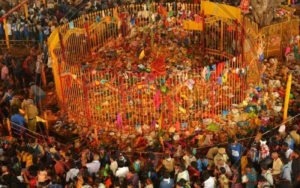
Telangana is preparing for the biennial Sammakka-Saralamma Jatara (Medaram Jatara), considered one of the largest tribal spiritual gatherings in the world.

About the Festival

  • Also called Medaram Jatara.
  • A tribal festival held in Medaram village, located inside Eturnagaram Wildlife Sanctuary in Mulugu district, Telangana.
  • Celebrated once every two years when tribal goddesses are believed to visit their people.
  • Entirely conducted by Koya tribal priests following traditional customs.
Sammakka-Saralamma Jatara (Medaram Jatara)

Historical Background

  • Commemorates the 12th-century revolt led by Sammakka and Saralamma (mother-daughter duo) against the Kakatiya rulers, who imposed taxes on tribals during a severe drought.
  • Symbolises resistance, sacrifice, and tribal identity.

Rituals and Practices

  • Devotees offer bangaram (jaggery) equal to their body weight to the goddesses.
  • Pilgrims take a holy dip in Jampanna Vagu, a tributary of the Godavari River.
  • Rituals highlight faith, sacrifice, and community bonding.

Significance

  • Recognised as one of the largest indigenous religious congregations globally.
  • Acts as a platform for interaction between mainstream society and tribal communities.
  • Promotes cultural harmony, inclusivity, and respect for tribal traditions.
  • Strengthens awareness of tribal heritage and ecological surroundings of Dandakaranya forest belt.

Conclusion

The Sammakka-Saralamma Jatara is not just a spiritual event but a symbol of tribal resistance and cultural pride, making it vital for India’s socio-cultural and heritage landscape.


Write a Review

Your email address will not be published. Required fields are marked *