Table of Contents
ToggleThe study of oceanic temperature involves analyzing how solar energy is absorbed and distributed across the vast marine bodies. Unlike land, the specific heat of water is much higher, meaning it heats up and cools down slowly, acting as a global thermostat.
Factors Affecting the Temperature of Ocean Water
The temperature of the surface water of the oceans varies from place to place. The following factors are responsible for this variation:
A. Latitude
- The temperature of surface water decreases from the Equator towards the Poles because the amount of insolation decreases poleward. The sun’s rays are vertical at the equator and become increasingly slanting toward the higher latitudes.
B. Unequal Distribution of Land and Water
The oceans in the Northern Hemisphere receive more heat due to their contact with larger landmasses than the oceans in the Southern Hemisphere. Consequently, the average temperature of surface water is higher in the Northern Hemisphere (approx. 19°C) compared to the Southern Hemisphere (approx. 16°C).
C. Prevailing Winds
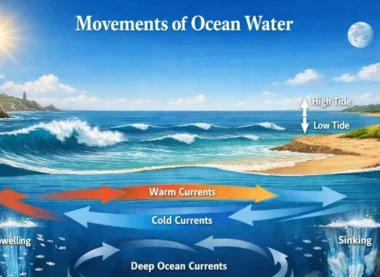
Winds blowing from the land toward the oceans (offshore winds) drive warm surface water away from the coast, causing cold bottom water to rise. This process is called Upwelling. Conversely, onshore winds pile up warm water near the coast, raising the temperature.
D. Ocean Currents
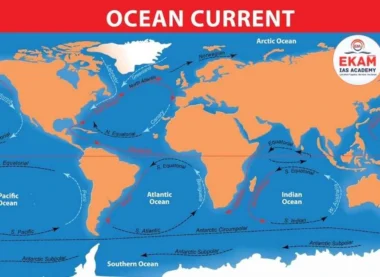
- Warm Currents: These raise the temperature in cold areas. For example, the Gulf Stream increases the temperature of the Eastern coast of North America and the Western coast of Europe.
- Cold Currents: These lower the temperature in warm areas. For example, the Labrador Current lowers the temperature near the North-east coast of North America.
E. Enclosed Seas
Seas in low latitudes that are enclosed by land (e.g., the Red Sea) record higher temperatures than open oceans. Seas in high latitudes (e.g., the Baltic Sea) record lower temperatures due to limited mixing with open ocean waters.
Horizontal Distribution of Temperature
The horizontal distribution refers to the temperature of the surface water across different latitudes.
- Average Temperature: The average temperature of surface water is about 26.7°C at the equator and decreases gradually toward the poles.
- Isotherms: These are lines joining places of equal temperature. In the oceans, isotherms generally run parallel to the latitudes, but they deviate where Ocean Currents or landmasses interfere.
- Highest Temperature: Interestingly, the highest surface temperatures are not recorded at the Equator but slightly north of it, in the sub-tropical high-pressure belts, due to less cloud cover and higher insolation.
Vertical Distribution of Temperature
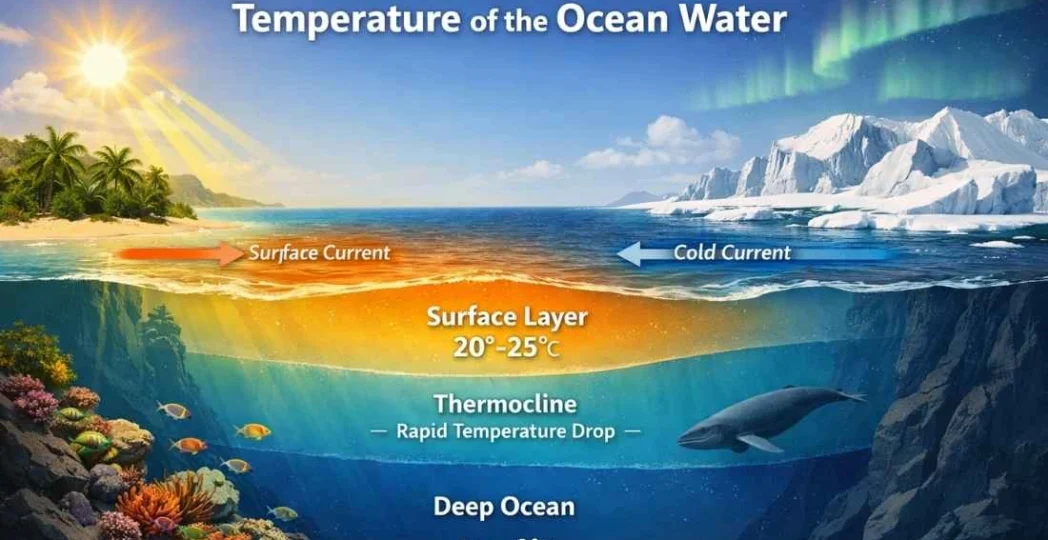
As we go deeper into the ocean, the temperature decreases. However, this decrease is not uniform. The vertical structure is divided into three distinct layers:
Layer 1: The Surface Layer
- Represents the top layer of warm water.
- It is about 500 m thick with temperatures ranging between 20°C and 25°C.
- This layer is present throughout the year in the tropics but develops only during summer in mid-latitudes.
Layer 2: The Thermocline
- This is the intermediate layer characterized by a rapid decrease in temperature with increasing depth.
- It extends from the base of the surface layer down to about 1,000 m.
- About 90% of the total volume of water is found below the Thermocline.
Layer 3: The Deep Layer
- This layer is very cold and extends from 1,000 m to the ocean floor.
- In the Arctic and Antarctic circles, surface water temperatures are close to 0°C, so the temperature change with depth is very slight. Here, the cold water is found from the surface to the deep ocean floor.
Range of Temperature
- Daily (Diurnal) Range: The difference between the maximum and minimum temperature in a day. For oceans, this is negligible (usually less than 1°C) because of the high heat capacity of water.
- Annual Range: The difference between the average temperature of the warmest and coldest months.
- The maximum annual range is recorded in enclosed seas.
- The range is higher in the Northern Hemisphere than in the Southern Hemisphere due to the influence of landmasses.
Significance for UPSC Answer Writing
Understanding ocean temperature is critical for discussing:
- Marine Biodiversity: Coral reefs thrive only in a specific temperature range (20°C to 25°C). Ocean Warming leads to Coral Bleaching.
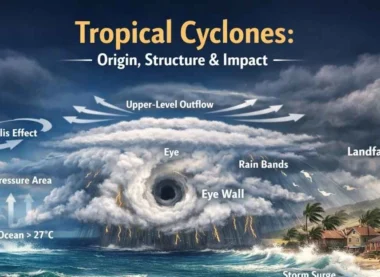
- Cyclone Intensity: Tropical cyclones gain energy from the Latent Heat of warm sea surfaces (>27°C).
- Carbon Sink: Cold water can dissolve more CO2 than warm water. As oceans warm, their ability to absorb greenhouse gases decreases.
UPSC Prelims: PYQs & Practice Questions
Previous Year Questions (PYQs)
1. What is the difference between the anticyclones of the Southern Hemisphere and the Northern Hemisphere? (Theme: Ocean Temperature/Air Interaction - Indirectly tested in various years like 2011/2015)
Q:
(a) Anticyclones in the Northern Hemisphere are colder than Southern Hemisphere.
(b) Direction of air movement (Clockwise in NH, Counter-clockwise in SH).
(c) The temperature of the ocean water does not affect anticyclones.
(d) None of the above.
Answer: (b)
Explanation: Anticyclones (high-pressure systems) rotate clockwise in the Northern Hemisphere and counter-clockwise in the Southern Hemisphere due to the Coriolis effect. Ocean temperature can influence pressure systems, but the key hemispheric difference asked here is the direction of circulation.
2. Which of the following statements is/are correct regarding the 'Thermocline'? (Generic UPSC Pattern)
Q:
1. It is a boundary region where there is a rapid decrease of temperature with increasing depth.
2. About 90% of the total volume of water is found below the thermocline.
Select the correct answer:
(a) 1 only
(b) 2 only
(c) Both 1 and 2
(d) Neither 1 nor 2
Answer: (c) Both 1 and 2
Explanation: The thermocline is the ocean layer where temperature drops rapidly with depth, separating warm surface water from cold deep water. Most ocean water by volume lies in the deep zone below the thermocline, which is why a very large share of total ocean volume is found beneath it.
Practice Questions (Prelims)
Question 1
Q: The highest surface temperature of ocean water is usually recorded at:
(a) The Equator
(b) 20° North Latitude
(c) The North Pole
(d) 60° South Latitude
Answer: (b) 20° North Latitude
Explanation: Although the equator receives the most direct sunlight, it also has heavy cloud cover and high humidity, which reduces insolation. The highest temperatures are found in the sub-tropical high-pressure belts (around 20°N) where the sky is clear.
Question 2
Q: Consider the following factors:
1. Upwelling of cold water.
2. Presence of a warm ocean current.
3. High salinity of the water body.
Which of these can lead to an increase in the surface temperature of the ocean?
(a) 1 and 2 only
(b) 2 and 3 only
(c) 1 and 3 only
(d) 2 only
Answer: (b) 2 and 3 only
Explanation: Warm currents (like the Kuroshio) raise temperatures. High salinity can lead to more heat absorption in the top layer. Upwelling always brings cold water to the surface, thus lowering the temperature.
UPSC Mains – Previous Year & Practice Questions
Previous Year Questions (Mains)
Horizontal Distribution of Ocean Temperature (GS Paper I)
Question: “Explain the factors affecting the horizontal distribution of temperature in the oceans.”
Key Points: Discuss Latitude, Land–water contrast, Prevailing Winds, and Ocean Currents.
Ocean Warming & Coral Bleaching (General Theme)
Question: “Critically analyze the impact of ‘Ocean Warming’ on marine biodiversity with special reference to Coral Bleaching.”
Key Points: Explain how corals have a narrow temperature tolerance and how the expulsion of Zooxanthellae occurs when water warms.
Vertical Stratification of Ocean Temperature (General Theme)
Question: “Discuss the vertical stratification of ocean water temperature. Why does the deep ocean remain cold even at the equator?”
Key Points: Mention the Thermocline and the lack of solar penetration beyond the Photic Zone.
Ocean Currents & Global Heat Redistribution (General Theme)
Question: “How do ocean currents act as a mechanism for global heat redistribution?”
Key Points: Explain the movement of warm water from tropics to poles (e.g., North Atlantic Drift).
Mediterranean & Red Sea Temperature Anomalies (General Theme)
Question: “Account for the variations in the temperature of the Mediterranean Sea and the Red Sea compared to the open Atlantic Ocean.”
Key Points: Discuss the effect of Enclosed Seas and high evaporation rates in low latitudes.
Mains Practice Questions
Arctic Amplification, Ocean Warming & Polar Vortex Stability
Question: “In the context of ‘Arctic Amplification’, examine how rising ocean temperatures are affecting the stability of the Polar Vortex.” (250 words)
Ocean Temperature & Marine Heatwaves: Implications for India’s Blue Economy
Question: “Ocean temperature is a key driver of the ‘Marine Heatwave’ phenomenon. Discuss its implications for the Indian blue economy.” (250 words)
Why Northern Hemisphere Oceans Are Warmer Than Southern Hemisphere Oceans
Question: “Explain why the Northern Hemisphere oceans are on average warmer than the Southern Hemisphere oceans.” (250 words)
Temperature of the Ocean Water - FAQs
Why is the surface temperature of the ocean higher than the bottom?
Water is heated by solar radiation, which cannot penetrate deep into the ocean (usually not beyond 200m). Therefore, the surface absorbs the most heat, while the deep layers remain insulated and cold.
What is 'Upwelling' and how does it affect temperature?
Upwelling is the process where deep, cold, nutrient-rich water rises to the surface to replace water pushed away by winds. This significantly lowers the surface temperature of the ocean in that specific area (e.g., the coast of Peru).
How does salinity affect ocean temperature?
Higher salinity increases the density of water. Denser water can hold more heat, but it also affects the Specific Heat. In general, saltier water in tropical regions can become warmer than fresher water because it absorbs solar energy more efficiently in the top layer.
Does the temperature of the ocean change daily?
The Diurnal Range (daily change) is almost negligible, usually less than 1°C. This is because water has a high Specific Heat and requires a massive amount of energy to change its temperature compared to land.
What is the significance of the 27°C threshold in ocean temperature?
This is the critical temperature required for the formation and intensification of Tropical Cyclones. If the sea surface temperature (SST) is below 27°C, the air lacks the necessary Latent Heat to sustain a cyclonic storm.