THE UN MATTERS AS A SYMBOL OF POSSIBILITY
TOPIC: (GS2) INTERNATIONAL RELATIONS: THE HINDU
Marking 80 years of the United Nations, the discussion highlights its evolution and challenges while emphasizing the need for reforms to keep it effective in a multipolar world.
Background
- The United Nations (UN) was founded in 1945, after World War II, to prevent future wars, uphold human rights, and promote global peace.
- It emerged as a symbol of hope after devastation, meant to replace conflict with cooperation.
- Over eight decades, the UN has evolved from a Cold War-era platform for superpower rivalry to a forum for international dialogue and humanitarian coordination.
Evolution and Achievements
Humanitarian Contributions
- Agencies such as UNHCR, UNICEF, and the World Food Programme (WFP) have provided life-saving assistance to refugees, children, and those hit by disasters and wars.
- The UN peacekeeping missions have helped maintain fragile peace in several conflict zones like East Timor and Namibia.
Norm-Setting Role
- Through its charters, resolutions, and declarations, the UN has shaped global values around human rights, gender equality, and sustainable development.
- The Sustainable Development Goals (SDGs), adopted in 2015, represent a roadmap for inclusive and equitable growth across nations.
Limitations and Criticism
- The UN Security Council (UNSC) reflects 1945 power equations, not the realities of today’s multipolar world.
- The veto system allows powerful nations to block decisions, often leading to inaction on global crises.
- Financial constraints and political interference weaken the UN’s operational capacity.
India’s Stand and Role
- India, as the world’s most populous democracy, major peacekeeping contributor, and rising global power, deserves a permanent seat in the UNSC.
- India advocates for a reformed, inclusive, and representative UN, reflecting modern geopolitical realities.
- Its policy of strategic autonomy aims at cooperation without alignment, promoting fairness and sovereignty in global governance.
Way Forward
- Reform the Security Council: To make it equitable and efficient by including major emerging powers.
- Enhance Agility: Simplify decision-making and embrace digital solutions for quick crisis response.
- Reclaim Moral Leadership: Speak firmly for human rights, justice, and global equity.
- Strengthen Political and Financial Commitment: Member-states must support the UN with funds and political will to sustain its functions.
Conclusion
At 80, the UN remains a symbol not of perfection but of possibility, a forum where humanity’s collective conscience seeks peace through dialogue, not domination. Its future depends on reform, representation, and renewed global trust in multilateralism.
This article has been updated and published in detail on our new platform. Please visit the link below for the latest version:
U.S. SANCTIONS ON RUSSIAN OIL GIANTS
TOPIC: (GS3) ECONOMY: THE HINDU
The United States has imposed fresh sanctions on Russia’s top oil producers, for funding Moscow’s ongoing war in Ukraine. Following the move, India is expected to cut Russian oil imports significantly to comply with the sanctions and align with government policy.
India’s Fuel Imports (2025)
- India is the third-largest oil importer globally.
- Over 85% of crude oil is imported to meet domestic demand.
Background
- The sanctions come amid continued Western pressure on Russia to end its invasion of Ukraine, now in its fourth year.
- Oil and gas revenues form about 25% of Russia’s national budget, and the U.S. aims to weaken this key funding source.
- The U.S. Treasury has given companies time until November 21 to wrap up ongoing transactions with the sanctioned Russian firms.
Key Developments
Sanctions on Russian Oil Majors
- The U.S. Treasury targeted Rosneft and Lukoil, which together produce over 5% of the world’s oil supply.
- These sanctions prohibit global firms from engaging in direct oil trade, transportation, or financing deals with these companies.
- Washington urged its allies to follow suit in isolating Russian energy exports.
Impact on Global Oil Market
- The announcement led to a 3% surge in global oil prices, reflecting supply concerns.
- Market analysts expect short-term volatility as refiners adjust to the new trade rules.
India’s Response and Adjustments
- U.S. President Donald Trump claimed that India had agreed to reduce oil imports from Russia to “almost nothing” by year-end.
- Indian refiners such as Reliance Industries (India’s largest buyer of Russian crude) are preparing to cut or halt Russian oil purchases, including ending deals with Rosneft.
- A Reliance spokesperson said the company would “recalibrate” imports in line with Government of India guidelines.
- State-owned refiners like Indian Oil Corporation (IOC), Bharat Petroleum (BPCL), and Hindustan Petroleum (HPCL) are reviewing documents to ensure compliance and avoid direct trade with sanctioned entities.
Strategic and Economic Implications
- The sanctions highlight the geopolitical tension between energy security and global diplomacy.
- India, which sources cheap crude from Russia to meet domestic demand, faces a balancing act between strategic autonomy and compliance with global sanctions.
- Reduced Russian imports may push India to seek alternative suppliers like Iraq, Saudi Arabia, and the U.S.
Top Crude Oil Suppliers to India (2025)
Country | Share in Imports (Approx.) | Notes |
Russia | ~30% (early 2025) → declining | Was top supplier; now declining due to US sanctions |
Iraq | ~20–22% | Stable supplier; key Middle East partner |
Saudi Arabia | ~17–18% | Traditional supplier; strategic ties |
UAE | ~10% | Increasing role in energy trade |
USA | ~8–10% | Rising imports due to diversification |
Nigeria & Angola | ~5–7% | African sources; used for blending |
Conclusion
The U.S. sanctions on Russian oil majors mark a major escalation in economic pressure on Moscow. India’s move to align with these measures shows its effort to balance global diplomacy while safeguarding national energy interests.
This article has been updated and published in detail on our new platform. Please visit the link below for the latest version:
HOW DO MONSOONS AFFECT TAMIL NADU?
TOPIC: (GS1) GEOGRAPHY: THE HINDU
The northeast monsoon arrived earlier than usual in Tamil Nadu for the second consecutive year, bringing excess rainfall above the long-period average.
Background
- Tamil Nadu receives nearly 48% of its annual rainfall from the northeast monsoon (October–December).
- While rainfall is essential for agriculture and water storage, climate change is causing short, intense rainfall spells that exceed the State’s drainage and storage capacity, leading to widespread flooding.
Impact of Heavy Rainfall
Urban Flooding
- Cities such as Chennai and Madurai face severe waterlogging due to poor drainage and overbuilt areas with impermeable concrete surfaces.
- Floodwaters disrupt transport, damage property, and lead to power cuts as a safety measure. Overflowing sewage mixes with floodwater, creating sanitation and health hazards.
Impact on Agriculture
- Waterlogged fields suffocate crop roots and wash away seeds and nutrients, reducing soil fertility. Fungal infections and pests thrive in prolonged wet conditions.
- Runoff from farmlands carries fertilizers and pesticides into rivers and reservoirs, worsening water pollution.
Health and Environmental Risks
- Stagnant water encourages the breeding of mosquitoes, leading to dengue, malaria, and Japanese encephalitis outbreaks.
- Flooding increases risks of leptospirosis and scrub typhus, particularly in rural and peri-urban areas.
Infrastructure Damage
- Prolonged rainfall raises the groundwater table, weakening building foundations and causing cracks, leaks, and mold growth.
- Roads and public structures lose load-bearing capacity, increasing repair costs and disrupting daily life.
Role of the Mullaperiyar Dam
- The Mullaperiyar Dam, situated in Kerala’s Idukki district but managed by Tamil Nadu, plays a key role in irrigation.
- When Kerala’s catchment areas receive heavy rain, Tamil Nadu must release excess water from the dam to maintain safety.
- This inflow coinciding with Tamil Nadu’s own monsoon rains creates a “double flood impact”, submerging Theni and nearby areas.
Way Forward
- Integrated Flood Management: Coordinate between Kerala and Tamil Nadu to regulate dam releases during overlapping monsoon periods.
- Urban Resilience Planning: Upgrade stormwater drains and restrict construction in flood-prone zones.
- Sustainable Agriculture: Promote flood-tolerant crop varieties and soil conservation measures.
- Public Health Preparedness: Strengthen vector control and disease surveillance after floods.
Northeast Monsoon
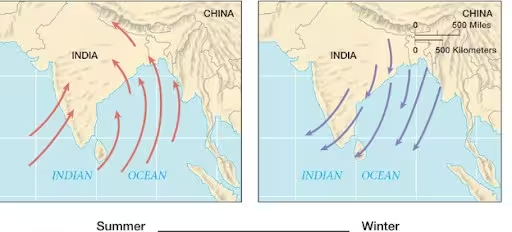
- The Northeast Monsoon (NEM) is the retreating phase of the Indian monsoon.
- It occurs from October to December, after the Southwest Monsoon (June–September) withdraws.
- Winds blow from the northeast direction — that is, from land to sea — hence the name.
- It mainly affects the southern parts of India, especially Tamil Nadu, coastal Andhra Pradesh, south interior Karnataka, and Kerala.
Mechanism
- October: Monsoon withdraws from northern India.
- High pressure forms over the Indian subcontinent.
- Low pressure develops over the Bay of Bengal.
- Winds blow from NE (land) → SW (sea).
- Winds absorb moisture over the Bay of Bengal.
- Moist winds strike the eastern coast of South India, especially Tamil Nadu.
- Result → Northeast Monsoon rains (Oct–Dec).
Conclusion
Tamil Nadu’s recurring floods highlight that “excess rain” is not always beneficial.
Managing inter-State water inflows, improving urban drainage, and adopting climate-resilient planning are essential to transform heavy monsoons from a disaster risk into a sustainable water resource.
This article has been updated and published in detail on our new platform. Please visit the link below for the latest version:
SHOULD INDIA TAKE GLOBAL LEADERSHIP ON CLIMATE CHANGE?
TOPIC: (GS3) ENVIRONMENT: THE HINDU
Ahead of COP30 (Conference of the Parties) to be held in Belém, Brazil, in November 2025, global climate leadership appears weakened as major Western nations step back from commitments.
Background
- The U.S. has withdrawn from the Paris Agreement, while the EU and Brazil have shown limited enthusiasm for leadership.
- As global momentum slows, India’s consistent and steady approach to climate commitments positions it as a potential leader among developing nations.
India’s Climate Progress
- Steady Implementation: India has been implementing its climate commitments responsibly, nearly 50% of India’s installed power capacity now comes from non-fossil fuel sources.
- Renewable Energy Transition: Massive growth in solar, wind, and green hydrogen sectors reflects India’s progress.
- Emission Trends: For the first time, power sector emissions have stabilised, showing a decoupling between energy use and emissions.
Key Priorities for COP30
- Focus on Climate Finance: Greater emphasis on adaptation finance (for agriculture, water, and climate resilience) — not just mitigation projects like EVs and solar power.
- Pipeline of Projects: India must prepare sector-specific, ready-to-invest projects that can attract international climate funding.
- Industrial Emissions Reduction: The industrial sector (cement, steel, etc.) remains hard to decarbonize. India could introduce new NDC targets focusing on electrification and cleaner technologies.
Global Context and Cooperation
- India can lead a new “Axis of Good” — countries collaborating on technology, forests, and renewable energy.
- International cooperation should be driven by shared strategic and security interests, not just charity.
- Global carbon markets and carbon pricing can encourage both innovation and accountability.
Paris Agreement
What is it?
- A global climate treaty adopted in 2015 under the UN Framework Convention on Climate Change (UNFCCC).
- Signed by 195+ countries, including India.
- Legally binding but allows flexibility in national targets.
Key Objectives
- Limit global warming to well below 2°C, preferably 1.5°C above pre-industrial levels.
- Strengthen countries’ ability to adapt to climate impacts.
- Promote low-carbon development and climate finance.
Core Features
- Nationally Determined Contributions (NDCs): Each country sets its own emission reduction targets. Targets are reviewed every 5 years for improvement.
- Climate Finance: Developed countries to provide $100 billion/year to developing nations for climate action.
- Transparency Framework: Countries must report progress on emissions and actions.
- Global Stocktake: Every 5 years, a collective review of global progress.
India’s Role
- India committed to:
- Reduce emissions intensity of GDP by 45% by 2030.
- Achieve 500 GW of non-fossil fuel capacity by 2030.
- Enhance forest cover to absorb carbon.
Conclusion
India is already a model of balanced climate action, showing both ambition and responsibility.
By leveraging its renewable energy success, industrial innovation, and adaptation expertise, India can justifiably take on a leadership role in shaping the global climate agenda — ensuring growth, resilience, and sustainability for all.
This article has been updated and published in detail on our new platform. Please visit the link below for the latest version:
IS PUNJAB’S STUBBLE BURNING PROBLEM REALLY DECLINING?
TOPIC: (GS3) ENVIRONMENT: THE HINDU
With the onset of the paddy harvest season in Punjab, cases of stubble burning have once again drawn attention.
Background
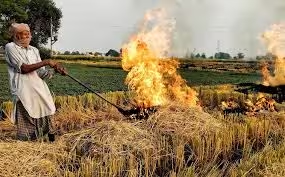
- Punjab, a key rice-producing State, witnesses widespread stubble burning after paddy harvest every year.
- Farmers burn leftover stalks to quickly prepare fields for wheat sowing, as they have only a three-week gap between the two crops.
- The practice is a major contributor to North India’s winter air pollution, especially affecting Delhi and surrounding regions.
Recent Trends
Decline in Reported Fire Incidents
- According to official data, Punjab recorded 10,909 stubble fires in 2024, compared to 36,663 in 2023, showing a 70% drop.
- Authorities attribute this to government measures, stricter enforcement, and subsidised machinery for residue management.
Increase in Burnt Area
- Despite fewer reported fires, the total area affected by burning remained almost the same — 19.17 lakh hectares in 2024 versus 19.14 lakh hectares in 2023.
- In 2022 and 2021, burnt areas were 15.4 lakh ha and 15.6 lakh ha, respectively, indicating a gradual increase in total burnt land.
Reasons for the Data Discrepancy
- Satellite Limitations: Fire incidents are detected using thermal sensors on satellites like MODIS and VIIRS, which pass over Punjab only a few times daily. Since most fires occur in the late afternoon or evening, many go undetected.
- Small and Fragmented Fires: Punjab’s small landholdings mean fires are short, localised, and low-intensity, making them harder to detect than large-scale forest fires.
- Human Evasion: Some farmers, aware of satellite monitoring, disguise or cover burnt fields before satellite overpass times.
- Improved Remote Sensing Tools: Experts suggest using optical sensors like Sentinel-2, which detect burn scars and discolouration post-fire, offering a more accurate picture.
Way Forward
- Integrated Monitoring Approach: Combine thermal and optical satellite data with ground verification surveys for accurate results.
- Emission-Based Assessment: Evaluate stubble burning impact based on fire intensity, fuel load, and duration, not just burnt area.
- Farmer Support Measures: Expand access to machinery for residue management and incentivise crop diversification.
- Awareness and Enforcement: Continue public awareness campaigns and ensure local-level accountability through village monitoring committees.
Conclusion
While Punjab reports fewer fire incidents, the scale of burnt land and emissions remains significant.
A comprehensive monitoring system, backed by technology and ground validation, is vital to ensure that the decline in numbers reflects real environmental improvement, not just data gaps.
This article has been updated and published in detail on our new platform. Please visit the link below for the latest version:
LABELLING AI-GENERATED CONTENT
TOPIC: (GS2) GOVERNANCE: THE HINDU
The Union Government of India has proposed mandatory labelling of AI-generated content through an amendment to the Information Technology (IT) Rules, 2021.
Background
- The rise of Generative AI has made it easy to create realistic fake images, videos, and voices that can mislead people.
- Such synthetic content has been increasingly used in political propaganda, advertising, and social media manipulation.
- Public figures have raised concerns about misuse of their likeness for false or defamatory material.
Government Initiative
- Mandatory Labelling of AI-Generated Content: Proposed under the IT Rules (2021) to ensure users can identify AI-generated or altered media. The goal is to improve digital transparency and reduce misinformation.
- Implementation Framework: The content will carry disclosure tags or watermarks indicating it was created using AI. Data will be monitored through social media platforms and AI companies.
- Industry Support: Companies like Meta already label AI-generated content on Facebook. The Coalition for Content Provenance and Authenticity (C2PA) is developing global standards for digital content verification.
Significance
- Helps protect democratic integrity by limiting the spread of false or manipulated information.
- Builds public trust in digital communication by ensuring authenticity.
- Encourages responsible AI innovation with ethical accountability.
Challenges
- Difficulties in detecting and tracking AI-generated content at scale.
- Risk of over-regulation affecting creativity and free expression.
- Need for Parliamentary oversight, as IT Rules are executive instruments, not legislative acts.
Conclusion
Mandatory labelling of synthetic media is a welcome first step toward transparency and accountability in the AI era. However, it must be paired with strong oversight, public awareness, and adaptive regulation to effectively counter the misuse of AI-generated content.
This article has been updated and published in detail on our new platform. Please visit the link below for the latest version:
MOUNT ETNA
TOPIC: (GS1) GEOGRAPHY: THE HINDU
Why in News:
Recent research on Mount Etna analyzed the ratio of small to large earthquakes beneath the volcano, revealing a strong link with its activity over the past 20 years.
Overview:
- Mount Etna is an active stratovolcano situated on Sicily, an island in the Mediterranean Sea, part of Italy.
- It is located above the convergent boundary where the African Plate meets the Eurasian Plate.
- The volcano is the tallest active volcano in Europe and the highest peak in Italy south of the Alps.
- Height: approximately 3,350 meters (11,000 feet).
- Area: covers about 1,190 sq. km with a basal circumference of 140 km.

Geological Significance:
- Classified as a stratovolcano, characterized by alternating layers of lava and ash.
- Its eruptions are influenced by tectonic activity at the African-Eurasian plate margin.
- The eruptive history extends back around 500,000 years, with at least 2,700 years of documented eruptions.
Cultural and Historical Importance:
- Mount Etna has inspired numerous legends in ancient Greek mythology.
- It is recognized as a UNESCO World Heritage Site for its geological and cultural significance.
Recent Developments:
- Studies show that the ratio of minor to major earthquakes under Mount Etna strongly correlates with volcanic activity.
- Understanding these seismic patterns helps predict potential eruptions and manage risks for nearby communities.

This article has been updated and published in detail on our new platform. Please visit the link below for the latest version:
FACTORIES MUST PROVIDE FACILITIES FOR WOMEN EMPLOYED IN HAZARDOUS JOBS
TOPIC: (GS2) SOCIAL JUSTICE AND HEALTH: THE HINDU
The Tamil Nadu government has proposed amendments to the Tamil Nadu Factories Rules, 1950, allowing women to work in hazardous or dangerous industrial operations from which they were earlier barred.
Background
- Historically, women were prohibited from engaging in dangerous factory operations under labour safety provisions.
- Tamil Nadu has been progressively reforming labour laws — earlier, it allowed women to work night shifts in factories, subject to written consent and safety measures.
- The new proposal extends this empowerment by lifting restrictions on women working in about 20 hazardous operations.
Key Provisions of the Amendment
Inclusion of Women in Hazardous Jobs
- Women can now be employed in operations involving chemicals, glass, lead, gas, petroleum, fireworks, tanning, pesticides, and high-noise industries.
- Only pregnant women and young persons remain excluded for safety reasons.
Written Consent for Night Shifts
- Factories must obtain written consent from women opting to work during night hours.
Focus on Equality
- The move aims to eliminate gender bias and promote women’s participation in all levels of industrial work.
- It challenges the traditional perception of women as “vulnerable” or “in need of protection.”
Challenges and Safeguards Needed
- Workplace Infrastructure: Factories must create gender-sensitive facilities, such as separate toilets, rest areas, changing rooms, and medical examination spaces.
- Health and Safety Measures: Proper protective gear, regular health checks, and training are vital in hazardous environments.
- Monitoring and Implementation: State Labour Departments must actively supervise implementation and prevent coercion of women into unsafe or unwanted roles.
- Avoiding Discrimination: Women should not face penalties for opting out of hazardous work due to health or family reasons.
Significance
- Marks a progressive shift toward gender parity in India’s industrial labour laws.
- Encourages greater economic participation of women, contributing to inclusive growth.
- Sets a precedent for other States to re-examine outdated restrictions and enable equitable opportunities in all sectors.
Conclusion
The reform is a welcome move toward gender inclusivity, but its success depends on creating safe, supportive, and well-equipped workplaces for women. Equality in law must be matched by equality in practice through robust safeguards and sensitivity.
This article has been updated and published in detail on our new platform. Please visit the link below for the latest version: