Table of Contents
ToggleIntroduction
The Vice President of India holds the second-highest constitutional office in the country, after the President. The position was established by the Constitution of India, under Article 63, and plays a dual role:
- Legislative Role – ex-officio Chairman of the Rajya Sabha.
- Executive Role – acts as President in case of resignation, removal, death, or incapacity of the President.
The office ensures continuity in governance and provides stability to the parliamentary system. Since its inception, India has had 15 Vice Presidents from 1952 to 2025.
Constitutional Position
The Vice President’s office is governed by Articles 63–71 of the Constitution. These provisions outline:
Article | Provision |
Article 63 | There shall be a Vice President of India. |
Article 64 | Cannot hold any other paid office; serves as de facto Chairman of the Rajya Sabha. |
Article 65 | Acts as President when the office is vacant or the President is unable to perform duties. |
Article 66 | Election by members of both Houses of Parliament; cannot be a member of Parliament or State Legislature during tenure. |
Article 67 | Term of office: 5 years. |
Article 68 | Procedure for filling vacancies due to resignation, death, or removal. |
Article 69 | Oath or affirmation before the President. |
Article 70 | Temporary discharge of President’s duties in emergencies. |
Election of the Vice President
- Electoral College: Members of Lok Sabha and Rajya Sabha only. State legislatures have no role.
- Voting System: Proportional representation by single transferable vote, similar to the Presidential election.
- Eligibility Criteria:
1.Citizen of India.
2.Minimum age: 35 years.
3.Must not hold any office of profit under Union, State, or local government.
Tenure and Vacancy
- Term: 5 years, but the Vice President continues until a successor is elected.
- Can resign before completing the term.
- Vacancy occurs due to:
- Completion of term
- Resignation
- Death in office
- Removal by resolution of Rajya Sabha, agreed by Lok Sabha
- Election declared invalid by Supreme Court
Note: Unlike the President, there is no formal impeachment process for the Vice President.
Powers and Functions
1. Legislative Role
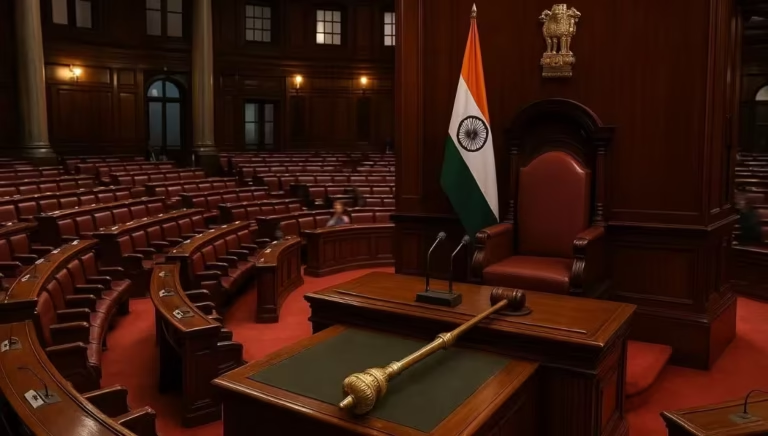
- Ex-officio Chairman of Rajya Sabha:
- Presides over sessions, ensures smooth functioning.
- Powers similar to the Speaker of the Lok Sabha.
- Rules over legislative procedures, conducts voting, and maintains decorum.
2. Executive Role
- Acts as President when the President is unable to perform duties due to:
- Resignation
- Removal
- Death
- Temporary absence or incapacity
- Can hold office as Acting President for a maximum of six months until a new President is elected.
3. Legal Continuity
- If the Supreme Court later declares the election invalid, all decisions taken before remain valid.
Vice Presidents of India (1952–2025)
| S. No | Vice President | Tenure | Presidents During Tenure |
|---|---|---|---|
| 1 | Dr. Sarvepalli Radhakrishnan | 13 May 1952 – 12 May 1962 | Dr. Rajendra Prasad |
| 2 | Dr. Zakir Hussain | 13 May 1962 – 12 May 1967 | Dr. Sarvepalli Radhakrishnan |
| 3 | Varahagiri Venkata Giri | 13 May 1967 – 20 July 1969 | Dr. Zakir Hussain |
| 4 | Gopal Swarup Pathak | 31 Aug 1969 – 30 Aug 1974 | V. V. Giri, Dr. Fakhruddin Ali Ahmed |
| 5 | Basappa Danappa Jatti | 31 Aug 1974 – 30 Aug 1979 | Dr. Fakhruddin Ali Ahmed, Neelam Sanjiva Reddy |
| 6 | Justice Muhammad Hidayatullah | 31 Aug 1979 – 30 Aug 1984 | Neelam Sanjiva Reddy, Giani Zail Singh |
| 7 | Ramaswamy Venkataraman | 31 Aug 1984 – 24 July 1987 | Giani Zail Singh |
| 8 | Shankar Dayal Sharma | 7 Sep 1987 – 24 July 1992 | Ramaswamy Venkataraman |
| 9 | Kocheril Raman Narayanan | 21 Aug 1992 – 24 July 1997 | Shankar Dayal Sharma |
| 10 | Krishan Kant | 21 Aug 1997 – 27 July 2002 | K. R. Narayanan, A. P. J. Abdul Kalam |
| 11 | Bhairon Singh Shekhawat | 19 Aug 2002 – 21 July 2007 | A. P. J. Abdul Kalam |
| 12 | Mohammad Hamid Ansari | 11 Aug 2007 – 10 Aug 2017 | Pratibha Patil, Pranab Mukherjee, Ram Nath Kovind |
| 13 | M. Venkaiah Naidu | 11 Aug 2017 – 11 Aug 2022 | Ram Nath Kovind |
| 14 | Jagdeep Dhankhar | 11 Aug 2022 – 21 July 2025 | Droupadi Murmu |
| 15 | C. P. Radhakrishnan | 9 Sep 2025 – Incumbent | Droupadi Murmu |
Notable Facts:
- Mohammad Hamid Ansari is the only Vice President to serve two full terms.
- First Vice President: Dr. Sarvepalli Radhakrishnan, renowned scholar and philosopher.
Salary and Perks
- Determined by Parliament.
- Current monthly salary: ₹1.25 lakh (as Chairman of Rajya Sabha).
- Entitled to official residence, allowances, and security arrangements.
Key Differences Between President and Vice President
| Feature | President | Vice President |
|---|---|---|
| Constitutional Rank | First citizen, head of state | Second-highest constitutional office |
| Legislative Role | No formal legislative role | Ex-officio Chairman of Rajya Sabha |
| Election | Elected by MPs + elected MLAs | Elected by MPs only |
| Removal | Impeachment for violation of Constitution | Simple resolution in Rajya Sabha, agreed by Lok Sabha |
| Acting Role | N/A | Acts as President in case of vacancy or incapacity |
| Tenure | 5 years | 5 years |
Conclusion
The Vice President of India plays a dual and crucial role in the governance and stability of the country:
- Ensuring legislative order in the Rajya Sabha.
- Acting as a constitutional safeguard by assuming presidential duties when necessary.
Though the role is often less visible than the President, it is vital for continuity, parliamentary discipline, and national governance.
Prelims Practice Questions
Q1. Who appoints the judges of the Supreme Court of India?
A) Prime Minister
B) Chief Justice of India
C) President
D) Parliament
Answer: C) President
Under Article 124(2), the President appoints the judges of the Supreme Court after consultation with judges as deemed necessary.
Q2. Which article of the Constitution provides for the office of the President of India?
A) Article 52
B) Article 53
C) Article 61
D) Article 74
Answer: A) Article 52
Article 52 states that there shall be a President of India, establishing the office of the President.
Q3. The President of India is elected by:
A) Members of both Houses of Parliament only
B) Members of Legislative Assemblies of States only
C) Electoral college of elected MPs and MLAs
D) All citizens of India
Answer: C) Electoral college of elected MPs and MLAs
The President is elected by an electoral college comprising elected members of both Houses of Parliament and State Legislative Assemblies.
Q4. Which of the following statements is correct regarding the impeachment of the President?
A) Initiated by one-fourth of members of Parliament
B) President can be removed by majority vote in Rajya Sabha alone
C) Requires two-thirds majority of both Houses
D) Has never been attempted in India
Answer: C) Requires two-thirds majority of both Houses
Article 61 provides that impeachment requires a two-thirds majority in both Houses for proven violation of the Constitution.
Q5. The maximum tenure of an acting President in case of vacancy is:
A) 3 months
B) 6 months
C) 1 year
D) Until the next Parliament session
Answer: B) 6 months
As per Article 62(1), an election to fill the vacancy must be held within six months.
Q6. The Vice President of India is:
A) Elected by members of both Houses of Parliament and State Legislatures
B) Elected only by members of both Houses of Parliament
C) Appointed by the President
D) Elected by Rajya Sabha members only
Answer: B) Elected only by members of both Houses of Parliament
As per Article 66, the Vice-President is elected by an Electoral College consisting of members of both Houses of Parliament.
Q7. Who was the first Vice President of India?
A) Zakir Hussain
B) V. V. Giri
C) Sarvepalli Radhakrishnan
D) Ramaswamy Venkataraman
Answer: C) Sarvepalli Radhakrishnan
Dr. Sarvepalli Radhakrishnan served as the first Vice-President of India from 1952 to 1962.
Q8. The Vice President acts as Chairman of which House?
A) Lok Sabha
B) Rajya Sabha
C) Both Houses
D) None
Answer: B) Rajya Sabha
The Vice-President is the ex-officio Chairman of the Rajya Sabha.
Q9. Articles 63–71 of the Constitution deal with which office?
A) President
B) Prime Minister
C) Vice President
D) Council of Ministers
Answer: C) Vice President
Articles 63–71 in Part V of the Constitution define the office, election, and powers of the Vice-President of India.
Q10. Which statement is true about removal of the Vice President?
A) Can be impeached like the President
B) Can be removed by Rajya Sabha resolution agreed by Lok Sabha
C) Cannot be removed under any circumstances
D) Removed by Supreme Court
Answer: B) Can be removed by Rajya Sabha resolution agreed by Lok Sabha
Under Article 67(b), the Vice-President can be removed by a resolution of the Rajya Sabha agreed to by the Lok Sabha.
Q11. Who appoints the Prime Minister of India?
A) Chief Justice of India
B) President of India
C) Lok Sabha Speaker
D) Council of Ministers
Answer: B) President of India
Under Article 75(1), the President appoints the Prime Minister and other ministers on the Prime Minister’s advice.
Q12. Which article of the Constitution mentions the appointment of the Prime Minister?
A) Article 75
B) Article 74
C) Article 52
D) Article 65
Answer: A) Article 75
Article 75 deals with the appointment, tenure, and responsibilities of the Prime Minister and the Council of Ministers.
Q13. The Prime Minister is responsible for:
A) Summoning Parliament sessions
B) Advising President on appointments of key officials
C) Presenting the Union Budget
D) All of the above
Answer: D) All of the above
The Prime Minister performs all these roles as the head of the Council of Ministers and leader of the government.
Q14. The Prime Minister’s term depends on:
A) Fixed 5-year term
B) Confidence of Lok Sabha
C) Pleasure of the President alone
D) Chief Justice of India
Answer: B) Confidence of Lok Sabha
The Prime Minister remains in office as long as they enjoy the confidence of the Lok Sabha.
Q15. Which body assists the Prime Minister in administrative and policy functions?
A) UPSC
B) PMO
C) Finance Commission
D) National Security Council
Answer: B) PMO
The Prime Minister’s Office (PMO) assists in policy coordination, administration, and decision-making at the highest level.
Mains Practice Questions
Q1. Examine the constitutional role and significance of the Vice President of India in the parliamentary system.
Q2. Discuss the election process, tenure, and eligibility criteria for the Vice President of India. How does it differ from the President’s election?
Q3. Critically analyze the legislative and executive powers of the Vice President of India. How does this dual role strengthen the functioning of Indian democracy?
Q4. Compare and contrast the roles, powers, and removal process of the President and Vice President of India.
Q5. “The Vice President of India is a constitutional safeguard ensuring continuity of governance.” Comment with suitable examples.
Q6. Trace the evolution of the office of Vice President in India since 1952 and examine the contributions of any three Vice Presidents to parliamentary and national governance.
Vice President of India – UPSC FAQ Guide
Who is the Vice President of India and what is the role?
The Vice President of India is the ex-officio Chairman of Rajya Sabha and can act as Acting President under Article 65.
How is the Vice President of India elected?
Elected by Members of Parliament (Lok Sabha + Rajya Sabha) using proportional representation, single transferable vote under Article 66.
What are the eligibility criteria for Vice President of India?
Indian citizen, 35+ years, eligible for Rajya Sabha, and no office of profit (Vice President eligibility).
What are the powers of the Vice President of India?
Presides over Rajya Sabha proceedings, maintains parliamentary procedure, and serves as Acting President during a vacancy/incapacity.
What is the tenure and removal process of the Vice President of India?
Tenure: 5 years; removal by Rajya Sabha resolution (effective majority) agreed to by Lok Sabha—no impeachment process.