
Daily Current Affairs 27-October-2025

Share this Post

THE CONTOURS OF CONSTITUTIONAL MORALITY

TOPIC: (GS2) INDIAN POLITY: THE HINDU

The concept of constitutional morality has regained attention in recent legal and political debates, highlighting its importance in ensuring ethical conduct by constitutional authorities and protecting democratic values in India.

Morality and Law

  • The connection between morality and law has long intrigued thinkers and jurists.
  • Historically, in India, the idea of dharma encompassed both legal and moral duties.
  • The courts have often debated whether law should lead or follow societal morality — for instance, abolition of untouchability (law leading morality) or gender equality (law following morality).

Emergence of Constitutional Morality

  • The term “constitutional morality” was first used by historian George Grote in his book History of Greece (1846).
  • It meant a deep respect for the Constitution’s forms, institutions, and procedures, while allowing free expression and lawful dissent.
  • Dr. B.R. Ambedkar borrowed this idea during the Constituent Assembly Debates, stressing that India must cultivate constitutional morality for democracy to thrive.
  • He famously remarked that democracy in India was only a “top dressing on an undemocratic soil,” implying that true democratic behaviour must be learned and practiced.

Meaning and Scope

  • Constitutional morality refers to adherence to the principles, values, and spirit of the Constitution by all — citizens and officials alike.
  • It ensures that actions of state functionaries respect rule of law, fairness, equality, and justice, beyond mere legal compliance.
  • It acts as a moral compass guiding decision-making in public life.

Judicial Interpretations

  • P. Rathinam vs Union of India (1994): Linked law to moral principles ensuring fairness and justice.
  • Sabarimala Case (2018): The Supreme Court equated public morality with constitutional morality, emphasizing equality and rights over social customs.
  • Manoj Narula vs Union of India: Court held that constitutional morality demands adherence to rule of law and ethical governance, though ultimate responsibility lies with political leadership.
  • NCT of Delhi vs Union of India: Court expanded the idea to include cooperation, dialogue, and respect among institutions.
  • K.S. Puttaswamy (Privacy Case): The state must act with constitutional morality, avoiding arbitrariness and upholding citizens’ rights.

Importance

  • Serves as the ethical foundation of democracy.
  • Prevents misuse of power by ensuring that constitutional offices act within moral and legal boundaries.
  • Encourages accountability not only in courts but also before Parliament and the electorate.
  • Strengthens inclusivity and equality, vital for India’s pluralistic society.

Conclusion

Constitutional morality is the living spirit of the Indian Constitution — it ensures justice, liberty, and equality beyond mere words. As Ambedkar envisioned, nurturing it is essential to transform democracy from a formality into a true way of life.

This article has been updated and published in detail on our new platform. Please visit the link below for the latest version:

👉 Read the full article on ekamiasacademy.in

INDIA–ASEAN TIES MAKING STEADY PROGRESS

TOPIC: (GS2) INTERNATIONAL RELATIONS: THE HINDU

Prime Minister Narendra Modi, addressing the 22nd India–ASEAN Summit held in Kuala Lumpur, reaffirmed that the India–ASEAN strategic partnership continues to grow even amid global uncertainties.

India–ASEAN Relations

  • ASEAN (Association of Southeast Asian Nations) is a 10-member regional group focused on political, economic, and security cooperation.
  • India became a sectoral dialogue partner in 1992, a full dialogue partner in 1996, and a strategic partner in 2012.
  • The relationship was elevated to a Comprehensive Strategic Partnership in 2022, marking 30 years of formal ties.
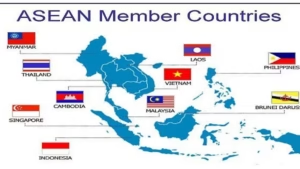
Asean Members Countries

Highlights of PM Modi’s Remarks

  • Strengthening Strategic Partnership: India–ASEAN relations continue to grow steadily despite global uncertainties, forming a vital pillar for regional peace, stability, and development.
  • Cultural and Historical Bonds: Rooted in shared heritage, traditions, and values, India and ASEAN together represent a significant portion of the world’s population, enhancing their global influence.
  • Deepening Maritime and Economic Cooperation: India announced 2026 as the Year of Maritime Cooperation to boost security and connectivity, while both sides work to modernise the ASEAN–India Trade in Goods Agreement (AITIGA) to expand trade and investment opportunities.
  • Shared Vision for a Resilient Future: As partners in the Global South, India and ASEAN are collaborating on digital inclusion, food security, renewable energy, counterterrorism, and people-to-people exchanges under the Act East Policy framework.

Malaysian Prime Minister’s Remarks

  • Malaysian PM Anwar Ibrahim, co-chairing the summit, praised the trust and friendship anchoring India–ASEAN ties.
  • He noted progress in trade, education, food security, and technology cooperation through the ASEAN–India Plan of Action (2026–2030).

Strategic Significance

  • Strengthens India’s Indo-Pacific outreach and maritime diplomacy.
  • Enhances India’s role in regional supply chains and the digital economy.
  • Reinforces ASEAN centrality in India’s foreign policy and counters China’s growing influence in the region.

Way Forward

  • Early conclusion of the revised AITIGA to deepen trade integration.
  • Expand maritime and digital cooperation through joint exercises and technology sharing.
  • Promote connectivity and infrastructure projects under the Act East Policy.
  • Increase people-to-people exchanges through education and tourism initiatives.

Conclusion

The India–ASEAN partnership continues to evolve as a pillar of regional peace and prosperity.
Through initiatives in trade, maritime security, and digital connectivity, both sides are shaping a stable and inclusive Indo-Pacific future.

This article has been updated and published in detail on our new platform. Please visit the link below for the latest version:

👉 Read the full article on ekamiasacademy.in

WINDING UP THE CLOCK OF INDIA–NEPAL ECONOMIC TIES

TOPIC: (GS2) INTERNATIONAL RELATIONS: THE HINDU

The Reserve Bank of India (RBI) recently introduced new measures to internationalise the Indian Rupee, which are expected to strengthen India–Nepal economic and trade relations by easing credit and promoting INR-based transactions.

Strengthening Rupee Linkages

  • On October 1, 2025, the RBI Governor announced three key steps to promote cross-border rupee transactions with Nepal, Bhutan, and Sri Lanka.
  • These reforms aim to expand the role of the Indian Rupee (INR) in regional trade, investment, and lending, which could reshape the India–Nepal economic partnership.

Key RBI Measures

  • INR Lending to Non-Residents: Indian authorised dealer (AD) banks can now lend in rupees to non-residents from Nepal for trade and business activities.
  • Special Rupee Vostro Accounts: RBI now allows foreign banks to use these accounts for investing in corporate bonds and commercial papers in India, expanding beyond government securities.
  • Transparent Currency Reference Rate: RBI will establish a benchmark rate for major trading currencies to enable INR-based international transactions with greater transparency.

Economic Context in Nepal

  • Nepal’s economy, still recovering from the COVID-19 slowdown, suffers from weak industrial growth and tight domestic lending.
  • Local banks’ cautious lending policies, dominated by major industrial groups, have limited access to credit for smaller businesses.
  • These factors have slowed supply chains, reduced domestic demand, and contributed to unemployment and political instability.

Impact on India–Nepal Trade

  • India is Nepal’s largest trading and investment partner, accounting for around two-thirds of Nepal’s total trade.
  • Nepal’s exports to India include edible oil, jute, tea, and coffee, while India exports goods worth billions annually.
  • RBI’s lending reform will help remove credit bottlenecks, boost joint ventures, and enable value-added exports from Nepal to global markets.

Strategic and Financial Implications

  • Promoting the INR as a trade currency will reduce Nepal’s dependence on the U.S. dollar, insulating its economy from exchange rate volatility.
  • The reform could ease foreign currency shortages, lower Nepal’s current account deficit, and strengthen overall macroeconomic stability.
  • Both countries should coordinate closely — the Nepal Rastra Bank (NRB) must align its regulations with RBI guidelines to ensure smooth implementation.

Conclusion

RBI’s new rupee-linked reforms open fresh avenues for India–Nepal trade and investment.
If implemented wisely, they can lay the foundation for a more balanced and resilient economic partnership between the two neighbours.

This article has been updated and published in detail on our new platform. Please visit the link below for the latest version:

👉 Read the full article on ekamiasacademy.in

MOST PEOPLE EXTRADITED TO INDIA ARE ECONOMIC OFFENDERS

TOPIC: (GS2) INTERNATIONAL RELATIONS: THE HINDU

A Belgian court recently cleared the way for the extradition of fugitive businessman Mehul Choksi, one of the main accused in the Punjab National Bank scam, marking a key moment in India’s efforts to bring back economic offenders.

India’s Push for Extradition

  • India has intensified its global campaign to extradite fugitives accused of economic offences, terrorism, and serious crimes.
  • The Ministry of External Affairs and investigative agencies have been coordinating with foreign governments to ensure that offenders face trial in India.
  • India currently has extradition treaties with 48 countries and arrangements with 12 others, enabling cooperation in criminal cases.

Recent Developments

  • Mehul Choksi Case: The Belgian court ruled that Choksi’s claims of potential mistreatment in Indian jails were unsubstantiated. India assured Belgium about humane conditions and fair trial standards.
  • U.K. Cooperation: A U.K. Crown Prosecution Service team inspected Tihar Jail to assess conditions before extraditing economic fugitives such as Vijay Mallya and Nirav Modi.

Trends in Extradition Data

  • Increased Efforts: India made 133 extradition requests in the past five years, including 39 in 2024, the highest during 2020–2024.
  • Foreign Requests: India also received 79 extradition requests from other countries in the same period.
  • Dominant Offences:
    • Economic crimes (35%) — fraud, forgery, and cheating.
    • Terror-related offences (27.5%) — including cases like Tahawwur Rana (26/11 conspiracy).
    • Murder and violent crimes (21%) — also among common reasons for extradition.
    • Other cases include drug trafficking and sexual offences.

Country-Wise Breakdown

  • Extraditions have been secured from 26 countries since 2002.
  • UAE and the U.S. together account for 46% of all extraditions, with 25 from UAE and 12 from the U.S.
  • Other countries include Canada, U.K., Thailand, and Mauritius.

Significance

  • India’s proactive extradition efforts reflect a stronger global stance against financial crimes and terrorism.
  • Successful cases enhance judicial credibility and deterrence against economic fugitives who flee abroad.

Conclusion

India’s growing success in extraditing fugitives—especially economic offenders—signals its determination to uphold accountability across borders. Strengthened diplomatic cooperation and legal assurances are key to sustaining this momentum.

This article has been updated and published in detail on our new platform. Please visit the link below for the latest version:

👉 Read the full article on ekamiasacademy.in

IUCN FLAGS INDIAN HERITAGE SITES AS ECOLOGICALLY VULNERABLE

TOPIC: (GS3) ENVIRONMENT: THE HINDU

The International Union for Conservation of Nature (IUCN) in its World Heritage Outlook 4 Report has flagged India’s World Heritage Sites of “significant concern” due to increasing environmental threats.

IUCN’s World Heritage Outlook 4 Report

  • The World Heritage Outlook 4 (2025) evaluates over 200 natural and mixed World Heritage Sites globally, assessing their conservation status and threats.
  • It classifies sites into four categories:
    Good, Good with some concerns, Significant concern, and Critical.
  • For the first time, the share of sites with a positive conservation outlook has declined notably, indicating worsening protection levels.

Major Threats Identified in South Asia

  • Climate Change: Rising temperatures and changing rainfall patterns are damaging habitats and altering species distribution.
  • Tourism Pressure: Unregulated tourism leads to waste generation, habitat disturbance, and increased human–wildlife conflict.
  • Invasive Alien Species: Non-native plants such as eucalyptus and acacia threaten native flora and forest structure.
  • Infrastructure Development: Roads, hydropower dams, and railways are fragmenting habitats and increasing wildlife mortality.
  • Additional issues include forest fires, illegal logging, encroachments, hunting, and waste disposal.

Status of Indian World Heritage Sites

  • Significant Concern: Western Ghats, Manas National Park, Sundarbans National Park.
  • Good with Some Concerns: Kaziranga, Keoladeo, Nanda Devi–Valley of Flowers, Great Himalayan National Park.
  • Good: Khangchendzonga National Park, Sikkim.

Why the Western Ghats Are Endangered

  • Among the world’s oldest mountain ranges, the Western Ghats host high biodiversity with over 300 threatened species.
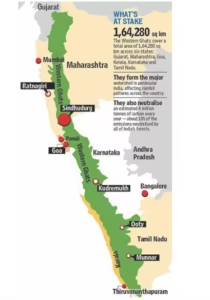
IUCN FLAGS INDIAN HERITAGE SITES AS ECOLOGICALLY VULNERABLE

  • Major challenges include:
    • Construction of hydropower and dam projects like the Sillahalla Pumped Storage Project.
    • Expansion of agriculture and plantations replacing native ecosystems.
    • Climate-induced shifts forcing species to move to higher altitudes.
    • Garbage and plastic waste from tourism affecting wildlife.
    • Spread of invasive species degrading forest health.

Threats to the Sundarbans

  • Increasing salinity, heavy metal contamination, and unsustainable resource extraction threaten mangrove health.
  • Sea-level rise and frequent cyclones further reduce biodiversity and habitat stability.

Global Context and Significance

  • Natural World Heritage Sites cover less than 1% of Earth’s surface, yet sustain over 20% of global species richness.
  • The report aligns with the Kunming–Montreal Global Biodiversity Framework, urging urgent conservation action to prevent biodiversity collapse.

INTERNATIONAL UNION FOR CONSERVATION OF NATURE (IUCN)

  • The IUCN is a global organization founded in 1948 that works for the conservation of nature and sustainable use of natural resources.
  • Key Function:
    It maintains the IUCN Red List of Threatened Species, which assesses the extinction risk of plant and animal species worldwide.
  • Headquarters & Membership:
    Headquartered in Gland, Switzerland, it brings together governments, NGOs, and experts from around the world to promote biodiversity conservation and environmental policy-making.

Conclusion:
The IUCN report serves as a warning and a roadmap — urging India and other nations to strengthen conservation, regulate tourism and infrastructure, and restore natural ecosystems to safeguard their priceless biodiversity.

This article has been updated and published in detail on our new platform. Please visit the link below for the latest version:

👉 Read the full article on ekamiasacademy.in

INDIA’S FIRST ASTRONOMICAL HERITAGE SITE IN LADAKH

TOPIC: (GS3) SCIENCE AND TECHNOLOGY: THE HINDU

The Hanle Dark Sky Reserve in Ladakh has gained attention for successfully combining astronomy, conservation, and local development. It is India’s first designated dark sky reserve, preserving clear Himalayan skies and promoting sustainable astro-tourism.
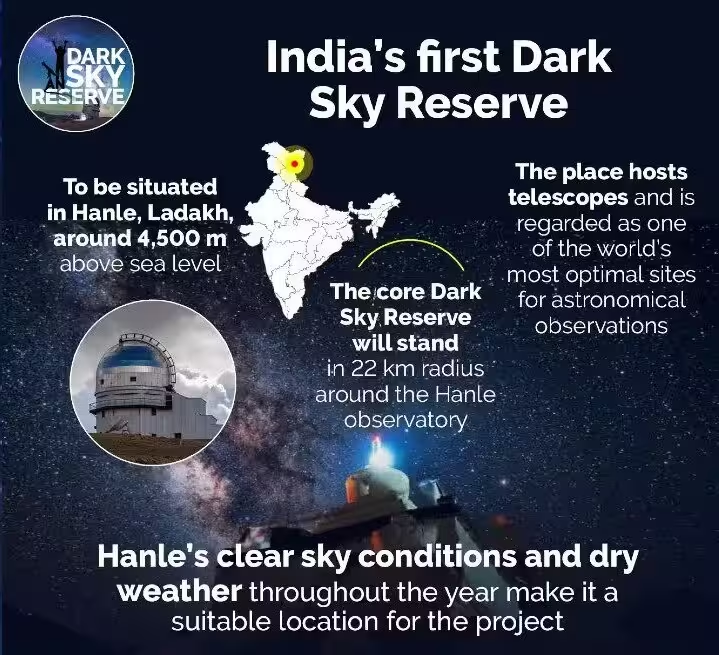
India's First Dark Sky Reserve

About Hanle Dark Sky Reserve

  • Located in Hanle village, Ladakh, within the Changthang Wildlife Sanctuary.
  • Recognised as one of the world’s darkest sites (Bortle-1 rating) — ideal for astronomical observation.
  • Established under a MoU between the Indian Institute of Astrophysics (IIA), the UT of Ladakh, and the Ladakh Autonomous Hill Development Council (LAHDC).
  • Managed with the aim of reducing light pollution and encouraging science-based tourism.

Key Features and Initiatives

  • Astronomical Facilities
    • Hosts major telescopes: Himalayan Chandra Telescope, GROWTH India Telescope, and Cherenkov Gamma-Ray Telescopes for space observation.
    • The clear, dry atmosphere and low humidity make it ideal for high-quality celestial studies.
  • Light Pollution Control
    • IIA has distributed warm-toned bulbs, blackout curtains, and lampshades to the local community.
    • Strict regulations are in place to maintain the reserve’s dark environment.
  • Community Involvement
    • Around 25 local youth (18 women) have been trained as “Astronomy Ambassadors.”
    • These ambassadors conduct night-sky tours, promoting astro-tourism and earning additional income.

Star Party and Astro-Tourism

  • The reserve hosts an annual “Star Party” for astronomers, students, and enthusiasts.
  • Activities include stargazing, astrophotography, and astronomy lectures under pristine skies.
  • Participants experience rare celestial events such as the zodiacal light, gegenschein, and Belt of Venus.
  • The event encourages scientific learning, public outreach, and sustainable tourism.

Impact on Local Economy and Education

  • Tourism has significantly boosted the livelihood of locals, with around 10,000 visitors recorded in 2024.
  • Astronomy Ambassadors also teach local students about science and traditional sky-related folklore.
  • Initiatives like the proposed mini planetarium and “Astroglobe” dome aim to expand astrotourism even during harsh winters.

Challenges

  • High altitude and low oxygen levels pose health challenges for visitors.
  • Maintaining balance between tourism and conservation is crucial to prevent environmental damage.

Significance

  • Hanle represents India’s integration of science with community-led conservation.
  • It demonstrates how astronomy, culture, and sustainability can coexist and generate local benefits.
  • Serves as a model for future dark-sky conservation efforts in other ecologically sensitive regions.

This article has been updated and published in detail on our new platform. Please visit the link below for the latest version:

👉 Read the full article on ekamiasacademy.in

SWAMIH FUND

TOPIC: (GS3) ECONOMY: THE HINDU

The Reserve Bank of India (RBI) has decided to exempt the government-backed SWAMIH Fund from its recently tightened regulations for Alternate Investment Funds (AIFs), ensuring continued support for stalled housing projects.

About the SWAMIH Fund

  • Establishment: The SWAMIH Fund was launched in 2019 by the Ministry of Finance to revive stalled real estate projects and provide last-mile funding for affordable and mid-income housing.
  • Management: It is managed by SBICAP Ventures Ltd, a subsidiary of the State Bank of India.
  • Fund Type: The Fund is registered as a Category-II AIF (debt fund) under the Securities and Exchange Board of India (SEBI).
  • Purpose: Acts as the lender of last resort for financially stressed but viable real estate projects, enabling homebuyers to receive delayed flats and boosting sector confidence.

Eligibility Criteria

  • The project must be registered under RERA (2016).
  • It should be stalled, delayed, or classified as a Non-Performing Asset (NPA) or under insolvency proceedings.
  • Funding is restricted to affordable and mid-income housing segments.

Significance

  • Helps revive housing demand, restore investor trust, and ensure timely delivery to homebuyers.
  • Supports the government’s vision of “Housing for All” while stabilising the real estate sector.

This article has been updated and published in detail on our new platform. Please visit the link below for the latest version:

👉 Read the full article on ekamiasacademy.in

ICGS AJIT AND ICGS APARAJIT

TOPIC: (GS3) SEQURITY: THE HINDU

The Indian Coast Guard (ICG) recently launched two new Fast Patrol Vessels (FPVs) — ICGS Ajit and ICGS Aparajit — at Goa Shipyard Limited (GSL), enhancing coastal security and maritime surveillance capabilities.

ICGS AJIT AND ICGS APARAJIT

About the Vessels

  • ICGS Ajit and ICGS Aparajit are the seventh and eighth vessels in a series of eight indigenously built Fast Patrol Vessels (FPVs).
  • Built by: Goa Shipyard Limited (GSL) under the government’s “Make in India” initiative.
  • Design & Specifications: Each vessel is 52 metres long, with a displacement of 320 tonnes, ensuring high endurance for long patrol missions.
  • Propulsion: Equipped with Controllable Pitch Propellers (CPP) for superior speed, agility, and operational efficiency in coastal waters.

Operational Roles

  • Perform multi-mission tasks such as:
    • Coastal and offshore patrols
    • Anti-smuggling and anti-piracy missions
    • Search and rescue operations
    • Fisheries protection and maritime surveillance around India’s Exclusive Economic Zone (EEZ) and island territories

About the Indian Coast Guard

  • Established: 1978 under the Coast Guard Act, 1978
  • Headed by: Director General, Indian Coast Guard (DGICG)
  • Ministry: Operates under the Ministry of Defence
  • Headquarters: New Delhi

Functions:

  • Safeguard offshore installations and artificial islands
  • Assist fishermen in distress
  • Prevent and control marine pollution
  • Enforce the Maritime Zones of India Act

This article has been updated and published in detail on our new platform. Please visit the link below for the latest version:

👉 Read the full article on ekamiasacademy.in

Write a Review

Your email address will not be published. Required fields are marked *