Table of Contents
ToggleThe Attorney General of India is the highest law officer of the country, playing a key role in the legal functioning of the Union Government. The office is constitutionally mandated under Article 76 of the Indian Constitution. The Attorney General serves as the chief legal advisor to the Union Government and represents it in the Supreme Court and other courts in India.
Importance of the Office
- The Attorney General (AG) is the chief legal advisor to the Government of India.
- He represents the Union Government in all legal matters before the Supreme Court and High Courts.
- He advises the government on legal questions, including constitutional, statutory, and other matters.
- The office ensures legal continuity and constitutional compliance in government actions.
Constitutional Provisions: Appointment, Term, and Removal
Article | Provision |
Article 76 | The President appoints a person qualified to be a Judge of the Supreme Court as Attorney General. He holds office during the pleasure of the President and receives remuneration determined by the President. He has the right of audience in all courts in India and advises the Government on legal matters. |
Article 88 | Right to speak and participate in the proceedings of both Houses of Parliament, joint sittings, and parliamentary committees (without voting rights). |
Article 105 | Grants powers, privileges, and immunities similar to that of a Member of Parliament. |
Removal:
- The Constitution does not specify a removal procedure.
- The AG holds office at the pleasure of the President, which makes the office somewhat vulnerable to executive influence.
Duties and Functions of the Attorney General
The Attorney General performs duties under the Constitution, legal mandates, and instructions from the President or Government:
Advisory Role:
- Advises the Government of India on all legal matters referred by the President or Union Ministries.
Litigation Role:
- Represents the Union Government in the Supreme Court in all cases where the government is a party.
- Appears in High Courts as required.
- Represents the government in references made by the President under Article 143.
Constitutional Duties:
- Performs functions conferred by the Constitution or any law.
- Provides legal opinions on complex or controversial issues affecting governance.
Rights of the Attorney General
- Right of audience in all courts in India.
- Right to speak and participate in proceedings of both Houses of Parliament (no voting rights).
- Enjoys privileges and immunities of a Member of Parliament.
Limitations of the Attorney General
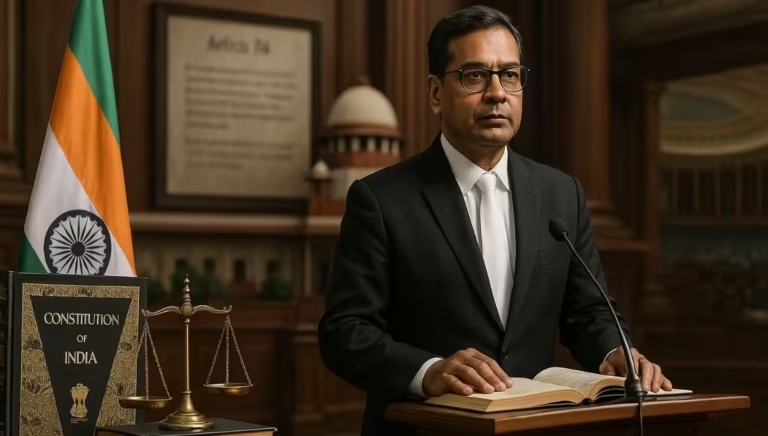
- Cannot advise or hold a brief against the Union Government.
- Cannot defend accused in criminal cases without the Government’s permission.
- Cannot accept corporate directorships without government approval.
- Cannot advise ministries, statutory organizations, or PSUs without reference through the Ministry of Law and Justice.
- Ensures no conflict of interest arises between private practice and duties as AG.
Issues Pertaining to the Office of AG
- Consent for Contempt Cases: AG’s pre-approval requirement in criminal contempt cases can be politically misused.
- Removal Procedure: No specified constitutional procedure; pleasure of the President doctrine may affect independence.
- Term Uncertainty: Term not fixed; AG can be removed at any time by the President.
- Private Practice: AG can practice privately, potentially causing conflict of interest.
Supporting Law Officers
- Solicitor General of India: Second-highest law officer, supports AG.
- Additional Solicitor Generals: Assist the AG.
- Legal Status: Not constitutional offices (unlike AG), but statutory positions under the Law Officers (Conditions of Service) Rules, 1987.
- Appointment: By Prime Minister-chaired Appointment Committee of Cabinet, usually for 3-year terms.
- Parliamentary Rights: AG can participate in parliamentary proceedings; Solicitor General and Additional Solicitor Generals cannot.
State Counterpart: Advocate General
- Highest law officer in a State, corresponding to the Attorney General at the Union level.
- Constitutional Provision: Article 165 – Governor appoints a person qualified to be a High Court judge.
- Term: Holds office at the pleasure of the Governor.
- Functions and Duties: Similar to AG but restricted to the state jurisdiction.
Attorney General of India
Aspect | Details |
Constitutional Basis | Article 76 |
Appointment | President appoints a person qualified to be Supreme Court Judge |
Tenure | Pleasure of the President |
Duties | Chief legal advisor, government representative in courts, constitutional advisor |
Rights | Audience in all courts, speak in Parliament (no vote), privileges like MP |
Limitations | Cannot advise/represent against the Union, cannot engage in private conflicts of interest |
Supporting Officers | Solicitor General, Additional Solicitor Generals (statutory posts) |
State Equivalent |
Prelims MCQs
Q1. Under which Article of the Indian Constitution is the Attorney General of India appointed?
A) Article 76
B) Article 75
C) Article 165
D) Article 88
Answer: A) Article 76
Q2. Which of the following statements about the Attorney General of India is correct?
1. Holds office at the pleasure of the President
2. Can vote in the Parliament
3. Can appear in all courts in India on behalf of the Union Government
4. Can advise ministries without reference through the Ministry of Law and Justice
A) 1 and 3 only
B) 2 and 4 only
C) 1, 2, 3
D) All of the above
Answer: A) 1 and 3 only
Q3. Who appoints the Advocate General of a State?
A) Prime Minister
B) Governor of the State
C) President
D) Chief Justice of the High Court
Answer: B) Governor of the State
Q4. Which of the following officers support the Attorney General of India?
1. Solicitor General
2. Additional Solicitor General
3. Advocate General
A) 1 and 2 only
B) 2 and 3 only
C) 1 and 3 only
D) All of the above
Answer: A) 1 and 2 only
Q5. Which of the following limitations apply to the Attorney General?
1. Cannot advise or hold brief against the Government of India
2. Cannot defend accused in criminal prosecutions without government permission
3. Cannot participate in parliamentary proceedings
A) 1 and 2 only
B) 2 and 3 only
C) 1 and 3 only
D) All of the above
Answer: A) 1 and 2 only
Q6. The Attorney General of India:
A) Holds a fixed 5-year term
B) Can be removed only through parliamentary approval
C) Holds office at the pleasure of the President
D) Cannot practice privately
Answer: C) Holds office at the pleasure of the President
Mains Descriptive Questions
Q1. Explain the constitutional provisions regarding the appointment, tenure, and removal of the Attorney General of India.
Q2. Discuss the duties and functions of the Attorney General of India. How does the office ensure legal and constitutional compliance for the Union Government?
Q3. Critically analyze the rights and limitations of the Attorney General of India. How do these limitations prevent conflict of interest?
Q4. Examine the issues pertaining to the office of Attorney General of India, such as removal procedure, pleasure doctrine, and private practice. Suggest measures to strengthen the independence of the office.
Q5. Compare and contrast the Attorney General of India and the Advocate General of a State in terms of powers, functions, and constitutional provisions.
Q6. How do the Solicitor General and Additional Solicitor Generals support the Attorney General of India? Discuss their constitutional/statutory status.
Attorney General of India (AG) – UPSC FAQ Guide
Who appoints the Attorney General of India?
The Attorney General of India is appointed by the President under Article 76 of the Constitution.
What are the duties of the Attorney General of India?
The Attorney General of India acts as the chief legal advisor to the Union Government, represents it in courts, and advises on constitutional and legal matters.
What is the tenure of the Attorney General of India?
There is no fixed term; the Attorney General of India holds office during the pleasure of the President.
What are the limitations of the Attorney General of India?
The Attorney General of India cannot represent against the Union Government, defend criminal cases without government consent, or take up corporate directorships without approval.
What is the difference between the Attorney General of India and Advocate General of a State?
The Attorney General of India is the highest law officer at the Union level (Article 76), while the Advocate General is the highest law officer at the State level (Article 165).