
BIHAR – A HUB OF GIRL CHILD TRAFFICKING
TOPIC: (GS1) SOCIAL ISSUES: THE HINDU
Child rights activist Bhuwan Ribhu has highlighted Bihar’s growing crisis of minor girls trafficked into orchestras and sex trade, with alarming rescue data reported till mid-2025.
The Trafficking Crisis in Bihar
- 271 girls rescued till June 2025; 153 from orchestras, 118 from sex trade. Many were found trapped in abusive conditions, under the pretext of employment in orchestra groups.
- In Saran district, 162 girls rescued from “orchestra troupes”.
- Most victims face violence, sexual exploitation, and are forced to perform vulgar dances.
- Girls as young as 12 years sold for as little as ₹10,000.
Why Bihar?
- Poverty and geography make Bihar vulnerable.
- Porous Nepal border and rail connectivity aid trafficking.
- Areas like Saran, Muzaffarpur, Gopalganj form the “orchestra belt”.
- False promises of jobs, love, or fame used to trap girls.
Legal Framework – Strong Laws, Weak Implementation
- India has robust laws: POCSO Act, JJ Act, ITPA, Child Labour Act, Bonded Labour Act, Bharatiya Nyaya Sanhita.
- But most cases are filed as missing/kidnapping, not trafficking.
- Anti-Human Trafficking Units (AHTUs) are underfunded and understaffed.
- Conviction rates are very low; rescued girls often sent back to unsafe families.
Solutions Proposed
- Ban minors in orchestras – identify, map, and shut such groups.
- Train and equip AHTUs to handle interstate coordination and follow-through.
- Vigilance at transport hubs – expand Railway Protection Force model to buses and terminals.
- Community-level prevention: Monitor school dropouts and migration. Empower panchayats to act when children disappear.
- Enforce victim rehabilitation and compensation.
- Prosecute landlords and organisers, and seize properties used for exploitation.
The PICKET Strategy
- Policy: Clear laws against child exploitation.
- Institutions: Strengthened enforcement and rehabilitation agencies.
- Convergence: Multi-agency coordination.
- Knowledge: Use survivor stories and community insights.
- Economics: Make trafficking financially risky.
- Technology: Data tracking, mapping hotspots, and inter-state info sharing.
Conclusion
Human trafficking in Bihar is a failure of prevention, prosecution, and protection. The system must shift from reactive rescue to proactive dismantling of trafficking networks. With laws and tools already in place, what’s needed now is the political and administrative will.
FORMALISATION AND PRODUCTIVITY IN INDIA’S MANUFACTURING SECTOR
TOPIC: (GS3) ECONOMY: THE HINDU
A recent study based on Annual Survey of Industries (ASI) data highlights that excessive use of contract labour in India’s formal manufacturing sector is lowering productivity, raising concerns over informalisation within formal enterprises.
Issue In Brief
- Share of contract labour doubled in formal manufacturing – from 20% in 1999-2000 to 40.7% in 2022-23.
- The trend reflects a shift toward cost-cutting, often at the expense of labour rights, skill-building, and productivity.
What is Informalisation within Formal Sector?
- Informalisation refers to insecure, low-paid, and unprotected employment even within registered (formal) firms.
- These jobs lack social security, regular pay, job stability, and worker protections.
Issues with Contract Labour
- Hired via third-party contractors, contract workers lack protection under key labour laws.
- They face lower wages, limited rights, and high vulnerability to arbitrary dismissals.
- In 2018-19, average wages for contract workers were 14.47% lower than regular workers.
- The cost of employing contract labour was up to 85% lower in some industries.
Impact on Productivity
- Firms using more contract labour (CLI enterprises) had 31% lower labour productivity than those relying on regular staff.
- The gap is worse in: Small enterprises (<100 workers): 36% lower productivity. Labour-intensive industries: 42% lower productivity
- High-skill and capital-intensive sectors showed a productivity advantage with contract labour, but they form only 20% of the sector.
Labour Reforms and Policy Suggestions
- The Industrial Relations Code (2020) allows fixed-term hiring directly by firms, bypassing contractors, with mandatory benefits.
- Concerns: It may worsen job insecurity and deepen informalisation.
Budget 2025–26 Measures for Informal Sector
- Social Security Expansion: Gig and platform workers (e.g. delivery, ride-hailing) will now be covered under PM-JAY and pension schemes (Budget initiative).
- Health & Income Support: ₹50,000 crore allocated for Universal Health Coverage, and direct income support for low-income households.
- Vernacular Workforce Protection: Reforms in PM SVANidhi for street vendors; UPI-linked debit cards for easier credit access.
- Skill & Entrepreneurship: Focus on skill development, start-up incubation in Tier-2/3 cities, and financial support for women and marginalized entrepreneurs.
INDIA’S INFORMAL WORKFORCE HIGHLIGHTS FROM THE ECONOMIC SURVEY
- Employment Share: About 57.3% of the workforce is self-employed and 18.3% are unpaid workers (Economic Survey).
- Sectoral Contribution: Informal/unorganised sector contributes over 44% of Gross Value Added (GVA) and employs nearly 75% of India’s non-agricultural workforce.
- Job Growth: ASUSE (2023–24) data shows informal sector employment rose by 10%, crossing 12 crore workers and adding 16 lakh establishments.
- Productivity Concerns: Real GVA growth for informal enterprises was 6.9%, still below the pre-pandemic peak; long-term CAGR declined by 0.2%.
Conclusion
While contract labour offers firms short-term cost advantages, overreliance hurts long-term productivity, worker morale, and innovation. For sustained industrial growth, India must focus on formalisation, skill development, and inclusive labour policies.
INTERRUPTED INDUSTRIAL GROWTH
TOPIC: (GS3) ECONOMY: THE HINDU
India’s Index of Industrial Production (IIP) for June 2025 showed a 10-month low growth of just 1.5%, mainly due to a steep drop in mining and electricity output caused by climate-related disruptions.
What is IIP?
- The Index of Industrial Production (IIP) is a monthly indicator that measures the volume of production in different sectors of the economy, mainly mining, manufacturing, and electricity.
- It reflects changes in industrial activity and serves as a barometer for economic performance.
- Published by the National Statistical Office (NSO).
Impact of Climate on Industrial Output
- The early arrival and irregular pattern of the southwest monsoon led to waterlogging in key mining areas in Odisha, Jharkhand, and West Bengal.
- Example: Jharkhand received 504.8 mm rainfall (normal: 307 mm) but still had five districts facing rain deficiency.
- This waterlogging disrupted mining operations and power infrastructure.
June 2025 IIP Performance
- IIP growth slowed to 1.5% in June, the lowest in 10 months.
- Mining output shrank by –8.7% (vs 10.3% in June 2024).
- Electricity output fell by –2.6% (vs 8.6% in June 2024).
- Overall industrial growth was 3.9%, slightly better than 3.5% last year.
Infrastructure-Led Manufacturing Growth
- Despite weak mining and power data, manufacturing of:
- Capital goods grew by 3.5%.
- Intermediate goods rose by 5.5%.
- Infrastructure goods grew by 7.2%.
- This suggests that growth is still heavily driven by government infrastructure investment.
Neglect of Climate Factors in Official Data
- Institutions like the RBI and Ministry of Statistics avoid mentioning climate disruptions in IIP or GDP reports.
- They usually cite: High base effect, Input cost changes, Weak global/domestic demand
- Unlike the European Central Bank or Bank of England, India is yet to fully integrate climate risk into economic data frameworks.
Way Forward
- India needs to recognize and reflect climate risks in macroeconomic indicators like IIP.
- Climate attribution may be complex but is essential for long-term policy planning and economic resilience.
QUESTIONING INDIA'S GINI INDEX RANKING AMID VISIBLE INEQUALITY
TOPIC: (GS3) ECONOMY: THE HINDU
India’s Gini Index score of 25.5 for 2024 ranks it among the world’s most equal countries. However, visible and widespread inequalities across wealth, gender, education, and digital access challenge this claim.
What is the Gini Index?
- It is a statistical measure of income or wealth distribution within a country.
- Ranges from 0 (perfect equality) to 100 (perfect inequality).
- India’s score of 25.5 (moderately low inequality) contradicts the lived experience of vast disparities.

Wealth and Income Inequality
- A small elite holds a significant portion of national income.
- In 2022-23, the top 1% earned 22.6% of the national income.
- Data underrepresents informal sector workers, as less than 10% of adults are captured in income tax records.
- Informal workers earn significantly less than those in formal employment.
Gender Inequality
- Women make up only 35.9% of the workforce.
- Only 12.7% of leadership roles are held by women.
- Just 7.5% of Indian start-ups are women-led, despite India being the third-largest startup ecosystem.
- Cultural norms further limit female access to education, inheritance, and financial independence.
Digital and Educational Divide
- Only 52.7% schools have working computers; Internet access in schools is at 53.9%.
- Broadband access is just 41.8% nationally, affecting online learning.
- Digital inequality translates into educational disadvantage, particularly when schooling becomes remote (e.g. due to pollution).
- Students from poor or rural backgrounds lack digital tools, limiting future job opportunities.
Gendered Digital Inequality
- Only 25% of rural women have Internet access, compared to 49% of rural men.
- This gap restricts women’s access to banking, jobs, education, and overall autonomy.
- Digital exclusion magnifies both gender and economic inequality.
Conclusion:
The Gini Index may not capture non-income dimensions of inequality (like digital access, gender gaps, and informal sector dynamics). For India to be truly equal, it must ensure equity in access to technology, education, employment, and opportunity.
FREE BUS RIDES & RURAL BURDEN
TOPIC: (GS3) ECONOMY: THE HINDU
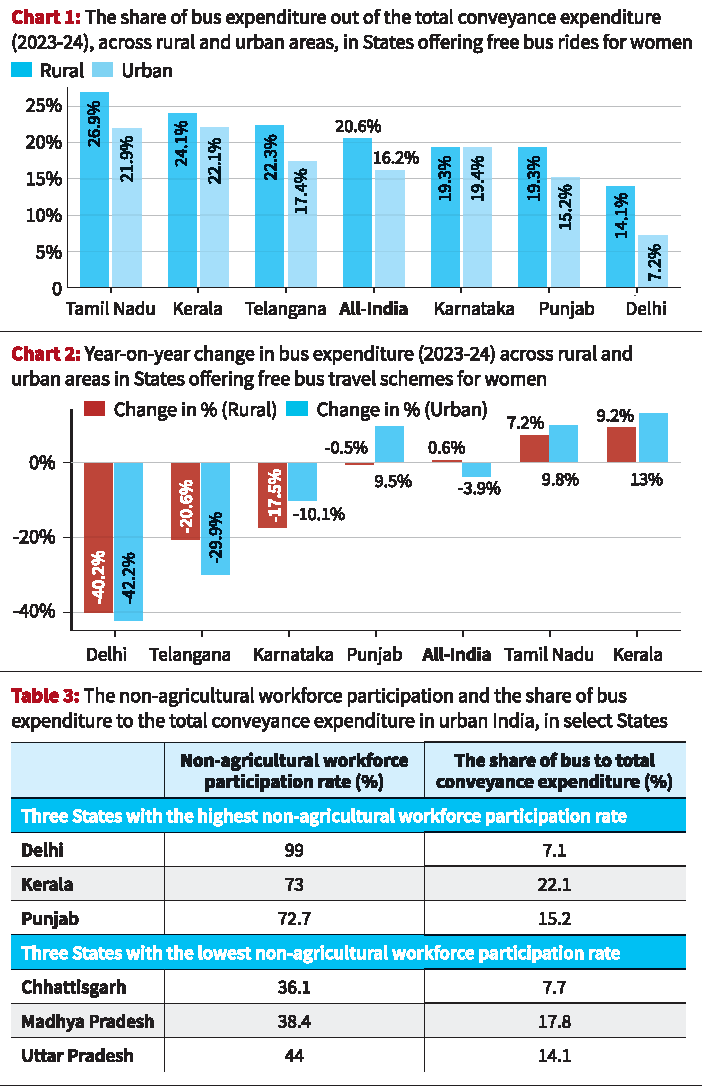
The latest Household Consumption Expenditure Survey (HCES) 2023-24 shows that rural households spend more on bus travel than urban ones, even in states offering free bus rides for women. It raises questions about the effectiveness of such schemes and rural transport access.
Key Findings from HCES 2023-24
- Per capita monthly spending is ₹4,122 in rural India and ₹6,996 in urban areas.
- Food expenses form 47% of rural spending and 39% in urban areas.
- Among non-food expenses, transport (conveyance) is the largest component.
Bus Travel Dominates Conveyance Spending
- 20.6% of conveyance expenses in rural India go toward bus travel, compared to 16.2% in urban areas.
- This reflects greater dependence on buses in rural areas due to lack of alternatives like metro or cabs.
Impact of Free Bus Schemes for Women
- Seven states offer free bus rides for women (e.g., Delhi, Tamil Nadu, Karnataka, Kerala).
- However, the benefits are uneven: Bus expenses fell in Delhi, Karnataka, and Telangana. But rose in Tamil Nadu and Kerala, even after free travel schemes.
- At the national level, bus spending rose by 0.6% in rural and dropped 4% in urban India.
Rural vs Urban Usage Patterns
- Lower-income rural households spend more on buses despite earning less.
- Urban poor may use buses less due to living near workplaces or lacking commuting needs.
- Rural residents often travel longer distances for work or basic services, raising costs.
Workforce and Bus Use: No Direct Link
- States like Delhi (with 99% non-agri workers) show lower bus share (7.1%).
- States with fewer non-agri workers (like Chhattisgarh or MP) show higher bus spending.
- Conclusion: Bus use is not only linked to jobs but also daily needs and access gaps.
Policy Recommendations
- Switch to electric buses to reduce costs and improve service efficiency.
- Increase bus availability: India has only 17 buses per 1 lakh people (target: 60).
- Improve affordability and bus quality, especially in rural areas, to ease the financial burden on low-income families.

ICJ ADVISORY OPINION ON CLIMATE OBLIGATIONS
TOPIC: (GS3) ENVIRONMENT: THE HINDU
The International Court of Justice (ICJ) recently issued its advisory opinion on countries’ climate obligations, reinforcing key principles of international climate law under the UNFCCC.
It addressed equity, historical responsibility, and clarified legal duties of states in tackling climate change.
Background of the Issue
- In 2023, Vanuatu and other island nations requested the ICJ to clarify legal duties of states under international law concerning climate change.
- This move reflects growing frustration among vulnerable nations about the slow global response to the climate crisis.
Highlights of the ICJ Opinion
Legal Obligation Under International Law
- The ICJ emphasized that countries are legally obligated to protect the environment under various international laws.
- States must ensure that their activities do not cause serious harm to the environment or human rights.
Role of the UNFCCC Principles
- The Court upheld the UN Framework Convention on Climate Change (UNFCCC) as the legal foundation for climate action.
- It confirmed that nations must reduce greenhouse gas emissions based on their historical contribution and current capacity.
Common But Differentiated Responsibilities (CBDR-RC)
- The ICJ strongly reiterated the principle of CBDR-RC — wealthier nations, with a history of more emissions, must take greater climate action.
- Developing countries’ responsibilities are recognized, but in line with their capacities and developmental needs.
Does the Opinion Create New Obligations?
- No new legal obligations were introduced, but: It clarified that existing climate-related obligations under international treaties and customary law are binding.
- The opinion strengthens the moral and legal pressure on countries to act more decisively.
Global Significance
- Though not legally enforceable, the opinion can: Be cited in future climate negotiations or legal disputes. Increase accountability and guide courts in national and regional cases.
ICJ STANDS FOR THE INTERNATIONAL COURT OF JUSTICE.
It is the principal judicial organ of the United Nations (UN) and settles legal disputes between countries (not individuals or private entities) and gives advisory opinions on legal questions referred by the UN.
Key Features of the ICJ:
- Established: In 1945, under the UN Charter; began working in 1946.
- Headquarters: The Hague, Netherlands.
- Official Languages: English and French.
- Members: All 193 UN member states are automatically parties to the ICJ Statute.
Functions of the ICJ:
Settles Disputes Between States: Deals with issues like boundary conflicts, diplomatic relations, and international treaties.
Advisory Opinions: Provides non-binding legal advice to UN bodies and specialised agencies (e.g., on climate change, use of force, etc.).
Conclusion
The ICJ’s opinion doesn’t create new laws but firmly reaffirms existing international duties, urging all nations to act according to equity and capability.
It is a landmark step toward clarifying climate justice and global responsibility.
KAZIRANGA’S TIGER DENSITY RANKS THIRD IN INDIA
TOPIC: (GS3) ENVIRONMENT: THE HINDU
Kaziranga Tiger Reserve (KTR) in Assam has recorded the third-highest tiger density in India, following Bandipur (Karnataka) and Corbett (Uttarakhand), as per the latest tiger estimation report released on Global Tiger Day 2025.
Why it Matters:
- Kaziranga is globally known for its one-horned rhinoceros, but its rising tiger population now highlights its growing role in big cat conservation.
- The report shows improved monitoring and the impact of expanded habitat sampling.
Key Highlights of the Report:
- Tiger Count: Total of 148 tigers recorded in 2024 in Kaziranga Tiger Reserve (KTR). In 2022, the count was 104
- Tiger Density: KTR has 18.65 tigers per 100 sq. km. It stands behind Bandipur (19.83) and Corbett (19.56).
- Survey Method:
- Conducted between Dec 2023–Apr 2024 using camera traps.
- Followed the National Tiger Conservation Authority (NTCA) and Wildlife Institute of India (WII) protocols.
- Used Spatially Explicit Capture-Recapture (SECR) method for precise estimation.
National Parks in India
- India has 106 national parks covering around 1.35% of its geographical area.
- Well-known National Parks:
- Jim Corbett (Uttarakhand) – India’s first national park.
- Bandipur (Karnataka), Kanha (Madhya Pradesh), Kaziranga (Assam), Sundarbans (West Bengal).
- Parks help conserve biodiversity and endangered species like tigers, elephants, rhinos, and swamp deer.
TIGER CENSUS IN INDIA
- India conducts the All India Tiger Estimation every 4 years.
- The latest (2022) estimation showed 3,682 tigers, making India home to over 75% of the global tiger population.
- Census uses technology-based methods (camera traps, GIS mapping, DNA sampling) for accuracy.
Conclusion:
Kaziranga’s rising tiger density reflects successful wildlife protection efforts, improved monitoring techniques, and Assam’s growing role in tiger conservation at the national level.
RBI Norms for Banks and NBFCs in Alternative Investment Funds (AIFs)
TOPIC: (GS3) ECONOMY: THE HINDU
The Reserve Bank of India (RBI) has issued new guidelines to limit how much banks and Non-Banking Financial Companies (NBFCs) can invest in Alternative Investment Funds (AIFs). This move is meant to reduce risk and prevent overexposure to debtor companies.
What are AIFs (Alternative Investment Funds)?
- AIFs are privately pooled investment funds (like venture capital, hedge funds, etc.) that invest in various assets.
- They are regulated by SEBI (Securities and Exchange Board of India).
- AIFs are usually meant for high-net-worth individuals or institutional investors.
What are NBFCs (Non-Banking Financial Companies)?
- NBFCs are financial institutions that provide banking services without having a banking license.
- They offer loans, credit, asset financing, and insurance but cannot accept demand deposits like banks.
- They are regulated by RBI.
Key Highlights of RBI’s New Guidelines
- A single bank or NBFC (Regulated Entity) can invest only up to 10% of an AIF scheme’s total corpus.
- All regulated entities together can invest only up to 20% of the AIF scheme’s total size.
- If a bank/NBFC invests more than 5% in an AIF that also indirectly invests in the bank’s debtor company (except equity),
- It must make a 100% provision for the investment amount linked to that debtor. This is capped at the level of the direct loan or investment already given to the company.
Why it Matters
- Ensures financial discipline and prevents indirect risky exposures.
- Strengthens RBI’s oversight on bank and NBFC investment behavior.
Conclusion
The RBI’s new guidelines aim to safeguard the financial system by capping investments in AIFs and avoiding indirect exposures to risky borrowers.
POOR STATE OF GOVERNMENT SCHOOL INFRASTRUCTURE
TOPIC: (GS2) INDIAN POLITY: THE HINDU
A school building collapse in Rajasthan’s Jhalawar district on July 25, 2025, led to the death of seven students, highlighting the poor state of government school infrastructure. Public outrage has followed, with questions raised about education safety and government responsibility.
Background of the Incident
- The incident took place at Piplodi Government School, Jhalawar, during morning prayers.
- Most victims were from tribal backgrounds.
- Another similar building collapse was reported in Nagaur, but it was a holiday, so no injuries occurred.
State of Government Schools in Rajasthan
- Rajasthan has over 70,000 government schools with around 84 lakh students.
- These schools mainly serve children from economically weaker and marginalised communities.
- The Education Department has listed about 8,000 schools in poor condition.
- The Jhalawar school was not on this list, showing hidden gaps in inspections.
Budget Allocation and Implementation Gaps
- ₹650 crore was allocated across two State budgets for school infrastructure.
- However, poor planning, monitoring, and delays have limited the impact.
- Funds often remain underutilised or mismanaged.
National Concern Over School Infrastructure
- The tragedy reflects a broader national neglect of public school infrastructure.
- NEP 2020 recommended raising education spending to 6% of GDP, with a focus on infrastructure.
- But implementation has been weak, with little visible change in ground-level conditions.
Policy Issues and Misplaced Priorities
- Governments have shifted focus toward privatisation and self-financing, ignoring basic education.
- Model schools receive attention, but mass education remains underfunded.
- Focus on foundational literacy and numeracy should be matched by investment in classrooms, buildings, and trained teachers.
Way Forward
- Conduct urgent safety audits of all government schools.
- Ensure effective use of allocated funds with transparency and accountability.
- Focus on teacher hiring, training, and safe infrastructure in rural and tribal areas.
- NEP targets should be met with real, on-ground action and not just on paper.