
TRUMP’S TARIFFS TO HIT INDIA FROM TOMORROW
TOPIC: (GS2) INTERNATIONAL RELATIONS: THE HINDU
The U.S. President Donald Trump has announced a 25% tariff on imports from India, along with an unspecified penalty, citing India’s trade barriers and defence and energy ties with Russia.
India’s Commerce Ministry has responded, stating it will take steps to protect the country’s national interest.
Background of the Issue
- India and the U.S. have been negotiating a Bilateral Trade Agreement since early 2025.
- A smaller “mini-deal” was also being discussed to reverse earlier tariffs.
- Tensions increased after India continued purchasing oil and military hardware from Russia, despite the war in Ukraine.
U.S. Tariff Decision
- Tariff Details: From August 1, the U.S. will impose a 25% tariff on Indian imports. An extra penalty will also be added, but the exact nature is still unclear.
- Reasons Cited by Trump:
- India’s high tariffs on U.S. goods.
- Non-monetary trade barriers that restrict fair access to Indian markets.
- India’s close ties with Russia, especially for energy and defense deals.
- Trump referred to India’s trade practices as “obnoxious and strenuous“.
India’s Response
- The Commerce and Industry Ministry said it is assessing the implications of the U.S. move.
- India reiterated its commitment to a fair and balanced trade deal.
- The government emphasized that it will protect farmers, small businesses (MSMEs), and national interest.
- India pointed out past efforts like the UK trade agreement as examples of its proactive approach.
Way Forward
- India may consider retaliatory measures or engage in fresh diplomatic talks.
- The outcome of this trade dispute could impact India-U.S. economic relations and future agreements.
- India will likely focus on protecting domestic industries while continuing efforts to keep trade channels open.
WHAT ARE TARIFFS?
Tariffs are taxes or duties imposed by a government on imported or exported goods. They are usually applied to imports to make foreign goods costlier than local products.
- Purpose: To protect domestic industries, raise revenue, or punish trade partners.
How Tariffs Impact Exports?
- Retaliation by Other Countries
- If Country A puts tariffs on Country B’s goods, B may respond with its own tariffs.
- This can hurt Country A’s exports as they become more expensive abroad.
- Reduced Competitiveness
- Exported goods with higher prices due to foreign tariffs become less attractive in international markets.
- Trade Barriers
- Tariffs act as non-tariff barriers, discouraging free trade.
- This leads to lower demand for exports and reduced foreign sales.
- Impact on Farmers & Industries
- Sectors like agriculture, textiles, or electronics often suffer due to export decline.
Example:
- India–U.S. Trade Tension (2019):
- The U.S. increased tariffs on Indian steel and aluminum.
- India retaliated with tariffs on U.S. almonds, apples, etc.
- Result: Both countries saw decline in exports of affected products.
Conclusion
The U.S. tariff decision reflects deepening trade and strategic tensions. India must now strike a careful balance between global diplomacy and protecting its economic interests.
INDIA’S POLICE MUST GET OUT OF DIRTY HARRY’S SHADOW
TOPIC: (GS2) GOVERNANCE: THE HINDU
The custodial death of Ajith Kumar, a temple watchman in Tamil Nadu, has raised serious concerns over the use of violence and torture by the police. The incident highlights the urgent need for police reforms and a shift towards ethical, evidence-based investigation methods.
Two Policing Models: A Comparison
- Sherlock Holmes Model: Represents smart, logical, and evidence-based investigation. Focuses on facts and observation without use of force.
- Dirty Harry Model: Relies on intimidation and violence to extract confessions. Values quick results over accuracy, often leading to injustice.
Rising Custodial Violence in India
- Custodial Deaths: Between 2018–2023, 687 people died in police custody, averaging 2–3 deaths weekly. States with the most cases include Gujarat, Maharashtra, Tamil Nadu, and Uttar Pradesh.
- Torture Targets: Mostly affects daily wage workers, Dalits, tribals, and migrants. Many deaths are misreported as suicides or health issues.
- Systemic Issues: Lack of proper training for lower-rank police officers. Weak punishment mechanisms and public acceptance of torture.
Torture Doesn’t Work – Scientific Evidence
- Research Findings: Torture affects memory and thinking, leading to false confessions. Example: During the Algerian War and CIA interrogations, torture gave useless or fake information.
- Global Experiences: Countries like UK, Norway, and New Zealand use the PEACE model, a humane, evidence-based method for interrogation.
- Non-violent approaches have helped solve serious cases, including terrorism-related crimes.
KEY COMMISSION REPORTS ON POLICE REFORMS
National Police Commission (NPC), 1977–1981
- Recommended separation of law and order from investigation duties.
- Called for a State Security Commission to reduce political interference.
- Suggested fixed tenure for police officers, especially DGPs and SHOs.
- Emphasized public complaints authority for independent oversight.
Justice Malimath Committee (2003)
- Advocated reforms in criminal justice system, including police accountability.
- Suggested scientific investigation techniques to reduce torture-based confession.
- Recommended a witness protection system and improved forensics.
Second Administrative Reforms Commission (ARC) – 5th Report: “Public Order” (2007)
- Urged for a Model Police Act to replace the colonial 1861 Police Act.
- Advocated community policing to build trust with citizens.
- Suggested a Police Performance Evaluation system focused on service delivery, not just crime control.
The Way Forward
- Legal Reforms: Enact a separate anti-torture law. Ratify the UN Convention Against Torture.
- Police Training: Adopt the PEACE model across India. Promote zero tolerance for custodial violence.
Suggestions for Good Governance & Responsible Policing
- Ensure transparency, accountability, and impartiality in police work.
- Establish Independent Police Complaint Authorities to monitor excesses.
- Invest in police training on ethics, sensitivity, and human rights.
- Use CCTV, body cams, and digital tracking to prevent custodial violence.
Conclusion
India’s policing needs a shift from force-based methods to professional, lawful investigation. Protecting the rights of the weakest will reflect the strength of our democracy.
BOOST THE CAPACITY OF LEGAL AID SYSTEMS
TOPIC: (GS2) INDIAN POLITY: THE HINDU
India’s legal aid system reached only 15.5 lakh people in 2023–24, despite being meant for nearly 80% of the population. This shows the gap between the goal of free legal help and actual access, prompting the need for reform and resource enhancement.
Legal Aid System
- Legal aid is provided under the Legal Services Authorities Act, 1987 to help the poor, undertrials, and vulnerable groups.
- Services are available through District Legal Services Authorities (DLSAs), legal aid clinics, and para-legal volunteers.
- The India Justice Report 2025 shows legal clinics exist only at a 1:163 village ratio, showing limited coverage.
LEGAL SERVICES AUTHORITIES ACT, 1987
To provide free legal aid and ensure access to justice for all, especially the poor, marginalized, and weaker sections of society.
Key Features
Statutory Backing:
- Passed in 1987, came into force in 1995.
- Based on Article 39A of the Constitution – “Equal justice and free legal aid.”
Provides free legal services to:
- Women, children, SC/STs, disabled persons, industrial workmen, and those earning below a certain income.
- Victims of mass disasters, ethnic violence, or natural calamities.
Legal Services Authorities:
- Constituted at national, state, district, and taluka levels.
- E.g., NALSA (National Legal Services Authority) at the top.
Lok Adalats (People’s Courts):
- An important mechanism under this Act.
- Resolve disputes quickly, amicably, and without court fees.
- Decisions are binding and final, like civil court orders.
Legal Awareness:
- Promotes legal literacy, especially in rural and backward areas.
Panel Lawyers:
- The authorities appoint trained lawyers to represent beneficiaries for free.
Budgetary Concerns
- Legal aid receives less than 1% of the total justice budget.
- Between 2017–18 and 2022–23, total legal aid funding increased from ₹601 crore to ₹1,086 crore.
- However, NALSA’s own funds reduced from ₹207 crore to ₹169 crore, and utilisation dropped from 75% to 59%.
- States like Karnataka and Maharashtra increased their legal aid budgets significantly.
Shrinking Para-Legal Volunteers
- Number of para-legal volunteers (PLVs) dropped 38% between 2019 and 2024.
- In 2023–24, only 14,000 of 53,000 trained PLVs were deployed.
- Low honorariums remain a concern — most States pay PLVs less than minimum wage.
Legal Aid Defence Counsel Scheme (LADC)
- Introduced in 2022, LADC provides legal help to accused persons only.
- It functions like the public defender model and is active in 610 out of 670 districts.
- In 2023–24, ₹200 crore was fully utilised for this scheme, but in 2024–25, funds dropped to ₹147.9 crore.
Key Challenges
- Underfunding and poor fund use.
- Lack of quality control and low trust in legal aid services.
- Insufficient staffing and lack of accountability at the local level.
Measures Needed
- Increase per capita spending on legal aid.
- Expand para-legal volunteer training and deployment.
- Revise and standardize honorariums for PLVs.
- Ensure better utilisation of NALSA funds.
- Integrate LADC and regular legal aid for broader coverage.
- Use technology for awareness, monitoring, and service delivery.
Constitutional Provisions
- Article 39A: Directs the State to ensure equal justice and free legal aid.
- Article 14 & 21: Guarantee equality before law and right to life and personal liberty, which includes fair trial and legal assistance.
Conclusion
Legal aid is essential for delivering justice to the most disadvantaged. Without more funds, trained personnel, and structural reforms, India’s promise of equal justice will remain incomplete.
SC QUESTIONS JUDGE’S ACTION OF MOVING TOP COURT AFTER INQUIRY BECAME ‘UNPALATABLE’
TOPIC: (GS2) INDIAN POLITY: THE HINDU
The Supreme Court has questioned Justice Yashwant Varma of the Allahabad High Court for challenging an in-house inquiry process only after it gave an unfavourable report. The Court observed that he had already submitted to the process but turned against it once its outcome went against him.
Background of the Case
- A fire occurred at Justice Varma’s official residence in Delhi in March, and burnt currency notes were reportedly found in an outhouse.
- A three-judge panel, appointed by then Chief Justice Sanjiv Khanna, carried out an internal inquiry.
- The panel recommended removal of the judge, and this was forwarded to the President and Prime Minister.
Supreme Court’s Observations
- The in-house inquiry system, followed for over 30 years, is designed to maintain the integrity of the judiciary.
- The Court said a judge, once having agreed to this system, cannot later call it illegal.
- The Chief Justice is not a mere messenger, and the process ensures proper review before any action is taken.
Arguments and Legal Provisions
- Senior Advocate Kapil Sibal argued that Articles 124(4), 124(5), and 218 provide the only constitutional process for judge removal — through Parliament.
- He claimed the in-house process is not part of the Constitution and lacks legal authority.
Current Status
- The Supreme Court has reserved its judgment on the challenge to the in-house procedure and the recommendation to remove Justice Varma.
REMOVAL OF A HIGH COURT JUDGE – CONSTITUTIONAL PROVISIONS
Article Involved: Article 217(1)(b) & Article 218 of the Indian Constitution
A High Court Judge can be removed only on the grounds of:
- Proved misbehavior, or
- Incapacity
These are the only grounds mentioned in the Constitution for removing a judge.
Steps of Impeachment (Removal) – In Simple Points
- Initiation of Motion:
- A removal motion can be introduced in either House of Parliament (Lok Sabha or Rajya Sabha).
- Must be signed by:
- At least 100 MPs (if in Lok Sabha), or
- At least 50 MPs (if in Rajya Sabha)
- Speaker/Chairman Admits the Motion:
- The Speaker (LS) or Chairman (RS) decides whether to admit the motion.
- Constitution of Inquiry Committee:
- If admitted, a three-member committee is formed:
- One Supreme Court judge
- One Chief Justice of a High Court
- One distinguished jurist
- If admitted, a three-member committee is formed:
- Investigation:
- The committee investigates the charges.
- If the judge is found guilty of misbehavior or incapacity, the process continues.
- Parliamentary Approval:
- The motion must be passed in both Houses of Parliament:
- With special majority:
- Majority of total membership AND
- 2/3rd of members present and voting
- President’s Order:
- After Parliament’s approval, the President of India issues an order to remove the judge.
Conclusion
This case raises critical questions about the accountability of judges and the legality of internal inquiry mechanisms within the judiciary.
EXTENSION OF PRESIDENT’S RULE IN MANIPUR
TOPIC: (GS2) INDIAN POLITY: INDIAN EXPRESS
The Lok Sabha has approved a resolution to extend President’s Rule in Manipur for another six months. This move aims to maintain peace in the state, which has faced prolonged ethnic tensions and governance issues.
What is President’s Rule?
- Also known as State Emergency or Constitutional Emergency.
- Imposed when a state government fails to function according to the Constitution.
- Invoked under Article 356 of the Indian Constitution.
What Happens During President’s Rule?
- The state legislative assembly is either suspended or dissolved.
- The state comes under direct control of the President (Union Government).
- Governor rules on behalf of the President.
- The Council of Ministers is removed.
Ongoing Conflict in Manipur
- Manipur has been facing ethnic violence between the Meitei community in the valley and the Kuki-Zo tribal groups from the hills.
- Political instability led to the resignation of Chief Minister N. Biren Singh earlier this year.
- President’s Rule was first imposed in February 2025 due to failure of constitutional machinery.
Recent Parliamentary Action
- The Lok Sabha passed a resolution to extend President’s Rule for another six months.
- The Rajya Sabha still needs to approve the extension for it to come into effect.
- The Home Ministry claimed that law and order is gradually improving.
Government’s Stand
- Minister of State for Home, Nityanand Rai, said the extension is essential to maintain normalcy.
- He reported: Only one violent incident with a single death in the last eight months. Recovery of over 2,500 illegal weapons, 1,900 explosives, and 30,000 rounds of ammunition.
Opposition’s Concerns
- Congress MP A. Bimol Akoijam opposed the extension.
- He called for the dissolution of the Assembly and fresh elections to restore democratic governance.
WHEN CAN IT BE INVOKED?
- Failure of Constitutional Machinery in the state:
- No party gets a majority in the assembly.
- Government loses majority and cannot prove confidence.
- State government doesn’t follow constitutional norms.
- Breakdown of law and order.
- Governor’s Report:
- The Governor of the state sends a report to the President recommending President’s Rule.
- Even without Governor’s Report:
- The President can act on his own if he is satisfied that governance cannot be carried on.
Duration and Extension
- Initial Duration: Can be imposed for 6 months at a time.
- Extension: Can be extended every 6 months, with Parliament’s approval.
- Maximum Duration: 3 years (i.e., six-month extensions up to 3 years), but with conditions after 1 year:
- National emergency should be in operation in India or that state.
- The Election Commission certifies that elections cannot be held.
- Parliament’s Role: President’s Rule must be approved by both Houses of Parliament:
- Within 2 months of its proclamation.
- Each extension also needs Parliamentary approval.
Article References:
- Article 356 – Proclamation of President’s Rule
- Article 357 – Consequences and powers during President’s Rule
Safeguards Against Misuse:
- S.R. Bommai Case (1994): Supreme Court laid down strict guidelines to prevent misuse.
- Now judicial review is allowed.
- President’s Rule can be challenged in court if used for political reasons.
Conclusion
The extension of President’s Rule reflects the Centre’s priority of ensuring stability, but concerns about democratic representation continue to be raised.
CIVIL SOCIETY FLAGS THREAT TO RIGHT TO INFORMATION IN NEW DATA LAW
TOPIC: (GS2) INDIAN POLITY: THE HINDU
Media groups and RTI activists have raised concerns over the Digital Personal Data Protection (DPDP) Act, 2023, saying it weakens the Right to Information (RTI) Act by restricting access to personal data. They demand rollback of the amendment to protect transparency and press freedom.
Issue with the Amendment
- The DPDP Act, 2023, includes an amendment to Section 8(1)(j) of the RTI Act, 2005.
- This section earlier allowed access to personal information if it was related to larger public interest.
- The new changes broaden the scope of denial, making it harder to access information related to public officials.
Protests and Demands
- The National Campaign for People’s Right to Information (NCPRI) has opposed this change for almost two years.
- They argue that it limits citizens’ right to know and protects wrongdoers in public office.
- A campaign named “Roll Back RTI Amendments” was launched involving over 20 media bodies.
Voices Raised by Press and Legal Experts
- Press bodies like the Press Club of India (PCI) and DIGIPUB raised concerns with the IT Ministry.
- Justice A.P. Shah (retd.) warned that this amendment marks a serious setback for transparency.
- IT Secretary S. Krishnan assured the Act won’t affect journalism, but no formal rollback has been announced.
WHAT IS RTI ACT, 2005?
RTI Act is a law passed by the Indian Parliament in 2005 to promote transparency and accountability in government functioning.
- It gives citizens the legal right to request information from any public authority.
- It applies to all levels of government — central, state, and local.
- Citizens can file an RTI application to seek answers about decisions, spending, and functioning of public bodies.
- It is enforced by Public Information Officers (PIOs) in each department and overseen by the Information Commissions (Central and State).
Key Features of RTI Act
- Covers all public authorities (except intelligence and security agencies under Section 24).
- Information should be provided within 30 days (48 hours for life or liberty-related matters).
- Citizens can appeal if information is denied or delayed.
- Penalties can be imposed on officers for not sharing information without valid reasons.
Advantages of RTI Act
- Promotes Transparency: Helps citizens know how government decisions are made and money is spent.
- Improves Accountability: Forces public officials to act responsibly, as their actions can be questioned.
- Empowers Citizens: Strengthens democratic participation by allowing people to question authorities.
- Reduces Corruption: Fear of exposure through RTI discourages corrupt practices in public offices.
- Strengthens Democracy: Ensures an informed citizenry, which is the backbone of a functioning democracy.
- Improves Public Services: Regular questioning under RTI leads to better delivery of schemes and services.
Conclusion
The DPDP Act’s amendment to the RTI Act risks weakening transparency and curbing press freedom, and several civil society groups are demanding its reversal.
RUSSIA EARTHQUAKE TRIGGERS TSUNAMI ACROSS PACIFIC
TOPIC: (GS1) GEOGRAPHY: INDIAN EXPRESS
A powerful 8.8 magnitude earthquake hit Russia’s Far East, triggering tsunami waves across the Pacific, including Japan, Hawaii, and the U.S. West Coast. While several injuries were reported, no major damage occurred.
About the Earthquake and Tsunami
- The earthquake struck near the Kuril Islands in Russia’s remote Far East region.
- It is considered one of the strongest quakes recorded in that region.
- The tremor’s epicenter was offshore, prompting tsunami warnings across Pacific coasts.
How Earthquakes Cause Tsunamis
- A tsunami is a series of large sea waves caused mainly by underwater earthquakes.
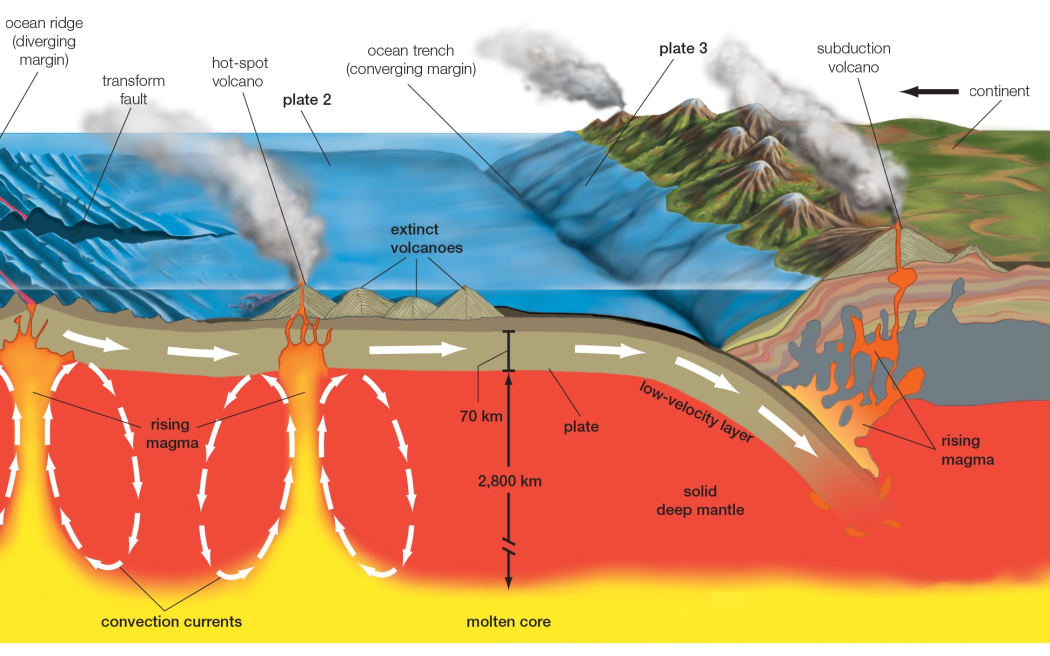
- When an earthquake happens under the ocean floor, especially at subduction zones:
- One tectonic plate slips beneath another, displacing a large volume of water.
- This vertical movement causes waves to form on the ocean surface.
- These waves travel at high speed and grow taller near coastlines, resulting in a tsunami.
What are Tectonic Plates?
- Tectonic plates are huge, rigid pieces of the Earth’s outer shell (called the lithosphere).
- These plates fit together like a jigsaw puzzle and cover the entire surface of the Earth.
- They float and slowly move over a soft, semi-liquid layer beneath them called the asthenosphere.
- Their movement causes natural events like earthquakes, volcanoes, and mountain formation.
Tsunami Impact Across Countries
- Russia (Kamchatka): Tsunami waves of 3 to 4 meters were recorded. Several people were injured, but none seriously.
- Japan (Hokkaido): 60 cm tsunami waves reached the northern coast. At least one person was reported injured.
- United States (San Francisco): Tsunami waves of 60 cm to 1.5 meters were observed. Authorities advised people to stay away from the coastline.
Warnings and Response
- Emergency alerts were issued in Russia, Japan, Hawaii, and the U.S. urging people to move to higher ground.
- Tsunami warnings were downgraded after the situation started to stabilize.
- No large-scale damage or fatalities were reported.
WHAT ARE EARTHQUAKES?
Earthquakes are sudden shaking or vibrations of the Earth’s surface caused by the movement of tectonic plates. They occur when stress builds up along cracks (called faults) in the Earth’s crust and is suddenly released.
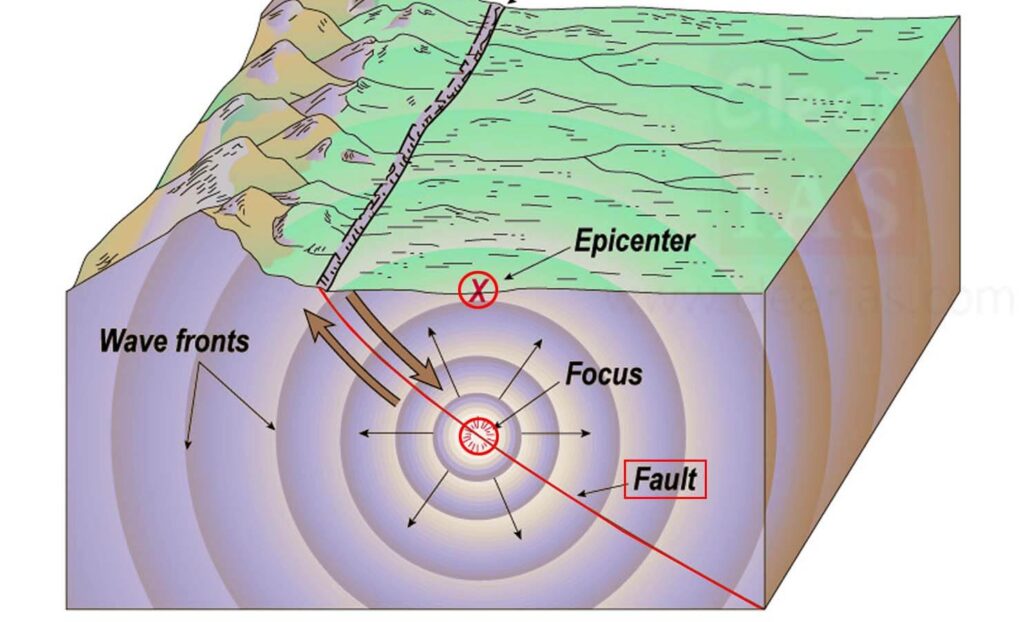
- The point inside the Earth where the earthquake starts is called the focus (or hypocentre).
- The point directly above the focus on the Earth’s surface is called the epicentre.
Mechanism of Earthquakes (Simple Points)
- Tectonic Plates Movement: The Earth’s crust is divided into several large plates (like jigsaw pieces) called tectonic plates. These plates are constantly moving slowly due to convection currents in the mantle.
- Stress Accumulation: When two plates move against each other, stress builds up at their boundaries or fault lines.
- Sudden Release of Energy: When the stress becomes too much, the rocks break and release energy in the form of seismic waves.
- Seismic Waves Travel Outward: These waves shake the ground and cause an earthquake.
- Richter Scale & Intensity: The magnitude is measured using the Richter Scale, while the effects on people and buildings are measured by the Mercalli Scale.
CONCLUSION:
This event highlights the vulnerability of coastal regions to undersea earthquakes, emphasizing the need for early warning systems and disaster preparedness.
DRDO'S SUCCESSFUL TEST OF PRALAY MISSILE
TOPIC: (GS3) SCIENCE AND TECHNOLOGY: PIB
The Defence Research and Development Organisation (DRDO) successfully carried out two back-to-back test launches of the Pralay missile from Dr. A.P.J. Abdul Kalam Island, Odisha.
These trials confirm the missile’s readiness for operational deployment and precision strike capabilities.
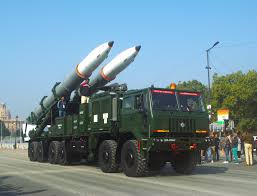
About Pralay Missile
- Type: It is an indigenously developed short-range surface-to-surface missile.
- Design: Classified as a quasi-ballistic missile, meaning it follows a partial ballistic trajectory, making it harder to intercept.
- Purpose: Designed for use in tactical battle scenarios by striking enemy military assets like radars and command centres.
Range and Payload
- Range: Capable of hitting targets between 150 to 500 km.
- Payload: Can carry warheads weighing 500 to 1,000 kg.
Features and Technology
- Propulsion: Powered by a solid-fuel rocket motor, allowing faster launch and transport.
- Navigation: Comes with advanced guidance systems and onboard avionics, enabling accuracy even in rough terrain.
- Mobility: Can be launched from mobile platforms, enhancing battlefield flexibility.
Significance
- Boosts India’s tactical strike capability.
- Strengthens deterrence posture against regional threats.
- Enhances indigenous defence manufacturing under ‘Make in India’.