
SARDAR PATEL’S VISION & MEANING OF NATIONAL UNITY TODAY
TOPIC: (GS2) INDIAN POLITY: THE HINDU
India celebrated Rashtriya Ekta Diwas (National Unity Day) on October 31, marking the birth anniversary of Sardar Vallabhbhai Patel. This year is special as it coincides with the 150th birth anniversary of Patel, with major events at Ekta Nagar near the Statue of Unity.
About Sardar Vallabhbhai Patel
- Iron Man of India: Known for his strong leadership and firm decisions in nation-building.
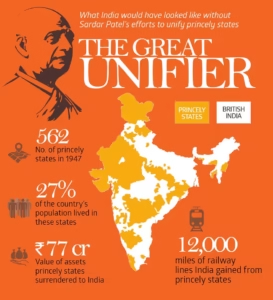
- Role in Integration: United more than 560 princely states after Independence to form one united India.
- First Home Minister: Strengthened internal security, administration, and civil services (helped create the modern IAS/IPS structure).
- Believer in Unity & Discipline: Promoted national unity, harmony and believed that strong discipline builds a strong nation.
- Served as India’s First Deputy Prime Minister: After Independence, Sardar Vallabhbhai Patel became the first Deputy Prime Minister of India and also handled the Home portfolio.
Patel’s Idea of Unity
- Unity without uniformity — India united by shared identity but respecting local cultures.
- Believed in a federation of hearts and minds, not forced sameness.
- Used realism, diplomacy, and firmness to prevent fragmentation post-Partition.
Examples
- Smooth integration of princely states like Junagarh, Hyderabad, Jammu & Kashmir into India.
National Unity Day
- Declared in 2014 to honour Patel and remind citizens that unity needs continuous effort.
- Activities: Run for Unity, pledge ceremonies, cultural events nationwide.
Culture as a Tool of National Integration
- India’s diversity is its strength; culture connects people more deeply than politics.
- Ministry of Culture works to democratize heritage so every region feels represented.
- Example: Students in Maharashtra learning Bihu or Assamese artists performing Lavani in Pune builds mutual respect and understanding.
- Tourism & Unity: Tourism helps Indians understand each other’s traditions and lifestyles.
Major Schemes
Scheme | Focus |
Dekho Apna Desh | Promote domestic travel |
Incredible India | Digital tourism promotion |
Swadesh Darshan / PRASHAD | Tourism circuits + pilgrimage infrastructure |
- Impact: 2024 saw 294 crore domestic tourist visits, boosting cultural exchange and local income.
Relevance of Patel’s Vision Today
- Unity requires daily commitment against regionalism, ignorance, and division.
- Government’s Panch-Pran for 2047 includes pledge for national solidarity.
Conclusion
True tribute to Sardar Patel lies not just in statues or ceremonies, but in living his vision — ensuring every citizen feels part of one national family. Cultural exchanges, travel, heritage awareness, and civic participation strengthen the invisible threads that hold India together.
This article has been updated and published in detail on our new platform. Please visit the link below for the latest version:
WHAT WILL POWER AI DATA CENTRES?
TOPIC: (GS3) SCIENCE AND TECHNOLOGY: THE HINDU
AI-driven data centres are expanding rapidly in India and globally, sharply increasing electricity demand. Small Modular Reactors (SMRs) are emerging as a possible long-term energy solution for powering AI data hubs, raising questions on safety, policy and infrastructure.
Why India Needs Large Data Centres
- India currently has less data-centre capacity (1.4 GW) despite having twice as many internet users as Europe.
- Strong growth in digital services, e-governance, fintech, OTT, and AI tools.
- Data rules require local storage, increasing domestic infrastructure.
- India’s AI data-centre capacity may grow 2–5× by 2030.
- AI vs Traditional Servers – Power Demand: AI server racks (GPUs): 80–150 kW each → ~5–7× more power
- Global data-centre energy demand may rise from 460 TWh (2024) to 1,300 TWh by 2035.
Example Cases
- China: data-centre use growing 25% yearly; expected 400+ billion kWh by 2025
- U.S. state Virginia: expected 25% electricity demand rise in 5 years
Where Are AI Data Centres Coming Up?
- Global hubs: U.S., China, Norway, Japan, U.K., Germany, Malaysia
- India: Vizag (Google), Jamnagar (Reliance), plus Mumbai, Chennai, Bengaluru & Hyderabad
Why Push for Low-Carbon Energy
- Big tech firms face decarbonisation commitments & regulatory pressure
- AI workload growth demands stable, low-carbon, round-the-clock energy
- Mix includes solar + storage, green hydrogen, geothermal, gas & emerging nuclear
Small Modular Reactors (SMRs)
Key Advantages
- Output range: 1–300 MW
- Modular factory-built → lower cost & faster deployment
- Passive safety features, less human intervention
- Constant baseload power, can be located near data centres
- $15.4 billion global investment so far
Safety Features
- Smaller fuel load, passive cooling, accident-tolerant fuels
- Lower risk of meltdown, smaller emergency zones
India’s SMR Plan
- Nuclear Energy Mission: ₹20,000 crore to target 100 GW by 2047
- Aim: 5 SMRs by 2033
- BARC developing 200 MW & 55 MW SMR models
- Proposed legal changes to attract $26 billion private capital
Challenges & Concerns
- Radioactive waste & new fuel types (e.g., HALEU) → disposal challenges
- Transport of factory-built reactors needs strict regulation
- Licensing frameworks globally still evolving
- Interim on-site nuclear waste storage likely needed
Way Forward
- Build regulatory readiness, safety training, & waste management systems
- Use retired coal-plant sites for SMRs
- Continue renewable + battery storage development
- Promote industry-government partnerships (AI firms + nuclear vendors)
WHAT ARE DATA CENTRES?
Data centres are special buildings that store and manage huge amounts of digital data (like your photos, videos, emails, apps, and websites).
- They contain powerful computers and servers that keep online services running 24/7 — like Google, YouTube, banks, hospitals, and government portals.
Why Data Centres are Important in the Future
- Growing Digital Life: As everything becomes online — payments, education, shopping, health — more data centres are needed to store and process information.
- AI & 5G Growth: Artificial Intelligence, cloud services, and fast 5G internet need huge computing power, which data centres provide.
- Data Security & Privacy: Countries want data stored inside the country for safety. (India’s data localisation policy = build more Indian data centres)
- Job Creation & Economy: Setting up data centres brings investment, tech jobs, and new infrastructure development.
Conclusion
A global AI boom will dramatically increase electricity use. India must balance digital expansion with clean, reliable energy. SMRs, alongside renewables, can support future AI data-centre growth — but safety, regulation, and waste management must be strengthened first.
This article has been updated and published in detail on our new platform. Please visit the link below for the latest version:
SHOULD AI BE PART OF SCHOOL CURRICULUM?
TOPIC: (GS2) GOVERNANCE: THE HINDU
The Ministry of Education has announced that AI will be introduced from Class 3 in schools starting 2026–27. This move has triggered debate on what age is appropriate to introduce such technology.
Background
- Government plans to introduce AI literacy from Class 3 and AI skills like Python & NLP in senior classes.
- Objective: build future readiness and tech skills in students early.
Need for AI Education
- Two layers of learning:
- AI literacy: understanding AI basics, safe use, critical thinking.
- AI skills: coding, creating AI tools, exploring tech careers.
- AI is already present in apps students use. School curriculum can provide guided and safe learning.
- Modern jobs increasingly require digital and AI familiarity.
Impact on Learning & Behaviour
- AI may weaken problem-solving ability if children rely too much on automated answers.
- Fear of “dis-education” — students lose curiosity and human learning habits.
- However, like past technologies (TV, internet), schools can adapt teaching methods to include AI meaningfully.
When Should AI Be Introduced?
- Up to Class 5: Strengthen reading, writing, numeracy, basic digital hygiene, supervised exposure.
- Middle school (6–8): AI awareness, safe & responsible use.
- Senior classes (9–12): Optional AI skills for students interested in tech careers.
Teacher Preparedness
- Teachers must be trained to:
- Understand AI basics and risks.
- Teach safe and ethical use.
- Evaluate AI outputs critically.
- Need continuous teacher development, especially in rural schools.
Concerns & Challenges
- Technology changes fast — curriculum may become outdated quickly.
- Digital divide: many schools lack electricity, internet, computers.
- Risk of over-dependence on AI, reducing motivation to learn and think independently.
- Children increasingly using AI as companions, raising psychological and privacy risks.
- Bias and safety issues in AI tools — young users may be influenced or misled.
- Teachers need continuous training; many currently lack skills to guide AI learning.
Way Forward
- Introduce AI gradually, with clear learning outcomes.
- Focus on AI ethics, safety, critical thinking, not only skills.
- Provide offline/unplugged curriculum where digital resources are limited.
- Ensure data privacy and child safety standards.
Conclusion
AI education in schools is necessary, but must prioritise literacy, safety, and gradual learning. Strengthening core education, bridging digital gaps, and training teachers are crucial before expanding full-scale AI education.
This article has been updated and published in detail on our new platform. Please visit the link below for the latest version:
LANGUAGE AND AI
TOPIC: (GS3) SCIENCE AND TECHNOLOGY: THE HINDU
A recent article highlights the rising use of Artificial Intelligence (AI) in learning and communication, raising questions about whether machines can truly replace human connection in language learning.
Technology changes
- Technology has changed human life — from old transport to modern machines, from letters to instant messages.
- Despite these changes, human communication remains rooted in emotion and social connection.
- AI now supports education and work — solving sums, drafting essays, and helping with research.
AI’s Strengths
- Helps in subjects with fixed rules like maths, physics, engineering.
- Offers instant explanations, problem-solving, visual learning.
- Works as a tutor, translator, and assistant.
- Helps teachers with faster feedback and planning.
Limits of AI in Language Learning
- Language is emotional and cultural, not just grammar and words.
- AI translates meaning, but misses tone, humour, emotion, hesitation, and warmth.
- A sentence like “I miss you” has emotion — machines cannot feel or express that.
- Machine translations can sound formal or lifeless.
Human Connection in Language
- Language learning grows through conversation, mistakes, laughter, real interaction.
- Confidence develops when learners talk, get corrected, and share real moments.
- Fluency needs empathy, understanding how others think and feel.
- Language is tied to culture, identity, and lived experience.
Language Evolution
- Words, slang, expressions change constantly.
- AI can record changes but cannot live inside a culture.
- True language mastery requires being part of a speech community — listening, reacting, adapting.
Concerns
- Biggest danger: people may stop learning languages, relying only on AI translators.
- This may reduce patience, humility, cultural respect, and deeper understanding.
- Language learning teaches a new way to see the world, not just new words.
Conclusion
AI will assist learning, but it cannot replace human connection. Human language learning remains emotional, slow, and deeply personal. Technology can translate words, but only humans can build real understanding and empathy across cultures.
This article has been updated and published in detail on our new platform. Please visit the link below for the latest version:
TIGER CONSERVATION & COMMUNITY RIGHTS
TOPIC: (GS3) ENVIRONMENT: THE HINDU
The Union Tribal Affairs Ministry has introduced a new policy framework on tiger conservation, emphasising that forest communities must not be displaced without completing Forest Rights Act (FRA) procedures.
Present situation:
- India follows a conservation model where local communities are partners, not intruders.
- Recent policy stresses that relocation from forests should be rare, only after full FRA compliance.
- A response to earlier directions that pushed for mass removal of villages from tiger reserves.
Features of the New Policy
- No eviction without FRA completion — forest dwellers recognised as legal stakeholders.
- Relocation = last option, not default action.
- Encourages research and trial models for humans + tigers coexisting safely.
- Uses SC/ST (Prevention of Atrocities) Act protections for illegal evictions.
- Creates a 3-tier grievance system for community complaints.
- Recognises communities have diverse needs — modern amenities vs traditional lifestyles.
Why Policy Shift Matters
- Counters trend of treating forests just as carbon sinks and people as obstacles.
- Tries to balance ecology, livelihood, and justice.
- Builds social legitimacy for tiger conservation through participation, not exclusion.
Challenges & Concerns
- Tigers need disturbance-free core zones in some areas — scientific conservation remains relevant.
- Local issues vary — uniform policy cannot address site-specific needs.
- State Forest Departments, not the Centre, largely control ground-level implementation.
- Possibility of dual systems — some States may still force relocations.
- Poor enforcement of compensation norms in previous relocation exercises.
Way Forward
- Combine community rights + scientific management.
- Strengthen local consultation, compensation, and transparent enforcement.
- Create custom strategies for each reserve, based on ecology and social context.
- Ensure conservation does not turn into either: pure fortress model (evicting people), or weak protection compromising tiger habitats.
India’s Major Tiger Conservation Initiatives
- Project Tiger (1973) – flagship programme to protect tigers and their habitats.
- National Tiger Conservation Authority (NTCA) – regulatory body for tiger protection.
- Tiger Reserves Network – 54 reserves covering major tiger landscapes.
- M-STrIPES App – monitoring tigers, patrolling, and ecological data.
- Global Tiger Forum & Global Tiger Initiative – international cooperation led by India.
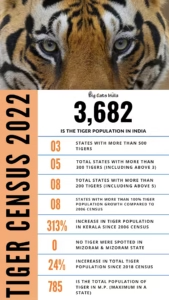
- 2022 Tiger Census – India holds ~75% of world tiger population.
Conclusion
India’s new approach aims to protect tigers without harming traditional forest communities. True success lies in balancing scientific conservation and human rights, ensuring forests remain safe for tigers while fair to people.
This article has been updated and published in detail on our new platform. Please visit the link below for the latest version:
AI’S REWRITING OF EDUCATION RULES
TOPIC: (GS2) GOVERNANCE: THE HINDU
India plans to introduce Artificial Intelligence (AI) learning from Class 3 starting 2026-27, aiming to build an AI-ready workforce. This move aligns with NEP 2020 and seeks to make students future-ready in a digital economy.
Objectives of AI in Education
- Develop digital and analytical skills from early schooling.
- Prepare students for AI-driven careers and automation.
- Promote personalised learning and modern teaching techniques.
- Build a tech-ready workforce for India’s growing digital economy.
Teacher Training and Capacity Building
- AI adoption requires skilled teachers, not just technology deployment.
- Govt. has launched pilot programs for teacher training.
- Around 10,000+ teachers trained since 2019 with support from:
- Intel, IBM
- National Institute of Electronics and IT (NIELIT)
- Teachers will use AI tools for:
- Creating lesson plans
- Assessing student needs
- Personalised teaching support
Challenge: Ensuring 1 crore+ teachers gain AI skills in time.
How AI Will Transform Learning
Personalised Learning
- AI tracks student learning speed, errors, and strengths.
- Slow learners receive extra support; advanced learners get higher-level tasks.
- Helps children with disabilities & different language backgrounds.
Role of AI in Classrooms
AI assists but does not replace teachers:
- Automates routine tasks (attendance, assessments, grading).
- Provides real-time feedback and study support.
- Allows teachers to focus more on creative and social learning.
Risks and Opportunities
Job Market Impact
- NITI Aayog estimates: 2 million tech jobs may be displaced by AI, 4 million new AI-related jobs likely by 2030
- Need to train youth for new-age jobs and adaptive skills.
Access & Digital Divide
- Unequal access to devices & internet could widen learning gap.
- Requires investment in digital infrastructure & rural schools.
Use of Generative AI in Education
- Many Indian colleges use Gen-AI for:
- 24×7 doubt-solving chatbots
- Custom learning content and quizzes
- Smart tutoring and feedback systems
Inclusivity Benefits
- AI tools help: Students with disabilities, Children from multiple language backgrounds
- Can reduce regional education gaps if implemented inclusively.
Challenges
- Large-scale teacher training
- Technology access for rural and poor students
- Ethical AI use and data privacy
- Avoiding over-dependence on technology
Conclusion
India’s move to embed AI in early education marks a major educational transition. Success will depend on teacher readiness, digital access for all, and balanced integration of technology with human values. If implemented well, AI can transform learning and prepare students for the future world—but must be inclusive and responsibly managed.
This article has been updated and published in detail on our new platform. Please visit the link below for the latest version:
AMAZON FACE PROJECT
TOPIC: (GS3) ENVIRONMENT: THE HINDU
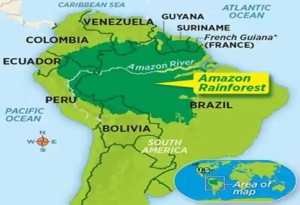
Scientists in Brazil have recently begun the AmazonFACE Project near Manaus to study how the Amazon rainforest reacts to rising carbon dioxide (CO₂) levels. This marks the first large-scale CO₂ enrichment experiment in a tropical forest.
What is the AmazonFACE Project?
- A scientific experiment designed to study how mature Amazon rainforest trees respond to future atmospheric CO₂ levels.
- Conducted in an old-growth forest near Manaus, Brazil.
- Backed by the Brazilian government and the UK.
Technology Used
- Uses Free-Air CO₂ Enrichment (FACE) technology.
- FACE systems release controlled CO₂ into open forest areas to imitate future climate conditions without enclosing the ecosystem.
How the Project Works
- Six circular steel towers are installed over the forest canopy.
- Each ring surrounds 50–70 grown trees.
- Three rings receive extra CO₂ (to simulate future climate conditions).
- Three rings act as control zones with normal air.
- Sensors measure:
- Tree CO₂ absorption
- Oxygen and water vapor release
- Response to sunlight, rainfall, storms
- Changes in growth and soil health (data every few minutes)
Significance
- Helps predict how tropical forests will behave in future high-carbon environments.
- Important for global climate models, as Amazon is a key carbon sink.
- Supports climate policy planning and forest conservation strategies.

This article has been updated and published in detail on our new platform. Please visit the link below for the latest version:
ABOUT MODEL YOUTH GRAM SABHA (MYGS)
TOPIC: (GS2) INDIAN POLITY: THE HINDU
A new initiative launched on 30 October 2025 to train students in village-level democracy by conducting mock Gram Sabha sessions in schools.
Aim
- To build democratic values, leadership, and civic responsibility among young students.
- To familiarise youth with local governance, planning, and decision-making processes.
Key Features
- Linked to NEP 2020 – supports experiential and civic learning.
- Encourages participation, accountability, transparency, and teamwork.
- Focus on young minds, especially in rural and tribal areas.
Where it will be implemented
- 1,000+ schools, including:
- Jawahar Navodaya Vidyalayas (JNVs)
- Eklavya Model Residential Schools (EMRSs)
- Government schools across states
Expected Benefits
- Creates future-ready, responsible citizens.
- Promotes awareness on village development needs.
- Strengthens community participation and democratic culture from early age.
GRAM SABHA
The Gram Sabha is the assembly of all adult villagers in a Gram Panchayat area.
It is the foundation of village-level democracy, where people directly take part in decision-making.
Key Points:
- People’s Participation: All adults (18+ years) in the village are members and can participate and vote.
- Local Decisions: Discusses and approves village development plans, welfare schemes, and budgets.
- Social Audit & Accountability: Checks how funds are used and ensures Panchayat work is transparent and fair.
Conclusion
The MYGS programme aims to nurture informed and active citizens by exposing students to grassroots governance. It strengthens democratic values and supports future leadership for rural development and good governance.
This article has been updated and published in detail on our new platform. Please visit the link below for the latest version: