

Why in News?
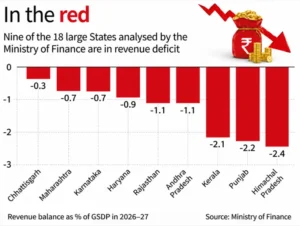
The Union Finance Ministry has cautioned that several States with high revenue deficits may struggle to handle future economic shocks.
Revenue Deficit
- Revenue Receipts: A revenue deficit occurs when a government’s revenue expenditure exceeds its revenue receipts.
- Revenue Expenditure: Salaries, pensions, subsidies, interest payments.
- Revenue Deficit = Revenue Expenditure – Revenue Receipts.
- Indicates dissaving and lack of funds for capital investment.
- Persistent deficits reflect structural fiscal imbalance.
Current Scenario
- Many States have projected revenue deficits for FY 2026–27, though a few expect surpluses.
- States like Punjab, Kerala, Andhra Pradesh, and West Bengal continue to face high fiscal stress.
- Some States show revenue surplus but high fiscal deficit, implying increased capital spending.
- Debt levels of several States remain above 25–30% of GSDP, raising sustainability concerns.
- Interest payments consume a significant share of revenue receipts, limiting fiscal flexibility.
Causes of Rising Revenue Deficits
1. High Committed Expenditure
- Salaries, pensions, and interest payments form a fixed burden.
- Limited scope for reduction in the short term.
2. Subsidy Burden
- Power, food, and welfare subsidies increase non-productive expenditure.
- Political economy factors often drive such spending.
3. Weak Revenue Mobilisation
- Dependence on GST compensation and central transfers.
- Limited capacity to raise own tax revenues.
4. Debt Trap
- Borrowing to finance deficits leads to higher interest liabilities.
- Creates a vicious cycle of debt and deficit.
5. External Shocks
- Events like pandemics or global crises reduce revenues but increase expenditure needs.
Implications of High Revenue Deficit
1. Fiscal Stress
- States face difficulty in responding to unexpected shocks.
- Reduced ability to fund welfare during crises.
2. Crowding Out Capital Expenditure
- Borrowed funds used for consumption rather than infrastructure creation.
- Hampers long-term economic growth.
3. Increased Dependence on Centre
- States may demand higher transfers or assistance.
- Weakens fiscal autonomy.
4. Debt Sustainability Risks
- Rising debt-to-GSDP ratio may lead to credit downgrades.
- Higher borrowing costs in future.
5. Intergenerational Inequity
- Future generations bear the burden of current consumption spending.
Special Observations
- Some States maintain fiscal deficit within limits but still run revenue deficits, indicating poor fiscal quality.
- States with revenue surplus are better positioned to invest in capital formation.
- Cases where fiscal deficit is high due to capital expenditure may not be fiscally harmful if investments yield returns.
Way Forward
- Shift focus from revenue expenditure to capital expenditure.
- Enhance tax base and compliance at State level.
- Rationalize subsidies through targeted delivery mechanisms.
- Strengthen fiscal responsibility laws and transparency.
- Promote cooperative federalism for better fiscal coordination.
Conclusion
Persistent revenue deficits weaken States’ fiscal health and resilience. Sustainable finances require prioritising productive spending and fiscal discipline.
Why in News?
India is set to establish its first green methanol plant in Kutch, Gujarat, using the invasive plant Prosopis juliflora as feedstock.
What is Green Methanol?
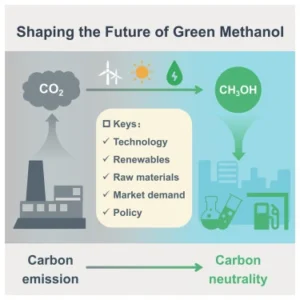
- A clean-burning liquid fuel produced from renewable biomass or captured carbon.
- Alternative to conventional fossil fuel-based methanol.
- Can be used in shipping, power generation, and industrial applications.
- Emits lower greenhouse gases, especially carbon dioxide (CO₂) and nitrogen oxides (NOx).
- Recognized as a potential fuel under global maritime decarbonization efforts.
Production Process
- Biomass Collection: Invasive species like Prosopis juliflora are harvested.
- Gasification: Biomass is heated in a low-oxygen environment to produce syngas (CO + H₂).
- Methanol Synthesis: Syngas is chemically converted into methanol.
- Refinement: Final purification for industrial and maritime use.
Why in News?
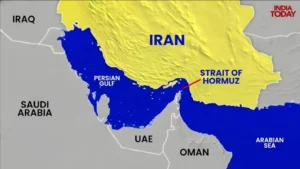
Iran has reiterated its resolve to protect its nuclear programme amid rising tensions with the United States and its allies.
Iran’s Nuclear Programme: Background
- Initiated in the 1950s with international assistance under peaceful objectives.
- Expanded significantly after the Islamic Revolution (1979).
- Iran maintains that its programme is for civilian purposes like energy generation and medical research.
- However, global powers suspect potential weaponization capability.
- Iran is a signatory to the Nuclear Non-Proliferation Treaty (NPT) but disputes restrictions on its enrichment activities.
Key Agreements and Developments
1. JCPOA (2015)
- Iran agreed to limit nuclear activities in exchange for sanctions relief.
- Included monitoring by the International Atomic Energy Agency (IAEA).
2. U.S. Withdrawal (2018)
- The United States exited the deal and reimposed economic sanctions.
- Iran gradually reduced compliance with JCPOA provisions.
3. Current Situation
- Ongoing negotiations remain uncertain and stalled.
- Iran continues uranium enrichment beyond earlier limits.
- Increasing tensions have raised fears of military escalation.
Why in News?
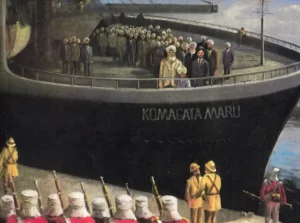
The Komagata Maru incident has been revisited in public discourse as a symbol of racial discrimination under colonial rule.
Background of the Incident
- The ship Komagata Maru was chartered by Gurdit Singh, a Punjabi entrepreneur.
- It sailed from Hong Kong to Vancouver (Canada) in April 1914.
- Carried around 376 passengers, mostly Sikhs, along with some Muslims and Hindus.
- All passengers were British subjects, expecting equal rights within the Empire.
- The voyage aimed to challenge discriminatory immigration laws in Canada.
Discriminatory Immigration Laws
- Canada had introduced the Continuous Journey Regulation (1908):
- Immigrants had to arrive via a direct, uninterrupted journey from their country of origin.
- This was practically impossible for Indians due to lack of direct shipping routes.
- Imposed financial requirements and administrative barriers.
- These rules were designed to exclude Asian immigrants, especially Indians.
Events at Vancouver Harbour
- The ship reached Vancouver in May 1914 but was denied permission to dock.
- Passengers were held offshore for nearly two months under harsh conditions.
- Legal battles were fought, but Canadian courts upheld exclusion laws.
- Only 20 passengers were allowed entry; the rest were forced to return.
Return Journey and Budge Budge Incident
- The ship arrived near Calcutta (Kolkata) in September 1914.
- British authorities attempted to send passengers to Punjab under surveillance.
- Passengers resisted, leading to a confrontation at Budge Budge.
- Police firing resulted in deaths and arrests.
- Several passengers were imprisoned; some escaped and joined revolutionary movements.
Connection with Ghadar Movement
- Many passengers were influenced by the Ghadar Party, which promoted armed revolt against British rule.
- The incident intensified anti-colonial sentiments among Indians abroad.
- Became a rallying point for revolutionary nationalism.
Significance of the Incident
- Exposure of Colonial Hypocrisy: Demonstrated that equality within the British Empire was a myth.
- Rise of Nationalism: Strengthened the resolve for independence and resistance.
- Diaspora Awareness: Highlighted struggles faced by Indian migrants abroad.
- Human Rights Perspective: Early example of racial discrimination in immigration policies.
Later Recognition and Apology
- Canada formally acknowledged the injustice decades later.
- In 2016, the Canadian Prime Minister issued an official apology in Parliament.
- The incident is now remembered as a symbol of injustice and resilience.
Challenges and Lessons
- Need to ensure non-discriminatory migration policies globally.
- Importance of protecting diaspora rights.
- Lessons on dangers of racial exclusion and legal manipulation.
Conclusion
The Komagata Maru incident remains a powerful reminder of colonial injustice and racial discrimination.
It underscores the need for fairness, equality, and dignity in global migration systems.
Why in News?
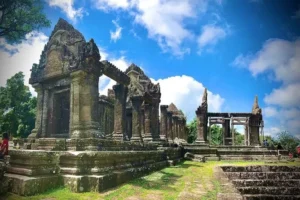
Renewed tensions between Thailand and Cambodia have brought the Preah Vihear Temple dispute back into focus.
Location and Geographical Significance
- Situated in Preah Vihear Province, Cambodia.
- Located atop the Dangrek Mountains, overlooking Thailand.
- Unique feature: access is easier from Thailand side, causing disputes.
- Strategic location gives it military and symbolic importance.
Historical Background
- Constructed during the Khmer Empire (11th–12th century).
- Initiated by Suryavarman I and expanded by Suryavarman II.
- Functioned as a major religious centre for over 800 years.
- Originally a Hindu temple, later adapted into a Buddhist site.
Architectural Features
- Represents classic Khmer temple design.
- Built along an 800-meter axial layout.
- Consists of multiple gopuras (gateway towers).
- Connected through stone pathways and staircases.
- Elevated terraces reflect cosmic symbolism (Mount Meru concept).
Dispute and Legal Status
- Conflict dates back to colonial-era boundary agreements (1904).
- Thailand disputed the border alignment.
- International Court of Justice (ICJ) ruling (1962) awarded ownership to Cambodia.
- Despite ruling, tensions persisted due to territorial claims.
UNESCO Recognition
- Declared a UNESCO World Heritage Site (2008).
- Recognition increased both tourism value and political tensions.
Why in News?
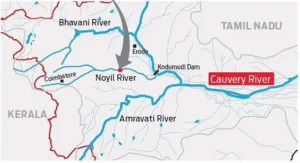
Farmers and environmental groups are demanding urgent restoration of the polluted Noyyal River.
Origin and Course
- Originates from the Vellingiri Hills in the Western Ghats.
- Flows through Coimbatore, Tiruppur, and Erode districts.
- Joins the Cauvery River at Karur district.
- Total length: approximately 158 km.
Hydrological Features
- A seasonal river, with higher flow during monsoon.
- Supported by an ancient tank irrigation system.
- Includes:
- 32 tanks
- 14 canals
- 23 anicuts
- 55 check dams
- Many structures built during the Chola period.
Historical Importance
- Served as a major drinking water source until the early 20th century.
- Supported agriculture and local economies.
- Played a key role in traditional water management systems.
Current Issues
1. Pollution
- Heavy contamination from textile dyeing industries in Tiruppur. High levels of chemical waste and untreated effluents.
2. Water Scarcity
- Reduced flow due to encroachment and overuse.
3. Ecosystem Degradation
- Loss of aquatic biodiversity. Decline in soil fertility in nearby agricultural lands.
Government and Community Efforts
- Initiatives for river cleaning and restoration.
- Judicial interventions for industrial waste control.
- Growing demand for sustainable water governance.
Why in News?
The Employees’ Provident Fund Organisation (EPFO) is launching the E-PRAAPTI portal to help users trace and activate inactive PF accounts.
E-PRAAPTI Portal
The E-PRAAPTI Portal (EPF Aadhaar-Based Access Portal for Tracking Inoperative Accounts) is a new digital platform developed by EPFO to address the issue of unclaimed and inactive provident fund accounts.
Background: EPF and UAN System
- EPF (Employees’ Provident Fund) is a mandatory savings scheme for salaried workers.
- Managed by EPFO under the Ministry of Labour and Employment.
- In 2014, EPFO introduced the Universal Account Number (UAN):
- A 12-digit unique ID for each employee.
- Enables portability of PF accounts across jobs.
What is an Inoperative EPF Account?
- A PF account becomes inactive when:
- No contributions are made for 36 months after leaving employment.
- The account is not linked to the UAN.
- Such accounts often remain unclaimed, leading to inefficiency in fund utilization.
Key Features of E-PRAAPTI Portal
1. Aadhaar-Based Authentication
- Uses Aadhaar verification for secure login.
- Ensures identity validation and fraud prevention.
2. Tracking Old Accounts
- Helps users locate multiple or forgotten PF accounts.
3. UAN Linking and Activation
- Enables seamless linking of old Member IDs with UAN.
- Facilitates account consolidation.
4. Member Profile Update
- Allows correction of personal details such as name, DOB, etc.
5. Phased Implementation
- Initially Member ID-based access.
- Future expansion to assist users without Member ID details.
Significance of the Portal
- Financial Inclusion: Ensures workers can access their savings easily.
- Ease of Doing Business: Simplifies compliance for employees switching jobs frequently.
- Reduction of Unclaimed Funds: Activates dormant accounts, improving fund utilization.
- Digital Governance: Promotes paperless, transparent, and efficient service delivery.