Table of Contents
TogglePlanning History in India
The Planning History in India is a key subject within macroeconomic governance, charting the nation’s transition from post-independence resource allocation to dynamic market-driven systems. For civil services aspirants, mastering Planning History UPSC modules provides critical analytical grounding for GS Paper III questions on state intervention, structural policy, and regional development.
What is Economic Planning
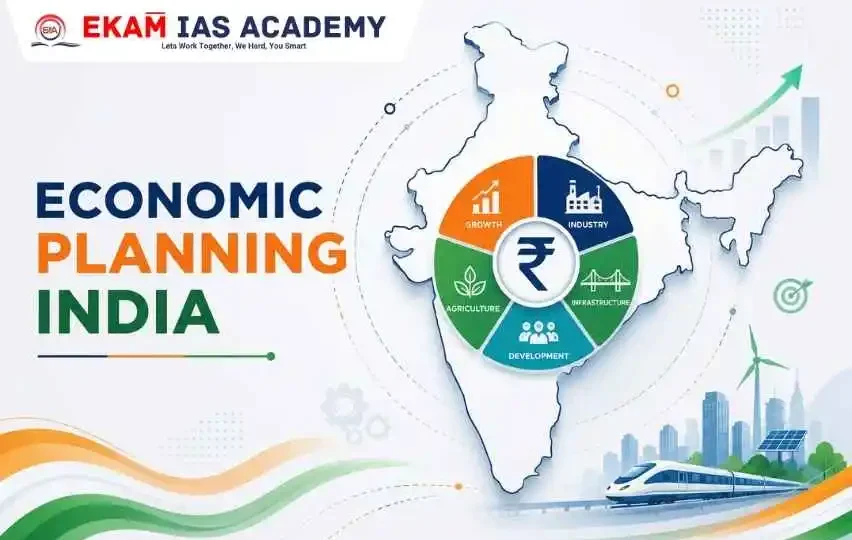
Economic Planning in India refers to a systematic process where a central authority evaluates available national resources, formulates growth targets, and allocates capital across sectors to fulfill socio-economic objectives. Grounded in a model of a Mixed Economy in India, early planning mechanisms balanced public sector control over core infrastructure with private enterprise in consumer markets.
History of Economic Planning in India
Prior to independence, several pre-planning frameworks shaped Indian Planning History:
- National Planning Committee (1938): Initiated under Subhash Chandra Bose and chaired by Jawaharlal Nehru.
- The Bombay Plan (1944): Proposed by leading industrialists to emphasize state-led heavy industrialization.
- Gandhian Plan (1944) & People’s Plan (1945): Focused on rural decentralization, cottage industries, and agrarian self-reliance.
- Sarvodaya Plan (1950): Formulated by Jaiprakash Narayan, advocating community-driven development.
Five-Year Plans (1951–2017)
India adopted Five Year Plans in India inspired by Soviet planning models. Across twelve plan cycles, Five Year Plans UPSC study topics track key developmental phases:
1st Plan (1951-56) ──► Agriculture & Harrod-Domar Model
2nd Plan (1956-61) ──► Industrialization & Mahalanobis Model
Plan Holidays/Annual ──► Wars, Droughts & Economic Crisis (1966-69, 1990-92)
8th Plan (1992-97) ──► Post-LPG Market Liberalization
12th Plan (2012-17) ──► “Faster, Sustainable, and More Inclusive Growth”
- 1st & 2nd Plans: Prioritized irrigation, agriculture, and rapid heavy industrial expansion through the Planning Commission of India.
- Plan Holidays (1966–69 & 1990–92): Interruptions caused by wars, droughts, and balance-of-payments crises.
- 8th to 12th Plans: Shifted focus toward market liberalization, service-sector growth, and sustainable human development.
Planning Commission vs NITI Aayog
Understanding Planning Commission vs NITI Aayog is vital for analyzing shifts in Indian federalism:
| Parameter | Planning Commission of India | NITI Aayog UPSC |
| Approach | Top-down command planning | Bottom-up cooperative federalism |
| Financial Power | Allocated funds to ministries & states | Advisory think-tank without fund allocation |
| State Role | Passive recipients of central plans | Active partners via Governing Council |
Transition to NITI Aayog & Importance of Planning
In 2015, the government established NITI Aayog, replacing centralized targets with 3-year Action Agendas, 7-year Strategy Documents, and 15-year Vision Plans. Planning remains essential to address market failures, eliminate regional growth imbalances, build infrastructure, and direct capital toward strategic sectors like green energy and technology.
Challenges, Recent Developments & Way Forward
- Challenges: Bureaucratic inertia, coordination gaps between central and state agencies, and regional disparities in plan implementation.
- Recent Developments: Digital Public Infrastructure frameworks (DPI 2.0), Aspirational Districts Program, and real-time data monitoring hubs.
- Way Forward: Deepening cooperative federalism, leveraging data-driven governance, and empowering local bodies to aggregate district-level demand.
Conclusion
The evolution of economic planning from command-style models to participatory governance reflects India’s economic maturity. As the nation targets Viksit Bharat 2047, agile policy planning will continue to drive inclusive, productivity-led growth.
UPSC Prelims: PYQs & Practice Questions
Previous Year Questions (Prelims)
Q: With reference to the governance of Indian planning, consider the following statements:
1. The Governing Council of NITI Aayog is chaired by the Union Finance Minister.
2. The National Development Council (NDC) was an organ of the Planning Commission.
Which of the statements given above is/are correct?
(a) 1 only
(b) 2 only
(c) Both 1 and 2
(d) Neither 1 nor 2
Answer: (d) Neither 1 nor 2
Explanation:
Statement 1 is incorrect because the Governing Council of NITI Aayog is chaired by the Prime Minister of India, not the Union Finance Minister.
Statement 2 is incorrect because the National Development Council (NDC) was established in 1952 as an independent extra-constitutional body to approve Five-Year Plans. It was an apex body above the Planning Commission, not an organ of it.
Q: Main objective of which Five Year Plan was "Faster, More Inclusive and Sustainable Growth"?
(a) 10th Five Year Plan
(b) 11th Five Year Plan
(c) 12th Five Year Plan
(d) 9th Five Year Plan
Answer: (c) 12th Five Year Plan
Explanation:
The official theme/objective of the 12th Five Year Plan (2012–2017) was "Faster, More Inclusive and Sustainable Growth".
In contrast, the theme of the 11th Five Year Plan (2007–2012) was "Towards Faster and More Inclusive Growth".
Practice Questions
Q: Regarding the pre-independence economic planning initiatives in India, consider the following pairs:
1. Bombay Plan (1944) – Spearheaded by leading industrialists advocating state intervention in heavy industries.
2. People’s Plan (1945) – Drafted by Jaiprakash Narayan emphasizing village-based cottage industries.
3. Sarvodaya Plan (1950) – Formulated by M.N. Roy focusing on socialized agriculture and consumer goods production.
How many of the above pairs are correctly matched?
(a) Only one
(b) Only two
(c) All three
(d) None
Answer: (a) Only one
Explanation:
Pair 1 is correctly matched. The Bombay Plan was authored by eight leading industrialists, including J.R.D. Tata and G.D. Birla, and advocated strong state intervention in heavy industries.
Pair 2 is incorrectly matched because the People’s Plan (1945) was drafted by Marxist leader M.N. Roy. Pair 3 is incorrectly matched because the Sarvodaya Plan (1950) was formulated by Jaiprakash Narayan based on Gandhian economic principles.
Q: Which of the following features distinguish NITI Aayog from the former Planning Commission of India?
1. Adoption of a bottom-up approach instead of a top-down mandate.
2. Direct allocation of central financial grants to state governments.
3. Inclusion of Chief Ministers of all States in its Governing Council.
Select the correct answer using the code given below:
(a) 1 and 2 only
(b) 1 and 3 only
(c) 2 and 3 only
(d) 1, 2 and 3
Answer: (b) 1 and 3 only
Explanation:
Statement 1 is correct. NITI Aayog functions on the principle of cooperative federalism and promotes a bottom-up approach in policy formulation.
Statement 3 is correct because the Governing Council of NITI Aayog includes the Chief Ministers of all States. Statement 2 is incorrect because NITI Aayog is an advisory think-tank and does not allocate funds to states; this power lies with the Ministry of Finance.
UPSC Mains – Previous Year & Practice Questions
Mains Previous Year Questions
UPSC CSE 2013 | GS-3
Question: Discuss the rationale for establishing the NITI Aayog in place of the Planning Commission. How far will this body help in achieving cooperative federalism in India?
UPSC CSE 2015 | GS-3
Question: How far has the Planning Commission of India been able to fulfill its objectives in addressing the socio-economic disparities across regions? Critically evaluate.
UPSC CSE 2017 | GS-3
Question: How are the principles of Cooperative Federalism reflected in the organizational structure and functioning of NITI Aayog?
UPSC CSE 2018 | GS-3
Question: Assess the performance of Five-Year Plans in India in achieving the growth and distributive justice objectives. Why was the plan model discontinued?
UPSC CSE 2021 | GS-3
Question: Explain the shift from centralized planning to strategic planning through NITI Aayog’s 15-year Vision Plan, 7-year Strategy, and 3-year Action Agenda.
Mains Practice Questions
Question: Critically analyze the pre-independence plans such as the Bombay Plan, Gandhian Plan, and People's Plan, and discuss how they influenced the foundational structure of economic planning in post-1947 India.
Question: “The transition from the Planning Commission to NITI Aayog marked a fundamental shift from allocative planning to strategic think-tank guidance.” Has this transition effectively empowered state-level policy execution? Examine.
Question: In the context of the Viksit Bharat @ 2047 vision, evaluate the role of decentralized district-level planning and real-time monitoring tools like the Aspirational Districts Program in accelerating inclusive growth.



Planning History in India-FAQs
What is Economic Planning in India?
Economic Planning in India refers to the systematic allocation of national resources by the state to achieve growth, equity, employment and regional development.
When did Five Year Plans begin in India?
Five Year Plans began in India in 1951 with the First Five Year Plan, which focused mainly on agriculture, irrigation and community development.
What was the role of the Planning Commission of India?
The Planning Commission prepared Five Year Plans, allocated resources, guided public investment and coordinated development priorities between the Centre and states.
Why was NITI Aayog created?
NITI Aayog was created in 2015 to replace centralized planning with cooperative federalism, data-driven governance and policy advisory support.
Why is Planning History important for UPSC?
Planning History is important for GS Paper III because it explains India’s economic model, state intervention, Five Year Plans, regional development, reforms and NITI Aayog.