
Table of Contents
ToggleTerror Threats Faced by India
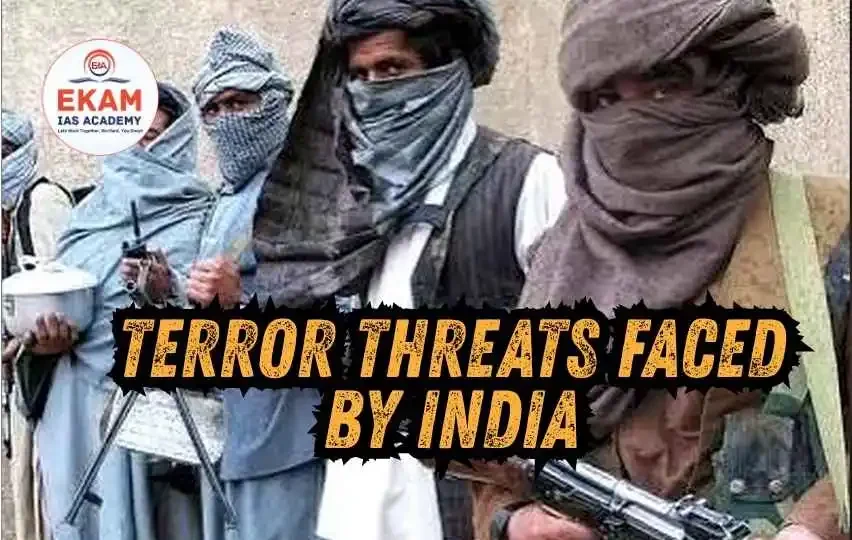
The architectural paradigm of India’s national security is facing a highly volatile and dynamic landscape. Terror Threats Faced by India have transitioned from localized, conventional insurgencies into highly sophisticated, technology-driven, and asymmetric operations. For aspirants reviewing Internal Security UPSC modules, understanding this shift is crucial. Modern non-state actors are increasingly exploiting systemic vulnerabilities, positioning Terrorism Threats in India as a dual challenge affecting both geographical borders and digital sovereignty.
Background
Historically, Terrorism in India has been deeply intertwined with geopolitical vulnerabilities and post-partition legacies. Since 1947, India’s security architecture has consistently battled externally aided proxy wars, ethno-nationalist movements in the Northeast, and Left-Wing Extremism (LWE) across the red corridor. However, globalization and the democratization of digital technology have permanently altered the National Security of India, transforming localized security concerns into an amorphous, transnational network of decentralized cells.
Types of Terrorism in India
Understanding the diverse Types of Terrorism in India requires analyzing distinct operational theatres:
- Cross-Border Terrorism in India: State-sponsored proxy warfare primarily concentrated along the Line of Control (LoC) in Jammu & Kashmir.
- Hinterland/Urban Terrorism: Coordinated bomb blasts and lone-wolf strikes executing high-impact attacks inside dense metropolitan hubs.
- Left-Wing Extremism (Naxalism): Ideology-oriented violent movements targeting infrastructure across tribal belts.
- Cyberterrorism and Bio-Terrorism: Emerging non-kinetic domains utilizing malware against critical informational grids or weaponizing hazardous pathogens.
Major Terrorist Organizations & Attacks
India’s security apparatus continuously intercepts operations from transnational and localized outfits. Organizations such as Lashkar-e-Taiba (LeT), Jaish-e-Mohammed (JeM), Hizbul Mujahideen, and the Communist Party of India (Maoist) present sustained Terror Threats to India.
The collective strategic consciousness has been systematically shaped by catastrophic events. These include the 1993 Bombay Bombings, the 2001 Parliament Attack, the 2008 Mumbai 26/11 Attacks, and the 2019 Pulwama Strike. Each occurrence triggered massive overhauls in India’s defensive positioning.
Factors Contributing to Terror Threats
According to comprehensive Internal Security Challenges in India documentation, several underlying structural drivers exacerbate vulnerabilities:
Porous and Hostile Borders: Difficult riverine and mountainous terrains allow illegal infiltration and weapon smuggling.
The Crime-Terror Nexus: Deep financial integration between drug cartels, fake currency networks (FICN), and operational terror modules (Narco-terrorism).
Digital Radicalization: Exploitation of social media platforms and encrypted dark-web applications by foreign handlers to groom homegrown lone-wolf actors.
Impact of Terrorism on India
The multi-dimensional impact of these disruptions destabilizes India’s growth trajectory. Beyond the tragic loss of human lives, terrorism strains state resources, forces massive capital diversion toward internal security procurement rather than environmental or social development, and damages investor confidence in conflict-prone economic zones.
Government Initiatives & Legal Frameworks
To fortify Counter Terrorism in India, the legislative and intelligence frameworks have been substantially reinforced:
- Unlawful Activities (Prevention) Act (UAPA): The baseline framework empowering the government to designate individuals as terrorists and freeze their financial pipelines.
- National Investigation Agency (NIA): The central agency mandated to investigate terror-related offenses seamlessly across state borders, registering a stellar conviction rate of over 92% recently.
- NATGRID & CERT-In: Cutting-edge data integration and cybersecurity monitoring networks protecting critical electronic infrastructure from asymmetric sabotage.
International Cooperation & Reports
At the global level, India remains a lead architect for unified response frameworks. India consistently demands the adoption of the Comprehensive Convention on International Terrorism (CCIT) at the UN. Furthermore, India collaborates closely with the Financial Action Task Force (FATF) to choke offshore financial pipelines. According to the Global Terrorism Index (GTI), while kinetic mass-casualty incidents have faced structural declines, the rise of digital and hybrid subversion underscores the evolving nature of global threats.
Challenges in Counter-Terrorism
The primary hurdle within contemporary security operations lies in technical attribution. Anonymized cyber-espionage networks, end-to-end encrypted messaging handlers, and the deployment of low-cost commercial drones for cross-border arms droppings bypass conventional human intelligence (HUMINT) systems, creating structural administrative gaps.
Way Forward
To comprehensively secure the nation, India must transition toward a proactive, intelligence-led doctrine:
- Smart Border Management: Installing comprehensive electronic surveillance, thermal imaging, and anti-drone laser defenses along sensitive borders.
- Counter-Radicalization Programs: Partnering with civil society leaders and community structures to neutralize extremist propaganda online.
- Inter-Agency Synchronicity: Ensuring real-time, fluid intelligence sharing between state police grids and central intelligence agencies through optimized institutional tools.
Conclusion
Neutralizing Major Terror Threats in India requires an adaptive strategy combining robust legislative enforcement with technological superiority. By modernizing security forces and maintaining a policy of absolute zero tolerance, India can seamlessly safeguard its national sovereignty and internal stability against the fluid architectures of modern asymmetric warfare. For comprehensive visual study materials and micro-analyses, continue tracking our updating Terrorism UPSC Notes repository.
UPSC Prelims: PYQs & Practice Questions
Previous Year Questions (Prelims)
Q: With reference to the National Investigation Agency (NIA) of India, consider the following statements: (UPSC CSE 2023)
1. It is empowered to investigate offences relating to human trafficking and counterfeit currency along with terror offences.
2. It has the jurisdiction to investigate scheduled offences committed outside India against Indian citizens or affecting the interest of India.
Which of the statements given above is/are correct?
(a) 1 only
(b) 2 only
(c) Both 1 and 2
(d) Neither 1 nor 2
Answer: (c) Both 1 and 2
Explanation:
Both statements are correct. Following the 2019 amendments to the NIA Act, the mandate of the NIA was expanded to include human trafficking, counterfeit currency, cyber-terrorism, and offences under the Anti-Hijacking Act. Further, Section 1(2) empowers the NIA to investigate scheduled offences committed outside India if they target Indian citizens or affect India’s interests.
Q: With reference to the Financial Action Task Force (FATF), consider the following statements: (UPSC CSE 2022)
1. It was established during the G7 Summit in Paris to develop policies to combat money laundering initially.
2. The FATF Secretariat is housed at the headquarters of the OECD in Paris.
Which of the statements given above is/are correct?
(a) 1 only
(b) 2 only
(c) Both 1 and 2
(d) Neither 1 nor 2
Answer: (c) Both 1 and 2
Explanation:
Both statements are correct. The FATF was established in 1989 by the G7 Summit in Paris to develop measures against money laundering. Its mandate expanded in 2001 to include counter-terrorism financing. Its permanent Secretariat is located at the OECD headquarters in Paris, France.
Practice Questions
Q: Consider the following security frameworks operational in India to mitigate Terror Threats Faced by India:
1. NATGRID directly collects and archives data from immigration, banking, and telecommunications sectors to provide a centralized real-time database for 11 core central intelligence agencies.
2. The Multi-Agency Centre (MAC) operates under the Ministry of Defence to handle real-time tactical intelligence sharing regarding coastal incursions.
Which of the statements given above is/are correct?
(a) 1 only
(b) 2 only
(c) Both 1 and 2
(d) Neither 1 nor 2
Answer: (a) 1 only
Explanation:
Statement 1 is correct. NATGRID is an integrated intelligence master-grid that links database inputs from sectors like airlines, banks, telecom, immigration, and other services for central agencies. Statement 2 is incorrect because the Multi-Agency Centre (MAC) functions under the Ministry of Home Affairs (MHA), not the Ministry of Defence. It serves as a nodal cross-agency platform for sharing domestic terror intelligence.
Q: In the context of tracking financial pipelines fueling Terrorism Threats in India, what is the primary mandate of the Financial Intelligence Unit - India (FIU-IND)?
(a) To execute kinetic raids and attach assets of designated individual terrorists under UAPA.
(b) To act as the central national agency responsible for receiving, processing, analyzing, and disseminating information relating to suspect financial transactions.
(c) To frame capital adequacy rules for banking systems to counter cross-border non-state actors.
(d) To act as a judicial tribunal resolving disputes related to money laundering.
Answer: (b) To act as the central national agency responsible for receiving, processing, analyzing, and disseminating information relating to suspect financial transactions
Explanation:
FIU-IND is an independent body reporting to the Economic Intelligence Council (EIC) headed by the Finance Minister. Its core mandate is to receive, process, analyze, and disseminate information related to suspicious financial transactions, including Suspicious Transaction Reports (STRs) and Cash Transaction Reports (CTRs), to help trace money laundering and terror funding lines.
UPSC Mains – Previous Year & Practice Questions
Mains Previous Year Questions
UPSC CSE 2025
Question: Terrorism is a global scourge. How has it manifested in India? Elaborate with contemporary examples. What are the counter measures adopted by the State? Explain.
GS-3 | 10 Marks | 150 Words
UPSC CSE 2024
Question: Explain how narco-terrorism has emerged as a serious threat across the country. Suggest suitable measures to counter narco-terrorism.
GS-3 | 10 Marks | 150 Words
UPSC CSE 2023
Question: Give out the major sources of terror funding in India and the efforts being made to curtail these sources. In the light of this, also discuss the aim and objective of the No Money for Terror (NMFT) Conference recently held at New Delhi.
GS-3 | 15 Marks | 250 Words
UPSC CSE 2023
Question: The use of unmanned aerial vehicles (UAVs) by our adversaries across the borders to ferry arms, ammunitions, drugs, etc., is a serious threat to internal security. Comment on the measures being taken to tackle this threat.
GS-3 | 10 Marks | 150 Words
UPSC CSE 2021
Question: Analyse the multidimensional challenges posed by external state and non-state actors to the internal security of India. Also, discuss measures required to be taken to combat these threats.
GS-3 | 15 Marks | 250 Words
Mains Practice Questions
[15 Marks | 250 Words]
Question: The traditional operational architecture of Cross-Border Terrorism in India is undergoing a tech-driven transition. Evaluate how emerging domains like cyber-sabotage, commercial drone deliveries, and encrypted command networks challenge the National Security of India.
[15 Marks | 250 Words]
Question: The convergence of organized crime syndicates, counterfeit currency networks, and drug cartels forms a lethal "Crime-Terror Nexus" that undermines internal stability. Analyze the structural drivers behind this nexus and suggest policy changes to fortify Counter Terrorism in India.
[10 Marks | 150 Words]
Question: Analyze the role played by Over-Ground Workers (OGWs) and sleeper cells in providing logistical and intelligence lifelines to terror modules executing hinterland attacks. What legal and social measures are necessary to dismantle these localized support structures?



Terror Threats Faced by India-FAQs
What are the major terror threats faced by India?
India faces major terror threats such as cross-border terrorism, urban terrorism, Left-Wing Extremism, cyberterrorism, bio-terrorism, drone-based smuggling and digital radicalization.
What is cross-border terrorism in India?
Cross-border terrorism refers to externally supported terrorist activities, mainly from across the border, aimed at destabilizing India through infiltration, arms supply and attacks on civilians or security forces.
What are the main causes of terrorism in India?
Major causes include hostile borders, proxy warfare, separatist ideologies, socio-economic deprivation, radicalization, narco-terrorism, fake currency networks and misuse of digital platforms.
Which laws and agencies help counter terrorism in India?
India counters terrorism through the UAPA, National Investigation Agency, NATGRID, CERT-In, intelligence agencies, state police forces and international cooperation through FATF.
Why is this topic important for UPSC?
This topic is important for UPSC because it connects with GS Paper III internal security, border management, cyber security, terrorism financing, Left-Wing Extremism, UAPA, NIA and national security.