
Table of Contents
ToggleTOWARDS THE BHARAT RATE OF GROWTH
TOPIC: (GS3) ECONOMY: THE HINDU
A recent article highlights how Artificial Intelligence (AI) can act as a reform catalyst similar to India’s 1991 liberalisation, potentially driving growth beyond 8%.
Historical Economic Trajectory
- Hindu Rate of Growth: For nearly 45 years postIndependence, India’s GDP growth stagnated at 3%.
- 1991 Liberalisation: Triggered by a balanceofpayments crisis, reforms opened markets, boosted exports, and attracted FDI.
- Outcome: Within a decade, India’s growth accelerated, proving that crisis breeds reform, and reform breeds growth.
India’s Digital Leapfrog
- Aadhaar: Enrolled 1.38 billion citizens, creating the world’s largest biometric identity system.
- UPI: Processes 250 billion annual transactions worth $3.4 trillion, accounting for 50% of global realtime payments.
- Reliance Jio: Launched in 2016, added 100 million subscribers in five months, slashed data prices from $3/GB to $0.10/GB.
- Lesson: India can leapfrog generations of infrastructure by combining policy innovation with technology adoption.
Current Opportunity
- AI as Reform Catalyst: Just as liberalisation transformed India in 1991, AI can drive the next wave of reforms.
- Strategic Potential: AI can boost productivity across agriculture, healthcare, judiciary, and education.
- Global Benchmark: India spends only 0.65% of GDP on R&D, far below China (2.4%) and Israel (5.4%), highlighting the need for higher investment.
- Policy Imperative: Making AI tokens free for schools and R&D institutions can democratise access, similar to how free data transformed connectivity.
India growth comparisons
- R&D Spending: India spends 0.65% of GDP; far below China (2.4%), US (3.5%), South Korea (4.9%), Israel (5.4%).
- AI Token Subsidy: Estimated at $2B annually (0.06% of GDP).
- Onefourteenth of food subsidy.
- Onetenth of fertilizer subsidy.
- Less than quarterly LPG compensation.
- Strategic Advantage: India’s 1.4B population gives it unmatched bargaining power with global tech firms.
Policy Proposals
- Free AI Tokens: Provide tokens to top 100 R&D institutions and 5,000 schools.
- PublicPrivate Partnerships: Collaborate with AWS, Google, Microsoft for compute infrastructure.
- CrossSubsidy Model: Enterprise tiers fund free access for schools and universities.
- Hosting Models: Build sovereign capacity to host LLMs like Sarvam, Llama, DeepSeek.
- Hardware Diversification: Adopt 40:30:30 mix — AWS/AMD (40%), Google TPUs (30%), NVIDIA (30%).
Challenges
- Vendor LockIn: NVIDIA dominates 80%+ of AI hardware, creating cost and dependency risks.
- Hosting Complexity: Requires expertise in latency, redundancy, efficiency, and security.
- Funding Priorities: Need to reallocate subsidies without hurting welfare.
Way Forward
- Announce a National AI Token Policy within 24 months.
- Pilot unlimited tokens at IITs and IISc, expand to 100 universities and 500 schools.
- Develop Indic AI benchmarks and deploy finetuned models in health, agriculture, judiciary, and education.
- Scale to 5,000 schools and 22 languages, enabling 10,000+ AInative startups.
AI Token Subsidy
Refers to government support for providing AI compute tokens (units of processing capacity used to run large language models and AI systems) at low or zero cost to institutions such as universities, schools, and research centres.
- Tokens are the basic unit of AI usage — similar to how data packets enable internet access. Subsidising them ensures affordable and widespread access to AI resources.
Purpose
- Democratising AI: Makes advanced AI tools available to students, researchers, and innovators without financial barriers.
- Boosting R&D: Encourages longterm industrial and scientific innovation by reducing costs of experimentation.
- Equity in Access: Prevents concentration of AI benefits among wealthy corporations by extending them to public institutions.
Conclusion
India’s next growth leap lies in treating AI as strategic infrastructure and making tokens as free as data to unlock the Bharat rate of growth.
DELAYED HONOUR AND ACCOUNTABILITY IN OPERATION SINDOOR
TOPIC: (GS2) POLITY: THE HINDU
The government formally acknowledged six soldier casualties in Operation Sindoor (2025) more than a year after the crossborder strikes.
Operation Sindoor
- Launched after the April 2025 Pahalgam terror attack that killed 26 civilians.
- Nature of Operation: Highintensity strikes across Pakistan targeting terror infrastructure.
- Casualties: Six Indian soldiers lost their lives, cremated with full military honours.
Issues Raised
- Delayed Acknowledgement: Government took over a year to confirm casualties publicly.
- Contradictory Statements: Defence Minister initially stated “no soldiers harmed,” later clarified as referring to pilots.
- Operational Secrecy vs Accountability: While secrecy is vital during war, transparency about losses is essential for credibility.
- Credibility Concerns: Selective disclosure undermines trust and disrespects sacrifices.
Way Forward
- Establish clear communication protocols for casualty reporting.
- Ensure Parliamentary accountability in defence disclosures.
- Strengthen civilmilitary trust through transparent honours and tributes.
- Balance operational secrecy with democratic responsibility.
Conclusion
True national honour lies not in silence but in timely recognition of sacrifice, ensuring credibility and respect for those who serve.
PREPARING INDIA FOR CHINA’S MISSILE CHALLENGE
TOPIC: (GS3) SEQURITY: THE HINDU
Recently concerns have risen over china’s deployment of 200+ conventional missile launchers opposite India, including hypersonic systems.
China’s Missile Arsenal
- Missile Bases: Located at Korla and Kunming, capable of firing DF15B, DF16, DF21C, and DF26.
- Hypersonic Systems: DF100 and CJ1000 can strike deep targets without warning.
- Strategic Impact: Reduces India’s Himalayan depth advantage; DF26 dualrole missile raises escalation risks.
India’s Current Missile Limitations
- Incomplete Missile Integration: Key systems like Agni, BrahMos, Nirbhay, and LRLACM are still under development and not fully integrated into a unified operational framework.
- Targeting Deficiency: India lacks robust realtime targeting infrastructure, and its missile stockpiles remain limited compared to China’s large arsenal.
- Rocket Force Gap: The idea of a dedicated rocket force is still at a conceptual stage, with no unified command or clear policy direction under the CDS.
- Hypersonic Technology Lag: India’s hypersonic missile programme is in early stages, while China already fields advanced systems like the DF100, creating a technological imbalance.
Strategic Role
- PLA’s Western Theatre Command: India must hold Tibet and Xinjiang at risk to deter missile coercion.
- Mutual Vulnerability: If China launches 100 missiles, India must inflict comparable damage, even with fewer numbers.
- Data Point: China has deployed 200+ conventional missile launchers opposite India, including DF15B, DF16, DF21C, DF26.
Operational Role
- Border Infrastructure: Capability to degrade PLA’s road/rail links, airbases, and logistics hubs.
- Reciprocal Risk: Medium and intermediaterange ballistic missiles (Agni variants) needed to hold Korla and Kunming bases at risk.
- Data Point: DF26 missiles can strike 3,000–4,000 km, threatening India’s hinterland.
Tactical Role
- Battlefield Targets: Strike PLA camps, gun positions, and ammunition dumps.
- Unified Command: Requires single authority under CDS for efficiency.
- Data Point: India’s current missile stockpile is finite, with Agni, BrahMos, Nirbhay still under integration.
Reforms Required
- Doctrinal Shift: Adopt countervalue strikes with unified national target lists.
- Structural Reform: Place rocket force under CDS; expand MRBM/IRBM inventory.
- Technological Push: Private sector participation to address propulsion, semiconductors, and material gaps.
- Hypersonic Development: Fasttrack indigenous hypersonic systems to match China’s DF100.
- Data Point: India spends 0.65% of GDP on R&D, far below China (2.4%) and Israel (5.4%).
Conclusion
India must urgently build a credible rocket force and diversify missile capabilities to ensure mutual vulnerability with China, preventing coercion and safeguarding national security.
RISE IN FOOD POISONING CASES AND LAPSES IN FOOD SAFETY
TOPIC: (GS2) POLITY: THE HINDU
Recent food poisoning incidents in Indore (school) and Bhiwandi (eatery) affecting over 200 people highlight gaps in food safety enforcement.
Food Safety Index & State Performance
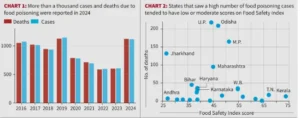
- Food Safety Index: Measures States/UTs on five parameters — human resources, compliance, food testing, training, and consumer empowerment.
- Low Scores: Nearly 75% of States/UTs scored below 50/100 in 202324.
- Examples:
- Jharkhand: 26.5 score, 130 deaths in 2024.
- Uttar Pradesh: 44.25 score, 200+ deaths in 2024. ➡ Shows correlation between weak enforcement and higher poisoning cases.
- National Deaths: 1,122 deaths in 2024 (Accidental Deaths & Suicides Report).
- Inspection Gaps: Maharashtra, only 20,877 samples tested vs 1.8 lakh registered FBOs.
- Vacancies: FSSAI sanctioned with 822 officers, 40% vacant. Only 2,997 FSOs filled out of 4,208 sanctioned posts.
Global Perspective
- WHO Estimates: Unsafe food causes 866M illnesses & 1.5M deaths annually.
- DALYs Lost: 57.1M days in 2021; 30% burden borne by children under 5.
- India’s Rank: 15th globally in years of life lost due to foodborne diseases, alongside lowincome African nations.
Challenges
- Implementation Weakness: Maharashtra tested only 20,877 food samples in 2024–25 against 1.8 lakh registered Food Business Operators (FBOs), showing poor inspection coverage.
- Manpower Deficit: Out of 4,208 sanctioned Food Safety Officer posts, only 2,997 are filled; FSSAI itself has 40% vacancies.
- Consumer Awareness: WHO (2026) estimated 866 million illnesses and 1.5 million deaths annually due to unsafe food, with 30% burden on children under 5, reflecting low public vigilance.
Way Forward
- RiskBased Inspections: Amended FSS Act mandates dynamic inspections based on establishment type and past records, ensuring targeted enforcement.
- Fill Vacancies & Expand Labs: Recruit FSOs across States and strengthen accredited food testing labs to cover all districts.
- Consumer Awareness Campaigns: Launch hygiene and safe food drives in schools, eateries, and rural areas to reduce poisoning incidents.
- Coordination Between Authorities: Improve collaboration between FSSAI and State Food Safety Authorities for uniform enforcement nationwide.
- Digital Monitoring: Use Food Safety Compliance System (FoSCoS) and AIbased surveillance for realtime compliance tracking.
Conclusion
India must urgently bridge enforcement gaps in food safety to prevent avoidable deaths and ensure public health security.
RBI’S NEW RULES ON SCAM COMPENSATION
TOPIC: (GS3) ECONOMY: THE HINDU
The Reserve Bank of India (RBI) has issued fresh rules (effective January 1, 2027) to protect customers from fraudulent electronic banking transactions (EBTs).
Changes in RBI Scam Compensation Rules
- Fraudulent EBTs Defined: RBI now recognises scam transactions as “fraudulent electronic banking transactions” ,covering cases where credentials are stolen or customers are forced to approve payments under duress.
- Eligibility Condition: Victims must report the fraud to the cybercrime helpline (1930) within five calendar days to qualify for compensation.
- Negligence Clause: Compensation will not be provided if customers ignore fraud alerts (e.g., UPI PIN warnings) or fail to update their registered phone/email, as this prevents banks from sending timely alerts.
- Reporting Timeline Extended: The window for reporting unauthorised transactions has been increased from 3 working days to 5 calendar days, giving customers more time to act.
Compensation Framework
- Loss Limit: Only covers scams up to ₹50,000.
- Compensation Rate: Victims can claim 85% of loss, capped at ₹25,000 once in a lifetime.
- Funding Split: 75% paid by RBI and remaining shared between customer and beneficiary banks.
- Example: For a ₹40,000 scam, customer receives ₹25,000 flat compensation.
Draft vs Final Rules
- Effective Date: Shifted from July 1, 2026 (draft) to January 1, 2027 (final).
- Settlement Timeline: Increased to 45 days (domestic) and 60 days (international transactions).
- Policy Concern: Framework excludes scams above ₹50,000, leaving highvalue fraud victims uncovered.
Challenges
- Customer Vulnerability: Indians face multiple fraud attempts weekly; RBI’s onetime compensation cap of ₹25,000 does not consider repeat victims who may fall prey to scams more than once.
- Legal Dimension: Under the Indian Contract Act, contracts made under coercion or fraud are voidable. Bundling such coerced transactions under “authorised” ones raises ambiguity in liability definitions.
- Financial Inclusion: Vulnerable groups, especially rural and elderly users, may struggle to meet the strict fiveday reporting timeline, risking exclusion from compensation despite genuine losses.
Conclusion
RBI’s new rules mark progress in consumer protection against scams, but limited coverage and strict eligibility conditions mean India must still strengthen safeguards for highvalue fraud victims and vulnerable users.
RADIOTAGGED WHITERUMPED VULTURE ELECTROCUTED
TOPIC: (GS3) ENVIRONMENT: THE HINDU
A captivebred, radiotagged whiterumped vulture (Gyps bengalensis) released in Mudumalai Tiger Reserve, Tamil Nadu, was electrocuted after hitting a power line.
Species Profile
- Conservation Status: Critically Endangered (IUCN Red List); Schedule I under Wildlife Protection Act, 1972.
- Ecological Role: Scavenger species vital for preventing spread of diseases by consuming carrion.
- Major Threat: Veterinary drug diclofenac caused catastrophic population decline in the 1990s–2000s, leading to >90% crash in vulture numbers.
Release History
- Initial Release: Released in TadobaAndhari Tiger Reserve, Maharashtra (Dec 2025).
- Shift to Mudumalai: Moved in April 2026 after illness treatment; aimed to strengthen South India’s last sizeable population.
- Objective: To integrate captivebred birds with wild populations and revive breeding success.
Way Forward
- Reinforce power lines with insulation and diverters in vulture habitats.
- Expand safe food zones free from diclofenac and harmful NSAIDs.
- Conduct scientific monitoring of captivebred birds across states.
- Strengthen crossborder conservation cooperation for migratory raptors.
Threats to Vultures
- Power Infrastructure: Transmission lines without insulation or diverters pose high mortality risks.
- Habitat Pressures: Expansion of settlements and roads fragment vulture habitats.
- Food Scarcity: Decline in safe carrion due to veterinary drug use (e.g., diclofenac).
- Failure to Acclimatise: Despite repeated captures and releases, the bird did not integrate with local flocks.
- Electrocution Risk: Power lines across Nilgiris have caused multiple vulture deaths in recent years.
Conservation Perspectives
- BNHS & Forest Departments: Coordinating across states for reintroduction trials.
- NGO Role: Arulagam stresses insulating power lines with bunchcabling.
- Global Practices: Bird diverters used in Africa and Europe to reduce electrocution.
- Policy Dimension: Need for integrating power infrastructure safety into conservation planning.
Way Forward
- Reinforce power lines with insulation and diverters in vulture habitats.
- Conduct scientific review of captivebred acclimatisation failures.
- Expand safe food zones under Vulture Conservation Breeding Programme.
- Strengthen crossstate coordination for monitoring released birds.
Conclusion
The incident underscores that successful species recovery demands not just reintroduction, but safe habitats free from manmade hazards.
INDIA’S 12 OPERATIONALLY DEPLOYED NUCLEAR WARHEADS
TOPIC: (GS3) SEQURITY: THE HINDU
The Stockholm International Peace Research Institute (SIPRI) Yearbook 2026 classified 12 of India’s 190 nuclear warheads as “operationally deployed” for the first time.
India’s Nuclear Doctrine
- NFU Policy: India pledges not to launch a preemptive nuclear strike; retaliation only if attacked.
- Credible Minimum Deterrence: Ensures survivability of arsenal to deliver assured retaliation.
- Political Commitment: Reaffirmed at UN in 2025; NFU remains the cornerstone of India’s nuclear posture.
Stockpile vs Deployment
- Demated Warheads: Traditionally stored separately from delivery systems for safety and restraint.
- Operational Deployment: Now 12 warheads are mated with delivery systems (missiles/submarines) and ready for use if authorised.
- Seabased Deterrent: Arihantclass SSBNs conduct deterrence patrols, enhancing survivability.
- Canisterised Missiles: Agni series kept fuelled in sealed launch tubes, enabling faster readiness.
NFU Architecture Strengthened
- SecondStrike Capability: Ensures retaliation even after absorbing a first strike.
- Submarine Advantage: SSBNs provide stealth and survivability, unlike landbased missiles at fixed sites.
- Triad Maturation: With three SSBNs operational, India can maintain continuous patrols, closing NFU vulnerabilities.
Category | Systems | Details |
Land-based missiles | Agni series (Agni-I to Agni-VI, including canisterised versions) | Range from 700 km (Agni-I) to 5,000+ km (Agni-V); canisterisation improves readiness. |
Prithvi-II | Short-range ballistic missile (~350 km). | |
Nirbhay & LR-LACM | Long-range land-attack cruise missiles under development. | |
Sea-based systems | Arihant-class SSBNs | Nuclear-powered ballistic missile submarines; at least 3 operational, ensuring survivable deterrence. |
K-15 (Sagarika) | Submarine-launched ballistic missile (~750 km). | |
K-4 SLBM | Longer-range (~3,500 km), strengthens sea-based deterrence. | |
Air-based systems | Mirage-2000, Jaguar IS, Su-30 MKI | Aircraft modified for nuclear delivery roles. |
Global Context
- Global Warheads: Nine nuclear states hold ~12,187 warheads.
- China’s Expansion: ~620 warheads, growing fastest among nuclear powers.
- Arms Control Weakening: Collapse of treaties, rise of hypersonics, AIenabled systems, and missile defence intensify risks.
- India’s Focus: Modernisation aimed at longrange systems to deter China, while maintaining stability with Pakistan.
Strategic Implications
- India’s deployment of 12 warheads signals greater operational readiness, not aggressive intent.
- Enhances credibility of NFU by ensuring assured retaliation.
- Reflects India’s adaptation to a changing global nuclear environment where deterrence stability is under strain.
Conclusion
India’s limited operational deployment strengthens its secondstrike credibility under NFU, ensuring deterrence while signalling restraint in a volatile global nuclear order.
MURCHISON WIDEFIELD ARRAY (MWA)
TOPIC: (GS3) SCIENCE AND TECHNOLOGY: THE HINDU
Astronomers using the Murchison Widefield Array (MWA) in Western Australia discovered a new millisecond pulsar under the Southern-sky MWA Rapid Two-metre (SMART) survey.
About MWA
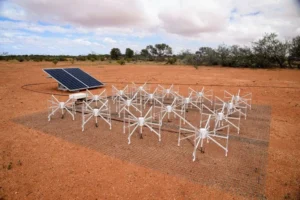
- Location: Situated at the Murchison Radio-astronomy Observatory, Western Australia.
- Collaboration: Involves 20 institutions from Australia, Canada, China, Japan, and the US; led by Curtin University.
- Structure: Comprises 4,096 spider-like antennas tuned to 70–300 MHz.
- Special Features: Wide field of view, nanosecond time resolution, digital pointing agility.
- Uses: Studies Epoch of Reionization, galaxy evolution, Sun & space weather, pulsars, fast radio bursts, and cosmic magnetism.
SMART Pulsar Survey
- Scope: Only low-frequency pulsar survey in the Southern Hemisphere (140–170 MHz).
- Expected Outcome: Hundreds of new pulsars to be identified.
- Significance: Provides baseline data for future Square Kilometre Array (SKA) pulsar searches.
Square Kilometre Array (SKA)
- Largest Radio Telescope: International project co-located in Australia (SKA-Low) and South Africa (SKA-Mid).
- Construction: Began on 5 December 2022; HQ in UK.
- Members: Includes India (joined Dec 2022), Australia, South Africa, UK, Canada, China, France, Germany, Italy, and others.
- Objective: To study galaxy formation, cosmic origins, and search for life.
Pulsars
- Definition: Rapidly rotating neutron stars emitting radiation pulses at intervals of seconds to milliseconds.
- Properties: Mass ~1.35 times the Sun, strong magnetic fields, beams of light sweeping Earth’s line of sight.
- Observation: Primarily detected at radio wavelengths; crucial for astrophysics and navigation studies.
Conclusion
The MWA’s pulsar discovery under the SMART survey strengthens India’s and global astronomy’s roadmap towards SKA, enhancing our ability to probe the universe’s origins and rare cosmic phenomena.