Table of Contents
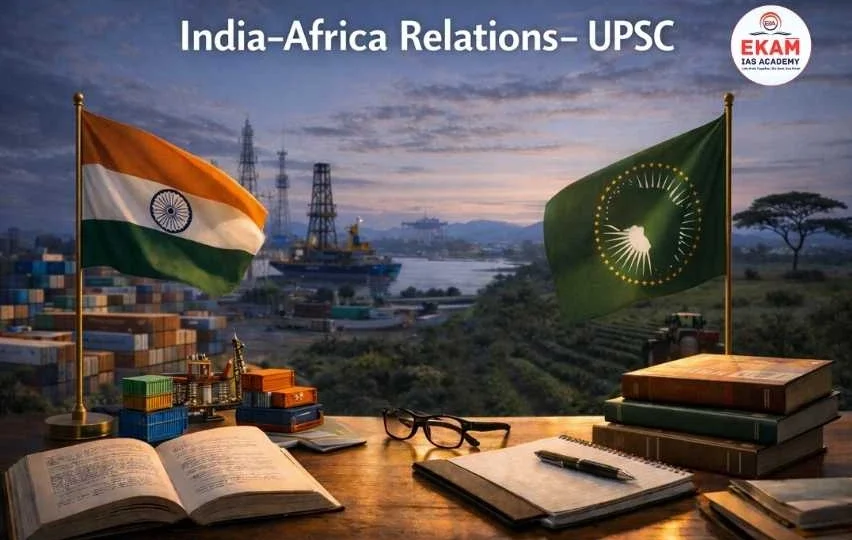
ToggleIndia-africa relations UPSC focus on a partnership rooted in a shared history of struggle against colonialism and a common vision for a multi-polar world. Today, Africa is no longer a “forgotten continent” but a vibrant land of opportunity. For New Delhi, Africa is the cornerstone of the india global south africa narrative, representing a model of “South-South Cooperation” that is non-prescriptive and demand-driven.
Historical and Cultural Linkage
The bonds between India and Africa are civilizational.
- Ancient Trade: Maritime links through the Indian Ocean connected Western India to the Swahili coast for centuries.
- Colonial Struggle: Mahatma Gandhi’s philosophy of Satyagraha was forged in South Africa. India was a leading voice against Apartheid and supported decolonization movements across the continent.
- The Diaspora: Over 3 million People of Indian Origin (PIOs) in countries like South Africa, Kenya, and Mauritius act as a “living bridge,” contributing to Africa’s economic and social fabric.
Strategic Importance of Africa
Africa is strategically indispensable for India’s global aspirations:
- Maritime Security: The eastern coast of Africa is vital for the security of the Western Indian Ocean and the safety of Sea Lines of Communication (SLOCs).
- Global Governance: With 54 votes in the UN, Africa’s support is essential for India’s bid for a permanent seat in the UNSC.
- Resource Security: Africa holds 30% of the world’s mineral reserves, including critical minerals like cobalt and lithium, essential for India’s green energy transition.
Political Relations
The relationship is institutionalized through the india africa forum summit (IAFS).
- IAFS Framework: This platform allows India to engage with the entire continent simultaneously, focusing on capacity building and infrastructure.
- AU Integration: India was a vocal advocate for the African Union (AU) to become a permanent member of the G20 during its 2023 presidency, cementing the “Voice of Global South” identity.
Economic and Trade Relations
India africa trade and cooperation have seen exponential growth.
- Bilateral Trade: Trade volume has surged to approximately $100 billion, making India one of Africa’s top five trading partners.
- Duty-Free Tariff Preference (DFTP): India offers duty-free access to 98% of its total tariff lines to Least Developed Countries (LDCs) in Africa.
- Investment: India is a top investor in sectors like telecommunications, hydrocarbons, and agriculture.
Defence and Security Cooperation
- Maritime Diplomacy: The AFINDEX (Africa-India Field Training Exercise) enhances interoperability in humanitarian assistance and counter-terrorism.
- Capacity Building: India provides training to African military officers through the ITEC (Indian Technical and Economic Cooperation) program.
- Counter-Piracy: The Indian Navy plays a key role in securing the Gulf of Aden and the Mozambique Channel.
Role of Key Companies
- Telecommunications: Airtel Africa has revolutionized mobile connectivity across 14 African nations.
- Energy: ONGC Videsh and Reliance Industries are heavily involved in oil and gas projects in Mozambique and Nigeria.
- Infrastructure: Tata Motors and Mahindra provide affordable transportation solutions, while L&T is instrumental in building power grids.
Recent Developments
- Digital Public Infrastructure (DPI): India is helping African nations implement “India Stack” (UPI, Aadhaar) to improve financial inclusion.
- Vaccine Diplomacy: The “Vaccine Maitri” initiative highlighted India’s role as the “Pharmacy of the World” during health crises in Africa.
- Critical Minerals Club: Recent MoUs with countries like Zambia and Namibia for the joint exploration of lithium.
Challenges in the Relationship
- The China Factor: China’s massive “Belt and Road Initiative” (BRI) and “Debt Trap Diplomacy” pose a competitive challenge.
- Security Volatility: Ongoing civil wars, coups in the Sahel region, and the rise of extremism (e.g., Al-Shabaab) affect project implementation.
- Logistical Barriers: High transaction costs and lack of direct shipping routes between many Indian and African ports.
Way Forward
- Triangular Cooperation: Partnering with countries like Japan (Asia-Africa Growth Corridor) or France to co-finance projects in Africa.
- Focus on Food Security: Utilizing African land and Indian agricultural technology to create a “win-win” for global food supply.
- Blue Economy: Strengthening cooperation in sustainable ocean mining and marine biotechnology.
Conclusion
The India-Africa strategic partnership is a unique model based on mutual respect rather than a patron-client relationship. For UPSC aspirants, this topic exemplifies India’s role as a bridge-builder. As Africa moves toward the AfCFTA (African Continental Free Trade Area), India’s “non-prescriptive” approach will ensure it remains a preferred partner for a prosperous and stable Africa.
UPSC Prelims: PYQs & Practice Questions
Previous Year Questions (Prelims)
Q1. [UPSC Prelims 2015]
Q: With reference to the 'Pan-African e-Network Project', consider the following statements:
1. It is a joint initiative of the Government of India and the African Union.
2. It aims to provide tele-education and tele-medicine services to African countries.
Which of the statements given above is/are correct?
(a) 1 only
(b) 2 only
(c) Both 1 and 2
(d) Neither 1 nor 2
Answer: (c) Both 1 and 2
Explanation:
The Pan-African e-Network Project was a joint initiative of the Government of India and the African Union. Launched in 2009, it connected African countries with leading Indian universities and hospitals through satellite and fibre-optic links, enabling tele-education and tele-medicine services.
Q: Which of the following describes the ‘Duty-Free Tariff Preference (DFTP)’ scheme of India?
(a) A scheme to promote Indian exports to the European Union.
(b) A unilateral trade concession by India to Least Developed Countries (LDCs), many of which are in Africa.
(c) A military cooperation pact between India and the African Union.
(d) A digital payment gateway for the African diaspora.
Answer: (b) A unilateral trade concession by India to Least Developed Countries (LDCs), many of which are in Africa
Explanation:
India’s Duty-Free Tariff Preference scheme is a unilateral trade concession extended to Least Developed Countries. It provides duty-free and quota-free access on most tariff lines and has significantly benefited many African countries. It is not related to military cooperation, digital payments, or exports to the European Union.
Practice Questions
Q: The 'AFINDEX' exercise, often mentioned in news, refers to: (Practice-based)
(a) A financial index for African stock markets.
(b) A joint field training exercise between the Indian Army and various African nations.
(c) An index measuring digital literacy in Africa.
(d) A diplomatic forum for India-Africa energy talks.
Answer: (b)
Explanation:
AFINDEX (Africa-India Field Training Exercise) focuses on humanitarian mine assistance and peace support operations. It strengthens defence cooperation between India and African countries under the framework of the "Lucknow Declaration."
UPSC Mains – Previous Year & Practice Questions
Mains Previous Year Questions
Question: "The 'Voice of the Global South' was a central theme of India’s G20 Presidency. How has India championed the inclusion of the African Union (AU) in global governance?" (2023)
Question: "Evaluate the economic and strategic dimensions of India’s engagement with Africa in the 21st century." (2016)
Question: "India’s focus on 'capacity building' and 'human resource development' distinguishes its partnership with Africa from other global powers. Discuss."
Question: "Discuss the strategic importance of the Western Indian Ocean for India's maritime security and the role of African littoral states."
Question: "How does the 'Asia-Africa Growth Corridor' (AAGC) provide an alternative model of development compared to the 'Belt and Road Initiative' (BRI)?" (2017)
Mains Practice Questions
Q1. [15 Marks | 250 Words]
Question: "The 'India-Africa Forum Summit' (IAFS) has institutionalized a multi-layered engagement. Analyze the impact of the hiatus in holding the 4th IAFS on bilateral ties."
Q2. [10 Marks | 150 Words]
Question: "Examine the potential of the African Continental Free Trade Area (AfCFTA) in expanding India's manufacturing exports under 'Make in India'."
Q3. [15 Marks | 250 Words]
Question: "With the rise of radicalism in the Sahel region and piracy in the Gulf of Guinea, discuss the need for a robust India-Africa security architecture."



India-Africa Relations-fAQs
What is the "Lucknow Declaration"?
Adopted during the first-ever India-Africa Defence Ministers’ Conclave in 2020, it outlines cooperation in defense manufacturing, R&D, and maritime security in the Indian Ocean Region.
How does India's approach to Africa differ from China's?
India’s model is “non-prescriptive” and “demand-driven,” focusing on local capacity building, digital infrastructure, and education. China’s model is often criticized for being resource-extractive and infrastructure-heavy, leading to “debt-trap” concerns.
What is the "Team-9" initiative?
It is the Techno-Economic Approach for Africa-India Movement, involving India and eight West African countries. It focuses on providing concessional credit for projects in agriculture, transport, and energy.
Why is the "Voice of Global South" summit significant for Africa?
Organized by India in 2023 and 2024, it provided a platform for African leaders to voice their concerns on climate change, debt distress, and food security before the G20, ensuring their priorities were reflected in the New Delhi Declaration.
What is the significance of "Airtel Africa" and "Tata" in the IR context?
These companies represent India’s “Soft Power” and economic footprint. Airtel is a top telecom provider in 14 African countries, while Tata Motors provides the majority of public transport buses in many African cities, building a positive brand image for India.