

Table of Contents
ToggleFALLOUT OF WEST ASIA CRISIS ON INDIA’S ECONOMY
TOPIC: (GS3) ECONOMY: THE HINDU
The West Asia conflict has disrupted global energy supply chains, causing crude oil prices to surge and creating multiple stress points for India’s economy, including inflation, trade imbalances, and fiscal pressures.
Background
- The crisis has led to a partial blockade of the Strait of Hormuz, restricting crude oil and fertilizer transport.
- India’s dependence on imported crude is nearly 90%, with imports from 41 countries.
- The Indian crude basket peaked at $157 per barrel (March 23, 2026) before falling to $120.28 per barrel (April 9, 2026) after a temporary ceasefire.
Economic Impact Channels
- Supply Disruptions: Energyintensive sectors such as textiles, chemicals, fertilizers, cement, and tyres face production bottlenecks. Fertilizer shortages could affect Kharif crop output beginning June.
- Rising Logistics Costs: Transport and storage, being energyheavy, have become costlier, pushing up prices of final goods across industries.
- Export Challenges: India’s exports to West Asia account for 16.4% of total merchandise exports (202425). Demand slowdown in the U.S. and Europe adds further strain, though rupee depreciation offers limited relief.
- Exchange Rate & Remittances: The rupee has depreciated sharply, worsened by $13.6 billion FPI outflows in March 2026. Remittances from Gulf countries are expected to decline, adding pressure on the exchange rate.
- Inflationary Pressures: RBI estimates show that a 10% rise in crude basket prices reduces GDP growth by 15 basis points and raises inflation by 30 basis points. With crude prices about $50 above baseline, GDP growth could fall by 1% and inflation rise by 2%.
Way Forward
- Align Retail Fuel Prices with Global Trends: Retail fuel prices should be allowed to adjust in line with international crude oil movements to avoid fiscal stress.
- Control Inflation through Monetary Prudence: The government and RBI must avoid excessive liquidity expansion, ensuring that costpush inflation does not spill over into general price rise.
- Diversify Energy Sources and Boost Renewables: India should reduce dependence on imported crude by expanding renewable energy capacity and tapping alternative fuels.
- Maintain Fiscal Discipline and Rationalise Subsidies: Subsidy support must be targeted and rationalised to prevent widening of the fiscal deficit while protecting vulnerable groups.
- Strengthen LongTerm Energy Security: A comprehensive energy security plan, including diversification of suppliers, investment in domestic production, and renewable integration, is essential to build resilience against external shocks.
Conclusion
While temporary ceasefires have eased crude prices, sustained peace, diversification of imports, and stronger renewable energy adoption are essential to safeguard India’s economy.
ONUS ON SUPREME COURT TO PROTECT DEMOCRACY
TOPIC: (GS2) POLITY: THE HINDU
The Supreme Court’s role in overseeing the Election Commission’s Special Intensive Revision (SIR) of electoral rolls in West Bengal has raised concerns about largescale voter deletions and the protection of democratic rights.
Background
- The Election Commission of India (ECI) undertook a Special Intensive Revision to “purge” electoral rolls.
- In West Bengal, nearly six million voters were flagged for discrepancies, with 2.7 million deletions left unresolved.
- The Supreme Court permitted the process, but questions remain about whether genuine voters were unfairly excluded.
Challenges
- Right to Vote at Risk: Voting is a constitutional right, yet many citizens were denied participation due to procedural hurdles and mass deletions.
- Trust in Institutions: The ECI, created to safeguard democracy, appears to have eroded public trust by prioritising “purging” over inclusion.
- Judicial Oversight: The Supreme Court, traditionally the guardian of rights, has been criticised for allowing largescale deletions despite earlier assurances against mass exclusions.
- Impact on Electoral Participation: Instead of encouraging voter registration, the process created barriers, potentially lowering turnout and weakening democratic legitimacy.
- Risk of Bias: Targeting specific communities, such as Bengalispeaking Muslims, has raised fears of discrimination and undermined the principle of “no voter left behind.”
Way Forward
- Judicial Vigilance: The Supreme Court must ensure that no genuine voter is disenfranchised, even if one wrongful deletion occurs.
- Transparent Processes: The ECI should adopt clear, fair criteria for voter roll revisions and allow adequate grievance redressal.
- CitizenFriendly Approach: Instead of creating hurdles, institutions should simplify registration and verification to strengthen participation.
- Restoring Trust: Both the ECI and SC must act to rebuild public confidence in electoral democracy by prioritising inclusion over exclusion.
- Safeguarding Democracy: Protecting the right to vote is essential for maintaining faith in democratic institutions and preventing voter apathy.
Conclusion
The Supreme Court carries the responsibility of ensuring that constitutional rights are not compromised, that “every vote matters.” Protecting the sanctity of the vote is vital to sustaining public trust in India’s democracy.
DEVELOPMENT IN WEST BENGAL
TOPIC: (GS1) SOCIAL ISSUES: THE HINDU
Ahead of the upcoming elections, an indicator-based analysis shows that West Bengal lags behind national averages in several economic and social parameters, though it performs relatively better in health and education indicators.
Economic Indicators
- Human Development Index (HDI): 0.719 in 2023, below the national average of 0.732.
- Per Capita Income: ₹1.63 lakh, ranking 16th out of 23 states, compared to the national average of ₹2.05 lakh. Delhi and Telangana record more than double this figure.
- Rural Wages: Average daily wage at ₹347, lower than the national average of ₹398.
Health Indicators
- Infant Mortality Rate (IMR): 17 per 1,000 live births, better than India’s average of 25.
- Immunisation Coverage: 88% of children fully vaccinated, placing the state 4th nationally.
- Undernutrition: 34% of children stunted, slightly below national average but still concerning.
- Maternal Mortality Rate (MMR): 103 per 1 lakh live births, higher than the national average of 97.
- Adolescent Childbearing: 16% of women aged 15–19 have begun childbearing, more than double the national average.
- Health Coverage: Only one-third of households have at least one member covered under a health scheme.
Education Indicators
- Elementary Enrolment: Adjusted net enrolment rate at 100%, comparable to top states.
- Dropout Rate: Secondary level dropout at 18%, indicating weak retention.
- Higher Secondary Enrolment: Gross enrolment ratio at 62%, slightly above the national average.
- Gender Parity: Balanced in higher education.
- No Schooling: 13% of men aged 15–49 have no schooling (rank 23rd), higher than national average of 10.7%. For women, 18.5% have no schooling, better than national average of 22.6%.
Infrastructure & Environment
- Fossil Fuel Consumption: Lower than national average, reflecting economic structure rather than efficiency.
- Plastic Waste: Higher than national average, ranking 8th out of 23 states.
- Rural Internet Penetration: Limited at 35 per 100 people.
- Urban Housing: Relatively better, with only 0.8% of households living in kachha houses.
Conclusion
West Bengal presents a mixed development picture. While health indicators like immunisation and infant mortality are encouraging, economic performance, rural wages, and education retention remain weak.
RISE IN MIDDLE CLASS VULNERABILITY
TOPIC: (GS3) ECONOMY: THE HINDU
A recent World Bank policy paper highlights that while India has reduced income-based poverty, a large section of the population remains stuck in a vulnerable middle class, lacking upward mobility and economic security.
Background
- Poverty reduction has been significant: share of Indians below the lower middle-income poverty line fell from 50% a decade ago to ~30% today.
- Welfare schemes like subsidised food, direct transfers, and financial inclusion have reduced extreme deprivation.
- However, crossing the poverty line does not guarantee stability; many households remain in a fragile zone with low and volatile incomes.
Key Concerns
1. Growth Without Mobility
- India’s growth has not translated into broad-based economic opportunity.
- Sectors driving growth are capital-intensive, absorbing limited labour.
- Formal employment remains scarce: fewer than 10% of workers have jobs with social security.
2. Income Vulnerability
- Data from the e-Shram portal shows 94% of informal workers earn less than ₹10,000/month.
- Average farm household income is ₹10,218/month, translating to just ₹75 per person per day.
- Real wages for salaried workers have stagnated despite productivity gains.
3. Labour Market Stress
- Manufacturing failed to absorb new entrants; between 2016–2021, the sector lost 24 million jobs.
- Agriculture still employs 46% of workforce but contributes only 18% of GDP, reflecting low productivity.
- Youth unemployment is around 45%, with graduate unemployment at 29%.
4. Inequality and Wealth Concentration
- India has 271 billionaires holding wealth equal to one-fourth of national income.
- The top 1% captures over 22% of national income, widening inequality.
5. Household Fragility
- Net household financial savings have fallen to ~5% of GDP, while debt has risen sharply.
- Credit is increasingly used to sustain consumption rather than build assets.
- Human development indicators remain weak: child wasting at 18.7% (highest globally) and stunting at 35.5%.
Policy Implications
- Shift Focus to Mobility: Policy must move beyond simply reducing poverty and instead aim at enabling upward mobility, ensuring households can transition from vulnerability to economic security.
- Generate Productive Employment: Expanding job opportunities in sectors that can absorb labour at scale is essential, while also strengthening the link between productivity growth and wage increases.
- Promote Inclusive Growth: Broader access to quality education, healthcare, and social security should be ensured so that growth benefits reach all sections of society.
- Address Structural Bottlenecks: Manufacturing and agriculture need targeted reforms to absorb the large labour force effectively, improve productivity, and provide stable incomes.
How the World Bank Measures Poverty
Household Surveys
- Poverty estimates are based on nationally representative household surveys.
- These surveys collect data on income, consumption, and expenditure patterns.
Welfare Aggregates
- Household data is converted into welfare aggregates (income or consumption per person).
- Consumption is often preferred over income because it better reflects living standards in developing countries.
Purchasing Power Parity (PPP) Adjustment
- To make comparisons across countries, welfare aggregates are adjusted using PPP exchange rates.
- This ensures that $1 in India reflects the same purchasing power as $1 in another country.
International Poverty Lines
- The World Bank defines poverty thresholds at different levels:
- Extreme Poverty: $2.15/day (2017 PPP) – minimum subsistence level.
- LowerMiddle Income Poverty: $3.65/day – relevant for countries like India.
- UpperMiddle Income Poverty: $6.85/day – used for more advanced economies.
Headcount Ratio
- The most common measure is the headcount ratio: the share of the population living below a given poverty line.
- Example: If 30% of Indians live below $3.65/day, that is the lowermiddle income poverty rate.
Conclusion
The task ahead is to restore the link between growth and opportunity, ensuring that progress translates into durable improvements in living standards.
BIOMETRIC VERIFICATION IN HARYANA MANDIS
TOPIC: (GS3) ECONOMY: THE HINDU
Farmers in Haryana have staged protests against the mandatory biometric verification system in mandis, alleging harassment and procedural hurdles, while the state government defends it as a step towards transparency in crop procurement.
Mandi System in India
- Mandis are regulated wholesale markets under APMC Acts, where farmers sell produce through auctions.
- Middlemen (arhatiyas) facilitate transactions, often creating dependency and debt cycles.
- Challenges include fragmented licensing, multiple levies, poor infrastructure, and farmers receiving only 30–40% of consumer price.
- Reforms like e-NAM (2016), Model APMC Act (2003), and upgrading Gramin Haats/PACS aim to reduce intermediaries and improve farmer access.
Haryana’s Biometric Procurement System
- Introduced in 2026, mandis now require Aadhaar-based fingerprint verification linked to the Meri Fasal-Mera Byora portal.
- Includes vehicle tracking, geofencing of procurement centres, and storage monitoring.
- Triggered by the 2025 Karnal paddy scam, where fake gate passes allowed paddy from other states to be sold fraudulently, causing revenue losses.
Farmers’ Concerns
- Farmers argue scams were due to collusion among officials and millers, not farmers.
- Verification causes long queues, delays, and difficulties when the registered farmer is absent.
- Many feel the system is humiliating and overly cumbersome, treating them with suspicion.
- Union leaders highlight that the burden of proof is unfairly shifted onto farmers.
Government vs Opposition
- Government’s Stand: Biometric verification ensures transparency, accountability, and efficiency, preventing fraud in procurement. Relaxations include allowing nominees and flexible vehicle documentation.
- Opposition’s Criticism: The system is seen as bureaucratic and arbitrary, burdening farmers while ignoring deeper issues of corruption among officials and traders.
Conclusion
The Haryana biometric verification system reflects the tension between reform and farmer convenience. While it aims to prevent fraud and strengthen accountability, its implementation has created procedural hardships and mistrust among farmers.
SENTINEL SPECIES
TOPIC: (GS3) ENVIRONMENT: THE HINDU
The International Union for Conservation of Nature (IUCN) recently declared the emperor penguin as an endangered sentinel species, highlighting its role as an early warning indicator of ecosystem decline.
Sentinel Species
- Definition: A sentinel species is one whose health reflects the condition of its ecosystem.
- Characteristics:
- They are the first to respond to environmental stressors like pollution or disease.
- Their reactions are more visible compared to other species.
- They often occupy fixed territories and live long enough to accumulate toxins.
- Their physiology amplifies environmental changes, making them reliable indicators.
- Role: Provide early warnings of ecological problems and help scientists track ecosystem health.
Examples of Sentinel Species
- Frogs: Sensitive to pesticides and pathogens due to permeable skin.
- Canaries in Coal Mines: Historically used to detect carbon monoxide before it harmed miners.
- Honeybees: Used to monitor agricultural chemical exposure.
- Polar Bears: Help track contaminant accumulation in the Arctic.
- Emperor Penguin: Now endangered, reflecting the impact of climate change and habitat loss in Antarctica.
Conclusion
Sentinel species act as nature’s early warning systems, alerting us to environmental stress before it becomes irreversible. Protecting them is not only about conserving biodiversity but also about safeguarding the ecosystems that sustain human life.
EXERCISE DUSTLIK
TOPIC: (GS3) SEQURITY: THE HINDU
The Indian Army contingent has departed to participate in the 7th edition of Exercise Dustlik, a joint military exercise with Uzbekistan.
Exercise Dustlik
- Nature of Exercise: A bilateral military drill between India and Uzbekistan, conducted annually on a rotational basis in both countries.
- Participating Forces: Primarily the MAHAR Regiment battalion from the Indian Army, supported by personnel from the Indian Air Force.
- Objective: To strengthen military cooperation and enhance the ability to conduct joint operations in semimountainous terrain.

Key Features
- Establishing a unified operational framework between the command structures of both armies.
- Practicing land navigation, strike missions on enemy bases, and seizure of enemyheld areas.
- Sharing best practices in tactics, techniques, and procedures for joint operations.
- Enhancing interoperability, operational synergy, and coordination between the two contingents.
Conclusion
By focusing on joint training and operational coordination, the exercise strengthens mutual trust and prepares both forces for effective collaboration in diverse operational scenarios.
SAGARMALA PROGRAMME
TOPIC: (GS3) ECONOMY: THE HINDU
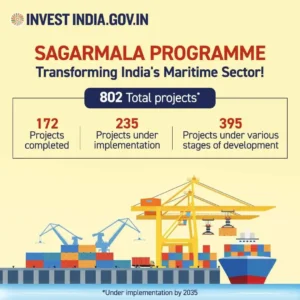
The Sagarmala Programme is currently implementing 845 projects worth ₹6.06 lakh crore, of which 315 projects worth ₹1.57 lakh crore have been completed, highlighting its progress in port-led development.
Sagarmala Programme
- Launch: Initiated in March 2015 to promote port-led development.
- Objective: Improve logistics efficiency, reduce transportation costs, and boost trade by integrating coastal shipping and inland waterways with road and rail networks.
- Scope: Projects are divided into 5 pillars and 24 categories.
Components of Sagarmala
- Port Modernisation & New Port Development: Upgrading existing ports and building new ones to expand capacity and efficiency.
- Port Connectivity Enhancement: Strengthening road, rail, and waterway links between ports and hinterland for faster cargo movement.
- Port-Led Industrialisation: Developing industrial clusters near ports to support manufacturing and economic activity.
- Coastal Community Development: Improving livelihoods and promoting sustainable growth in coastal regions.
- Coastal Shipping & Inland Waterways: Encouraging greater use of waterways for cargo transport to reduce logistics costs.
Institutional Framework
- National Sagarmala Apex Committee (NSAC): Provides overall policy guidance and oversight.
- Maritime States Development Council (MSDC): Facilitates centre–state coordination for port development.
- State Sagarmala Committees (SSC): Identify and monitor projects at the state level.
- Sagarmala Finance Corporation Limited (SMFCL): Formerly Sagarmala Development Company Limited (SDCL, 2016), restructured in June 2025 to finance maritime infrastructure projects.
Conclusion
With hundreds of projects already completed, its success depends on sustained coordination between the Centre, states, and private stakeholders to ensure economic growth and coastal community development.