Table of Contents
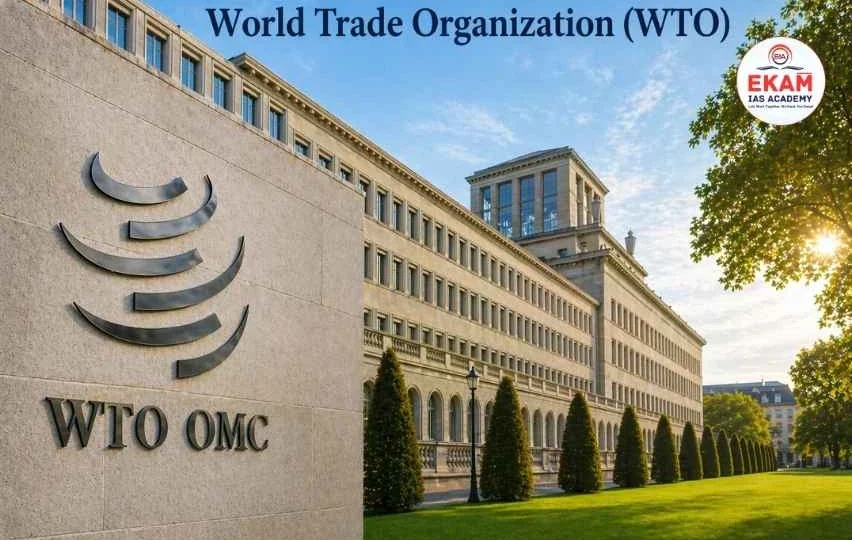
ToggleThe World Trade Organization (WTO) is the only global international organization dealing with the rules of trade between nations. For WTO UPSC preparation, it is essential to understand that the organization acts as a forum for negotiating trade agreements, settling disputes, and supporting the needs of developing countries. Established in 1995, it remains the heart of the multilateral trading system.
Historical Background
The WTO is the successor to the General Agreement on Tariffs and Trade (GATT), which was established in 1948 following World War II. While GATT focused primarily on trade in goods, the Uruguay Round (1986-1994) led to the creation of the WTO expanding the mandate to include trade in services and intellectual property.
Objectives and Principles
The primary objective of the WTO is to ensure that trade flows as smoothly, predictably, and freely as possible. World Trade Organization notes UPSC must highlight its core principles:
- Most-Favoured-Nation (MFN): Treating all member nations equally; no country can grant special favors to one without doing so for all.
- National Treatment: Imported and locally-produced goods must be treated equally after the foreign goods have entered the market.
- Reciprocity: Mutual lowering of trade barriers.
- Predictability: Through “binding” commitments that prevent sudden increases in tariffs.
WTO Functions and Structure
The WTO Functions and structure follow a democratic “one member, one vote” system.
- Ministerial Conference: The highest decision-making body, meeting every two years.
- General Council: Manages day-to-day work; it also functions as the Dispute Settlement Body (DSB) and the Trade Policy Review Body.
- Secretariat: Headed by the Director-General, providing administrative support.
Key Functions
- Administering Trade Agreements: Ensuring members follow the rules.
- Dispute Settlement: Acting as a “judge” to resolve trade conflicts, ensuring stability.
- Technical Assistance: Building trade capacity for developing nations.
- Trade Negotiations: Reducing obstacles to international trade.
Key WTO Agreements
- Agreement on Agriculture (AoA): Focuses on market access, export subsidies, and domestic support (Amber, Blue, and Green boxes).
- GATS: General Agreement on Trade in Services.
- TRIPS: Trade-Related Aspects of Intellectual Property Rights.
- TRIMS: Trade-Related Investment Measures.
India and WTO Issues
India and WTO issues are characterized by a balance between promoting global trade and protecting domestic interests.
- Public Stockholding (PSH): India advocates for a permanent solution to ensure food security for its millions of poor, clashing with the “De Minimis” limits on subsidies.
- Peace Clause: A temporary mechanism that protects India’s food procurement programs from being challenged in the DSB.
- TRIPS Waiver: India and South Africa led the call for waiving patent rights for COVID-19 vaccines to ensure equitable global access.
- Fisheries Subsidies: India seeks “Special and Differential Treatment” (S&DT) to protect its small-scale fishers.
Challenges Facing WTO
- Appellate Body Crisis: The paralysis of the dispute settlement mechanism due to the non-appointment of members (primarily by the US).
- Rise of Protectionism: Increasing use of unilateral trade barriers and “trade wars.”
- Plurilateral vs. Multilateral: A shift toward smaller groups making deals rather than the full consensus of all 164 members.
Recent Developments
- MC13 and MC14 Progress: Discussions on digital trade and the moratorium on e-commerce transmissions.
- Investment Facilitation for Development (IFD): Efforts to streamline investment procedures to boost FDI in developing nations.
- Environment and Trade: Integrating the “Green Trade” agenda into the WTO framework.
Way Forward
- Restoring the DSB: Revitalizing the Appellate Body is crucial for the WTO’s credibility.
- Agricultural Reform: Finding a permanent solution to Public Stockholding to address the concerns of the Global South.
- Digital Economy: Updating rules to reflect the reality of the global digital and services-led economy.
Conclusion
The WTO stands at a crossroads. While its effectiveness is questioned by the rise of bilateralism, it remains the only shield for developing nations against economic bullying. For UPSC aspirants, the WTO represents the complex intersection of global economics and national sovereignty. A reformed, inclusive WTO is essential for the “Viksit Bharat” vision and global stability.
UPSC Prelims: PYQs & Practice Questions
Previous Year Questions (Prelims)
Q: Consider the following statements: (2017)
1. India has ratified the Trade Facilitation Agreement (TFA) of WTO.
2. TFA is a part of WTO’s Bali Ministerial Package of 2013.
3. TFA came into force in January 2016.
Which of the statements given above is/are correct?
(a) 1 and 2 only
(b) 1 and 3 only
(c) 2 and 3 only
(d) 1, 2 and 3
Answer: (a) 1 and 2 only
Explanation:
The Trade Facilitation Agreement (TFA) was a major outcome of the Bali Ministerial Package (2013). India ratified it in 2016. However, it officially came into force in February 2017, not January 2016.
Q: In the context of the WTO, which of the following is/are categorized under the 'Amber Box' subsidies?
1. Research and Development
2. Minimum Support Price (MSP)
3. Environmental protection programs
4. Input subsidies like electricity and fertilizers
Select the correct answer:
(a) 1 and 3 only
(b) 2 and 4 only
(c) 1, 2 and 4 only
(d) 2, 3 and 4 only
Answer: (b) 2 and 4 only
Explanation:
Amber Box includes domestic support measures that distort production and trade, such as MSP and input subsidies. By contrast, Research and Development and environmental protection programs generally fall under the Green Box, as they cause minimal or no trade distortion.
Practice Questions
Q: The 'Marrakesh Agreement' is associated with the establishment of which organization? (PYQ - Static)
(a) IMF
(b) World Bank
(c) WTO
(d) United Nations
Answer: (c) WTO
Explanation:
Signed in April 1994 in Morocco, the Marrakesh Agreement concluded the Uruguay Round and officially replaced GATT with the WTO on January 1, 1995.
UPSC Mains – Previous Year & Practice Questions
Mains Previous Year Questions
Question: The World Trade Organization (WTO) is struggling to maintain its relevance in the face of rising protectionism and the paralysis of its Dispute Settlement Body. Discuss.
Question: What are the key differences between the GATT and the WTO? Discuss the significance of the Uruguay Round in this transition.
Question: India’s food security concerns have often clashed with WTO’s Agreement on Agriculture (AoA). Critically examine the issue of Public Stockholding (PSH) and the 'Peace Clause'.
Question: The TRIPS Agreement has been a bone of contention between developed and developing nations. Analyze in the context of access to essential medicines.
Question: Discuss the implications of 'Special and Differential Treatment' (S&DT) for developing countries like India in the WTO negotiations.
Mains Practice Questions
Q1. [15 Marks | 250 Words]
Question: The shift from a 'Multilateral' to a 'Plurilateral' approach in trade negotiations threatens the democratic fabric of the WTO. Examine.
Q2. [10 Marks | 150 Words]
Question: Analyze the impact of the WTO’s 'Fisheries Subsidies Agreement' on India's small-scale fishing community and maritime economy.
Q3. [15 Marks | 250 Words]
Question: With the rise of the digital economy, the moratorium on e-commerce transmissions has become a focal point of debate. Discuss India's stand on this issue.
World Trade Organization-FAQs
What is the "Peace Clause"?
It is a temporary mechanism agreed upon at the Bali Ministerial (2013). it protects developing countries from being challenged at the WTO if they breach the subsidy cap (10% for developing nations) for Public Stockholding of food grains for food security. India is the first country to invoke this clause.
Why is the WTO Appellate Body paralyzed?
The USA has blocked the appointment of new judges to the Appellate Body (the “Supreme Court” of world trade), citing concerns over judicial overreach. This prevents the WTO from reaching final, legally binding decisions on trade disputes.
What are the 'Three Boxes' in the Agreement on Agriculture (AoA)?
- Green Box: Subsidies that don’t distort trade (No limits).
- Blue Box: Subsidies with production limits (No current limits).
- Amber Box: Trade-distorting subsidies (Limited to 5% for developed and 10% for developing countries).
What is the "Most Favoured Nation" (MFN) principle?
It means you cannot discriminate between your trading partners. If you lower a tariff for one member, you must lower it for all members. (Exceptions exist for Free Trade Agreements and developing countries).
What is the significance of the "Ministerial Conference"?
It is the highest decision-making body of the WTO. All members (164) are represented. Decisions are usually taken by consensus, meaning a single country can block a proposal, which makes negotiations rigorous but inclusive.