Table of Contents
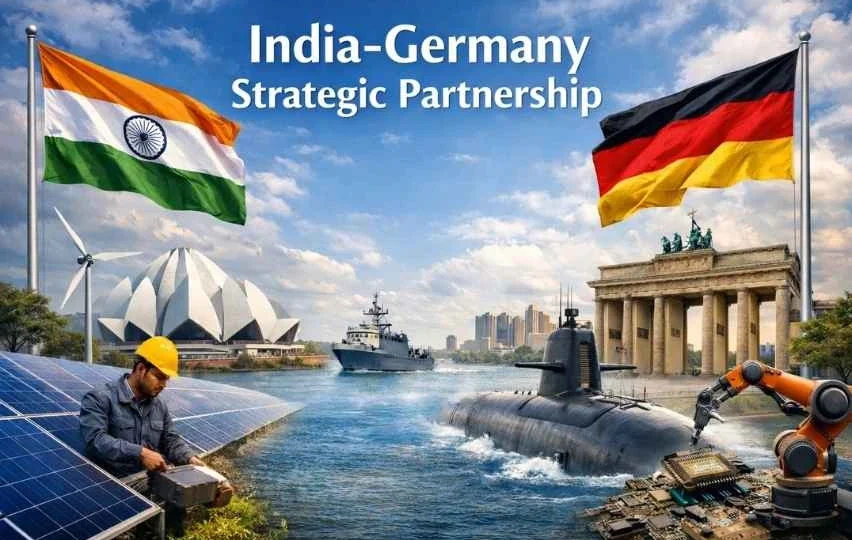
ToggleIndia-Germany relations UPSC represent a deep, multi-dimensional bond between the world’s third and fifth-largest economies. Officially elevated to a Strategic Partnership in 2001, the relationship is anchored in shared democratic values, a commitment to a rules-based international order, and a massive convergence in technological and climate goals. Today, Germany is India’s largest trading partner in the European Union (EU).
Historical Background
Diplomatic ties were established in 1951, making India one of the first countries to recognize the Federal Republic of Germany after World War II.
- The Indology Legacy: German interest in India predates politics; the first Chair of Indology was established at the University of Bonn in 1818.
- Cold War Era: Relations were primarily economic and cultural, but the end of the Cold War and Germany’s reunification in 1990, followed by India’s Economic Liberalization (1991), acted as catalysts for deeper engagement.
Strategic Significance and Foreign Policy Importance
Germany is indispensable for India’s foreign policy for several reasons:
- Gateway to Europe: Germany is the “engine” of the EU; a strong bond with Berlin facilitates India’s broader engagement with Brussels.
- Multilateral Alignment: Both nations are part of the G4 nations (along with Japan and Brazil), seeking permanent membership in a reformed UN Security Council (UNSC).
- Indo-Pacific Convergence: Under Germany’s Indo-Pacific Guidelines, India is seen as a central maritime partner to maintain freedom of navigation and a rules-based order against regional hegemony.
Economic and Trade Relations
The india germany economic cooperation is the bedrock of the relationship.
- Trade Volume: Bilateral trade has surpassed $50 billion (2024-25), accounting for over 25% of India’s total trade with the EU.
- Investment: Germany is the 7th largest foreign direct investor in India. Initiatives like the “Make in India Mittelstand” (MIIM) have helped over 150 German SMEs enter the Indian market.
- CEO Forum: High-level institutional mechanisms ensure continuous private-sector collaboration in manufacturing, chemicals, and pharmaceuticals.
Defence and Security Cooperation
Historically a “buyer-seller” relationship, it is now shifting toward co-development.
- Strategic Dialogue: The High Defence Committee meetings focus on maritime security and counter-terrorism.
- Submarine Deal: Major negotiations are underway for the co-production of advanced conventional submarines (P-75I project).
- Exercises: Germany’s participation in Exercise MILAN and the Tarang Shakti air exercise (2024/2026) reflects growing military-to-military synergy.
Science, Technology and Green Partnership
- GSDP: The Green and Sustainable Development Partnership (2022) saw Germany commit €10 billion by 2030 to support India’s climate targets.
- Green Hydrogen: India and Germany are developing a “Green Hydrogen Task Force” to establish supply chains for clean energy.
- Innovation: Collaboration in Artificial Intelligence (AI), 6G, and semiconductors is facilitated through the Indo-German Digital Dialogue.
Recent Developments
- 75 Years of Diplomacy (2026): Celebrations marking the milestone emphasize the transition to a “Transformational” partnership.
- Visa-Free Transit: Germany recently introduced a visa-free transit regime for Indian passport holders at its airports.
- Skilled Migration: The Migration and Mobility Partnership Agreement has made Germany the top destination for Indian students, with over 50,000 currently enrolled.
Challenges in the Relationship
- Restrictive Export Laws: Germany’s strict arms export regulations often delay defense technology transfers.
- FTA Stagnation: The India-EU Free Trade Agreement remains stalled due to differences over market access and labor standards.
- Geopolitical Nuances: Divergent stances on the Russia-Ukraine conflict and the pace of “de-risking” from China can create occasional diplomatic friction.
Way Forward
- Operationalizing GSDP: Focus on “Green Hydrogen corridors” to make the duo a global hub for clean energy.
- Defense Indigenization: Moving toward joint research and co-production of MALE UAVs and propulsion systems.
- Skill Bridge: Recognizing Indian vocational degrees in Germany to address the German labor shortage and leverage India’s demographic dividend.
Conclusion
The India-Germany strategic partnership has entered a “mature phase” where economic necessity meets geopolitical alignment. For UPSC aspirants, this relationship is a prime study in how two diverse democracies can engineer a partnership for sustainability and technology. As India strives for Viksit Bharat 2047, the German “Mittelstand” spirit and technological prowess will be vital components of India’s growth story.
UPSC Prelims: PYQs & Practice Questions
Previous Year Questions (Prelims)
Q: The 'G4 Nations', frequently mentioned in the news in the context of global governance, include which of the following countries?
1. India
2. Germany
3. Brazil
4. Japan
5. South Africa
Select the correct answer:
(a) 1, 2, and 3 only
(b) 1, 2, 3, and 4 only
(c) 1, 2, 4, and 5 only
(d) All of the above
Answer: (b) 1, 2, 3, and 4 only
Explanation:
The G4 nations are India, Germany, Brazil, and Japan. These countries support each other’s candidature for permanent membership of the United Nations Security Council. South Africa is not part of the G4; it is associated with African representation demands through other groupings.
Q: With reference to the 'Green and Sustainable Development Partnership' (GSDP), consider the following statements:
1. It was signed between India and Germany in 2022.
2. Under this, Germany agreed to provide €10 billion in new and additional developmental assistance to India by 2030.
Which of the statements given above is/are correct?
(a) 1 only
(b) 2 only
(c) Both 1 and 2
(d) Neither 1 nor 2
Answer: (c) Both 1 and 2
Explanation:
Both statements are correct. The Green and Sustainable Development Partnership was launched between India and Germany in 2022 during the Inter-Governmental Consultations. It focuses on climate action, clean energy, green hydrogen, and sustainable development, with Germany committing substantial long-term development assistance.
Practice Questions
Q: Which of the following best describes the 'Make in India Mittelstand' (MIIM) initiative? (Practice-based)
(a) A digital platform for Indian startups to access the German market.
(b) An investment facilitation program to help German small and medium enterprises (SMEs) settle in India.
(c) A military exchange program for junior officers.
(d) A scholarship program for Indian vocational students in Berlin.
Answer: (b) An investment facilitation program to help German small and medium enterprises (SMEs) settle in India
Explanation:
Launched in 2015, the Make in India Mittelstand initiative is aimed at attracting German Mittelstand companies, which form the backbone of Germany’s economy, to invest and manufacture in India. It offers facilitation support, including a single-window mechanism, to encourage German SMEs to establish a stronger presence in the Indian market.
UPSC Mains – Previous Year & Practice Questions
Mains Previous Year Questions
Question: The ‘Strategic Partnership’ between India and Germany is anchored in shared values and common interests. Discuss the significance of this partnership for India’s technological and energy security.
Question: Germany’s Indo-Pacific guidelines signify a shift in its foreign policy toward a more active role in Asia. Analyze the implications for India-Germany maritime cooperation.
Question: Evaluate the role of the G4 grouping in the context of reforms in the United Nations Security Council (UNSC).
Question: Discuss the importance of the India-EU Free Trade Agreement (FTA) for the growth of the Indo-German economic relationship.
Question: The Inter-Governmental Consultations (IGC) are a unique institutional mechanism between India and Germany. Explain how this format enhances bilateral synergy.
Mains Practice Questions
Q1. [15 Marks | 250 Words]
Question: "As the world's third and fifth-largest economies, the India-Germany economic partnership is the engine of the India-EU relationship. Identify the emerging sectors of cooperation beyond traditional manufacturing."
Q2. [10 Marks | 150 Words]
Question: Examine the challenges in India-Germany defense cooperation, specifically regarding export control laws and the 'Make in India' initiative.
Q3. [15 Marks | 250 Words]
Question: "The 'Green Hydrogen Task Force' represents the next frontier of the Indo-German climate partnership. Discuss its potential in achieving India's Net-Zero targets by 2070."



India-Germany Relations-FAQs
What is the "Inter-Governmental Consultations" (IGC)?
The IGC is a unique biennial mechanism where the Prime Minister of India and the German Chancellor meet along with several cabinet ministers from both sides. Germany is one of the very few countries with which India has such a high-level institutionalized format.
What are "Mittelstand" companies?
They are highly specialized, often family-owned, Small and Medium Enterprises (SMEs) in Germany. They are world leaders in niche engineering and technology and form the core of the German “Economic Miracle.” India actively courts these companies for technology transfer.
How do India and Germany cooperate on the "Green Hydrogen" front?
Both nations have established an Indo-German Green Hydrogen Task Force. Germany provides the technology and capital, while India provides the scale and manufacturing base to create a global supply chain for clean hydrogen energy.
What is Germany’s stand on India’s bid for the UNSC?
Germany is a strong supporter of India’s permanent membership. Both are part of the G4 nations and argue that the current UNSC structure is outdated and does not reflect the realities of the 21st century.
What is the significance of the "Migration and Mobility Partnership"?
Signed in 2022, it facilitates the movement of students and skilled professionals between the two countries. It addresses Germany’s labor shortage and provides Indian talent with access to world-class German industries and research.