Table of Contents
ToggleIndia france relations UPSC focus on a partnership that is unique for its high level of strategic autonomy and mutual trust. France was the first country with which India established a Strategic Partnership in 1998. Today, the bond has evolved into a “Comprehensive Strategic Partnership” that spans across the Indo-Pacific, space, and nuclear energy, making IR UPSC notes france a high-yield topic for aspirants.
Historical Background
Diplomatic ties were established in 1947. Unlike many Western nations, France maintained a nuanced stance during the Cold War and was the first to offer civil nuclear cooperation after India’s 1998 nuclear tests. The peaceful transfer of French territories like Puducherry to India remains a cornerstone of the mutual respect and “no-interference” policy that defines the relationship.
Political and Strategic Relations
The india france strategy partnership is built on the shared principle of “Strategic Autonomy.” France is often seen as India’s “gateway to Europe” and a reliable veto-holding ally in the UNSC. Both nations are members of the G20 and have initiated the International Solar Alliance (ISA). The frequent exchange of high-level visits, including the French President being the Chief Guest for India’s Republic Day, underscores the political synergy.
Defence and Security Cooperation
Defence is the strongest pillar of the relationship.
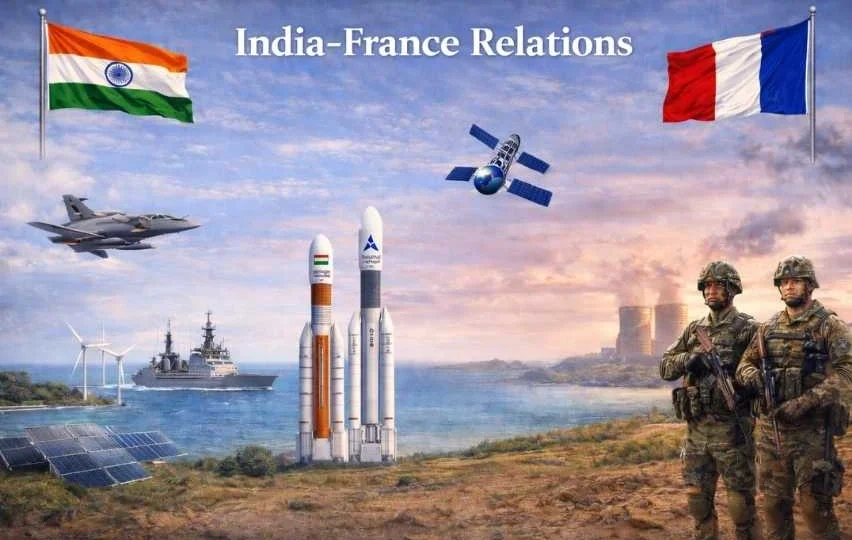
- Hardware: The procurement of Rafale fighter jets and the Scorpene (Kalvari-class) submarine program under ‘Make in India’ are flagship projects.
- Exercises: Regular joint military drills include Varuna (Navy), Garuda (Air Force), and Shakti (Army).
- Maritime Security: France is a resident power in the Indian Ocean (due to territories like Réunion Island), leading to a robust india france indo-france pacific cooperation to ensure freedom of navigation.
Economic and Trade Relations
- Bilateral Trade: Trade has grown steadily, crossing $13 billion, with over 1,000 French companies operating in India.
- Investment: France is one of the top 10 investors in India, with major interests in aviation, chemicals, and sustainable urban development.
- Blue Economy: Both nations have adopted a roadmap on the Blue Economy and Ocean Governance to promote sustainable fishing and ocean mining.
Science, Technology and Energy Cooperation
- Space: ISRO and CNES (French Space Agency) have a 60-year history of cooperation, ranging from satellite launches to the Gaganyaan mission.
- Nuclear Energy: The Jaitapur Nuclear Power Project in Maharashtra, supported by French technology (EDF), aims to be the world’s largest nuclear power site.
- Green Energy: As co-founders of the ISA, both nations lead the global shift toward solar energy and green hydrogen.
Education and People-to-People Ties
- Education: India and France have set a target to welcome 30,000 Indian students in France by 2030.
- Migration: The Migration and Mobility Partnership Agreement facilitates the movement of skilled professionals.
- Culture: The ‘Namaste France’ and ‘Bonjour India’ festivals showcase the deep-rooted cultural appreciation between the two civilizations.
Recent Developments
- Horizon 2047: A roadmap marking the 100th anniversary of diplomatic ties, focusing on sovereign defense technologies and climate action.
- Indo-Pacific Trilateral: Strengthening the India-France-UAE and India-France-Australia trilaterals to maintain regional balance.
- Industrial Synergy: Collaboration in the co-development of aircraft engines and advanced sensors.
Challenges in the Relationship
- Trade Barriers: Disagreements over high tariffs and the stalled India-EU Free Trade Agreement (FTA).
- Bureaucratic Delays: The slow pace of negotiations for the Jaitapur nuclear project and certain defense offsets.
- Geopolitical Balancing: Navigating the different approaches toward the Russia-Ukraine conflict and the role of NATO in the Indo-Pacific.
Way Forward
- Defense Indigenization: Shifting from a buyer-seller relationship to joint research and co-production of high-tech military hardware.
- Cyber Security: Deepening cooperation in Artificial Intelligence and protecting undersea cable networks.
- Pacific Engagement: Leveraging French territories in the Pacific for joint developmental projects in Pacific Island Countries.
Conclusion
The India-France bond is a “partnership of the future.” It is a rare relationship where strategic interests perfectly align with mutual trust. For the UPSC exam, understanding this “resident power” of the Indian Ocean is vital. As India rises as a leading power, France remains its most consistent and sophisticated strategic anchor in the Western world.
UPSC Prelims: PYQs & Practice Questions
Previous Year Questions (Prelims)
Q1. [UPSC Prelims 2016]
Q: Consider the following statements:
1. The International Solar Alliance (ISA) was launched at the United Nations Climate Change Conference in 2015.
2. The Alliance includes all the member countries of the United Nations.
Which of the statements given above is/are correct?
(a) 1 only
(b) 2 only
(c) Both 1 and 2
(d) Neither 1 nor 2
Answer: (a) 1 only
Explanation:
The International Solar Alliance was launched by the Prime Minister of India and the President of France at COP21 in Paris in 2015, so Statement 1 is correct. Statement 2 is incorrect because, although membership is open to all UN member states, not all countries have joined the Alliance.
Q: Which of the following are the bilateral military exercises between India and France?
1. Varuna (Navy)
2. Garuda (Air Force)
3. Shakti (Army)
4. Desert Knight (Air Force)
Select the correct answer:
(a) 1 and 2 only
(b) 1, 2, and 3 only
(c) 2, 3, and 4 only
(d) All of the above
Answer: (d) All of the above
Explanation:
All four are associated with India-France military cooperation. Varuna is the naval exercise, Garuda is the air force exercise, and Shakti is the army exercise conducted regularly between the two countries. Desert Knight was a special air exercise featuring advanced fighter aircraft, including Rafales, and reflected the growing depth of the bilateral defence partnership.
Practice Questions
Q: With reference to the 'Jaitapur Nuclear Power Project', consider the following statements: (Practice Question)
1. It is a proposed nuclear power project in Maharashtra.
2. It is being built with technical assistance from the USA.
Which of the statements given above is/are correct?
(a) 1 only
(b) 2 only
(c) Both 1 and 2
(d) Neither 1 nor 2
Answer: (a) 1 only
Explanation:
Statement 1 is correct because the Jaitapur Nuclear Power Project is a proposed nuclear power project in Maharashtra. Statement 2 is incorrect because the project is being developed with technical assistance from France through EDF, not the USA. It is planned to be one of the world’s largest nuclear power plants by installed capacity.
UPSC Mains – Previous Year & Practice Questions
Mains Previous Year Questions
Question: India and France have shared a long-standing strategic partnership. In the context of the changing global order, discuss the significance of this relationship for India’s strategic autonomy.
Question: Discuss the role of France as a 'resident power' in the Indian Ocean and its importance for India’s maritime security.
Question: Critically examine the impact of the Rafale deal on India’s defense preparedness and its 'Make in India' initiative in the aviation sector.
Question: The International Solar Alliance (ISA) is a testimony to the leadership of India and France in global climate action. Elaborate.
Question: Evaluate the importance of the 'Horizon 2047' roadmap in shaping the future of India-France relations.
Mains Practice Questions
Q1. [15 Marks | 250 Words]
Question: "France has often been described as India's 'new best friend' in the West. Analyze why the India-France relationship is more resilient compared to India’s ties with other P5 nations."
Q2. [10 Marks | 150 Words]
Question: Examine the potential of India-France cooperation in 'Third Countries', specifically in Africa and the Pacific Island nations.
Q3. [15 Marks | 250 Words]
Question: With the rise of threats to undersea cables and maritime domain awareness, discuss the need for a dedicated India-France-UAE trilateral security framework.



India-France Relations-FAQs
Why is France called a "resident power" of the Indian Ocean?
Unlike other Western powers, France has actual territories in the Indian Ocean, such as Réunion Island and Mayotte. It has over 1.6 million citizens and thousands of troops stationed in the region, making its interests directly aligned with India’s maritime security.
What is "Horizon 2047"?
It is a strategic roadmap signed in 2023 to mark the 25th anniversary of the strategic partnership and the 100th anniversary of diplomatic ties (in 2047). It focuses on three pillars: Partnership for Security, Partnership for Planet, and Partnership for People.
How does the "Scorpene Submarine" project reflect 'Make in India'?
The Kalvari-class (Scorpene) submarines are built by Mazagon Dock Shipbuilders Limited (MDL) in Mumbai with technology transfer from France’s Naval Group. This is a prime example of defense indigenization.
What is the "Blue Economy Roadmap" between India and France?
Adopted in 2022, it aims to enhance cooperation in maritime trade, sustainable fisheries, ocean research, and marine biotechnology, ensuring that the development of ocean resources does not harm the environment.
Has France ever sanctioned India for its nuclear program?
Notably, France did not impose sanctions on India after the 1998 Pokhran-II nuclear tests, unlike many other Western countries. Instead, it opened a strategic dialogue, which eventually led to the 1998 Strategic Partnership.