Table of Contents
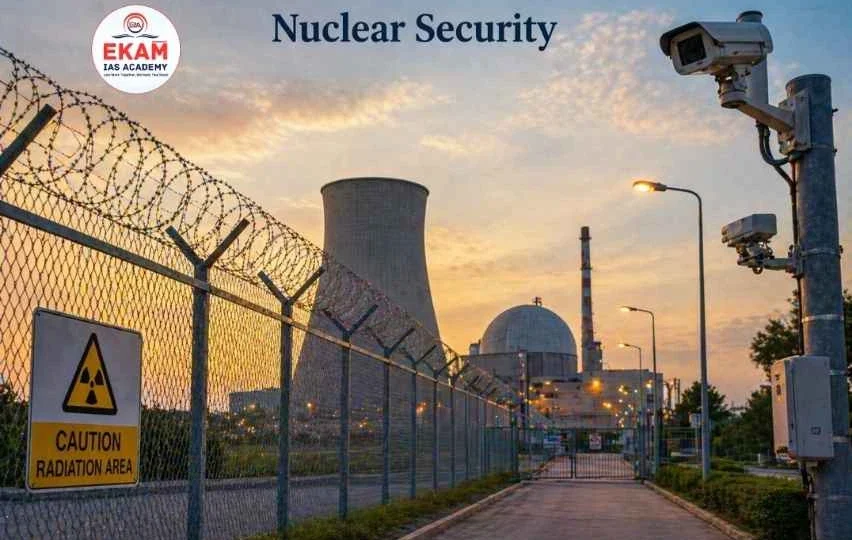
ToggleIn an era of geopolitical volatility and the rise of non-state actors, nuclear security UPSC studies have become paramount. Nuclear security refers to the prevention, detection, and response to theft, sabotage, unauthorized access, or illegal transfer of nuclear and radioactive materials. It is the “physical” shield that ensures nuclear technology remains a boon rather than a catastrophic threat to humanity.
Nuclear Security vs. Nuclear Safety vs. Nuclear Safeguards
It is essential for aspirants to distinguish between these three overlapping yet distinct pillars:
- Nuclear Security: Focuses on intentional malicious acts (theft or sabotage) by humans. It is about “protecting the material from the people.”
- Nuclear Safety: Focuses on preventing accidental failures or natural disasters (e.g., Chernobyl or Fukushima). It is about “protecting the people from the material.”
- Nuclear Safeguards: These are administrative and technical measures by the IAEA to ensure nuclear materials are not diverted from peaceful uses to nuclear weapons.
Global Nuclear Security Framework
The international architecture is built on several legal and institutional instruments:
- Convention on the Physical Protection of Nuclear Material (CPPNM): The only legally binding international instrument in the area of physical protection of nuclear material.
- International Convention for the Suppression of Acts of Nuclear Terrorism (ICSANT): Focuses on criminalizing nuclear terrorism.
- UNSC Resolution 1540: Obliges states to refrain from supporting non-state actors from developing or acquiring WMDs.
- Nuclear Security Summits (NSS): A series of summits (2010–2016) that significantly raised political awareness regarding global security challenges.
Major Global Concerns and Case Studies
- Nuclear Terrorism: The possibility of a “dirty bomb” (Radiological Dispersal Device) being used by groups like ISIS or Al-Qaeda.
- Cyber Threats: The Stuxnet attack on Iran’s nuclear facilities highlighted the vulnerability of nuclear Command and Control (C2) systems to cyber-warfare.
- Illicit Trafficking: Small-scale thefts of radioactive sources from hospitals or industrial sites remain a persistent threat.
India’s Approach to Nuclear Security
India’s nuclear policy is defined by responsibility and restraint.
- India Nuclear Doctrine UPSC: India maintains a “No First Use” (NFU) policy and a “Credible Minimum Deterrence.”
- Institutional Setup: The Department of Atomic Energy (DAE) and the Atomic Energy Regulatory Board (AERB) oversee the security of civilian installations.
- GCNEP: India established the Global Centre for Nuclear Energy Partnership in Haryana as a world-class facility for research and training in nuclear security.
India’s Commitments to International Conventions
India is a party to almost all major international instruments, including:
- CPPNM and its 2005 Amendment.
- ICSANT (Ratified in 2006).
- India participates in the IAEA Incident and Trafficking Database (ITDB).
- India is a member of the Missile Technology Control Regime (MTCR) and the Wassenaar Arrangement, showing its commitment to non-proliferation.
Key Challenges
- Non-State Actors: The decentralized nature of terrorist cells makes intelligence gathering difficult.
- Inside Threats: The risk of radicalized or disgruntled employees within nuclear facilities.
- Emerging Technologies: Drones (UAVs) and AI-driven attacks pose new physical threats to reactors.
- For India: Maintaining security across a vast geography and securing “orphaned” radioactive sources used in medicine and industry.
Recent Developments
- IAEA Nuclear Security Plan (2022–2025): Focuses on helping states build capacity for digital security at nuclear facilities.
- Small Modular Reactors (SMRs): As the world moves toward SMRs, the security challenge shifts toward protecting decentralized, smaller nuclear units.
- Zaporizhzhia Crisis: The ongoing conflict in Ukraine has redefined the risks of active warfare near operating nuclear power plants.
Way Forward
- Universalization: Ensuring all nations ratify and implement the CPPNM and ICSANT.
- Technological Upgradation: Utilizing AI and blockchain for real-time tracking of nuclear fuel rods.
- Global Cooperation: Strengthening the IAEA’s role as the central coordinator for nuclear security assistance.
Conclusion
Nuclear security is not a one-time achievement but a continuous process of evolution. For India, a robust security posture is the prerequisite for its “Nuclear Renaissance” and its goal of reaching Net-Zero by 2070. As global security challenges evolve, the “Atoms for Peace” vision can only be realized through an unwavering commitment to “Atoms for Security.”
UPSC Prelims: PYQs & Practice Questions
Previous Year Questions (Prelims)
Q: Consider the following countries: (2015)
1. China
2. France
3. India
4. Israel
5. Pakistan
Which of the above are Nuclear Weapons States as recognized by the Treaty on the Non-Proliferation of Nuclear Weapons, commonly known as the Nuclear Non-Proliferation Treaty (NPT)?
(a) 1, 2, 3, 4 and 5
(b) 1, 2 and 5 only
(c) 1 and 2 only
(d) 2 and 5 only
Answer: (c) 1 and 2 only
Explanation:
Under the NPT, only those countries that manufactured and exploded a nuclear weapon or other nuclear explosive device before January 1, 1967, are recognized as Nuclear Weapon States (NWS). These are the P5: USA, Russia, UK, France, and China. India, Pakistan, and Israel are nuclear-armed states, but they are not recognized as NWS under the treaty.
Q: What is the ‘Additional Protocol’ with the International Atomic Energy Agency (IAEA)? (2018)
(a) The civilian nuclear reactors come under IAEA safeguards.
(b) The military nuclear installations come under the inspection of IAEA.
(c) The State has the privilege to import uranium from the Nuclear Suppliers Group (NSG).
(d) The foreign ministers of the G-7 countries agree to allow the expansion of nuclear energy.
Answer: (a)
Explanation:
An Additional Protocol (AP) is a legal instrument that grants the IAEA expanded rights of access to information and sites. For India, signing the AP means that its civilian nuclear facilities are subject to IAEA safeguards and inspections, ensuring they are not diverted for military purposes.
Practice Questions
Q: With reference to the 'Global Centre for Nuclear Energy Partnership' (GCNEP), consider the following statements:
1. It is the world’s first multi-disciplinary nuclear energy facility established by the IAEA.
2. It is located at Bahadurgarh, Haryana, India.
Which of the statements given above is/are correct?
(a) 1 only
(b) 2 only
(c) Both 1 and 2
(d) Neither 1 nor 2
Answer: (b) 2 only
Explanation:
Statement 1 is incorrect because GCNEP was established by the Government of India through the Department of Atomic Energy, not by the IAEA, though it works in cooperation with international partners. Statement 2 is correct as it is located at Bahadurgarh, Haryana.
UPSC Mains – Previous Year & Practice Questions
Mains Previous Year Questions
Question: With growing energy needs, should India keep on expanding its nuclear energy programme? Discuss the facts and fears associated with nuclear energy. (2018)
Question: Give an account of the growth and development of nuclear science and technology in India. What is the advantage of a fast breeder reactor programme in India? (2017)
Question: Discuss the strategic importance of the Indo-US Civil Nuclear Agreement in the context of India’s energy security and its status as a nuclear power.
Question: Analyze the threats posed by nuclear terrorism to global security. Evaluate the effectiveness of international legal frameworks like ICSANT.
Question: India’s nuclear doctrine is a clear reflection of its status as a responsible nuclear power. Discuss.
Mains Practice Questions
[15 Marks | 250 Words]
Question: Distinguish between Nuclear Safety, Nuclear Security, and Nuclear Safeguards. Why is the synergy between these three essential for the global expansion of nuclear energy?
[10 Marks | 150 Words]
Question: The Russia-Ukraine conflict has highlighted the vulnerability of nuclear power plants in active war zones. Examine the need for a 'Geneva Convention' for nuclear installations.
[15 Marks | 250 Words]
Question: Critically examine India's challenges in securing 'orphaned' radioactive sources and the role of the Atomic Energy Regulatory Board (AERB) in mitigating radiological threats.



Nuclear Security-FAQs
What is a "Dirty Bomb"?
Technically known as a Radiological Dispersal Device (RDD), it is not a nuclear bomb. It uses conventional explosives (like dynamite) to scatter radioactive material over a targeted area. The primary danger is radiological contamination and mass panic rather than a nuclear explosion.
What is the "1540 Committee"?
It is a committee established by UNSC Resolution 1540. It monitors the implementation of obligations on all UN member states to prevent non-state actors (terrorists) from acquiring nuclear, chemical, or biological weapons.
How does India secure its nuclear materials?
India uses a “layered security” approach. Physical security is handled by the Central Industrial Security Force (CISF), while technical oversight is provided by the Department of Atomic Energy (DAE). India also uses a “Personal Reliability Program” to vet employees with access to sensitive materials.
What is the significance of India’s membership in the "Wassenaar Arrangement"?
India uses a “layered security” approach. Physical security is handled by the Central Industrial Security Force (CISF), while technical oversight is provided by the Department of Atomic Energy (DAE). India also uses a “Personal Reliability Program” to vet employees with access to sensitive materials.
What is "Nuclear Forensic"?
It is the scientific analysis of intercepted nuclear or radioactive materials. It helps authorities determine the origin of the material and the point at which it was diverted or stolen, acting as a deterrent against illicit trafficking.