
...
Daily Current affairs 13 June 2026

Daily Current Affairs 13-June-2026

Share this Post

EL NIÑO IN PACIFIC AND IMPACT ON INDIAN MONSOON

TOPIC: (GS3) ENVIRONMENT: THE HINDU

The India Meteorological Department (IMD) has confirmed the onset of El Niño in the Pacific Ocean, expected to intensify during the southwest monsoon season, raising concerns about rainfall variability in India.

What is El Niño?

  • Warm Phase of ENSO: El Niño is the warm phase of the El Niño–Southern Oscillation (ENSO) cycle.
  • Ocean–Atmosphere Link: Occurs when trade winds weaken or reverse, allowing warm water to move eastwards toward South America.
  • Frequency & Duration: Typically arises every 2–7 years, lasting 9–12 months, peaking between November and February.
  • Measurement: Declared when sea surface temperatures in Niño 3.4 region rise +0.5°C above normal for at least five consecutive overlapping three‑month periods.

Global Impact

  • South America: Heavy rainfall and floods in Peru and Ecuador, damaging infrastructure and agriculture.
  • North America: Wetter winters in southern USA, milder winters in northern USA and Canada.
  • Australia & Southeast Asia: Severe droughts and wildfires due to suppressed rainfall.
  • Africa: Droughts in southern Africa, but wetter conditions in East Africa.
  • Marine Ecosystems: Collapse of fisheries off Peru due to reduced nutrient upwelling.

Indian Context

  • Monsoon Weakening: El Niño often reduces southwest monsoon rainfall, leading to droughts (e.g., 2002, 2009, 2015).
  • Agriculture Stress: Crops like rice, pulses, and sugarcane suffer yield losses; food inflation rises.
  • Water Security: Reservoirs and groundwater recharge decline, affecting drinking water and hydropower.
  • Regional Variation: While northwest India faces drought, some regions may experience excess rainfall due to complex monsoon dynamics.
  • Policy Response: IMD issues forecasts; government promotes drought‑resistant crops, crop insurance, and contingency plans.

Effect on Indian Monsoon

  • Reduced Rainfall: Past El Niño years (e.g., 2002, 2015) saw deficient monsoons.
  • Agriculture Stress: Crops like rice, pulses, and sugarcane are highly dependent on monsoon rains.
  • Water Security: Lower rainfall impacts reservoirs, groundwater recharge, and urban water supply.
  • Regional Variation: Some areas may face droughts, while others may see excess rainfall due to complex monsoon dynamics.

IMD & Government Response

  • IMD Forecasts: Continuous monitoring of Pacific Ocean temperatures and issuing advisories.
  • Disaster Preparedness: NDMA and state governments conducting rescue drills (e.g., Mumbai beach exercises).
  • Agriculture Measures: Promotion of drought‑resistant crops, crop insurance schemes, and contingency plans.
  • International Cooperation: India collaborates with WMO and other agencies for climate prediction.

Examples & Case Studies

  • 2009 El Niño – India faced 23% rainfall deficit, leading to food inflation.
  • 2015 El Niño – Severe drought in parts of Maharashtra and Andhra Pradesh.
  • Positive Example – In some years, El Niño coincided with neutral Indian Ocean Dipole (IOD), reducing its negative impact.

Way Forward

  • Strengthen climate‑resilient agriculture through crop diversification.
  • Enhance early warning systems and community‑based disaster preparedness.
  • Invest in water conservation projects like rainwater harvesting and watershed management.
  • Integrate climate change adaptation policies with rural development schemes.

Conclusion

El Niño’s emergence is a reminder that climate variability directly affects India’s food, water, and economic security, making resilient planning and preparedness essential.

INFLATION & MONETARY POLICY

TOPIC: (GS3) ECONOMY: THE HINDU

The Monetary Policy Committee (MPC) of the Reserve Bank of India (RBI) has kept interest rates unchanged while projecting inflation at 5.1% for FY 2026.

What is inflation

  • Inflation is Persistent increase in prices across the economy.
  • Leads to loss of purchasing power – ₹100 today buys less tomorrow.
  • Opposite is deflation, when prices fall and money gains value.

Inflation Trends

  • Retail Inflation – Rose to 3.93% in May from 3.48% in April (NSO data).
  • Food Inflation – Increased to 4.78%, driven by sharp rises in tomatoes and ginger.
  • Energy Prices – Domestic LPG price hikes impacted transport and restaurant costs.
  • Household Expectations – Inflation expectations firmed up, rising by 80 basis points (3‑month) and 50 basis points (1‑year ahead).

Monetary Policy Committee (MPC)

  • Monetary Policy Committee (MPC) is A statutory body under the RBI Act, 1934 (amended in 2016).
  • Main Work: Decides repo rate and other policy rates to maintain price stability while supporting growth.
  • Members: 6 members:
    • RBI Governor (Chairperson)
    • RBI Deputy Governor (Monetary Policy)
    • One RBI official nominated by the Central Board
    • Three external members appointed by the Government of India.
  • Mandate: Keep inflation within 4% ± 2% band as per Flexible Inflation Targeting Framework.

Broader Implications for India

  • Agriculture: Food inflation highlights vulnerability of supply chains; need for better storage and logistics.
  • Energy Security: LPG and fuel price hikes affect households and industries.
  • Policy Balance: RBI must balance inflation control with growth revival.
  • Public Programs: Schemes like PM‑Kisan, Price Stabilisation Fund, and buffer stock management can cushion shocks.

MONETARY POLICY

Tight Monetary Policy

  • Definition – Also called contractionary policy, it is adopted when inflation is high.
  • Measures – RBI raises repo rate, increases CRR (Cash Reserve Ratio), and reduces money supply.
  • Impact – Borrowing becomes costlier, demand slows, and inflationary pressures ease.
  • Example – In 2022–23, RBI raised repo rate from 4% to 6.5% to control retail inflation above 7%.

Expansionary Monetary Policy

  • Definition – Adopted during slowdown or recession to boost growth.
  • Measures – RBI lowers repo rate, reduces CRR, and injects liquidity.
  • Impact – Cheaper loans encourage investment and consumption, stimulating demand.
  • Example – During COVID‑19 (2020), repo rate was cut to 4%, supporting businesses and households.

Neutral Monetary Policy

  • Definition – A balanced stance where RBI neither tightens nor loosens liquidity aggressively.
  • Objective – Maintain price stability while supporting moderate growth.
  • Impact – Ensures inflation remains within the target band (4% ± 2%) without hurting investment.

Example – RBI’s stance in 2017–18 was neutral, balancing inflation control with growth revival.

Conclusion

Inflation management requires constant vigilance and balanced monetary policy, ensuring stability while safeguarding growth and household welfare.

INDIA’S EMPLOYMENT CURVE

TOPIC: (GS3) ECONOMY: THE HINDU

Recent CMIE data shows India’s employment rate has fallen to 38.7% in March 2026, compared to 42.7% in 2016–17, highlighting concerns about job creation and labor market health.

Employment Indicators

  • Workforce: Refers to all people aged 15 years and above who are either employed or actively seeking work. India’s Labor Force Participation Rate (LFPR) is around 40% in 2026, compared to the global average of ~60%.
  • Employment Rate: The share of the working‑age population (15+) with a job. As per CMIE, India’s employment rate declined from 42.7% in 2016–17 to 38.7% in March 2026, showing weak job creation.
  • Unemployment Rate: The percentage of the labor force actively seeking but unable to find work. India’s youth unemployment is estimated at 17–18%, reflecting demographic stress.
  • Policy Significance: These indicators guide schemes like MGNREGA, Skill India, and PM Kaushal Vikas Yojana, and highlight challenges such as low female participation (~20%) and high informal sector dependence (>80% jobs).

Decline Over the Decade

  • 2016–17 – Employment rate stood at 42.7%.
  • 2020 Pandemic Impact – Sharp fall due to lockdowns and economic slowdown.
  • 2026 – Employment rate at 38.7%, showing structural weakness despite recovery efforts.
  • Demographic Variation – Youth (15–29 years) face higher unemployment; women’s participation remains low (~20%).

Reasons for Decline

  • Structural Issues – Slow growth in manufacturing and formal sector jobs.
  • Agriculture Dependence – Nearly 45% workforce still in agriculture, with low productivity.
  • Informal Sector – Over 80% jobs are informal, lacking security and benefits.
  • Skill Mismatch – Education system not aligned with industry needs.
  • Automation & Technology – Rising mechanization reduces low‑skill employment opportunities.

Policy Dimensions

  • Government SchemesPM Kaushal Vikas Yojana, Skill India Mission, and Start‑Up India aim to boost employability.
  • Infrastructure Push – Programs like Gati Shakti and Make in India target manufacturing and logistics jobs.
  • Social SecurityMGNREGA provides rural employment but limited to unskilled work.
  • Private Sector Role – Need for industry‑academia collaboration to reduce skill gaps.

Stats & Examples

  • Labor Force Participation Rate (LFPR) – Around 40% in 2026, lower than global average (~60%).
  • Female Workforce Participation – Only 20%, among the lowest globally.
  • Youth Unemployment – Estimated at 17–18%, reflecting demographic stress.
  • Urban vs Rural – Urban areas show higher unemployment due to migration and limited formal jobs.

Way Forward

  • Promote labor‑intensive industries like textiles, food processing, and construction.
  • Strengthen vocational training and digital skills for youth.
  • Encourage women’s participation through flexible work policies and safety measures.
  • Expand formal sector jobs with better labor reforms and ease of doing business.
  • Integrate green jobs in renewable energy and climate adaptation projects.

Conclusion

India’s declining employment curve signals the urgent need for inclusive job creation and skill development to harness its demographic dividend effectively.

8TH CENTRAL PAY COMMISSION AND A CHANCE FOR REFORM

TOPIC: (GS3) ECONOMY: THE HINDU

The Government of India is expected to set up the 8th Central Pay Commission (CPC) soon, which will review salaries, allowances, and pensions of government employees.

What is a Pay Commission?

  • Definition – A Pay Commission is a government‑appointed body set up roughly every 10 years to review and recommend changes in the salary, allowances, and pensions of central government employees, defense personnel, and pensioners.
  • Objective – To ensure fair compensation, maintain parity across services, and balance fiscal sustainability with employee welfare.
  • Historical Context – Since independence, India has constituted seven pay commissions; the 8th CPC is expected soon.

Pay Commissions

  • 7th CPC – Implemented in 2016, recommended:
    • Minimum pay of ₹18,000 per month.
    • Fitment factor of 2.57 for salary revision.
  • Fiscal Impact – The 7th CPC added nearly ₹1 lakh crore annually to government expenditure.
  • Budget Share – Pay and pensions account for over 25% of Union Budget revenue expenditure.
  • Defense Salaries – Armed forces constitute 30–35% of pay and pension bills.

Framework Deficit

  • Current system is ad hoc, with no permanent institutional mechanism.
  • Difficulty in balancing civil services, defense forces, and other cadres.
  • Proposal for a National Compensation Authority to ensure fairness, transparency, and consistency.

Pension Challenge

  • Pension Burden: Pensions form a large share of government spending, rising with life expectancy.
  • OPS vs NPS: Debate continues between defined benefit (OPS) and defined contribution (NPS) models.
  • Liabilities: Longer lifespans increase long‑term fiscal pressure.
  • Suggestion – Create a sustainable pension framework with partial indexation and contributory elements.

New Compensation Architecture

  • Proposal for an independent authority to review pay regularly instead of once in a decade.
  • Align salaries with inflation, productivity, and fiscal capacity.
  • Ensure equity between civil and military services.
  • Introduce performance‑linked incentives to improve efficiency.

Way Forward

  • Establish a permanent compensation authority for transparency.
  • Balance employee welfare with fiscal prudence.
  • Integrate technology and performance metrics in pay structures.
  • Reform pension systems to reduce future liabilities.
  • Ensure equity across services to maintain morale and efficiency.

Examples

  • 7th CPC Impact: Added nearly ₹1 lakh crore annually to government expenditure.
  • Defense Salaries: Armed forces constitute 30–35% of pay and pension bills.
  • Comparative Example: Countries like the UK have independent pay review bodies for different sectors.
  • India’s Fiscal Challenge: Pay and pensions account for over 25% of Union Budget revenue expenditure.

Conclusion

The 8th CPC offers a historic chance to redesign India’s pay and pension system, ensuring fairness for employees while safeguarding fiscal stability.

COAL EXCHANGE RULES 2026 AND ENERGY MARKETS

TOPIC: (GS3) ECONOMY: THE HINDU

The Government of India has notified the Coal Exchange Rules, 2026, aiming to establish regulated trading platforms for coal to improve price discovery, transparency, and accessibility for consumers.

Coal Exchange in India

  • Coal’s Dominant Role in Energy Security – Coal remains the backbone of India’s power sector, contributing nearly 70% of total electricity generation.
  • Challenges in the Existing System – The sector faces issues such as non-transparent pricing, supply bottlenecks, transportation constraints, and unequal access for smaller industries.
  • Growing Demand for Market Reforms – Rising industrial and power sector demand has highlighted the need for a more efficient and competitive coal distribution mechanism.
  • Shift Towards Market-Based Trading – Drawing lessons from the success of power exchanges, the government is exploring coal exchanges to enable transparent price discovery and competitive trading.
  • Objective of the Reform – To create a more accessible, efficient, and market-driven coal ecosystem that benefits producers, consumers, and industries alike.

Features of Coal Exchange Rules

  • Market Mechanism – Coal will be traded on regulated electronic platforms, enabling real-time bidding and better price signals.
  • Transparency – Contracts must be standardized; coal quality assessed by Coal Controller‑approved sampling agencies to reduce disputes.
  • Access for Small Consumers – MSMEs and non‑regulated sectors can procure coal competitively, unlike earlier dependence on auctions with premiums.
  • Secondary Market – Allows resale and redistribution, balancing shortages across regions.
  • Role of Coal Controller – The Coal Controller Organisation (CCO) registers exchanges, enforces compliance, and oversees dispute resolution.
  • Eligibility Criteria – Entities must be demutualised and hold a minimum net worth of ₹50 crore to establish an exchange. Licenses valid for 25 years.

Benefits with Data

  • Price Discovery: Transparent bidding eliminates distortions; India consumed 1.03 billion tonnes of coal in 2025, making fair pricing critical.
  • Efficiency: Reduces reliance on long‑term contracts; currently, 70% of coal supply is tied to power sector agreements.
  • Competition: Enables multiple suppliers; public sector companies like Coal India (producing ~700 MT annually) can expand market participation.
  • Stability: Spot trading balances shortages; similar to power exchanges, which stabilized electricity markets.
  • Environmental Angle: Transparent markets incentivize cleaner grades of coal and efficiency, aligning with India’s National Electricity Plan and energy transition goals.

Broader Implications

  • Energy Security: Coal remains India’s backbone, contributing 70% of electricity generation.
  • Industrial Growth: MSMEs gain reliable access, reducing dependence on imports.
  • Fiscal Impact: Transparent pricing reduces graft and improves government revenue collection.
  • Global Comparison: Similar to commodity exchanges abroad, but tailored for physical delivery rather than financial trading.

Challenges

  • Regulatory Oversight: Success depends on strong monitoring by the Coal Controller Organisation.
  • Quality Assurance: Need for robust grading and certification systems.
  • Infrastructure: Logistics and transport bottlenecks may limit exchange effectiveness.
  • Transition Issues: Existing contracts and PSU dominance may resist change.

Examples

  • Power Exchanges Model: Similar platforms like IEX have improved electricity price discovery.
  • Coal Demand: India consumed over 1 billion tonnes of coal in 2025, highlighting the scale of the market.
  • MSME Impact: Small industries often face shortages; exchanges can democratize access.

Way Forward

  • Digital Coal Platforms: Expand robust electronic trading systems with real‑time bidding; India’s power exchanges already handle >7,000 MW daily trades, showing feasibility.
  • Quality Certification: Mandate Coal Controller‑approved grading labs; currently, 30% of disputes in coal supply stem from quality mismatch.
  • Environmental Standards: Integrate emission norms and cleaner coal incentives; aligns with India’s National Electricity Plan 2023, targeting 50% non‑fossil capacity by 2030.
  • Public‑Private Partnerships: Encourage PPPs in rail, ports, and warehousing; logistics costs form 20–25% of coal price, reducing competitiveness.
  • Energy Transition Alignment: Synchronize coal exchange with energy diversification goals; India aims to cut coal’s share in power generation from 70% (2025) to 50% (2030).

Conclusion

The Coal Exchange Rules 2026 mark a decisive step towards transparent, efficient, and equitable energy markets, balancing industrial needs with fiscal and environmental priorities.

INDIA AT G7 AND THE INDO-MEDITERRANEAN STRATEGIC VISION

TOPIC: (GS2) INTERNATIONAL RELATIONS: THE HINDU

India’s participation in the G7 Summit reflects its growing global influence. The visit highlights the importance of the Indo-Mediterranean framework and stronger India-Europe cooperation.

G7: Importance for India

  • Regular Invitee: India’s consistent presence at G7 reflects its rising global stature and economic weight.
  • Technology Dominance: G7 nations, though contributing only ~30% of global GDP today (down from ~50% in 1990), still lead in AI, semiconductors, defence manufacturing, and cyber security.
  • Global Governance: Participation strengthens India’s role in shaping climate action, trade rules, and strategic affairs.

Indo‑Mediterranean Vision

  • Strategic Concept: Links the Indian Ocean with Europe via West Asia and the Mediterranean.
  • Integration: Focus on trade routes, logistics, energy corridors, and technology partnerships.
  • Beyond Indo‑Pacific: Expands India’s strategic outlook into Europe, complementing Indo‑Pacific initiatives.

IMEC

  • Launch: Announced at G20 Summit 2023.
  • Connectivity: Corridor expected to cut transport costs by 30–40%, diversify supply chains, and boost trade.
  • Alternative Model: Promotes transparent, sustainable connectivity, countering China’s Belt and Road Initiative.
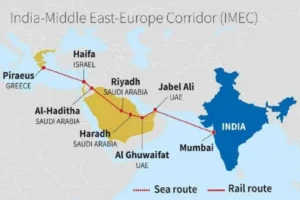
    India At G7 And The Indo-mediterranean Strategic Vision

Why Europe Matters

  • Trade Partner: EU is India’s third‑largest trading partner, with bilateral trade crossing $135 billion in 2023–24.
  • Technology Access: Europe provides advanced ecosystems in semiconductors, green energy, and EV mobility.
  • TTC Collaboration: The India‑EU Trade and Technology Council fosters cooperation in digital transformation and clean energy.

Strategic & Geopolitical Significance

  • Diversification: Reduces reliance on traditional partners, balancing ties with US, EU, and West Asia.
  • Maritime Security: Enhances safety of sea lanes crucial for India’s 85% oil imports.
  • Energy & Supply Chains: Strengthens resilience against global shocks.
  • Global Power: Supports India’s ambition to be a leading power while retaining autonomy.

Challenges

  • West Asia Instability: Conflicts may disrupt connectivity projects.
  • Financing Issues: Large‑scale projects need sustained funding.
  • Trade Barriers: Regulatory hurdles slow India‑EU FTA progress.
  • China’s BRI: Competes with IMEC in connectivity and influence.

Way Forward

  • Fast‑track India‑EU Free Trade Agreement for market access.
  • Operationalise IMEC with concrete infrastructure projects.
  • Expand cooperation in AI, semiconductors, clean energy, and digital technologies.
  • Strengthen maritime partnerships across Indian Ocean and Mediterranean.
  • Build resilient, diversified supply chains to reduce external shocks.

Conclusion

The Indo‑Mediterranean vision positions India as a strategic bridge between Asia, Europe, and West Asia, reinforcing its role as a major economic and geopolitical power in the evolving world order.

MASROOR ROCK CUT TEMPLES

TOPIC: (GS1) Art & Culture

The Masroor Rock‑Cut Temples in Kangra Valley, Himachal Pradesh, an 8th‑century heritage site, have drawn attention for their unique architecture and neglect in preservation, despite being called the “Ellora of Himachal.”

Historical Background

  • Construction Period: Built around the 8th century CE, nearly 1200 years ago, resembling Gupta‑era architectural style.
  • Discover:  First reported by Henry Shuttleworth (1913); later surveyed by Harold Hargreaves (ASI, 1915).
  • Records: No mention in scriptures, making its origins mysterious.

    Masroor Rock Cut Temples

Architectural Features

  • Temple Complex: 15 rock‑cut monuments carved from monolithic stone.
  • Style: Resembles Nagara style, dedicated to Shiva, Rama, Sita, and Lakshmana.
  • Orientation: Faces northeast towards Dhauladhar mountains, unlike most east‑facing temples.
  • Layout: Square plan with central shrine surrounded by smaller temples in a mandala pattern.
  • Entrances: Three entrances (NE, SE, NW); evidence of an unfinished fourth.
  • Sacred Pool: Water tank adds ritual significance.
  • Reliefs: Elaborate carvings of Vedic and Puranic deities; many damaged due to earthquakes.

Significance

  • Cultural Value: Called the “Himalayan Pyramid”, showcasing India’s rock‑cut heritage beyond Ellora and Ajanta.
  • Tourism Potential: Can boost Himachal’s cultural tourism if properly promoted.
  • Preservation Issues: Earthquake damage and neglect threaten survival; ASI needs stronger conservation efforts.
  • Comparative Example: Similar to Ellora caves (Maharashtra), but less recognized nationally.

Conclusion

The Masroor Rock‑Cut Temples are a hidden jewel of Indian heritage, demanding urgent preservation and recognition as a national treasure.


SOLAR 1

TOPIC: (GS3) SCIENCE AND TECHNOLOGY: THE HINDU

The United States has launched SOLAR‑1, its first satellite exclusively for space weather monitoring, to provide faster warnings of solar storms that threaten GPS, communications, satellites, and power grids.

SOLAR‑1

  • First Dedicated Satellite: Designed solely for continuous operational observation of solar activity.
  • Operato:  Managed by the U.S. National Oceanic and Atmospheric Administration (NOAA).
  • Renaming: Originally called SWFO‑L1, later renamed Space Weather Observations at L1 to Advance Readiness – 1 (SOLAR‑1).
  • Launch Details: Launched on 24 September 2025 aboard a SpaceX Falcon 9 rocket.
  • Orbit: Positioned at Sun‑Earth Lagrange Point 1 (L1), ~1.6 million km from Earth, offering uninterrupted solar monitoring.

Mission Features

  • Continuous Monitoring: Tracks solar wind and coronal mass ejections (CMEs) before they reach Earth.
  • Compact Coronagraph: Special telescope to observe solar corona and eruptions.
  • Rapid Transmission: Sends CME images to NOAA’s Space Weather Prediction Center within 30 minutes (older systems took up to 8 hours).
  • Gravitational Stability: L1 location allows minimal fuel use for station‑keeping.

Significance & Impact

  • Aurora Forecasts: Improves prediction of auroras and geomagnetic storms.
  • Infrastructure Protection: Strengthens defense of power grids, navigation systems, and communication networks.
  • Space Missions Safety: Enhances protection for satellites and astronauts from solar radiation.
  • Global Example: Similar to ESA’s Vigil mission, showing international focus on space weather resilience.

Conclusion

SOLAR‑1 marks a major leap in space weather preparedness, ensuring faster alerts and stronger protection for critical infrastructure and global space activities.

Write a Review

Your email address will not be published. Required fields are marked *

Seraphinite AcceleratorOptimized by Seraphinite Accelerator
Turns on site high speed to be attractive for people and search engines.