

...
Daily Current affairs 11 June 2026

Daily Current Affairs 11-June-2026

Share this Post

THE REALITY BEHIND FALLING NET FDI IN INDIA

TOPIC: (GS3) ECONOMY: THE HINDU

India’s net foreign direct investment (FDI) has sharply declined despite strong gross inflows, raising concerns about the sustainability of capital, technology transfer, and industrial growth.

FDI in India

  • FDI is an investment where an entity from one country establishes lasting interest in another country’s enterprise.
  • It usually involves 10% or more ownership stake in voting shares, giving the investor control over management decisions.
  • Unlike FPI, FDI is about direct participation in operations, not just financial returns.
  • Greenfield Projects: Involve setting up new factories or infrastructure, bringing fresh capital and jobs.
  • Brownfield Entry: Occurs through mergers, acquisitions, or share swaps, often restructuring existing assets rather than adding new ones.
  • Financial Capital: Includes private equity, venture capital, and sovereign wealth funds, which focus more on financial returns than longterm industrial growth.
  • Capital Recycling: A large share of inflows are intragroup reorganizations or debt conversions, meaning no genuine new investment enters the economy.

FDI Trends and Concerns

  • Effective Inflows: Between 2022–23 and 2025–26, real FDI contributed 41.9%, while financial investors accounted for 40.9%, showing rising dominance of financial flows.
  • Manufacturing Decline: Manufacturing attracted only 10.6% of total inflows in the latest period, continuing a threecycle decline, weakening the Make in India push.
  • Disinvestment Pressure: Frequent capital repatriation and investor exits have reduced net inflows, undermining stability.
  • Dividend Outflows: Rising dividend and royalty payments offset inflows, limiting domestic retention of foreign capital.

Implications

  • Industrial Development: Reduced manufacturing FDI weakens India’s push for Make in India and industrial selfreliance.
  • Technology Transfer: Lower real FDI limits access to advanced technologies and global supply chains.
  • Employment Impact: Decline in greenfield projects reduces job creation potential.
  • Financial Volatility: Heavy reliance on private equity and venture capital increases vulnerability to global market swings.

Challenges

  • Exit Strategies: Quick disinvestment by foreign investors reduces longterm stability.
  • Policy Gaps: Lack of clear incentives for manufacturing FDI.
  • Data Transparency: Gross inflows often mask the absence of fresh capital.

Way Forward

  • Strengthen Manufacturing FDI: Provide targeted incentives for sectors like electronics, renewable energy, and semiconductors.
  • Improve Transparency: Distinguish between real capital inflows and financial restructuring in official data.
  • Encourage LongTerm Investors: Attract pension funds and sovereign wealth funds with stable policies.
  • Balance Outflows: Rationalize dividend and royalty payments to retain more capital domestically.

Conclusion

India’s falling net FDI highlights the need to shift focus from headline inflows to genuine, longterm investments in manufacturing and technology, ensuring sustainable growth and resilience.

INDUSTRIAL ACCIDENTS IN INDIA AND SAFETY GAPS

TOPIC: (GS3) DISASTER MANAGEMENT: THE HINDU

A recent explosion at RINL–Visakhapatnam Steel Plant has reignited concerns about industrial safety in India with weak inspection mechanisms across factories.

Industrial Landscape

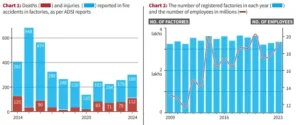
  • Factory Scale: India has 2.2 lakh registered factories employing nearly 20 million workers (2023).
  • Accident Trends: Fire and explosion incidents continue to claim hundreds of lives annually, highlighting systemic safety gaps.
  • Oversight Institutions: The DGFASLI serves as the apex advisory body but suffers from staff shortages, limiting its effectiveness.
Industrial Accidents in India and Safety Gaps

Safety Statistics

  • Fatalities: ASI data shows 200–300 deaths annually in factory fire accidents (2014–2023).
  • Injuries: Nonfatal injuries range between 30,000–35,000 per year, while fatal injuries remain at 2,000–3,000 annually.
  • Vacancies: Nearly 50% of 340 sanctioned posts in DGFASLI are vacant (2023), weakening enforcement capacity.
  • Inspection Deficit:
    • Tamil Nadu: 46,556 factories, only 416 inspections (≈0.009 per factory).
    • Maharashtra: 42,426 factories, only 83 inspections (≈0.002 per factory).
    • Gujarat: 26,619 factories, only 47 inspections.
  • Decline in Oversight: Share of factories inspected nationally fell from 36% in 2009 to 22.5% in 2022, showing a steady erosion of monitoring capacity.

Challenges

  • Weak Enforcement: Factory inspections have declined sharply — coverage dropped from 36% in 2009 to 22.5% in 2022. Tamil Nadu had 46,556 factories but only 416 inspections in 2023. Nearly 50% of sanctioned posts in DGFASLI remain vacant.
  • Data Deficiency: Key states like UP, Karnataka, and MP failed to submit accident data, weakening national statistics and policy planning.
  • Infrastructure Risks: Outdated machinery and poor maintenance contribute to 2,000–3,000 fatal injuries annually, alongside 30,000–35,000 nonfatal injuries.
  • Worker Safety: India’s 20 million factory workers often lack protective gear and training, increasing vulnerability during accidents.

Way forward

  • Strengthen Oversight: Fill 170+ vacant posts in DGFASLI and raise inspection frequency to at least 10% of factories annually, in line with ILO norms.
  • Digital Monitoring: Deploy AIenabled dashboards; pilot projects in Gujarat showed 15% faster accident reporting with digital systems.
  • Safety Audits: Mandate annual thirdparty audits for highrisk industries like steel, chemicals, and mining, potentially reducing fatalities by 20–25%.
  • Worker Training & Transparency: Train 5 lakh workers annually under Skill India Mission and establish a national digital repository for accident data across 2.2 lakh factories.

Conclusion

India’s industrial growth must be matched with robust safety governance — without stronger inspections, training, and accountability, factories risk turning into zones of recurring tragedy.

FLOATING SOLAR POTENTIAL IN INDIA’S RESERVOIRS

TOPIC: (GS3) ENVIRONMENT: THE HINDU

A report by the National Institute of Solar Energy (NISE) under the Ministry of New and Renewable Energy has estimated that Indian reservoirs can host about 102 GW of floating solar capacity, highlighting a major opportunity for renewable expansion.

Solar Panels on Water Surfaces

  • Concept: Panels are installed on reservoirs, lakes, or other water bodies instead of land, helping reduce landuse conflicts.
  • Land Efficiency: Saves valuable agricultural and urban land, making renewable expansion more sustainable.
  • Water Conservation: Limits evaporation losses from reservoirs, supporting irrigation and drinking water supply.
  • Performance Boost: Cooler water surfaces improve panel efficiency, generating higher output compared to landbased systems.

Floating Solar Pannels

Key Findings of the Report

  • Potential Capacity: India’s reservoirs can generate 102 GW of floating solar power.
  • State Contributions: Maharashtra, Madhya Pradesh, Karnataka, Odisha, and Telangana account for the bulk of this potential.
  • Flagship Project: The Omkareshwar floating solar park in Madhya Pradesh aims for 600 MW capacity, one of the largest globally.

Implications

  • Energy Security: Helps India diversify renewable sources beyond landbased solar and wind.
  • Climate Goals: Supports India’s target of 500 GW renewable capacity by 2030 under the Paris Agreement commitments.
  • Water-Energy Nexus: Reduces evaporation losses, aiding irrigation and drinking water supply.
  • Economic Impact: Creates jobs in installation, maintenance, and local supply chains.

Challenges

  • High Costs: Floating solar is costlier than landbased projects.
  • Technical Risks: Requires durable anchoring systems to withstand winds and waves.
  • Environmental Concerns: Potential impact on aquatic ecosystems if not carefully designed.

SOLAR ENERGY IN INDIA

  • Installed Solar Capacity: As of May 2026, India has 157 GW of solar power capacity, including 118.79 GW groundmounted, 27.88 GW rooftop, and 6.31 GW offgrid systems.
  • Largest Solar Plant: The Bhadla Solar Park in Rajasthan is the largest in India and one of the biggest globally, with 2,245 MW capacity spread over 14,000 acres.
  • Global Ranking: India ranks 3rd worldwide in renewable energy installed capacity, after China and the USA.
  • State Leaders: Rajasthan, Gujarat, Maharashtra, Karnataka, and Madhya Pradesh together account for over 70% of India’s renewable potential.

India’s Energy Mix (2025–26)

  • Coal Dominance: Coal remains the largest source, supplying ~60% of electricity.
  • Renewable Share: Renewables contributed 29.2% of total electricity generation in 2025–26, with solar being the largest component.
  • Milestone Achievement: India achieved 50% of its installed capacity from nonfossil sources in June 2025, five years ahead of its Paris Agreement target.
  • Future Target: India aims for 500 GW of nonfossil capacity by 2030, aligning with COP26 commitments.

Conclusion

Floating solar offers India, a gamechanging renewable pathway, combining energy generation with water conservation a critical step toward sustainable development.

BIRSA MUNDA, THE TRIBAL ICON OF RESISTANCE AND IDENTITY

TOPIC: (GS1) MODERN HISTORY: THE HINDU

The legacy of Birsa Munda, the revolutionary tribal leader from Jharkhand, has gained renewed attention in his role of shaping Adivasi identity and rights, in tribal empowerment and land protection laws.

Early Life and Background

  • Birth and Origin: Born in 1875 in Ulihatu village (Jharkhand), Birsa belonged to the Munda tribe, known for their deep connection with forest and land.
  • Colonial Context: British policies disrupted tribal land systems through the Zamindari system, displacing Adivasis and enabling exploitation by moneylenders and landlords.
  • Cultural Awakening: Birsa initiated a socioreligious movement promoting tribal unity, indigenous faith, and resistance to forced conversions.

ULGULAN MOVEMENT

The movement arose in the Chotanagpur plateau, where British land policies replaced the traditional Khuntkatti system (community ownership) with Zamindari, dispossessing tribal farmers.

  • Leadership and Mobilization: Birsa Munda united various tribal groups — Mundas, Oraons, and Kharias — under a common banner of resistance, emphasizing “Abua Raj” (selfrule).
  • Timeline:
    • Began around 1899 in Ranchi and Khunti regions.
    • Reached its peak in 1900, when British forces suppressed the rebellion and arrested Birsa Munda.
  • Nature of Revolt: It was both socioreligious and political, combining spiritual revival with armed resistance against colonial exploitation.
  • British Response: The British deployed military forces to crush the uprising, but the movement forced them to reconsider tribal land laws.
  • Legal Outcome: The Chotanagpur Tenancy Act (1908) was enacted later, ensuring that tribal lands could not be transferred to nontribals — a direct legacy of Ulgulan.
  • Religious Dimension: Birsa’s spiritual message rejected missionary dominance and revived indigenous faith, known as Birsaite Dharma, emphasizing purity and unity.
  • Socioeconomic Impact:
    • Strengthened tribal solidarity and identity.
    • Inspired later tribal movements like Tana Bhagat Movement (1914–1920) and Jharkhand statehood movement.
  • Symbolism: “Ulgulan” became a metaphor for tribal assertion and dignity, influencing India’s later discourse on indigenous rights and environmental justice.

Birsa Munda’s Ideological Legacy

  • Tribal Identity: He redefined Adivasi identity as one rooted in land, forest, and community autonomy.
  • Religious Reform: Advocated worship of a single god and moral discipline, rejecting exploitative practices.
  • Political Symbolism: His struggle inspired later tribal movements and the demand for Jharkhand statehood, achieved in 2000.
  • National Recognition: The Government of India observes Birsa Munda Jayanti (November 15) as Janjatiya Gaurav Diwas, honoring tribal contributions to nationbuilding.

Contemporary Relevance

  • Policy Linkages: His ideals resonate in modern schemes like Van Dhan Yojana, PESA Act (1996), and Forest Rights Act (2006), empowering tribal communities.
  • Cultural Revival: Tribal art, language, and heritage are being revived through government initiatives and UNESCO recognition efforts.
  • Environmental Dimension: His emphasis on harmony with nature aligns with India’s sustainable development goals and forest conservation policies.

Conclusion

Birsa Munda’s life stands as a symbol of indigenous resistance and empowerment, reminding India that true progress lies in protecting its tribal heritage and ensuring justice for its most rooted communities.

INDIA’S RECORD REMITTANCES

TOPIC: (GS3) ECONOMY: THE HINDU

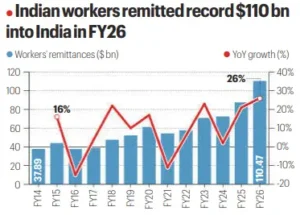
India received $110 billion in workers’ remittances in FY26, the highest ever, providing stability to the balance of payments despite weak FDI inflows and capital outflows.

The Lifeline of External Accounts

  • Remittances is the Money sent by Indian workers abroad to families back home.
  • Global Standing: India is the largest recipient of remittances worldwide, ahead of Mexico and China.
  • Regional Sources: Major inflows come from West Asia (UAE, Saudi Arabia, Qatar), followed by the US and UK.
  • Growth Trend: FY26 saw a 34% yearonyear rise, reaching $110 billion, with a 26% growth in Q4 alone.

BALANCE OF PAYMENTS

BoP is the systematic record of all economic transactions (trade, services, investments, remittances) between residents of a country and foreigners during a specific period.

  • It helps measure a country’s economic strength and external stability.
  • Every inflow is a credit, every outflow is a debit.

Main Components

Current Account

    • Records exports and imports of goods and services.
    • Includes remittances, tourism, software exports, and income from abroad.
    • Example: India exporting IT services = credit; importing crude oil = debit.

Capital Account

    • Records capital transfers like debt forgiveness, sale of patents, or ownership transfers.
    • Usually smaller compared to other accounts.

Financial Account

    • Tracks investments and financial flows such as FDI, FPI, loans, and real estate purchases.
    • Example: Foreign investors buying Indian bonds = credit; Indian firms investing abroad = debit.

Economic Significance

  • Balance of Payments: Remittances contributed to a $52.2 billion surplus in Jan–Mar 2026, offsetting weak FDI and portfolio outflows.
  • Currency Stability: Inflows strengthen the rupee, reducing dependence on volatile capital markets.
  • Consumption Boost: Funds support household spending, education, and healthcare, driving rural demand.
  • Social Impact: Improves living standards, reduces poverty, and supports financial inclusion through banking channels.
Indias Record Remittances

Challenges

  • Dependence on Gulf Economies: Heavy reliance on West Asia makes inflows vulnerable to oil price shocks and regional conflicts.
  • Migration Policies: Stricter visa rules in advanced economies may affect future flows.
  • Skill Diversification: India needs to shift from lowskilled to highskilled migration to sustain remittance growth.
  • Currency Risks: Exchange rate fluctuations can reduce the real value of remittances.

Policy Dimensions

  • Government Initiatives: Schemes like Pravasi Bharatiya Bima Yojana and SWADES skill mapping program support migrant workers.
  • RBI Role: Ensures smooth transfer through banking channels, reducing informal hawala routes.
  • LongTerm Solutions: Expanding bilateral labor agreements, promoting digital remittance platforms, and encouraging diaspora investments.

Conclusion

India’s record remittances highlight the economic resilience provided by its diaspora, but longterm sustainability requires diversifying migration, strengthening skill exports, and reducing dependence on volatile regions.

HINDU KUSH HIMALAYA

TOPIC: (GS1) GEOGRAPHY: THE HINDU

A recent scientific study warns that the Hindu Kush Himalaya (HKH) region will face belownormal monsoon rainfall and higher temperatures in 2026, while climate hazards like floods, landslides, and droughts will persist due to longterm climate change.

Hindu Kush Himalaya (HKH)

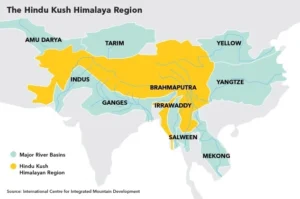
  • Geographical Spread: Extends 3,500 km across Afghanistan, Pakistan, Nepal, India, China, Bangladesh, Myanmar, and Bhutan.
  • River Basins: Source of 10 major Asian rivers including the Ganga, Indus, and Brahmaputra, supporting nearly 2 billion people.
  • Ecological Importance: Rich biodiversity, glaciers, and forests crucial for water security and climate regulation.
Hindu Kush Himalaya

Key Findings of the Study

  • Monsoon Outlook: Predicted drier monsoon with reduced rainfall.
  • Temperature Rise: Abovenormal temperatures expected, worsening glacier melt.
  • Climate Hazards: Despite less rainfall, risks of floods, landslides, and droughts remain due to fragile ecosystems.
  • El Niño–La Niña Influence: Transition from El Niño to La Niña may alter rainfall distribution later in the year.

Implications for India and Region

  • Water Security: Reduced rainfall threatens irrigation, drinking water, and hydropower.
  • Agriculture: Crops dependent on monsoon (rice, pulses) may face yield losses.
  • Disaster Risks: Increased vulnerability to flash floods, glacial lake outburst floods (GLOFs), and landslides.
  • Regional Cooperation: Shared river basins demand crossborder collaboration for disaster management and water governance.

Policy Dimensions

  • National Action: India’s National Action Plan on Climate Change (NAPCC) and National Mission on Himalayan Ecosystem aim to strengthen resilience.
  • International Frameworks: Aligns with Paris Agreement and UN SDGs on climate adaptation.
  • Scientific Monitoring: Need for advanced forecasting, glacier monitoring, and early warning systems.
  • Community Role: Local participation in afforestation, watershed management, and sustainable tourism.

Conclusion

The Hindu Kush Himalaya is the climate lifeline of Asia, and safeguarding it requires regional cooperation, scientific innovation, and communitybased resilience to secure water, food, and ecological stability.

CAUSTIC SODA

TOPIC: (GS3) ENVIRONMENT: THE HINDU

The Environment (Protection) Second Amendment Rules, 2025 mandate that caustic soda plants using membrane cell technology must pass a fishsurvival test to ensure wastewater is nontoxic, strengthening environmental safeguards.

Caustic Soda

  • Definition: Also called sodium hydroxide (NaOH), lye, or soda lye.
  • Production: Made by electrolysis of brine (NaCl solution) or by reacting sodium carbonate with calcium hydroxide.
  • Properties:
    • Strong alkali, soluble in water.
    • White crystalline solid, absorbs moisture.
    • Releases heat when dissolved or neutralized.
    • Corrosive to skin, eyes, and metals.

Industrial Applications

  • Chemical Industry: Used in soap, detergents, textiles, paper, aluminium, petrochemicals.
  • Water Treatment: Helps in purification and pH regulation.
  • Metal Processing: Used in electroplating, oxide coating, bleaching, and cleaning.
  • Other Uses: Cotton fabric processing, laundering, and bleaching.

Environmental Concerns

  • Toxicity: Wastewater discharge can harm aquatic life.
  • New Regulation: Fishsurvival test ensures effluents are safe for ecosystems.
  • Sustainability: Pushes industries towards cleaner technology and compliance with green standards.

Policy and Governance

  • Regulatory Framework: Rules framed under the Environment Protection Act, 1986.
  • Global Practices: Aligns India with international norms on chemical safety.
  • Government Initiatives: CPCB and MoEFCC monitor industrial effluents to safeguard rivers and reservoirs.

Conclusion

Caustic soda remains vital for industry, but strict environmental checks ensure growth does not compromise ecological balance.

GHARIALS

TOPIC: (GS3) ENVIRONMENT: THE HINDU

Recently, 31 gharial hatchlings were released in the Gandak River (Bagaha area, Bihar) as part of conservation efforts to revive populations of this critically endangered species.

About Gharials

  • Classification: Freshwater crocodile, Order Crocodylia, Family Crocodylidae.
  • Name Origin: Derived from Hindi word ghara (pot), referring to the bulbous snout of adult males.
  • Habitat Preference: Found in deep, clear rivers with sandy banks, mainly Himalayan river systems.
  • Distribution: Present in rivers of India, Nepal, Bangladesh, Bhutan, Myanmar, and Pakistan.
  • Key Rivers: Chambal (largest wild population), Girwa (India), RaptiNaryani (Nepal).

Gharials

Features

  • Physical Traits: Long, narrow snout; adult males have a bulb called ghara.
  • Aquatic Nature: Most aquatic among crocodilians, rarely leaving water except for basking and nesting.
  • Diet: Piscivorous — feeds mainly on fish, helping regulate riverine biodiversity.
  • Reproduction: Mating in Nov–Jan, eggs laid in Mar–May.

Conservation Status

  • IUCN: Critically Endangered.
  • CITES: Appendix I.
  • Wildlife Protection Act: Schedule I species in India.

Conservation Efforts

  • Reserves: Located in Uttar Pradesh, Madhya Pradesh, and Rajasthan.
  • Government Initiatives: Breeding and release programs under National Chambal Sanctuary and Gandak River project.
  • Ecological Role: Maintains fish diversity, supports river health, and acts as an indicator of freshwater ecosystem stability.

Conclusion

The release of gharial hatchlings in Bihar highlights India’s commitment to saving its freshwater biodiversity, proving that conservation is vital for both species survival and ecological balance.


Write a Review

Your email address will not be published. Required fields are marked *

Seraphinite AcceleratorOptimized by Seraphinite Accelerator
Turns on site high speed to be attractive for people and search engines.