

Daily Current affairs 12 June 2026

Daily Current Affairs 12-June-2026

Share this Post

LIMITED OPPORTUNITIES AND THE EMPLOYMENT CHALLENGE

TOPIC: (GS3) ECONOMY: THE HINDU

More than 28 lakh candidates applied for around 32,000 constable posts in Uttar Pradesh, highlighting the intense competition for government jobs.

Background

  • Uttar Pradesh recently conducted one of the largest police recruitment drives in India.
  • The overwhelming number of applicants included engineering graduates, postgraduates, and candidates from diverse educational backgrounds.
  • The trend reflects a broader national concern regarding employment opportunities and job security.

Why Government Jobs Attract Youth

  • Job Security: Government employment offers stable income and lower risk of layoffs. Employees receive pensions, healthcare benefits, and social security provisions.
  • Social Prestige: Public sector jobs continue to carry significant social respect, particularly in rural areas. Families often view government service as a symbol of economic stability.
  • Predictable Career Progression: Promotions, salary increments, and service conditions are clearly defined. Recruitment through competitive examinations is perceived as transparent and merit-based.
  • Example: Similar trends are visible in recruitment examinations conducted by SSC, Railways, and State Public Service Commissions, where applications far exceed vacancies.

High Educated Unemployment

  • Degree Holders Struggling: Many applicants with engineering, management, and professional degrees compete for low-skill jobs.
  • Data Point: In 2024, 46,000 graduates and postgraduates applied for sanitation jobs in Haryana, and 12,000 professionals competed for 18 peon posts in Rajasthan.
  • Graduate Unemployment Rate: 11.2% in 2025, compared to the national average of 3.1%. Rural graduates fare worse at 11.8%.
  • Campus Placement Collapse: 2 out of every 5 IIT graduates went unplaced in 2024.

Underemployment

  • Mismatch of Skills: Educated individuals often take jobs requiring lower qualifications.
  • Human Capital Waste: 66% of India’s unemployed are graduates or postgraduates.
  • Wage Stagnation: Average fresh graduate salary remains ₹3–4 lakh per annum, stagnant for nearly a decade.

Limited Private Sector Absorption

  • Manufacturing Weakness: Job creation in labour-intensive sectors has not matched workforce growth.
  • IT Sector Cuts: Leading IT firms cut 64,000 jobs in FY24.
  • Perception Issue: Youth often see private jobs as insecure and less rewarding compared to government employment.

Regional Imbalances

  • Urban Concentration: Employment opportunities remain clustered in metros like Bengaluru, Hyderabad, and Delhi.
  • Rural Dependence: Youth in Bihar and Jharkhand face educated unemployment rates exceeding 35%, relying heavily on government exams.
  • Migration Pressure: Skilled youth migrate to urban centres or abroad, contributing to brain drain.

Broader Economic Implications

  • Demographic Dividend at Risk: India has one of the world’s largest youth populations — 65% under 35 years.
  • Economic Survey (2018–19): Peak demographic dividend expected around 2041, when working-age population will be 59% of total.
  • Migration Pressures: PLFS Labour Force Participation Rate (LFPR) is 58% in rural areas vs. 50.7% in urban, showing rural youth moving to cities for work.
  • Social Consequences: NCRB Data shows Over 14,000 suicides among unemployed youth, highlighting distress.
  • Underemployment: Educated youth often take jobs below their qualification, wasting human capital.

Government Initiatives

  • Skill Development: Skill India Mission aims to improve employability through vocational training.
  • Employment Generation: Prime Minister Employment Generation Programme promotes self-employment and entrepreneurship.
  • Manufacturing Push: Make in India seeks to expand industrial employment opportunities.
  • Startup Ecosystem: Startup India encourages innovation and job creation.

Wayforward:

  • Shift to Labour-Intensive Sectors By 2030, industries like textiles, food processing, electronics assembly, and tourism are projected to absorb millions of workers. According to NITI Aayog, these sectors could generate 20–25 million jobs if supported under Make in India and PLI schemes.
  • Rise of Gig and Platform Work India already has 7.7 million gig workers (2024), expected to reach 23 million by 2030 (NITI Aayog report). Youth are increasingly engaging in delivery services, freelancing, and digital platforms, diversifying employment beyond traditional salaried jobs.
  • Entrepreneurship in Smaller Cities With digital infrastructure expanding, Tier-II and Tier-III cities are emerging as startup hubs. By 2040, nearly 40% of new enterprises are expected to originate outside metros, reducing migration pressures and creating localized employment.
  • Green and Sustainable Jobs India’s renewable energy sector aims to reach 500 GW capacity by 2030, potentially creating 10 million green jobs in solar, wind, and sustainable construction. This will diversify employment into climate-friendly industries.

Conclusion

The surge in applicants for a small number of government posts reflects not merely job preference but a deeper need for broad-based, quality employment generation across the Indian economy.

FOREIGN CONTRIBUTION REGULATION AMENDMENT BILL, 2020

TOPIC: (GS2) POLITY: THE HINDU

The Foreign Contribution (Regulation) Amendment Bill, 2020 has drawn attention for tightening rules on foreign donations to NGOs, trusts, and civil society groups. Critics argue it risks curbing their autonomy and weakening grassroots social work.

What is Foreign Contribution Regulation Act (FCRA)

  • The Foreign Contribution Regulation Act (FCRA) is India’s key law that regulates how individuals, NGOs, and associations can receive and use foreign donations.
  • It was first enacted in 1976, comprehensively revised in 2010, and further amended in 2020 and 2022 to tighten transparency and national security safeguards.

Recent regulatory concerns

FCRA Amendment Bill, 2026

    • Introduced in Lok Sabha on March 25, 2026.
    • Proposes creation of a Designated Authority to take control of foreign contributions and assets when NGO registration lapses, is cancelled, or surrendered.
    • Assets created partly or wholly from foreign funds would vest provisionally in this authority, raising concerns about autonomy of civil society groups.

Kerala Controversy

    • Opposition parties and minority institutions, especially Christian organisations, argue the amendment could adversely impact their functioning.
    • The issue has gained political significance ahead of the Kerala Assembly elections, with both the ruling Left and Congress opposing the move, claiming it increases government control over NGOs and religious institutions.

Provisions of the 2020 Amendment

  • Single Bank Account Rule: All foreign contributions must be received in one designated SBI branch in New Delhi.
  • Administrative Expense Cap: Reduced from 50% to 20%, limiting funds for salaries, rent, and staff.
  • Suspension & Cancellation: Government empowered to suspend or cancel NGO registrations more easily.
  • Transfer Ban: NGOs cannot transfer foreign funds to other organizations, restricting collaborative projects.
  • Designated Authority: Section 16A introduces a government-appointed authority to oversee compliance.

Misuse of funds

  • MHA Audits (2019–2022): Out of 335 NGOs inspected, 201 (≈60%) were found guilty of one or more offences under FCRA. These included diversion of funds, nonsubmission of returns, and misuse of donations.
  • License Cancellations: Between 2019 and 2022, the Ministry of Home Affairs cancelled 1,816 NGO registrations and suspended 52 licenses for violations.
  • Administrative Cap Violations: Many NGOs exceeded the permissible limit of using 20% of foreign funds for administrative expenses (earlier 50%), diverting money away from declared social objectives.

Implications

  • Civil Society Autonomy: Limits flexibility of NGOs, especially small grassroots groups.
  • Developmental Impact: Restricts funding for health, education, and tribal welfare projects.
  • Constitutional Concerns: Critics argue it infringes on Article 19 rights (freedom of association and expression).
  • Global Comparisons: Similar restrictions exist in countries like Russia and China, raising concerns about democratic space.
  • Government’s View: Claimed to ensure transparency, prevent misuse, and safeguard national interest.

Examples of Misuse

  • Action Aid India (2016–2018): Alleged diversion of foreign contributions meant for poverty alleviation into political activities. Its FCRA license was suspended temporarily.
  • Transparency International India (2018–2020): Accused of using foreign funds for political advocacy instead of anticorruption campaigns; license renewal delayed pending compliance audit.

Why Funds Need to be Regulated

  • Transparency: Ensures foreign contributions are used for declared social objectives like health, education, and welfare.
  • National Interest: Prevents external influence on political processes, media, and sensitive sectors.
  • Accountability: Mandates audits and reporting to avoid misuse or diversion of funds.
  • Global Practice: Similar restrictions exist in countries like Russia and China, showing international precedence.

How Funds Can Be Misused

  • Political Activities: Diverted to fuel protests or campaigns against government policies.
  • Religious Conversion: Allegations of funds being used for mass conversions in rural areas.
  • Corruption: Administrative expenses exceeding legal limits, weakening developmental impact.
  • Money Laundering: Shell NGOs used to channel funds for non-transparent purposes.

Conclusion

The FCRA Amendment 2020 reflects the tension between state oversight and civil society autonomy; striking a balance is essential for a vibrant democracy.

LABOUR CODES IN INDIA

TOPIC: (GS2) POLITY: THE HINDU

India has completed the implementation of four labour codes However, concerns remain that workers, especially informal and gig workers, continue to face vulnerabilities despite the new framework.

Labour Codes Simplification Vs Workers

  • Consolidation of Laws The four labour codes merge 29 existing labour laws to simplify compliance and improve ease of doing business.
  • Universal Social Security Aim to provide social security coverage for all workers, including gig and platform workers, while streamlining wage definitions.
  • Industrial Relations Designed to strengthen employer–employee relations by setting clear rules on layoffs, retrenchments, and dispute resolution.

Key Provisions

  • Code on Wages, 2019: Standardizes wage definitions, ensures timely payment, and introduces a national minimum wage.
  • Industrial Relations Code, 2020: Raises threshold for layoffs and retrenchments without government approval, impacting job security.
  • Social Security Code, 2020: Extends coverage to gig and platform workers, but lacks clarity on funding and benefits.
  • Occupational Safety, Health and Working Conditions Code, 2020: Consolidates safety laws but excludes smaller establishments, leaving many workers outside its ambit.

Critical Gaps

  • Wage Definition Issues: Ambiguity in wage calculation may reduce take-home pay.
  • Worker Safeguards: Limited consultation with unions; grievance redressal mechanisms remain weak.
  • Gig Economy: While recognized, gig workers lack enforceable social security benefits.
  • Safety Concerns: Codes overlook informal sector workers who face hazardous conditions.

Relevant Examples

  • Construction Workers: Despite welfare boards, many remain outside coverage due to registration hurdles.
  • Gig Workers: Platforms like Swiggy and Ola employ lakhs, but benefits under the Social Security Code are not yet operational.
  • ILO & NITI Aayog Reports: Stress the need for inclusive labour protections to meet SDG 8 (Decent Work and Economic Growth).
  • Government Portals: The Shram Suvidha Portal aims to simplify compliance but workers’ awareness remains low.

Way Forward

  • Effective Implementation Clear rules and accountability are vital — India has 1 inspector for every 500 factories (DGFASLI, 2024), highlighting the need for stronger enforcement capacity.
  • Social Security for Informal Workers Over 90% of India’s workforce is informal (ILO, 2023); strengthening social security funds can protect gig and platform workers under the Social Security Code.
  • Tripartite Consultations Worker participation in policy-making remains weak — only 12% of registered trade unions are consulted (Labour Ministry data, 2022), showing the need for inclusive dialogue.
  • Safety Norms Expansion Small and informal establishments employ nearly 70% of workers (Economic Survey, 2023) but remain outside safety coverage; expanding norms can reduce accidents and fatalities.

Conclusion

Labour codes promise simplification, but without robust safeguards, they risk leaving millions of workers vulnerable in India’s changing economy.

INDIA’S POPULATION POLICY AND SHIFTING APPROACHES

TOPIC: (GS2) POLITY: THE HINDU

India’s policymakers are revisiting population control strategies as fertility rates decline, raising concerns about ageing, and the need for balanced demographic planning.

India’s Demographic Transition

  • Declining Fertility Trends: India’s fertility rate has dropped to 1.99 in 2023 (NFHS5), below the replacement level of 2.1. States like Kerala (1.7) and Tamil Nadu (1.6) show very low fertility, while Bihar (3.0) and UP (2.7) remain higher.
  • Policy Evolution: Earlier policies focused on reducing fertility through family planning. Today, the challenge is sustaining workforce size and addressing the ageing population, projected to reach 20% of total population by 2050 (UN Population Division).
  • Global Experience: Countries like Japan (fertility 1.3) and South Korea (fertility 0.7) struggle with ageing despite incentives like childcare subsidies and tax breaks. Their experience highlights the difficulty of reversing fertility decline once it sets in.
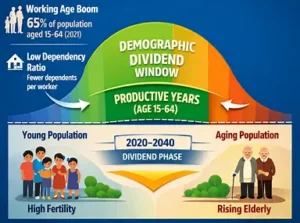
  • Economic & Social Implications: India’s demographic dividend window (2020–2040) risks narrowing if job creation and social security do not keep pace. By 2036, India will have 315 million elderly citizens, creating pressure on pensions, healthcare, and welfare systems.

International Experience

  • Japan: Despite incentives like childcare support, fertility remains low.
  • China: Shift from one-child policy to pro-natalist measures, but ageing continues.
  • Europe: Countries like France offer family benefits, yet demographic transition persists.

India’s Demographic Studies

  • Longitudinal Ageing Study in India (LASI) Found that 75 million elderly (60+) in 2020 will rise to 315 million by 2050, with high prevalence of chronic illnesses like hypertension (≈45%) and diabetes (≈20%).
  • NITI Aayog Reports Stress balanced demographic planning; note that 90% of India’s workforce is informal, requiring stronger social security and skill development.
  • UN Population Projections India will remain the most populous country till 2060, but growth is slowing — fertility rate has dropped to 1.99 (NFHS5, 2023).
Centre Exempts Excise Duty on Higher Ethanol-Blended Petrol

Implications

  • Economic Shrinking workforce: India’s working-age population share will peak at 59% by 2041, then decline, affecting productivity and GDP growth.
  • Social Demand for elderly care rising — by 2036, 140 million elderly will need pensions, healthcare, and social security.
  • Political Interstate migration reshapes demographics; e.g., Kerala and Tamil Nadu rely on migrant labour from Bihar and UP, altering resource allocation.
  • Health Non-communicable diseases dominate — WHO estimates 60% of deaths in India are NCD-related, burdening healthcare systems.

Way Forward

  • Balanced Regional Policies Address fertility variations — Bihar (3.0) vs Kerala (1.7) — through tailored interventions.
  • Strengthen Social Security Expand pension and healthcare coverage; currently only 28% of elderly receive pensions (LASI 2020).
  • Women’s Empowerment Increase female labour force participation, which is just 25.7% in urban areas (PLFS 2025), to sustain workforce size.
  • Migration Management Develop policies to integrate migrant workers into low-fertility states, ensuring balanced workforce distribution.
  • Integrate SDGs Align demographic planning with SDG 3 (Health) and SDG 8 (Decent Work) to ensure inclusive growth.

Conclusion

India’s demographic shift demands a move from fertility control to holistic population management, ensuring both workforce sustainability and dignity for the ageing population.

SUPREME COURT RECOGNITION OF HOMEMAKERS’ WORK

TOPIC: (GS2) POLITY: THE HINDU

The Supreme Court has ruled that homemakers’ unpaid domestic labour must be valued in compensation claims.

Recognition of Homemakers’ Economic Contribution

  • Traditional Exclusion For decades, homemakers’ unpaid domestic labour was excluded from economic valuation in legal compensation cases. The NSSO (2019) estimated that women spend 5–6 hours daily on unpaid household work, contributing indirectly to national productivity.
  • Judicial Shift in Terminology The Supreme Court replaced the term “housewife” with “homemaker”, emphasizing dignity and economic value. This linguistic shift reflects recognition of women’s nonmarket labour as a form of social and economic contribution.
  • Motor Accident Claims Tribunal (MACT) The Court directed MACTs to include domestic care as a compensable head in accident cases. It fixed a base value of ₹30,000 per month for homemakers’ work, with a 10% increment every three years, acknowledging inflation and rising living costs.
  • Economic Context According to NITI Aayog (2022), unpaid domestic work by women contributes an estimated 15–20% of India’s GDP if monetized. This recognition aligns with SDG 5 (Gender Equality) and global efforts to value unpaid care work.

Implications

  • Gender Equality: Acknowledges women’s invisible labour in household management.
  • Economic Valuation: Brings unpaid domestic work into formal economic recognition.
  • Policy Impact: May influence future welfare schemes and social security measures.
  • Social Change: Strengthens discourse on dignity of women’s work in Indian society.

Empirical Evidence of Homemakers’ Economic Role

  • Census & NSSO Findings The Census 2011 recorded over 160 million women engaged primarily in unpaid household work. The NSSO 2019 TimeUse Survey found women spend 5.7 hours daily on domestic tasks versus 1.6 hours for men, revealing a major gender gap in unpaid labour.
  • NITI Aayog Reports Estimate that unpaid domestic work could contribute 15–20 % of India’s GDP if monetized. The thinktank urges inclusion of household labour in national accounts to reflect women’s invisible economic participation.
  • Global Commitments – SDG 5 Recognition of homemakers aligns with Sustainable Development Goal 5 (Gender Equality), which calls for valuing unpaid care and domestic work through public services and social protection policies.
  • Comparative Perspective Countries like Australia and Canada include unpaid household labour in satellite national accounts, valuing it at 30–40 % of GDP, setting a benchmark India can emulate.

Conclusion

By valuing homemakers’ labour, the Supreme Court has advanced gender justice and economic recognition of unpaid work, marking a step towards inclusive social policy.

CENTRE EXEMPTS EXCISE DUTY ON HIGHER ETHANOL-BLENDED PETROL

TOPIC: (GS3) ENVIRONMENT: THE HINDU

The Union Government has removed central excise duty on petrol variants with higher ethanol blends (E22, E25, E27, E30).

Ethanol Blending Programme

  • Programme Objective Launched to reduce crude oil imports (India imports nearly 85% of its oil needs) and cut carbon emissions from transport fuel.
  • Policy Goal India targets 20% ethanol blending in petrol by 2025, up from 12% achieved in 2023 (MoP&NG data).
  • Government Clarification The recent excise duty exemption is preparatory, not an immediate rollout of higher blends, ensuring readiness of infrastructure and vehicle compatibility.
  • Environmental Impact Ethanol blending could reduce carbon monoxide emissions by 30–50% and hydrocarbon emissions by 20%, supporting India’s Paris Agreement commitments.

Ethanol Blending

  • Duty Exemption Applies to E22, E25, E27, and E30 petrol blends. India currently achieves 12% blending (2023), aiming for 20% by 2025.
  • Biofuel Promotion Encourages cleaner alternatives and supports farmers. India produces 5 billion litres of ethanol annually, largely from sugarcane and maize, boosting rural incomes.
  • Energy Security India imports 85% of crude oil needs; blending could save ₹30,000 crore annually in foreign exchange (MoP&NG estimates).
  • Environmental Impact Ethanol reduces carbon monoxide emissions by 30–50% and hydrocarbons by 20%, helping India meet Paris Agreement targets and improve urban air quality.
Indias Popilation Policy and Shifting Approaches

Implications

  • Economic: Boosts rural income by creating demand for agricultural produce like sugarcane and maize.
  • Social: Strengthens India’s commitment to sustainable energy under SDG 7 (Affordable and Clean Energy).
  • Strategic: Aligns with India’s climate commitments under the Paris Agreement.
  • Practical Challenge: Infrastructure for storage, distribution, and vehicle compatibility needs scaling up.

Present Status of Ethanol Blending

  • Achievement of E20 India reached 20% ethanol blending in 2025, ahead of the original 2030 target. This was possible due to expanded distillation capacity and multiple feedstocks like sugarcane, maize, rice, and bamboo.
  • Production & Supply Against a national requirement of 1,050 crore litres for E20, industry capacity exceeded 1,776 crore litres, showing surplus readiness. Over ₹1.18 lakh crore has already flowed to farmers through ethanol procurement by early 2026.
  • Fuel Standards In May 2026, the Bureau of Indian Standards (BIS) notified specifications for E22, E25, E27, and E30 fuels, ensuring safety and compatibility for higher blends.

Targets Ahead

  • E25 & E30 Transition India aims to progressively move towards 25% and 30% blending by 2030, with policy predictability needed to unlock further investment in distilleries.
  • Economic Impact Ethanol blending has already saved ₹1.4 lakh crore in foreign exchange and reduced dependence on crude oil imports (India imports 85% of its needs).
  • Environmental Benefits E20 fuels have shown 30–50% reduction in carbon monoxide emissions and improved urban air quality, aligning with India’s Paris Agreement commitments.

Conclusion

The excise duty exemption signals India’s intent to accelerate its biofuel transition, balancing energy security, farmer welfare, and environmental sustainability.


REPRODUCTIVE RIGHTS AND CONTRACEPTION IN INDIA

TOPIC: (GS2) POLITY: THE HINDU

India’s family planning approach is under discussion as female sterilisation continues to dominate contraceptive use, raising concerns about reproductive rights, gender equity, and the need for diversified methods.

Reproductive Rights & Contraception in India

  • Family Planning Programme India launched the world’s first official family planning programme in 1952. Despite decades of effort, contraceptive use remains skewed.
  • Current Scenario According to NFHS5 (2019–21), female sterilisation accounts for 36% of contraceptive use nationally, while male sterilisation is below 1%. Rural areas show higher reliance on sterilisation compared to urban centres.
  • Policy Concern Heavy dependence on women reflects structural gender imbalance. India’s contraceptive basket remains narrow, with limited access to modern methods like pills, IUDs, and injectables.

Implications

  • Social Reinforces gender stereotypes, limiting women’s autonomy in reproductive decisions.
  • Economic Women’s health issues reduce productivity; WHO estimates India loses 6% of GDP annually due to poor female health outcomes.
  • Policy Overdependence on sterilisation undermines commitments to SDG 5 (Gender Equality) and SDG 3 (Health & Wellbeing).
  • Demographic Skewed contraceptive practices may distort fertility trends and population balance, especially in highfertility states.

Key Issues

  • Gender Burden Women disproportionately bear responsibility — over 80% of contraceptive users are female, while male participation is negligible.
  • Limited Choices Access to modern contraceptives is uneven; condom use is only 9% nationally, and awareness of emergency contraception remains low.
  • Health Risks Sterilisation procedures carry risks; NFHS5 data shows 1 in 5 women reported lack of informed consent during sterilisation.
  • Awareness Gap Rural communities face limited counselling — only 54% of women were informed about side effects of chosen methods (NFHS5).

Relevant Examples

  • NFHS5 Data: Sterilisation remains dominant; male sterilisation negligible at 0.3%.
  • NITI Aayog Reports: Recommend expanding contraceptive basket and improving awareness campaigns.
  • WHO Guidelines: Stress informed choice, equal responsibility, and safe access to diverse contraceptive methods.

Way Forward

  • Promote Male Participation Incentivise male sterilisation and condom use; currently less than 1% men opt for sterilisation.
  • Expand Modern Contraceptives Ensure wider availability of pills, injectables, and IUDs through public health centres.
  • Strengthen Counselling Train ASHA workers and health staff to provide informed guidance; only 54% women currently receive counselling (NFHS5).
  • Ensure Consent & Safety Mandate strict protocols for sterilisation procedures to avoid coercion and health risks.
  • Integrate Rights with Empowerment Link reproductive rights with women’s empowerment policies to achieve gender equity and dignity in family planning.

Conclusion

India’s reproductive health strategy must move beyond sterilisation to ensure choice, equality, and dignity in family planning.

PATRIARCHY AND DOWRY PRACTICES IN INDIA

TOPIC: (GS2) POLITY: THE HINDU

Recent debates highlight how patriarchy shapes dowry practices and family relations in India, with tragic consequences such as dowry deaths and social pressures, making it a pressing issue in gender justice and social policy.

What is Patriarchy?

  • Definition: A social system where men hold primary power in roles of authority, property, and decision-making.
  • Societal Perspective: Patriarchy influences family structures, marriage customs, and gender roles, often limiting women’s autonomy.
  • Cultural Manifestation: Seen in practices like dowry, inheritance bias, and preference for male heirs.

Dowry and Patriarchy

  • Origins: Rooted in kanyadaan (gift of the bride), later evolving into financial demands from the bride’s family.
  • Regional Variations:
    • North India → Dowry demands more pronounced, linked to social prestige.
    • South India → Cross-cousin marriages reduce dowry pressures but kinship expectations remain.
  • Social Pressure: Families often borrow money for dowry, leading to debt, shame, and in extreme cases, suicides.
  • Patriarchal Control: Dowry reinforces male dominance by treating marriage as a financial transaction.

Prevalence of these issues

  • NFHS5 Findings Despite legal bans, dowryrelated harassment persists — NFHS5 shows over 30% of married women reported spousal violence, often linked to dowry disputes.
  • NCRB Statistics In 2022 alone, 6,589 dowry deaths were recorded nationwide, averaging 18 deaths per day, reflecting systemic failure in enforcement.
  • UN & SDG 5 Commitments Global frameworks emphasize gender equality and elimination of harmful practices; India’s dowry prevalence undermines progress toward SDG 5 (Gender Equality).
  • Government Initiatives Schemes like Beti Bachao Beti Padhao aim to shift social attitudes, yet UNICEF surveys show 42% of rural households still consider dowry a “social necessity.”

Implications of Patriarchy in Society

  • Gender Inequality: Women face restricted choices in marriage, education, and employment.
  • Violence: Dowry-related harassment and deaths remain a major social issue.
  • Economic Impact: Dowry drains household savings and perpetuates poverty cycles.
  • Legal Framework: Laws like the Dowry Prohibition Act (1961) exist but enforcement remains weak.
  • Social Change: Women’s movements, education, and awareness campaigns challenge patriarchal norms.

Way Forward

  • Strengthen Legal Enforcement: Dowry Prohibition Act must be enforced strictly. NCRB data shows 6,589 dowry deaths in 2022, averaging 18 deaths per day, highlighting weak enforcement.
  • Promote Gender-Sensitive Education: Integrate gender equality modules in schools and colleges. NFHS5 (2019–21) found only 66% of women aged 15–49 had completed secondary education, limiting awareness of rights.
  • Encourage Community-Level Awareness: Grassroots campaigns can shift social norms. UNICEF surveys show that 42% of rural households still consider dowry a “social necessity,” requiring targeted awareness drives.
  • Empower Women Economically: Provide skill development and property rights to reduce dependence. As per NSSO 2019, women contribute 5.7 hours daily to unpaid labour, yet only 13% own land or property, showing economic vulnerability.
  • Foster Inclusive Family Structures: NFHS5 data reveals only 38% of married women participate in household financial decisions, reflecting patriarchal control.

Conclusion

Patriarchy sustains dowry practices and gender inequality, but empowering women and enforcing social reforms can dismantle these entrenched structures.

Write a Review

Your email address will not be published. Required fields are marked *