
India has emerged as the thirdlargest startup hub globally, with over 77,000 DPIITrecognised startups (2025).
India’s Startup Journey
- The Indian startup ecosystem has transformed into a driver of innovation, employment, and global competitiveness.
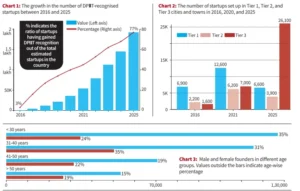
- From just ~500 recognised startups in 2016, the number has surged to 77,000 in 2025, supported by Startup India, digital infrastructure, and rising investor confidence.
Drivers of Growth
- Government support: Startup India scheme, tax incentives, and easier compliance.
- Digital revolution: UPI, Aadhaar, and Digital India created a strong tech backbone.
- Funding boom: Venture capital inflows crossed $24 billion in 2025.
- Tier2/3 expansion: Startups in smaller towns rose from 3,800 (2016) to 19,200 (2025), showing decentralisation of innovation.
- Demographic advantage: 53% of founders are aged 31–40 years, reflecting youthful entrepreneurship.
Recent Case Studies
- Startup numbers: From ~500 (2016) to 77,000 (2025), India now ranks 3rd globally.
- Founders’ growth: From 70,000 (2016) to 1.32 million (2025); female founders grew at 14% CAGR, faster than males (12%).
- Sectoral success:
- Fintech: UPI transactions crossed ₹18 lakh crore/month (2025).
- EdTech: Platforms like Byju’s and upGrad expanded globally.
- HealthTech: Telemedicine startups served 50 million users during COVID19.
- Case study – Tier3 cities: In 2025, Tier2 and Tier3 startups equalled Tier1 numbers (9,600 each), proving ecosystem diversification.
Government Initiatives
- Startup India: Tax exemptions, funding support, and incubation centres.
- Fund of Funds for Startups: ₹10,000 crore corpus to boost venture capital.
- Digital India: Enabled egovernance and digital payments.
- Atal Innovation Mission: Over 10,000 tinkering labs established in schools.
Challenges
- Funding Slowdown: The 2023–24 funding winter saw venture capital inflows drop by nearly 35% compared to 2021 peak levels, slowing valuations and expansion plans.
- Regulatory Complexity: A 2025 DPIIT survey found 42% of founders citing regulatory bottlenecks as a major growth barrier.
- High Failure Rate: Nearly 80% of startups fail within five years, largely due to scalability challenges, weak market linkages, and limited mentorship.
- Intellectual Property & Global Access: Weak IP enforcement discourages innovation; India ranked 42nd in the Global Innovation Index 2025.
Way Forward for Sustainable Growth
- Expand Credit Access: Strengthen credit guarantee schemes and tailor financing for earlystage ventures.
- Mentorship & Incubation in Smaller Cities: Establish more incubation hubs in Tier2/3 cities, where startup numbers rose to 19,200 in 2025.
- Women Entrepreneurship Promotion: Targeted schemes like StandUp India and Women Startup Programme (IIMB) should be scaled.Female founders already show 14% CAGR growth (2016–25), faster than male counterparts.
- DeepTech & Green Startups: Encourage ventures in AI, biotech, clean energy, and climate tech with tax breaks and R&D support.
India has received the fourth squadron of the S400 Triumf air defence system from Russia in May 2026.
Features of S400 System
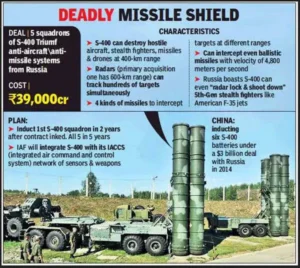
- Multirange capability: Can engage targets up to 400 km away and at altitudes of 30 km.
- Versatile defence: Uses multiple missile types to intercept aircraft, UAVs, and ballistic missiles.
- AIenabled support: Incorporates decisionsupport systems for threat prioritisation, though final engagement remains humancontrolled.
- Operational deployment: Squadrons already deployed in Punjab, Assam, and Tamil Nadu to cover sensitive borders.
Recent Developments & Data
- Fourth squadron delivered (May 2026); fifth expected by 2027.
- India now has four operational squadrons, enhancing coverage across northern and eastern fronts.
- The system integrates with India’s Integrated Air Command and Control System (IACCS) for realtime coordination.
Strategic Importance for India
- Deterrence against adversaries: Counters threats from neighbouring countries’ missile arsenals.
- Force multiplier: Complements indigenous systems like Akash and upcoming XRSAM.
- Geopolitical dimension: Despite global sanctions on Russia, India continues procurement, reflecting strategic autonomy.
Challenges Ahead
- Dependence on imports: Indigenous alternatives like XRSAM are still under development.
- Maintenance & spares: RussiaUkraine conflict may affect supply chains.
- Integration issues: Harmonising S400 with India’s diverse defence platforms requires advanced networking.
Way Forward
- Accelerate indigenous missile defence projects under DRDO.
- Strengthen joint training and simulation exercises for optimal use.
- Diversify procurement sources to reduce dependency risks.
- Enhance cybersecurity measures to protect AIenabled defence systems.
Conclusion
The S400 strengthens India’s air defence shield and strategic deterrence, but longterm reliance must shift towards indigenous systems.
The Great Nicobar Island project has gained attention in 2026 as India pursues strategic infrastructure development in the IndoPacific.
Great Nicobar Island project
- Mega project plan (2025): ₹72,000 crore investment for port, airport, power plant, and township.
- Employment potential: Estimated 50,000 jobs over the next decade.
- Ecological impact assessment: Reports highlight risk to 130 sq. km of forest land and marine nesting sites.
Strategic Importance of Andaman & Nicobar Islands (ANI) - Location near Malacca Strait: Nearly 90,000 merchant ships annually pass through this corridor, carrying 30–40% of global trade.
- Maritime surveillance: ANI hosts India’s only triservice command (ANC), enabling integrated Army, Navy, and Air Force operations.
- Exclusive Economic Zone (EEZ): ANI adds 300,000 sq. km to India’s EEZ, rich in marine resources and potential hydrocarbon deposits.
- Regional cooperation: ANI strengthens India’s Act East Policy, enabling closer ties with Southeast Asian nations like Myanmar, Thailand, and Indonesia.
- Port Blair can serve as a hub for disaster relief, counterpiracy, and searchandrescue operations.
Security Concerns in the Indian Ocean Region (IOR)
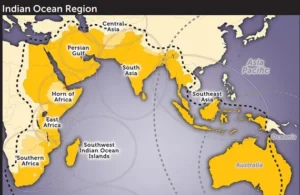
- Maritime chokepoints: The Strait of Malacca, BabelMandeb, and Hormuz are vulnerable to blockades or disruptions, threatening global energy and trade flows.
- China’s String of Pearls: Chinese investments in Gwadar (Pakistan), Hambantota (Sri Lanka), and Kyaukpyu (Myanmar) raise concerns of dualuse military facilities encircling India.
- Piracy and terrorism: Somali piracy and maritime terrorism remain threats to shipping lanes.
- Naval competition: Growing presence of US, Chinese, and Japanese navies increases militarisation of the region.
Challenges
- Ecological Fragility: Risk to 130 sq. km of pristine forest land and nesting sites of endangered species like the leatherback turtle. Largescale deforestation may disrupt coastal balance and biodiversity.
- Tribal Concerns: Indigenous groups such as the Shompens and Nicobarese depend on forests and marine ecosystems. Development may threaten their livelihoods, cultural identity, and forest rights.
- Climate Vulnerability: The island lies in a seismically active zone prone to tsunamis and cyclones. Large infrastructure projects could increase disaster risks.
- Geopolitical Pressures: While strategically vital, heavy militarisation may invite regional tensions in the IndoPacific.
Balancing Ecology and Development Activities
- Phased Development: Implement projects gradually with regular ecological audits. Prioritise lowimpact infrastructure before heavy industrialisation.
- EcoTourism Promotion: Develop naturebased tourism that generates revenue while conserving biodiversity. Showcase tribal culture and traditional practices as part of sustainable tourism.
- Renewable Energy Integration: Replace conventional power plants with solar, wind, and tidal energy projects. Reduce carbon footprint while meeting energy needs.
- Community Participation: Involve local Gram Sabhas under PESA Act in decisionmaking. Ensure tribal voices are central to project planning.
Conclusion
Great Nicobar must balance national security with ecological responsibility to ensure sustainable progress.
Mission “Senehjori” was recently launched to transform Assam’s Muga silk sector into a globally competitive luxury textile ecosystem.
Assam’s Muga Silk Heritage
- Muga silk, known as the “Golden Silk of Assam”, is unique for its natural golden sheen and durability.
- Despite its GI tag recognition, the sector has faced challenges of low productivity, weak branding, and limited global reach.
- Mission Senehjori seeks to reposition Muga silk as a premium global textile while empowering local communities.
Mission Senehjori
- Value chain strengthening: From hostplant cultivation and silkworm seed production to weaving and exports.
- Digital traceability: Ensuring authenticity through GIbased certification.
- Tourism integration: Promoting silk clusters as cultural and ecotourism hubs.
Funding & Scale
- Estimated investment: ₹396–411 crore over three years.
- Coverage: Major Muga silk districts of Assam under a clusterbased approach.
- Support: Convergence of Central Ministries, Assam Government, technical institutions, and private partners.
Key Features
- Cluster model: Focused development in production zones.
- Infrastructure support: Modern reeling units, Common Facility Centres (CFCs), and Farmer Producer Organisations (FPOs).
- Brand identity: Unified branding under “Senehjori” for global market access.
- Wholeofgovernment approach: Institutional convergence for efficiency.

Significance
- Economic impact: Potential to generate employment for 1.5 lakh artisans and farmers.
- Export potential: Positioning Muga silk as a luxury textile in global markets.
- Cultural preservation: Protecting Assam’s traditional weaving heritage.
- Sustainability: Strengthening hostplant ecology and ecofriendly production.
Way Forward
- Expand international branding campaigns for Muga silk.
- Encourage youth entrepreneurship in silk clusters.
- Integrate ecotourism and handloom promotion for holistic growth.
- Ensure inclusive participation of women weavers in decisionmaking.
Conclusion
Mission Senehjori is a transformative step to globalize Assam’s golden silk while empowering local communities.
Residents of Boston recently reported loud explosions and booms, suspected to be caused by a significant bolide entering the atmosphere.
Bolides
- Exceptional Brightness: Bolides shine far more intensely than ordinary meteors. Their luminosity is so strong that they can sometimes be seen even during daylight.
- Explosive Nature: As they enter the atmosphere at high velocity, friction generates extreme heat. This causes fragmentation and powerful shock waves, leading to a dramatic explosion.
- Sonic Booms: The explosion often produces loud booms, similar to thunder or blasts. These sounds are a result of rapid air compression during the bolide’s breakup.
- Frequency of Occurrence: Bolides occur several times each year across the globe. Most events go unnoticed as they happen over oceans or remote regions, away from populated areas.
Scientific Significance of Bolides
- Revealing Composition: Bolides provide valuable clues about the mineral and chemical makeup of meteoroids.
- Atmospheric Entry Dynamics: sheds light on how meteoroids interact with Earth’s atmosphere. It explains processes like frictional heating, shock wave formation, and fragmentation patterns.
- Planetary Defence Applications: Data from bolide events helps in predicting the impact behaviour of larger asteroids.
- Insights are crucial for designing early warning systems and mitigation strategies against potential asteroid threats.
Recent Examples
- Chelyabinsk, Russia (2013): A bolide explosion injured 1,500 people due to shock waves.
- US NASA records (2025): Detected ~20 bolides globally, most over oceans.
- Boston (2026): Latest suspected bolide event, with residents reporting explosions and flashes.
Difference Between Meteors, Bolides, and Meteorites
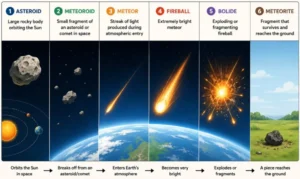
- Meteoroid: Space rock before entering Earth’s atmosphere.
- Meteor: Fireball formed when it burns in the atmosphere.
- Bolide: Exceptionally bright meteor that explodes dramatically.
- Meteorite: Rock fragments that survive and reach Earth’s surface.
Way Forward
- Enhance global monitoring networks for bolide detection.
- Promote public awareness to distinguish natural events from manmade explosions.
- Strengthen international collaboration in planetary defence research.
Conclusion
Bolides are spectacular natural events offering scientific insights and public fascination, while reminding us of Earth’s vulnerability to space objects.