Table of Contents
ToggleBankim Chandra Chattopadhyay
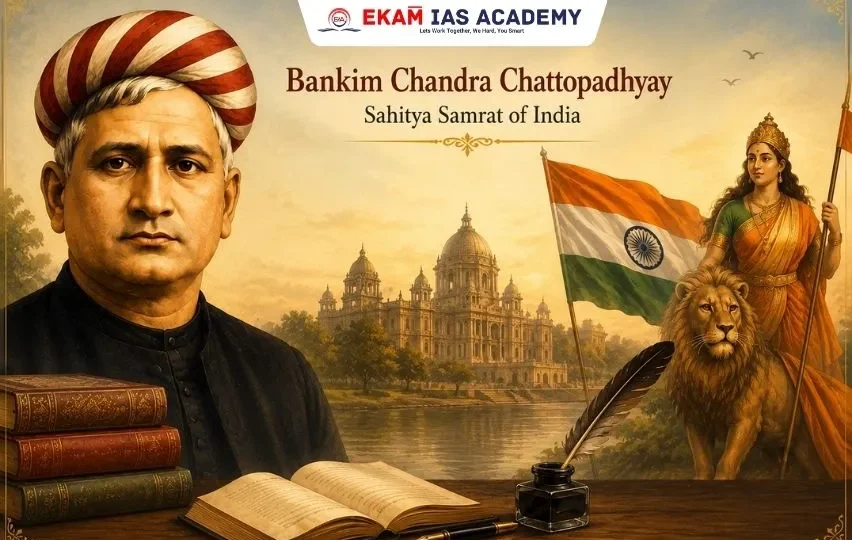
Bankim Chandra Chattopadhyay (1838–1894) was one of the greatest literary figures of modern India and is widely regarded as the “Sahitya Samrat” (Emperor of Literature). He played a significant role in shaping modern Bengali literature and awakening the spirit of Indian nationalism during British rule. His immortal composition “Vande Mataram” became the rallying cry of India’s freedom movement and was later adopted as the National Song of India. For UPSC aspirants, Bankim Chandra is an important personality under Modern Indian History, Art & Culture, and Indian National Movement.
Early Life
Bankim Chandra Chattopadhyay was born on 27 June 1838 in Naihati, Bengal Presidency (present-day West Bengal). He belonged to an educated Bengali family and displayed exceptional academic brilliance from an early age.
He was among the first graduates of the University of Calcutta, one of India’s earliest modern universities. After completing his education, he joined the British administration and served as a Deputy Magistrate and Deputy Collector from 1858. Despite serving under the British government, his writings reflected deep patriotism and concern for India’s cultural identity.
Contribution to the Bengal Renaissance
Bankim Chandra was one of the leading intellectuals of the Bengal Renaissance, a period marked by social, cultural, and literary awakening in the 19th century.
His major contributions include:
- Considered the Father of the Modern Bengali Novel.
- Introduced realism and historical themes into Bengali literature.
- Promoted Indian culture, spirituality, and nationalism through literature.
- Inspired future freedom fighters and literary personalities.
- Strengthened the cultural identity of Bengal and India.
His literary works transformed Bengali prose and laid the foundation for modern Indian fiction.
Major Literary Works
Bankim Chandra authored several novels that continue to be celebrated as classics.
Anandamath (1882)
- Inspired by the Sannyasi Rebellion.
- Introduced the famous patriotic song Vande Mataram.
- Depicted the struggle against oppression and inspired nationalist thought.
Durgeshnandini (1865)
- Regarded as the first major modern Bengali romance novel.
- Established Bankim Chandra as a leading novelist.
Kapalkundala (1866)
- One of his most popular romantic novels.
- Explores themes of love, morality, and society.
Vishabriksha (1873)
- Focuses on family relationships and social reform.
- Highlights the changing social values of 19th-century Bengal.
Devi Chaudhurani (1884)
- Features a strong female protagonist.
- Combines themes of patriotism, leadership, and social justice.
Krishna Charitra
A philosophical work presenting Lord Krishna from a historical and moral perspective.
Rajmohan's Wife (1864)
Bankim Chandra also wrote Rajmohan’s Wife, which is widely regarded as the first Indian English novel. It occupies a special place in the history of Indian English literature.
Vande Mataram
One of Bankim Chandra’s greatest contributions to the Indian freedom movement was the composition of Vande Mataram.
Important facts:
- Written in Sanskritised Bengali.
- First published in the literary magazine Bangadarshan in 1875.
- Later incorporated into his novel Anandamath.
- Sung by Rabindranath Tagore at the Indian National Congress session in 1896.
- Became the slogan of the Swadeshi Movement during the anti-partition movement in Bengal.
- In 1950, the first two stanzas were officially adopted as the National Song of India.
The song symbolizes devotion to the motherland and played a crucial role in inspiring India’s struggle for independence.
Legacy
Bankim Chandra Chattopadhyay’s influence extends far beyond literature. His writings awakened patriotic feelings among Indians and inspired generations of freedom fighters, writers, and social reformers.
His legacy includes:
- Pioneer of modern Bengali literature.
- Father of the Bengali novel.
- Creator of India’s National Song, Vande Mataram.
- Leading intellectual of the Bengal Renaissance.
- Inspiration for cultural nationalism and the Indian freedom movement.
- Honoured with the title “Sahitya Samrat” for his extraordinary literary achievements.
Today, Bankim Chandra Chattopadhyay remains one of the most influential figures in Indian literary and cultural history.
UPSC Prelims Quick Facts
| Topic | Fact |
|---|---|
| Born | 27 June 1838 |
| Birthplace | Naihati, Bengal Presidency |
| Died | 8 April 1894 |
| Title | Sahitya Samrat |
| Profession | Novelist, Poet, Essayist, Deputy Magistrate |
| Famous Song | Vande Mataram |
| National Song Status | First two stanzas adopted in 1950 |
| Famous Novel | Anandamath |
| First Major Novel | Durgeshnandini |
| First Indian English Novel | Rajmohan’s Wife |
| Important Movement | Bengal Renaissance |
| UPSC Relevance | Modern History, Art & Culture, Indian National Movement |
UPSC Mains Value Addition
Why is Bankim Chandra Chattopadhyay important?
- Pioneer of modern Indian literature.
- Symbol of cultural nationalism.
- Inspired the Indian freedom struggle through literature.
- Strengthened Indian identity during colonial rule.
- His works continue to influence Indian literature, history, and political thought.



Frequently Asked Questions (FAQs) About Bankim Chandra Chattopadhyay
Why is Bankim Chandra Chattopadhyay known as the "Sahitya Samrat"?
Bankim Chandra Chattopadhyay is called the “Sahitya Samrat” (Emperor of Literature) because of his immense contribution to modern Bengali literature. His novels revolutionized Indian literary traditions and inspired generations of writers and freedom fighters.
Which is the most famous work of Bankim Chandra Chattopadhyay?
His most famous work is Anandamath (1882), a patriotic novel that introduced the iconic song Vande Mataram, which later became the National Song of India.
What is the significance of Vande Mataram?
Vande Mataram was composed by Bankim Chandra Chattopadhyay and became a powerful symbol of India’s freedom movement. The first two stanzas were officially adopted as the National Song of India in 1950.
What are the major literary works of Bankim Chandra Chattopadhyay?
Some of his notable works include Anandamath, Durgeshnandini, Kapalkundala, Vishabriksha, Devi Chaudhurani, Krishna Charitra, and Rajmohan’s Wife, which is regarded as the first Indian English novel.
Why is Bankim Chandra Chattopadhyay important for UPSC preparation?
Bankim Chandra Chattopadhyay is an important topic for UPSC under Modern Indian History, Art & Culture, and the Indian National Movement. Questions often focus on his literary contributions, the Bengal Renaissance, Vande Mataram, and his role in inspiring Indian nationalism.