Table of Contents
ToggleArticle 48 of the Indian Constitution
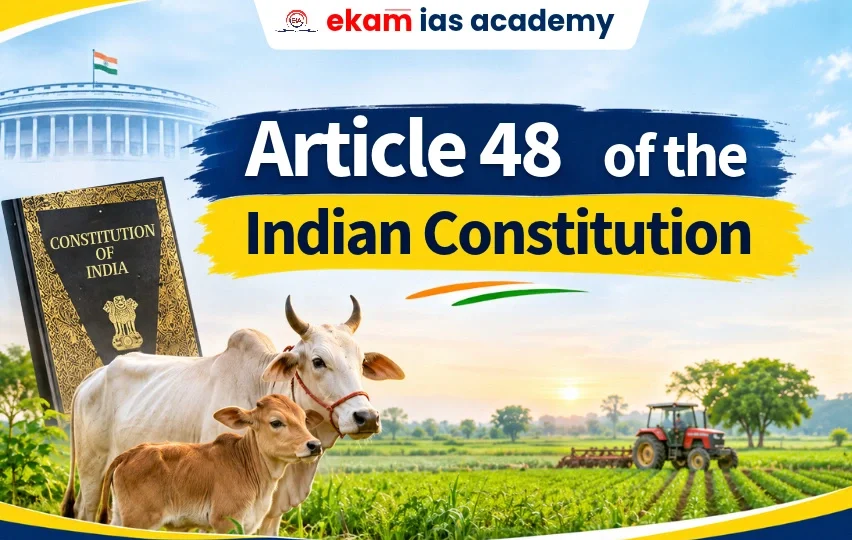
- Article 48 of the Indian Constitution directs the state to organize agriculture and animal husbandry on modern and scientific lines while safeguarding vital livestock.
- Placed under Part IV of Indian Constitution, it operates as a non-justiciable directive that guides policy formulation toward rural prosperity and Cattle Protection in India.
- For Indian Polity UPSC and Agriculture and Animal Husbandry UPSC preparation, Article 48 Explained highlights how economic growth, scientific farming, and livestock welfare intersect.
Constitutional Background
- Article 48 Constitution of India was incorporated into the Directive Principles of State Policy UPSC framework to guide socio-economic governance without making animal welfare a judicially enforceable fundamental right of citizens.
- Dr. B.R. Ambedkar noted that fundamental rights apply to human beings rather than imposing enforceable obligations on citizens regarding animals, placing this mandate within Part IV of Indian Constitution.
- The provision has remained unamended since adoption and works alongside Entry 15 of the State List (preservation and improvement of stock) and Entry 17 of the Concurrent List (prevention of cruelty to animals).
Key Provisions of Article 48
- The first limb of Article 48 of the Indian Constitution mandates the state to endeavor to organize agriculture and animal husbandry on modern and scientific lines.
- The second limb directs the state to take steps, in particular, for Preservation of Cows and Cattle, improving breeds, and Prohibition of Cow Slaughter, calves, and other milch and draught cattle.
- Rather than framing the mandate solely around religion, the text links Organisation of Agriculture and Animal Husbandry with breed improvement, farm utility, and livestock conservation.
Historical Background
- Debates in the Constituent Assembly after independence weighed cultural sentiments surrounding cattle against agrarian and economic realities in a predominantly rural nation.
- Compromise placed Article 48 Directive Principles of State Policy as a guiding policy principle rather than a justiciable right, allowing legislatures to calibrate measures over time.
- Subsequent state legislations and judicial rulings shaped how Prohibition of Cow Slaughter and Cattle Protection in India were interpreted and enforced.
Objectives and Significance
- Article 48 UPSC aims to advance Modernisation of Agriculture in India through better inputs, research, and Scientific Agriculture Practices alongside improved livestock management.
- Protecting milch and draught cattle supports rural livelihoods, dairy output, farm power, and organic manure availability in agrarian communities.
- Balancing Preservation of Cows and Cattle with modern farm practices helps strengthen food security and sustainable rural development.
Article 48 vs Article 48A
← Swipe left or right to view the full comparison →
| Comparison Feature | Article 48 | Article 48A |
|---|---|---|
| Primary Focus | Organisation of Agriculture and Animal Husbandry. | Protection and improvement of the environment, and safeguarding forests and wildlife. |
| Constitutional Background | An original provision of the Constitution, in force since 1950. | Inserted by the 42nd Constitutional Amendment Act, 1976. |
| Key Directive | Organise agriculture and animal husbandry on modern and scientific lines, preserve and improve breeds, and prohibit the slaughter of cows, calves, and other milch and draught cattle. | Protect and improve the environment and safeguard the country's forests and wildlife. |
| Policy Scope | Scientific farming, livestock improvement, and cattle preservation. | Environmental protection, forest conservation, and wildlife protection. |
| Constitutional Placement | Part IV — Directive Principles of State Policy. | Part IV — Directive Principles of State Policy. |

Cow Slaughter and Constitutional Position
- Because preservation of stock falls under the State List, laws regulating or restricting Prohibition of Cow Slaughter vary across Indian states and Union Territories.
- Article 48 frames cattle protection in terms of cows, calves, and milch and draught cattle, while courts have examined the scope of state bans against fundamental rights like freedom of trade and religion.
- Over time, judicial interpretation has treated Article 48 Directive Principles of State Policy as an important public-interest consideration when evaluating reasonable restrictions.
Important Supreme Court Judgments
- In Mohd. Hanif Quareshi v. State of Bihar (1958), a Constitution Bench upheld bans on slaughtering cows and calves while striking down total bans on bulls and bullocks at that time and holding that cow sacrifice is not an obligatory religious practice.
- In State of Gujarat v. Mirzapur Moti Kureshi Kassab Jamat (2005), a larger Bench upheld a total ban on slaughtering cows and their progeny (bulls and bullocks), reading Article 48 harmoniously with Article 48A and Article 51A(g).
- Earlier decisions such as Abdul Hakim Qureshi v. State of Bihar (1961) also addressed challenges under Article 25, reinforcing the balance between constitutional rights and state policy goals.
Government Initiatives
- Schemes focused on indigenous bovine breed conservation, genetic improvement, semen stations, and Scientific Agriculture Practices operationalize the modernization and breed-improvement aspects of Article 48 UPSC.
- Programs supporting dairy development, fodder management, and Modernisation of Agriculture in India help farmers improve productivity and income stability.
- State-level cattle preservation statutes and animal welfare schemes further translate Cattle Protection in India into regional administration.
Challenges and Issues
- Restrictions on cattle slaughter alongside declining draught animal use can contribute to stray cattle challenges, affecting standing crops, road safety, and municipal management.
- Wide variations in state laws, enforcement capacity, and veterinary infrastructure create uneven outcomes across regions for Agriculture and Animal Husbandry UPSC.
- Balancing Modernisation of Agriculture in India, farmer livelihoods, and Preservation of Cows and Cattle requires coordinated policy design.
Way Forward
- Strengthening veterinary care, breed improvement, and sustainable fodder systems can advance Organisation of Agriculture and Animal Husbandry while minimizing stray-cattle disruptions.
- Expanding extension services and Scientific Agriculture Practices will help small and marginal farmers boost resilience and productivity.
- Harmonizing state-level cattle welfare measures with practical rural economics will make Article 48 Explained more effective on the ground.
Conclusion
- Article 48 of the Indian Constitution remains a foundational guideline linking Modernisation of Agriculture in India with Preservation of Cows and Cattle.
- Read alongside Article 48A and Article 51A(g), it reflects the constitutional effort to harmonize economic progress, Cattle Protection in India, and ecological responsibility.
- Mastery of Article 48 UPSC and Indian Polity UPSC equips aspirants to analyze how directive principles shape agrarian and livestock governance.
UPSC Prelims: PYQs & Practice Questions
Previous Year Questions (Prelims)
Q: Consider the following statements regarding the Directive Principles of State Policy in the Constitution of India:
1. Article 48 directs the State to organize agriculture and animal husbandry on modern and scientific lines and to take steps for preserving and improving the breeds of cows, calves, and other milch and draught cattle.
2. Article 48 was inserted into Part IV of the Constitution by the Forty-second Constitutional Amendment Act, 1976.
Which of the statements given above is/are correct?
(a) 1 only
(b) 2 only
(c) Both 1 and 2
(d) Neither 1 nor 2
Answer: (a) 1 only
Explanation:
Statement 1 is correct: Article 48 directs the State to endeavour to organise agriculture and animal husbandry on modern and scientific lines and, in particular, take steps for preserving and improving breeds and prohibiting the slaughter of cows, calves, and other milch and draught cattle.
Statement 2 is incorrect: Article 48 is an original provision of the Constitution. Article 48A, dealing with the protection and improvement of the environment and safeguarding forests and wildlife, was inserted by the 42nd Constitutional Amendment Act, 1976.
Q: Which of the following pairs of constitutional provisions and their subjects is/are correctly matched?
1. Article 48: Organisation of agriculture and animal husbandry
2. Article 48A: Protection and improvement of environment and safeguarding of forests and wildlife
3. Article 50: Separation of judiciary from executive
Select the correct answer using the code given below:
(a) 1 and 2 only
(b) 2 and 3 only
(c) 1 and 3 only
(d) 1, 2 and 3
Answer: (d) 1, 2 and 3
Explanation:
All three pairs are correctly matched under Part IV (Directive Principles of State Policy).
Article 48: Deals with agriculture, animal husbandry, and cattle preservation.
Article 48A: Added by the 42nd Constitutional Amendment Act, 1976, deals with environment, forests, and wildlife.
Article 50: Directs the State to separate the judiciary from the executive in the public services of the State.
Practice Questions
Q: With reference to Article 48 of the Constitution of India, consider the following statements:
1. The text of Article 48 explicitly mentions religious grounds for prohibiting the slaughter of cattle.
2. Preservation and improvement of stock falls under the State List of the Seventh Schedule.
3. In State of Gujarat v. Mirzapur Moti Kureshi Kassab Jamat (2005), the Supreme Court upheld a total ban on the slaughter of cows and their progeny.
Which of the statements given above is/are correct?
(a) 1 and 2 only
(b) 2 and 3 only
(c) 1 and 3 only
(d) 1, 2 and 3
Answer: (b) 2 and 3 only
Explanation:
Statement 1 is incorrect: Article 48 frames its mandate around modern and scientific organization of agriculture and animal husbandry and the preservation and improvement of breeds and milch/draught cattle, rather than religious grounds.
Statement 2 is correct: Preservation and improvement of stock is a State List subject under Entry 15 of the Seventh Schedule.
Statement 3 is correct: In State of Gujarat v. Mirzapur Moti Kureshi Kassab Jamat (2005), a seven-judge Bench upheld a total ban on slaughtering cows and their progeny, including bulls and bullocks.
Q: Consider the following statements regarding judicial rulings related to Article 48:
1. In Mohd. Hanif Quareshi v. State of Bihar (1958), the Supreme Court held that cow sacrifice on Bakr-Id is not an obligatory religious practice.
2. In State of Gujarat v. Mirzapur Moti Kureshi Kassab Jamat (2005), the Supreme Court read Article 48 harmoniously with Articles 48A and 51A(g).
Which of the statements given above is/are correct?
(a) 1 only
(b) 2 only
(c) Both 1 and 2
(d) Neither 1 nor 2
Answer: (c) Both 1 and 2
Explanation:
Both statements are correct. In Mohd. Hanif Quareshi v. State of Bihar (1958), the Court held that cow sacrifice is not an essential or obligatory religious practice.
In State of Gujarat v. Mirzapur Moti Kureshi Kassab Jamat (2005), the Court read Article 48 alongside Article 48A and Article 51A(g) and upheld the constitutional validity of a total ban on slaughter of cows and their progeny.
UPSC Mains – Previous Year & Practice Questions
Mains Previous Year Questions
Question: Discuss the possible factors that inhibit India from enacting for its citizens a uniform civil code as provided for in the Directive Principles of State Policy. (UPSC CSE Mains 2015, GS-II)
Question: Despite consistent experience of high growth, India still goes with the lowest indicators of human development. Examine the issues that make balanced and inclusive development elusive. (UPSC CSE Mains 2019, GS-II)
Question: How far are arguments/concerns over farm subsidies consistent with the need to ensure reduced subsidy burden and more effective allocation of Government expenditure? (UPSC CSE Mains 2013, GS-III)
Question: What are the major bottlenecks in implementing the Direct Benefit Transfer scheme in India? Point out the alternatives, if any. (UPSC CSE Mains 2013, GS-II)
Question: Environmental impact assessment studies are increasingly undertaken before a project is cleared by the Government. Discuss the environmental laws and institutions related to this process. (UPSC CSE Mains 2012, GS-III)
Mains Practice Questions
[10 Marks | 150 Words]
Question: Analyze the dual mandate of Article 48 of the Indian Constitution. How does the directive to modernize agriculture and animal husbandry interact with the conservation of cattle breeds in contemporary rural India?
[15 Marks | 250 Words]
Question: Trace the judicial evolution surrounding Article 48 from Mohd. Hanif Quareshi v. State of Bihar (1958) to State of Gujarat v. Mirzapur Moti Kureshi Kassab Jamat (2005). How have courts balanced Directive Principles with fundamental rights and economic considerations?
[10 Marks | 150 Words]
Question: Why do laws on cattle preservation vary significantly across Indian states? Discuss the federal distribution of legislative powers and the administrative challenges arising from stray cattle management.


Article 48 of the Indian Constitution-FAQs
What is Article 48 of the Indian Constitution?
Article 48 directs the State to organise agriculture and animal husbandry on modern and scientific lines and take steps for the preservation and improvement of cattle breeds.
What does Article 48 say about cow slaughter?
It directs the State to take steps for prohibiting the slaughter of cows, calves and other milch and draught cattle, while leaving the specific legal framework largely to the states.
Is Article 48 a Fundamental Right?
No. Article 48 is a Directive Principle of State Policy (DPSP) under Part IV and is therefore non-justiciable, though it is fundamental to governance.
What is the difference between Article 48 and Article 48A?
Article 48 focuses on agriculture, animal husbandry and cattle preservation, whereas Article 48A focuses on environmental protection, forests and wildlife.
Which Supreme Court case is important for Article 48?
State of Gujarat v. Mirzapur Moti Kureshi Kassab Jamat (2005) is a landmark case in which the Supreme Court upheld a broader cattle-slaughter prohibition and considered Article 48 alongside fundamental duties and environmental principles.