Table of Contents
ToggleSanthal Rebellion 1855-56
The Santhal Rebellion (1855–1856), also known as the Santhal Hul, was one of the largest tribal uprisings against British colonial rule before the Revolt of 1857. Led by the courageous tribal leaders Sidhu Murmu and Kanhu Murmu, the rebellion was a mass movement against exploitation by the British administration, oppressive landlords (zamindars), moneylenders (mahajans), and revenue officials. The revolt reflected the determination of the Santhal community to protect their land, identity, and traditional way of life.
The Santhal Rebellion occupies an important place in Indian history and remains a significant topic for UPSC Prelims, UPSC Mains (GS Paper-I), State PSC examinations, and other competitive exams.
Why is the Santhal Rebellion in News?
The 30th of June is observed as a significant date in remembrance of the Santhal Hul of 1855, when thousands of Santhals united against British colonial oppression. The day highlights the immense contribution of tribal communities to India’s freedom struggle and brings renewed attention to tribal rights, indigenous heritage, and resistance movements.
What was the Santhal Rebellion?
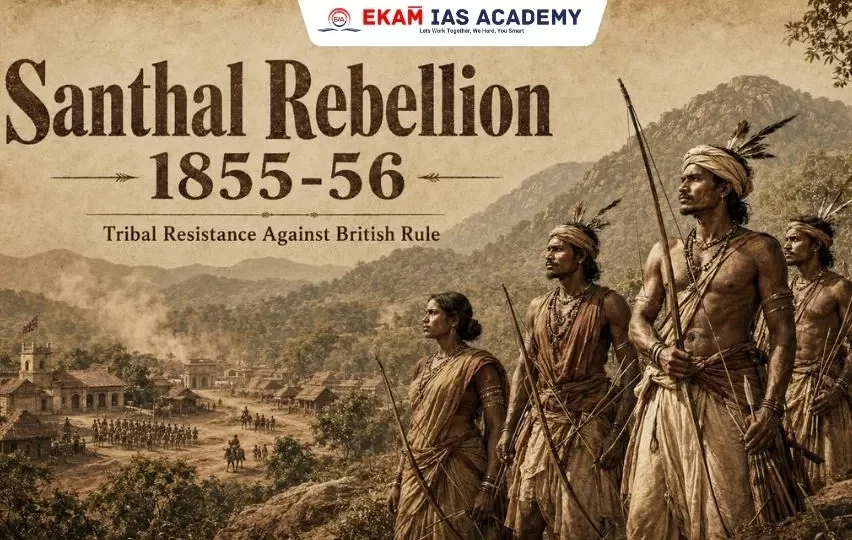
The Santhal Rebellion, popularly known as the Santhal Hul, was a tribal uprising that began in June 1855 in the Rajmahal Hills region, covering present-day Jharkhand, Bihar, and West Bengal. Nearly 10,000 Santhals assembled at Bhognadih village under the leadership of Sidhu Murmu and Kanhu Murmu, declaring the end of British authority and calling for self-rule.
Armed mainly with traditional weapons such as bows, arrows, axes, and spears, the Santhals challenged British forces and colonial institutions with remarkable courage.
Causes of the Santhal Rebellion
Several factors contributed to the outbreak of the rebellion:
Permanent Settlement of 1793
The British revenue system under the Permanent Settlement imposed excessive land revenue demands. Many Santhal families lost their ancestral lands due to their inability to pay taxes, leading to widespread displacement.
Exploitation by Moneylenders and Zamindars
Moneylenders charged exorbitant interest rates, trapping tribal communities in perpetual debt. Landlords seized tribal lands, reducing many Santhals to bonded labour.
Administrative Oppression
British courts, police, and revenue officials often sided with landlords and moneylenders, denying justice to the tribal population.
Cultural Interference
The colonial administration ignored traditional tribal customs and governance systems, weakening the Santhals’ social and cultural autonomy.
Leaders of the Santhal Rebellion
The movement was led by four prominent tribal leaders:
- Sidhu Murmu
- Kanhu Murmu
- Chand Murmu
- Bhairav Murmu
These leaders inspired thousands of Santhals to unite and resist colonial exploitation despite overwhelming military disadvantages.
Course of the Uprising
On 30 June 1855, thousands of Santhals gathered at Bhognadih and pledged to overthrow British rule and end the exploitation by zamindars and moneylenders.
The rebels:
- Attacked police stations and government offices.
- Destroyed symbols of colonial authority.
- Targeted oppressive landlords and moneylenders.
- Used guerrilla warfare and traditional weapons to resist British troops.
Initially, the rebellion achieved significant local success, but the British soon deployed a large military force equipped with modern firearms and artillery.
The uprising was eventually suppressed under martial law, resulting in the deaths of an estimated 10,000–20,000 Santhals. Sidhu and Kanhu were captured and executed.
Outcomes of the Santhal Rebellion
Although the rebellion was militarily crushed, it had lasting administrative and political consequences.
Creation of Santhal Parganas
Recognizing the intensity of tribal grievances, the British created the separate administrative district of Santhal Parganas in 1856 to improve governance in tribal regions.
Legal Protection for Tribal Lands
The colonial government introduced measures restricting the transfer of tribal lands to non-tribals, helping preserve indigenous land rights.
Tribal Identity and Resistance
The rebellion became a symbol of tribal courage, dignity, and resistance against exploitation. It inspired later tribal movements across India.
Significance of the Santhal Rebellion
The Santhal Rebellion is regarded as one of India’s earliest organized tribal resistance movements. It demonstrated that tribal communities actively participated in resisting colonial rule long before the Revolt of 1857.
The movement highlighted issues such as:
- Land alienation
- Economic exploitation
- Tribal rights
- Indigenous identity
- Colonial administration
Today, the Santhal Hul continues to inspire movements for social justice, tribal welfare, and constitutional protection of Scheduled Tribes.
UPSC Exam Relevance
Prelims
- Santhal Rebellion (1855–56)
- Sidhu and Kanhu Murmu
- Santhal Parganas
- Permanent Settlement
- Tribal Revolts in India
GS Paper I
- Tribal uprisings during British rule
- Peasant and tribal resistance movements
- Impact of colonial land revenue policies
- Contributions of tribal communities to India’s freedom struggle
Essay & Interview
The Santhal Rebellion provides valuable insights into inclusive history, indigenous rights, grassroots resistance, and the role of tribal communities in shaping India’s struggle against colonialism.
Conclusion
The Santhal Rebellion (1855–1856) was far more than an armed uprising—it was a determined struggle to protect land, dignity, culture, and freedom. Despite facing a powerful colonial administration, the Santhals displayed extraordinary courage and unity. Their sacrifice compelled the British to reconsider administrative policies toward tribal regions and left a lasting legacy in India’s freedom movement. For UPSC aspirants, understanding the Santhal Rebellion is essential not only from an examination perspective but also for appreciating the vital role of tribal communities in India’s historical and democratic journey.



Frequently Asked Questions (FAQs) on the Santhal Rebellion (1855–1856)
What was the Santhal Rebellion?
The Santhal Rebellion (1855–1856), also known as the Santhal Hul, was a major tribal uprising against British colonial rule. Led by Sidhu Murmu and Kanhu Murmu, the rebellion opposed the exploitation of the Santhal community by British officials, zamindars, and moneylenders.
What were the main causes of the Santhal Rebellion?
The rebellion was caused by several factors, including the Permanent Settlement, excessive taxation, exploitation by moneylenders and landlords, loss of tribal lands, administrative injustice, and interference with the traditional social and cultural life of the Santhal people.
Who were the leaders of the Santhal Rebellion?
The movement was led by four prominent tribal leaders:
- Sidhu Murmu
- Kanhu Murmu
- Chand Murmu
- Bhairav Murmu
They united thousands of Santhals in their fight against British colonial oppression.
What were the major outcomes of the Santhal Rebellion?
Although the British suppressed the rebellion, it resulted in significant administrative reforms. The British created the Santhal Parganas as a separate administrative district in 1856 and introduced measures to provide better protection for tribal land rights.
Why is the Santhal Rebellion important for UPSC preparation?
The Santhal Rebellion is an important UPSC topic because it covers tribal movements, British colonial policies, land revenue systems, freedom struggle, and social justice. It is frequently asked in UPSC Prelims, GS Paper-I, State PSCs, SSC, and other competitive examinations.