Table of Contents
ToggleReforms 3.0: Towards the Bharat Rate of Growth
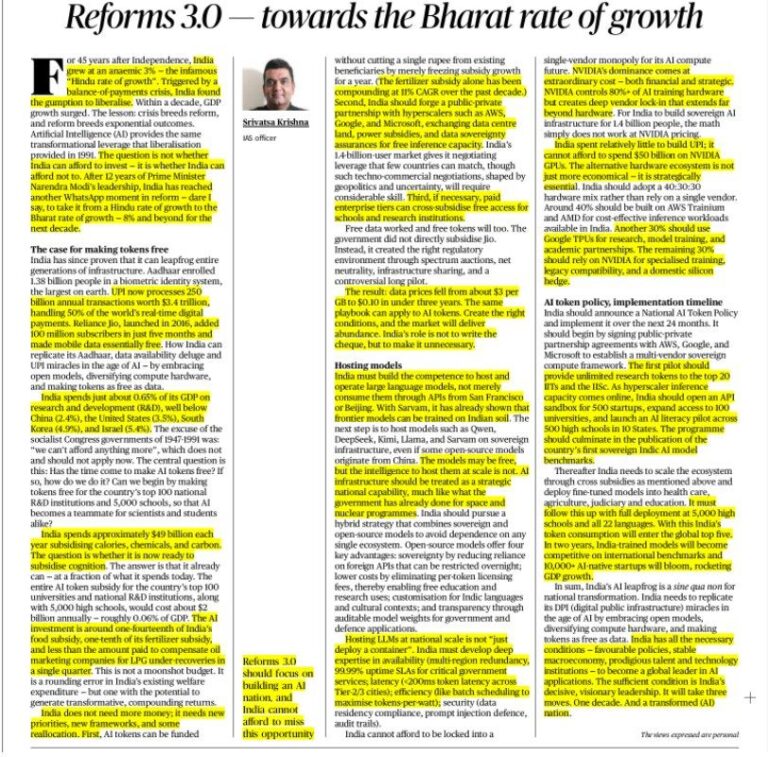
Artificial Intelligence (AI) is emerging as the next engine of India’s economic transformation, much like the IT revolution and the Unified Payments Interface (UPI). The editorial “Reforms 3.0 – Towards the Bharat Rate of Growth” argues that India has a unique opportunity to achieve sustained 8–10% economic growth by investing in AI infrastructure, research, talent development, and digital innovation. Instead of merely regulating AI, India must build an ecosystem that enables innovation while ensuring technological self-reliance.
Why in News?
The editorial highlights that AI has reached an inflection point where countries investing early in computing infrastructure, AI talent, semiconductor capabilities, and open-source models are likely to dominate the next phase of global economic growth. It calls for “Reforms 3.0” to position India as a global AI leader.
Background
India has successfully leveraged technology to transform governance through initiatives such as Aadhaar, UPI, Digital India, and Direct Benefit Transfer (DBT). These reforms significantly improved financial inclusion and public service delivery. However, India’s expenditure on Research and Development (R&D) remains around 0.65% of GDP, much lower than leading innovation-driven economies. The editorial argues that AI presents an opportunity to bridge this gap and accelerate economic growth.
Key Highlights of the Editorial
AI as the Next Growth Engine
AI can become the foundation of India’s next economic revolution, similar to the role played by information technology in the 1990s.
Invest in AI Research
The editorial recommends substantial investment in universities, research institutions, and AI laboratories to develop indigenous innovation.
Build AI Infrastructure
India should expand access to high-performance computing, cloud infrastructure, data centres, and semiconductor capabilities to support AI development.
Promote Open-Source AI
Encouraging open-source AI models can reduce dependence on foreign technologies and foster domestic innovation.
Strengthen AI Talent
Greater investment in AI education, scholarships, and industry-academia collaboration is essential to create a globally competitive workforce.
Major Challenges
Low R&D Investment
India’s spending on research remains significantly below global innovation leaders, limiting technological breakthroughs.
Dependence on Foreign AI Technologies
Heavy reliance on imported AI hardware, advanced chips, and cloud services creates strategic vulnerabilities.
Limited Computing Infrastructure
Insufficient GPU availability and high-performance computing facilities constrain AI research and innovation.
Skill Gaps
India requires a much larger pool of AI researchers, engineers, and data scientists to compete globally.
Government Initiatives
- IndiaAI Mission
- Digital India Programme
- National Quantum Mission
- Semicon India Programme
- Production Linked Incentive (PLI) Scheme for Semiconductors
- National Supercomputing Mission
- Atal Innovation Mission
Economic Significance
The editorial argues that AI can significantly enhance productivity across agriculture, manufacturing, healthcare, education, financial services, and governance. Higher productivity can boost GDP growth, improve public service delivery, generate high-skilled employment, and strengthen India’s global competitiveness.
Way Forward
India should adopt Reforms 3.0 by increasing R&D expenditure, expanding AI infrastructure, investing in semiconductor manufacturing, promoting open-source AI ecosystems, strengthening university-industry partnerships, and developing a highly skilled AI workforce. A long-term national AI strategy supported by policy stability, private investment, and innovation-friendly regulations will enable India to achieve the envisioned “Bharat Rate of Growth” and emerge as a global AI powerhouse.
Conclusion
Artificial Intelligence has the potential to become the cornerstone of India’s next phase of economic growth and global competitiveness. By implementing Reforms 3.0, strengthening AI infrastructure, increasing investment in research and innovation, and promoting indigenous technological capabilities, India can unlock sustained high growth while ensuring digital self-reliance. A balanced approach that combines innovation, skilled talent, and supportive policies will help India realize the vision of the “Bharat Rate of Growth” and emerge as a leading AI-powered economy.
Frequently Asked Questions (FAQs)
What is Reforms 3.0?
Reforms 3.0 is a proposed AI-driven economic strategy aimed at accelerating India’s growth through innovation, digital infrastructure, and technology-led reforms.
Why is Artificial Intelligence important for India's growth?
AI can boost productivity, create high-skilled jobs, improve governance, and help India achieve sustained long-term economic growth.
What are the biggest challenges to AI-led growth in India?
Low R&D investment, dependence on foreign AI technologies, limited computing infrastructure, and a shortage of skilled AI professionals are key challenges.
What government initiatives support AI development in India?
Initiatives such as the IndiaAI Mission, Digital India Programme, Semicon India Programme, and National Supercomputing Mission are strengthening India’s AI ecosystem.
How can India achieve the "Bharat Rate of Growth"?
India can achieve the Bharat Rate of Growth by investing in AI research, semiconductor manufacturing, digital infrastructure, and developing a globally competitive AI workforce.
Source From : The Hindu
Next UN Chief’s Job: Keeping Global Conversations Alive
The next UN Secretary-General will take charge at a time when the world is facing deep divisions, rising conflicts, weakening trust, and growing pressure on the United Nations system. The central challenge is not only to stop wars, but to keep dialogue alive when nations refuse to talk. In today’s world of geopolitical rivalry, climate crisis, nuclear risks, and humanitarian emergencies, the UN’s role in global peace and international cooperation has become more important than ever.
Why the UN Chief Matters
The United Nations Secretary-General is often described as the world’s top diplomat. The role does not come with military power or direct authority over nations, but it carries moral influence, negotiation capacity, and the responsibility to build trust among conflicting parties. From the Cold War era to present global tensions, successful UN leadership has depended on quiet diplomacy, patience, and the ability to bring opposing sides to the table.

Key Challenges Before the Next UN Secretary-General
Rising Global Conflicts
The world is witnessing conflicts in regions such as Ukraine, West Asia, and Africa. These crises show that the international order is under stress. The next UN chief must work to strengthen peacekeeping, conflict resolution, and preventive diplomacy.
Weakening Multilateralism
Many countries are increasingly acting through military alliances, trade blocs, and regional groups instead of relying on global institutions. This weakens multilateralism and reduces the ability of the UN to solve common problems collectively.
Reform of the United Nations
The demand for UN Security Council reform has grown stronger. Countries like India have argued that the present structure does not reflect today’s global realities. The next UN chief must push for reforms that make the UN more representative, democratic, and effective.
Climate, Poverty and Humanitarian Crises
Apart from wars, the UN must also respond to climate change, food insecurity, displacement, pandemics, and poverty. These issues require cooperation among governments, civil society, and international organisations.
Conclusion
The next UN Secretary-General’s role will be to protect the relevance of the United Nations in a divided world. The biggest task is to keep conversations alive, build trust, and prevent conflicts from turning into disasters. For students of UPSC international relations, this topic is important because it connects global governance, diplomacy, peacekeeping, and reforms in international institutions.
Frequently Asked Questions (FAQs)
What is the main role of the UN Secretary-General?
The UN Secretary-General acts as the world’s top diplomat, promoting peace, dialogue, and cooperation among nations.
Why is the next UN chief’s role important?
The next UN chief must handle rising conflicts, global mistrust, climate challenges, and weakening multilateral cooperation.
What is the biggest challenge before the United Nations today?
The biggest challenge is keeping dialogue alive between countries when conflicts, rivalry, and distrust are increasing.
Why is UN Security Council reform needed?
UNSC reform is needed to make the United Nations more representative of today’s global power structure, including countries like India.
How is this topic important for UPSC?
It is important for UPSC International Relations as it covers global governance, diplomacy, peacekeeping, and UN reforms.