
Table of Contents
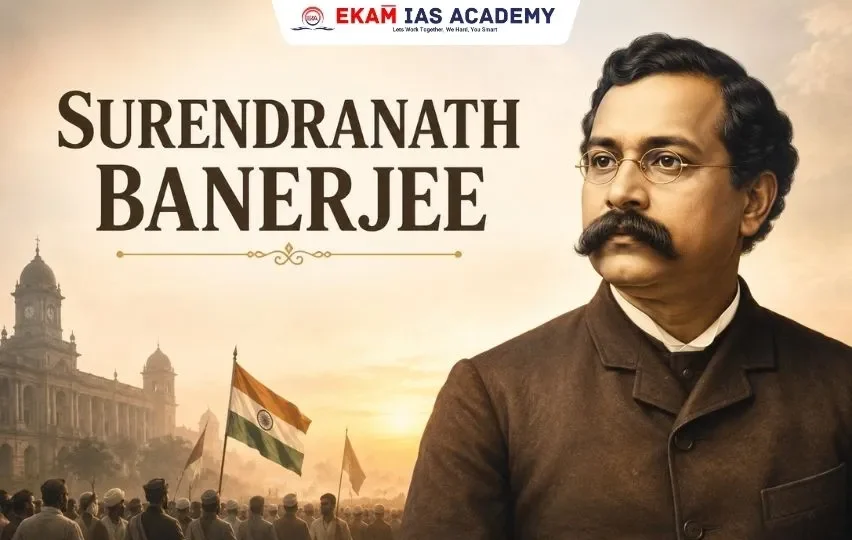
ToggleSurendranath Banerjee
The nation remembers Surendranath Banerjee (1848–1925), one of the earliest leaders of the Indian freedom movement and a prominent figure in the growth of political consciousness during the colonial period.
Known as the “Maker of Bengal” for his role during the 1905 anti-partition movement, Banerjee played a significant role in shaping early Indian nationalism through constitutional methods, political organisations, journalism and education.
Early Life and Entry into Civil Services
Surendranath Banerjee was born on 10 November 1848 in Calcutta (present-day Kolkata) into a Bengali Brahmin family.
He travelled to England after completing his graduation and appeared for the prestigious Indian Civil Service (ICS) examination in 1869.
- He became one of the earliest Indians to clear the ICS examination.
- His selection represented a significant achievement at a time when British administration largely excluded Indians from higher government positions.
However, his career in the civil service was short-lived.
He was appointed as an Assistant Magistrate in Sylhet (present-day Bangladesh) but was dismissed in 1874 by the British authorities over alleged procedural irregularities. Banerjee considered the dismissal discriminatory and viewed it as an example of racial bias faced by Indians under colonial rule.
This experience became a turning point, motivating him to dedicate his life to political activism and national service.
Beginning of Political Career
After leaving the civil service, Surendranath Banerjee emerged as one of the earliest advocates of Indian political rights.
In 1876, along with Anandamohan Bose, he founded the:
Indian National Association
The organisation aimed to:
- Create political awareness among Indians.
- Unite people across regions and communities.
- Promote constitutional reforms and greater Indian participation in administration.
The Indian National Association became one of the earliest organised political platforms in India and later merged with the Indian National Congress in 1886, strengthening the national movement.
Role in the Indian National Congress
Surendranath Banerjee was among the important early leaders of the Indian National Congress (INC).
He served as the President of the Congress twice:
- Poona Session (1895)
- Ahmedabad Session (1902)
As a moderate nationalist leader, he believed in achieving reforms through:
- Constitutional methods
- Public debates
- Petitions and peaceful political mobilisation
He played an important role in creating the foundation of organised political activity in India.
Contribution to the Anti-Partition Movement and Swadeshi Movement
The Partition of Bengal in 1905 by Lord Curzon became a major turning point in Banerjee’s political career.
He strongly opposed the partition, considering it a strategy to divide Indian society.
His contributions included:
- Leading public protests against the partition.
- Mobilising people through speeches and political campaigns.
- Supporting the Swadeshi Movement, which encouraged the use of indigenous goods and rejection of foreign products.
His leadership during this period earned him the title:
“Maker of Bengal”
for awakening political consciousness among the people of Bengal.
Contribution to Journalism and Education
Surendranath Banerjee used journalism as a powerful tool to spread political awareness.
The Bengalee Newspaper
- In 1879, he became associated with The Bengalee, a nationalist newspaper.
- Through his writings, he criticised colonial policies and encouraged political awareness among Indians.
In 1883, he became one of the first Indian journalists to face imprisonment after being charged with contempt of court for his writings.
Educational Contributions
Banerjee believed education was essential for national development.
- He founded Ripon College in 1882.
- The institution was later renamed Surendranath College in his honour.
Through education, he aimed to create informed citizens capable of participating in public life.
Political Ideology and Later Years
Surendranath Banerjee belonged to the Moderate School of Indian Nationalism.
He supported:
- Gradual constitutional reforms.
- Greater representation of Indians in administration.
- Expansion of civil liberties.
However, with the rise of more assertive nationalist movements led by leaders such as Bal Gangadhar Tilak and later mass movements under Mahatma Gandhi, moderate politics gradually lost influence.
Disagreements regarding the Montagu-Chelmsford Reforms led Banerjee to leave the Congress in 1919.
He later established the:
Indian National Liberation Federation
Role in Government and Recognition
In 1921, Surendranath Banerjee was awarded a knighthood by the British government.
He also served as:
- Minister for Local Self-Government in Bengal
During this period, he continued working for administrative reforms and public welfare.
Literary Work
Surendranath Banerjee documented his political journey and experiences in his autobiography:
“A Nation in Making”
The book provides insights into:
- The early nationalist movement.
- Growth of political consciousness in India.
- Challenges faced by Indian leaders under colonial rule.
Legacy of Surendranath Banerjee
Surendranath Banerjee occupies an important place in the history of India’s freedom struggle.
His contributions include:
- Building one of India’s earliest political organisations.
- Strengthening constitutional nationalism.
- Promoting education and journalism.
- Mobilising public opinion against colonial policies.
Although later phases of the freedom movement adopted more radical approaches, Banerjee’s efforts laid the foundation for organised political resistance against British rule.
He passed away on 6 August 1925, leaving behind a legacy as one of the pioneers of Indian nationalism.



Frequently Asked Questions (FAQs) About Surendranath Banerjee
Who was Surendranath Banerjee?
Surendranath Banerjee (1848–1925) was one of the earliest leaders of the Indian nationalist movement. Known as the “Maker of Bengal”, he played a significant role in promoting constitutional reforms, political awareness, journalism, and education during British rule.
Why is Surendranath Banerjee called the "Maker of Bengal"?
Surendranath Banerjee earned the title “Maker of Bengal” for his leadership during the Anti-Partition Movement of Bengal (1905). He mobilised public opinion against the partition and actively supported the Swadeshi Movement, which encouraged the use of indigenous goods and boycott of foreign products.
What was the contribution of Surendranath Banerjee to the Indian freedom movement?
Surendranath Banerjee founded the Indian National Association in 1876, served twice as the President of the Indian National Congress, promoted constitutional methods of protest, opposed the Partition of Bengal, and used journalism and education to spread nationalist ideas.
Which book was written by Surendranath Banerjee?
Surendranath Banerjee authored the autobiography A Nation in Making, which chronicles his political journey, the rise of Indian nationalism, and the challenges faced during the freedom struggle under British rule.
Why is Surendranath Banerjee important for UPSC preparation?
Surendranath Banerjee is an important topic for UPSC because of his contributions to the Moderate Phase of the Indian National Movement, the Indian National Association, the Swadeshi Movement, and constitutional nationalism. His life and work are relevant for UPSC Prelims and GS Paper I (Modern Indian History).