
Table of Contents
ToggleWhy in News?
Geographical Indication (GI) tags are playing an important role in protecting India’s cultural heritage by connecting unique products with their specific places of origin.
The expanding GI ecosystem is helping artisans, farmers, weavers and producer communities by preventing misuse of traditional products, improving market recognition and creating opportunities for better income through domestic and global markets.
Supported by legal protection and government initiatives in areas such as exports, tourism, marketing and financial assistance, GI tags are emerging as important tools for rural development and heritage conservation.
What is Geographical Indication (GI)?
A Geographical Indication (GI) is a certification given to products that originate from a specific geographical region and possess qualities, reputation or characteristics associated with that particular location.
A GI tag indicates that the uniqueness of a product is linked to its geographical origin.
Definition under TRIPS Agreement
“Indications which identify a good as originating in the territory of a member, or a region or locality in that territory, where a given quality, reputation or other characteristic of the good is essentially attributable to its geographic origin.”
International Framework for GI Protection
Geographical Indications are recognised under important international agreements, including:
- Paris Convention for the Protection of Industrial Property
- WTO Agreement on Trade-Related Aspects of Intellectual Property Rights (TRIPS)
These frameworks provide global protection to products whose identity is linked to their geographical origin.
GI Framework in India
Legal Framework
In India, GI protection is governed by:
- Geographical Indications of Goods (Registration and Protection) Act, 1999
- Geographical Indications of Goods (Registration and Protection) Rules, 2002
The law aims to protect traditional products from imitation and ensure that only genuine producers can use the geographical identity.
Administration and Registration
- The Geographical Indications Registry, located in Chennai, manages GI registration and protection in India.
- A GI registration remains valid for 10 years and can be renewed for successive periods of 10 years.
Cancellation of GI Registration
Under Section 27 of the GI Act, registration can be cancelled, modified or corrected if:
- It was obtained improperly.
- The indication becomes misleading.
- It does not comply with legal requirements.
Recent Developments in GI Ecosystem
GI Amendment Rules, 2025
The Geographical Indications of Goods (Registration and Protection) Amendment Rules, 2025 introduced measures to make GI registration more accessible.
Key changes include:
- Reduction of GI application and related fees by 80%.
- Reduction of renewal fee from ₹3,000 to ₹500.
Growth of GI Registrations
India’s GI ecosystem has expanded significantly:
- India has more than 800 registered GI products.
- Over 607 GI products have been registered since 2014.
- Authorised users increased from 365 to nearly 29,000 by January 2025.
Leading States in GI Registrations
As of December 2025:
- Uttar Pradesh – 81 GI products
- Tamil Nadu – 76 GI products
- Maharashtra – 55 GI products
First GI Registered Products in India
The first product to receive GI registration in India was:
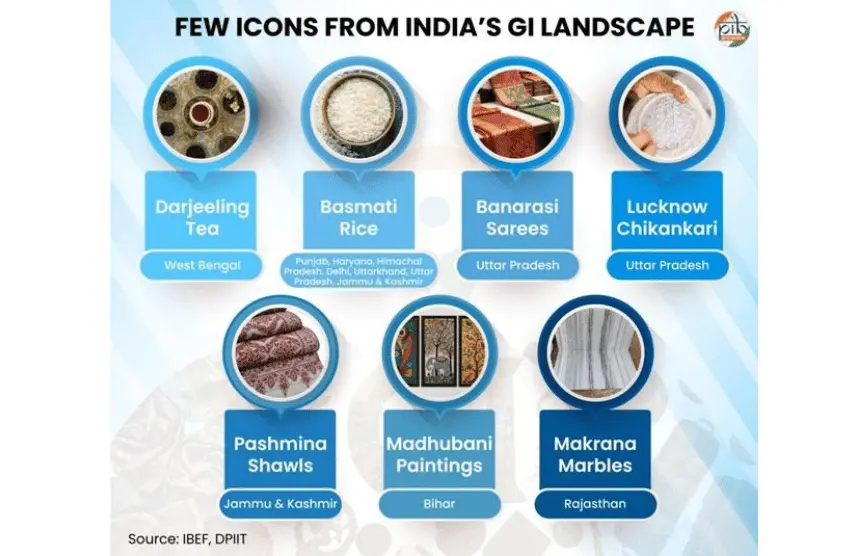
Darjeeling Tea
It was followed by other traditional products such as:
- Aranmula Kannadi
- Pochampally Ikat
Significance of GI Tags
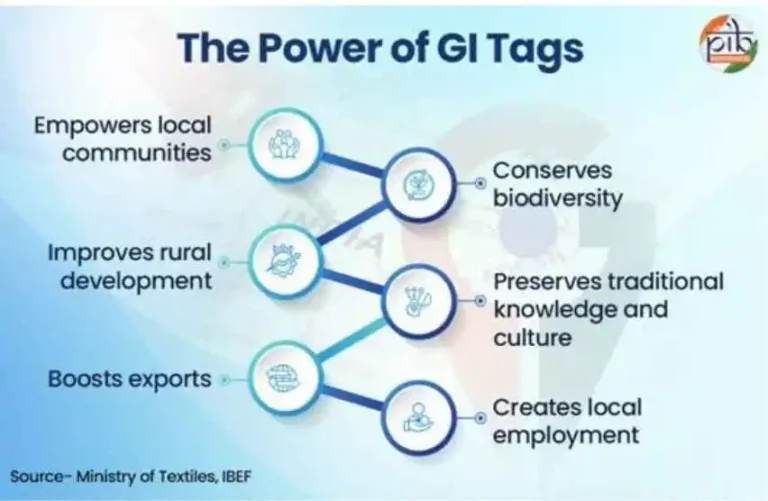
1. Protection of Heritage and Authenticity
GI tags preserve:
- Traditional knowledge
- Indigenous craftsmanship
- Regional identity
They also help consumers identify genuine products with assured quality and origin.
2. Improving Livelihoods of Producers
GI recognition provides:
- Better market visibility
- Improved bargaining power
- Access to premium markets
It can increase income opportunities for artisans, farmers and local producers.
3. Promoting Exports
GI tags improve the global recognition of Indian products.
For example:
- Muzaffarnagar jaggery was exported to Bangladesh in 2025.
- The initiative benefited around 545 farmer members.
Government Initiatives to Strengthen GI Ecosystem
1. PM Ekta Malls
The government is promoting dedicated retail spaces for:
- GI-tagged products
- One District One Product (ODOP) items
- Handicrafts
An allocation of ₹5,000 crore has been made for establishing these malls across states.
2. One Station One Product Initiative
Railway stations provide dedicated stalls where:
- Artisans
- Farmers
- Weavers
- Producer groups
can directly sell regional products to passengers.
3. GI-Based Tourism Promotion
GI products are being integrated with tourism initiatives through:
- Craft villages
- Weaving trails
- Tea estate tourism
For example, Assam’s proposed:
- Muga Silk Trail
- Silk Tourism Park
- Muga Utsav
aim to promote traditional silk heritage.
4. MSME Innovative Scheme
The Intellectual Property Rights component under the scheme provides:
- Reimbursement of GI registration expenses.
- Financial support up to ₹2 lakh per registered GI.
5. Legal and Financial Assistance
The Development Commissioner for Handicrafts provides support for:
- GI enforcement
- Legal expenses
- Registration assistance
- Institutional training
Financial assistance of up to ₹1.5 lakh is available for GI enforcement activities.
Promotion of Handloom and Agricultural GI Products
Handloom Sector Support
Under the National Handloom Development Programme:
- More than 104 GI-registered handloom products have received support.
- Assistance has been provided for GI promotion and marketing.
APEDA’s Export Promotion
The Agricultural and Processed Food Products Export Development Authority (APEDA) promotes GI-tagged agricultural products through:
- Quality improvement
- Infrastructure development
- Capacity building
- International market promotion
Expansion of Global Markets
Indian GI products are gaining international recognition.
Examples include:
- Karnataka GI fruits exported to Maldives.
- Salem Sago exported to Canada.
- Joha Rice exported to the UK and Italy.
- Tezpur Litchi exported to Dubai.
These initiatives improve farmers’ income and market access.
GI Protection through Trade Agreements
GI protection is increasingly becoming part of India’s international trade negotiations.
Examples:
- Indi Lime received export opportunities after the India–Oman CEPA.
- New Zealand has committed to facilitating registration of Indian GIs.
- India and the European Union are negotiating a dedicated GI agreement.
Promotion and Awareness Initiatives
GI products are promoted through:
- Craft fairs
- Dilli Haat exhibitions
- Seminars
- World Food India
- Tribal Business Conclave
- GI & Beyond: Virasat se Vikas Tak
These platforms provide visibility to traditional producers.
Conclusion
Geographical Indication tags are not merely intellectual property rights; they are instruments for cultural preservation, rural empowerment and economic development.
By connecting products with their places of origin, GI recognition enables artisans, farmers and weavers to move from anonymous production towards premium branding.
With stronger quality control, wider authorised user registration, digital marketing, tourism integration and export promotion, India can transform its traditional products into globally recognised brands and strengthen its heritage economy.
Geographical Indication-FAQs Answered
What is a Geographical Indication tag?
A Geographical Indication tag is a certification given to products whose quality, reputation or uniqueness is linked to a specific geographical region.
Which law governs GI tags in India?
GI tags in India are governed by the Geographical Indications of Goods (Registration and Protection) Act, 1999 and GI Rules, 2002.
Which was the first GI-tagged product in India?
Darjeeling Tea was the first product to receive GI registration in India.
Why are GI tags important?
GI tags protect traditional products from misuse, preserve cultural heritage, improve market recognition and support artisans, farmers and weavers.
Why are GI tags important for UPSC?
GI tags are important for UPSC because they connect intellectual property rights, rural development, heritage conservation, exports, MSMEs and inclusive growth.